
 By

72.9 million people in the United States worked independently in 2025, according to MBO Partners' State of Independence survey. Freelancing isn't an unusual alternative to a career. It's a way of running a business, even when that business starts with a laptop and a small assignment.
The hard part isn't creating a profile. It's choosing something a buyer wants enough to pay for, delivering it reliably, and finding another buyer without starting from scratch. If you're learning how to start freelancing, begin with a useful outcome, not a long list of skills.
Table of Contents
- What Starting Freelancing Requires in 2026
- How to Package One Outcome-Based Service
- Starter Pricing Models and Rate Ranges
- How to Find the First Paying Clients
- Fixes When Proposals and Cash Flow Stall
- Lock In Clients Beyond the First Platform
What Starting Freelancing Requires in 2026
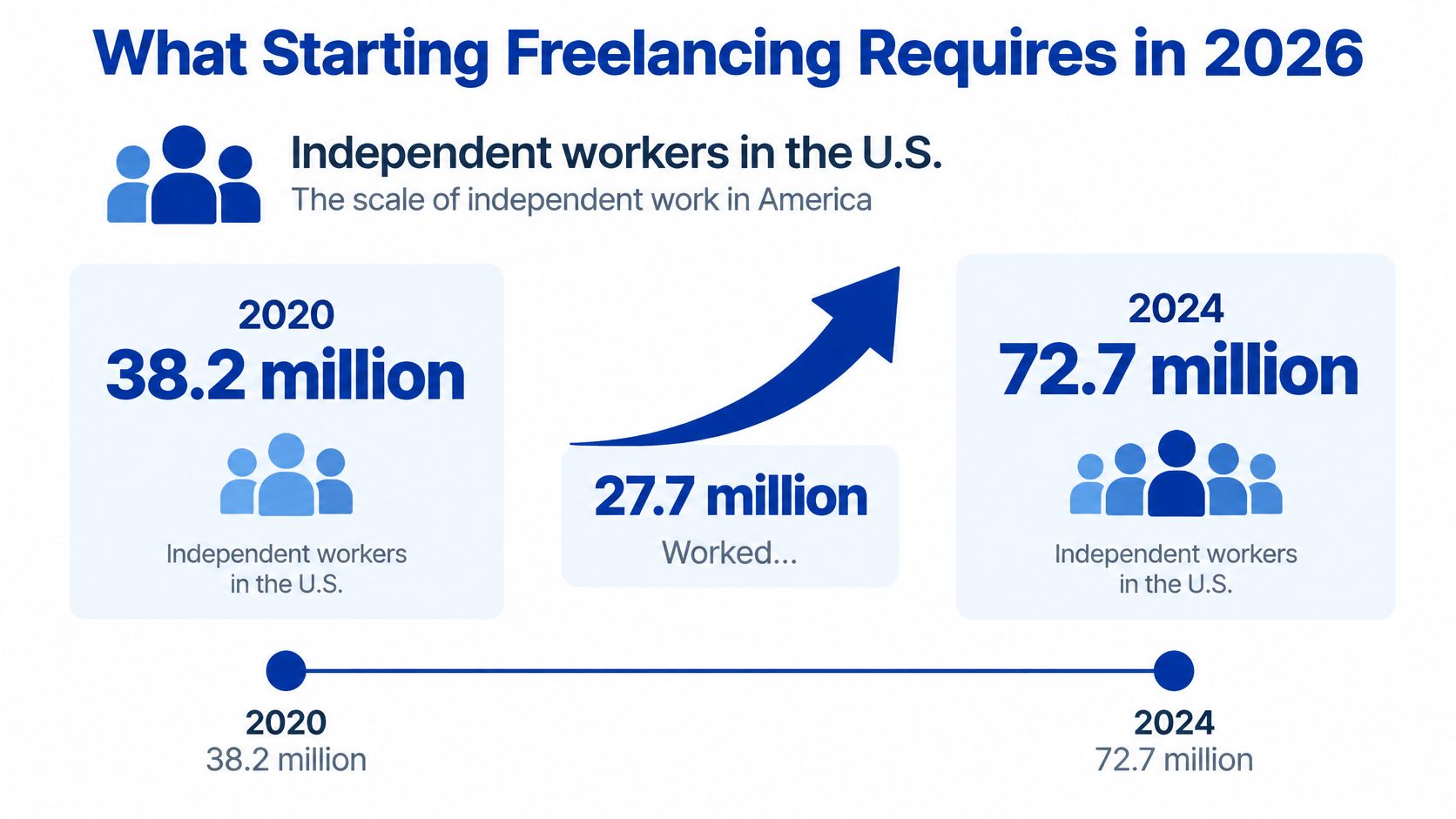
MBO Partners' 2024 State of Independence report counted 72.7 million independent workers in the United States in 2024, compared with 38.2 million in 2020. Those figures describe independent work broadly, not just people selling professional services through freelance marketplaces.
Freelancing means selling services to clients rather than taking an employee role for that work. You gain control over the assignments you accept, but you also take responsibility for selling, scheduling, collecting payment, and covering business expenses.
The comparison below puts that choice in context.
Start with a controlled business test
You don't need to make freelancing your main income immediately. If your employment terms allow outside work, test whether you can sell and deliver a service alongside your job. Keep employer equipment, confidential information, and working hours separate.
Use this sequence:
- Define the offer. Name a buyer, a problem they're trying to solve, and a deliverable you can complete.
- Choose the commercial terms. Set a paid pilot price and describe the standard package it could lead to.
- Build an acquisition routine. Contact fitting prospects, track their responses, and work toward a paid pilot.
- Prepare the business basics. Put the agreement and invoicing process in writing, then establish another client source before relying on a marketplace.
Keep the setup proportionate
Before accepting payment, understand how you'll receive money and record expenses. FastCorp's comparison of business structures can help you assess banking and compliance requirements, alongside advice specific to your location.
Don't spend your launch budget on branding before testing demand. A clear offer and credible work sample are more useful than an elaborate website with nothing specific to sell.
Define the service before setting its price. A fee only makes sense when both sides know what the buyer will receive.
How to Package One Outcome-Based Service
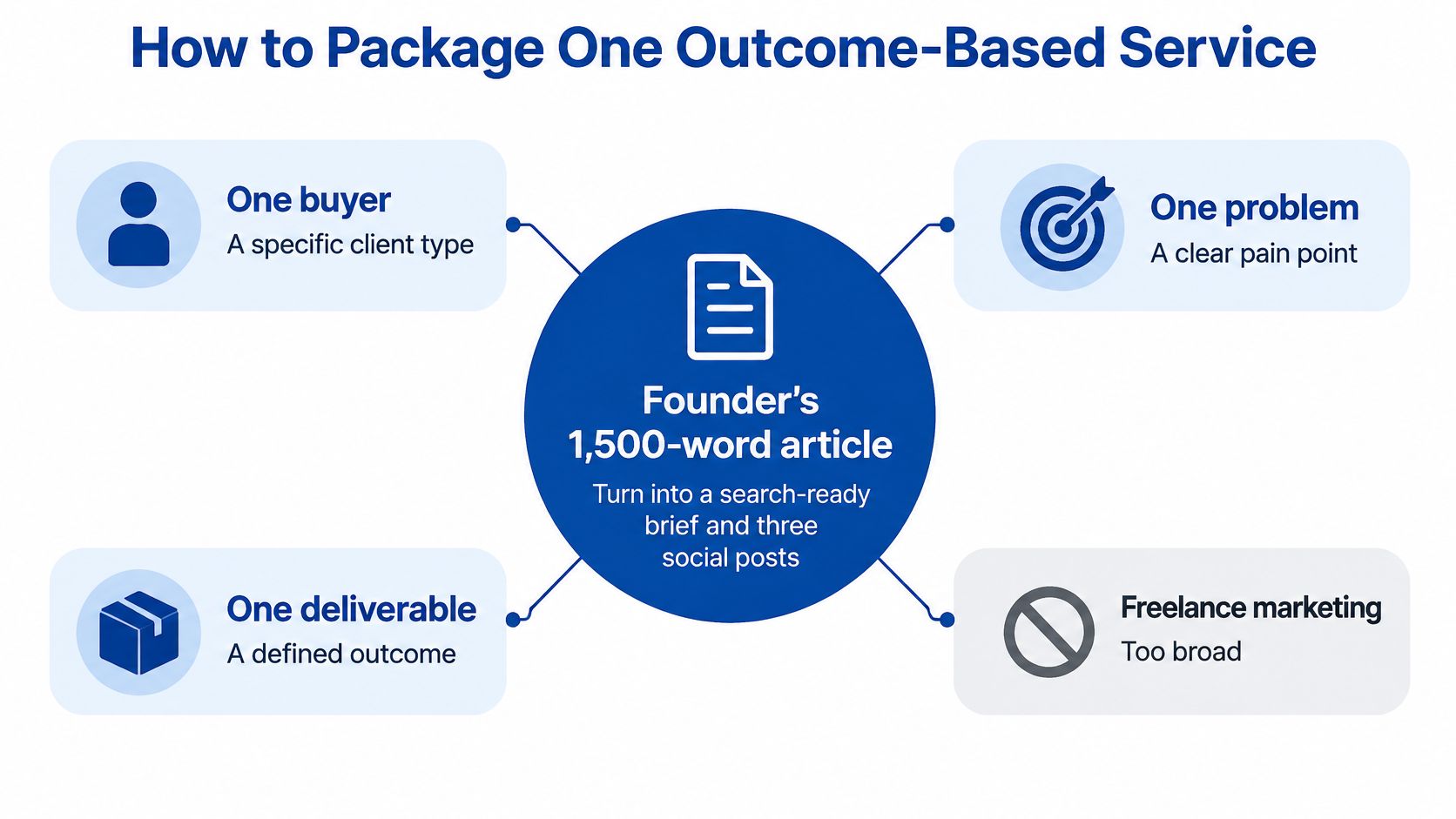
A founder publishes thoughtful articles but rarely adapts them for other channels. You could offer general marketing help, or you could turn an existing article into a search-ready brief and a set of social posts, with editorial review included.
The second offer is easier to evaluate. The founder knows what to provide, what you'll deliver, and why the work might be useful.
Use this structure to keep the offer focused.
Choose a service you can already deliver
Businesses buy writing, design, web development, digital marketing, virtual assistance, data analysis, and consulting. These are starting categories, not finished offers.
Writing becomes a service when you specify the buyer and assignment. Data analysis becomes useful when you explain which decision your report will support.
Make a shortlist of services you could deliver competently, then compare them against these tests:
- Buyer demand. Can you find businesses already buying this kind of work or actively trying to solve the problem?
- Proof. Can you show a relevant before-and-after example without needing privileged access to a client's systems?
- AI exposure. Does the work mainly involve generic execution, or does it require checking, interpretation, and decisions?
Choose the strongest fit and remove unrelated services from your profile. You can have broad abilities while presenting a narrow entry offer.
Sell judgment, not access to AI
According to Upwork's Future Workforce Index research, generative-AI and creative-production contract starts grew 90% year over year while earnings per contract fell 13%. More demand for a task doesn't necessarily mean better pay for the person performing it.
Generic drafts, simple image generation, and basic cleanup are easy for buyers to compare on price. A stronger service includes decisions the buyer doesn't want to make alone: choosing what to publish, checking claims, matching the audience, or diagnosing why a checkout page confuses customers.
Practical rule: Use AI to shorten production work. Charge for the diagnosis, decisions, quality control, and finished deliverable you take responsibility for.
For the founder-content offer, AI might organize source material or suggest variations. You still check factual accuracy, preserve the founder's meaning, remove unsupported claims, and decide which ideas deserve emphasis. Don't upload confidential client material without permission and an acceptable handling process.
This video provides an additional starting point for thinking about freelance work.
Make your samples demonstrate decisions
A portfolio doesn't need a large client list. It needs relevant evidence.
Build representative samples that show the business problem, your process, the tools used, the finished work, and the delivery timeline. Personal projects are acceptable when they're clearly labeled. Don't invent client results or present a proposed improvement as a measured gain.
For a service-page rewrite, show the original confusion, explain your structural changes, and display the revised page. If it hasn't been published, describe the intended outcome rather than claiming additional enquiries.
Your profile offer can then be simple:
I help founders turn existing articles into search-ready briefs and social content, with fact-checking and voice editing included, so they can publish useful material without managing the production process.
Starter Pricing Models and Rate Ranges
Choose the pricing model after defining the deliverable. A client shouldn't have to guess whether your quote covers research, production, meetings, or revisions.
There isn't a defensible universal beginner rate range across these services. A support assignment and a specialist technical project aren't interchangeable, so use scope-based quoting rules rather than treating a broad dollar range as a market standard.
Beginner pricing models and ranges
| Model | Best first use | Typical beginner range | Main risk |
|---|---|---|---|
| Paid pilot | Prove an outcome on a small scope | A fixed quote for a tightly bounded test | Vague deliverables cause free extra work |
| Hourly | Undefined support or advice | An agreed hourly rate with an approved spending cap | Income stops when the hours stop |
| Fixed project | A defined deliverable and deadline | A project quote built from scope, effort, costs, and risk | Underpriced revisions |
| Monthly retainer | Repeat work after a finished project | A monthly quote for reserved capacity or recurring deliverables | Cancellation if results aren't reported |
A paid pilot is usually the clearest first offer. It limits the buyer's commitment while giving you a real assignment to deliver. Keep it useful on its own, not merely a paid sales presentation for a larger engagement.
Hourly billing works when the workload can't yet be defined. Troubleshooting, advisory calls, and changing administrative support can fit this model, provided the client approves a spending limit and knows how you record time.
Fixed pricing suits a stable deliverable. A retainer suits an established recurring need, but it shouldn't mean unlimited access to you.
Build a quote you can sustain
Estimate the work behind the visible output. Include discovery, production, checking, communication, administration, and likely changes. Then account for direct expenses and the uncertainty you're accepting.
Your internal calculation can use time even when the client buys a fixed package. The distinction is that you use hours to test profitability rather than asking the buyer to manage your working day.
- Narrower package. Remove deliverables or reduce coverage when the client's budget is limited.
- Standard package. Include the work needed to achieve the agreed purpose without optional extras.
- Expanded package. Add useful implementation, testing, or reporting rather than padding the deliverable list.
For example, a founder with a limited monthly content budget could choose editing alone, editing plus repurposing, or a broader publishing service. Don't offer the same workload at a discount just because the buyer asks.
Include software costs deliberately. If your package includes scheduling content, browse social publishing subscription plans from PostSyncer to evaluate that expense before promising publishing support. Specify whether the client supplies the account or your fee covers access.
Designers can also use our guide to pricing a shirt design to think through deliverable-specific quoting rather than treating every design assignment alike.
Before accepting the job: Put the pilot quote in writing, list what's included, limit revisions, and agree on a deposit before production begins.
Specialist knowledge, convincing proof, and demanding deadlines can justify a higher quote. Lack of proof is a reason to shrink the first assignment, not to accept an open-ended job cheaply.
How to Find the First Paying Clients
Build a repeatable prospecting routine instead of opening accounts everywhere. The useful question isn't which platform has the most jobs. It's where you can identify buyers whose needs match your offer.
An Upwork Research Institute survey of 3,000 U.S. skilled knowledge workers found that 28% freelanced or worked independently in 2024. That establishes context for skilled independent work, not your personal probability of winning a project.
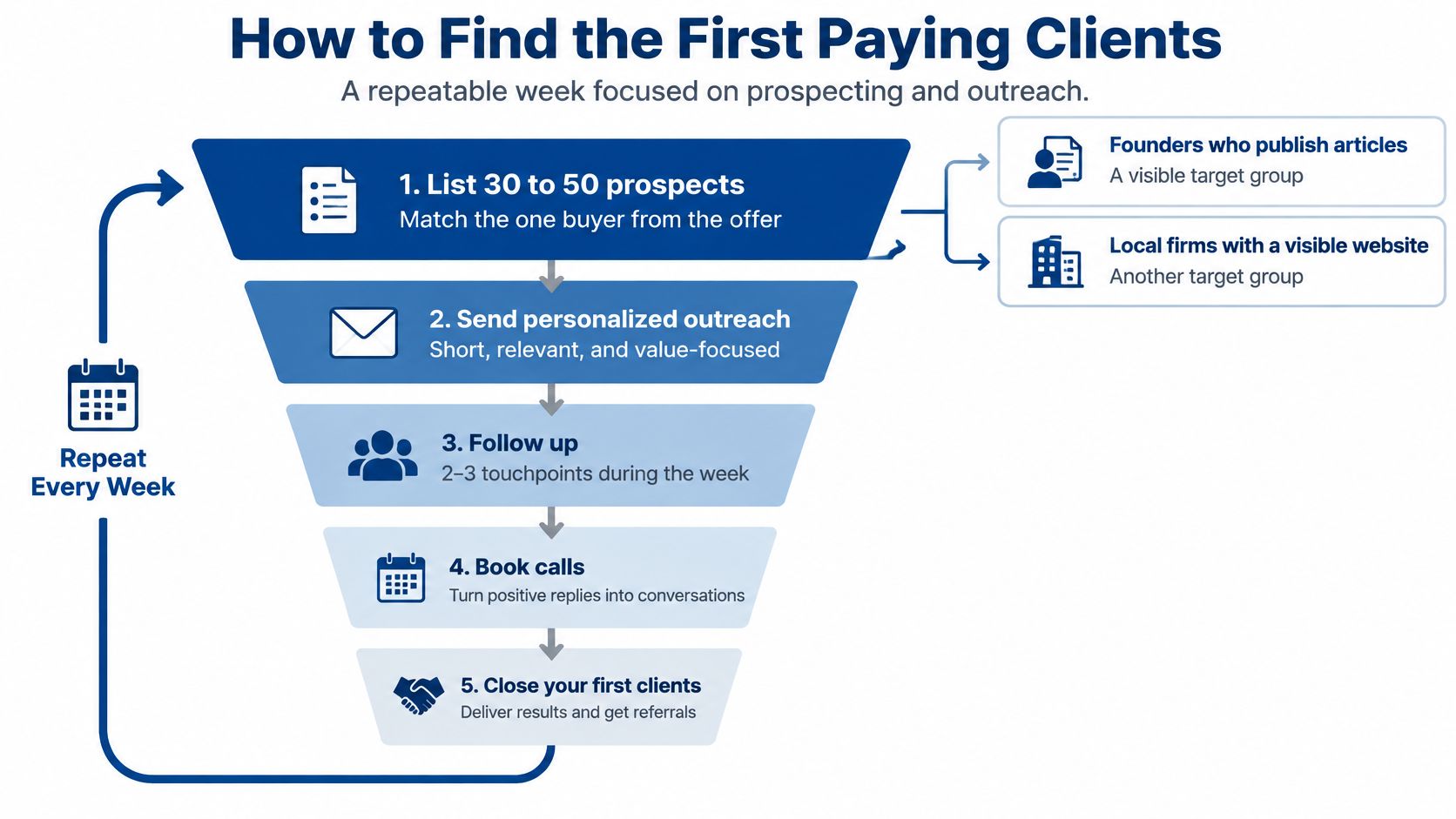
The funnel below shows the path from a fitting prospect to a paid assignment.
Run a focused outreach routine
- Build the prospect list. Find businesses that match your buyer description. For content repurposing, look for founders who publish substantial articles but rarely distribute the ideas elsewhere.
- Record a visible need. Save the relevant page or post and explain the gap in plain language. Avoid diagnosing private business performance from a quick look at a website.
- Send a specific offer. Name the observed problem, the deliverable, your pilot price, and an achievable delivery date.
- Follow up respectfully. Add a useful clarification after a reasonable interval. Don't turn silence into a sequence of increasingly urgent messages.
- Sell a paid test. Share an existing relevant sample rather than producing a custom assignment for free.
- Log the result. Track proposals, replies, calls, wins, average deal value, and repeat work in Google Sheets or a CRM.
A direct note might read:
Your recent article explains the onboarding problem clearly, but the company feed doesn't appear to share its main lessons. I can adapt it into a search-ready brief and social content, including editorial checks. Would you like the fixed pilot scope and delivery options?
Once the prospect responds, supply the actual price and schedule. Don't hide those details behind a compulsory sales call.
Weekly acquisition funnel baseline
Treat the following as an illustrative planning scoreboard, not an expected conversion rate. Its purpose is to separate activity from results so you can identify where prospects stop progressing.
| Stage | Baseline per week | If it falls short |
|---|---|---|
| Targeted prospects contacted | 50 | Check list quality and whether you're completing outreach |
| Replies | 5 | Prospect list or opening line may be wrong |
| Discovery calls | 2 | The ask may be vague |
| Paid pilots | 1 | Scope or price may be unclear after the call |
These counts illustrate how to organize a test; they aren't promises about what a beginner should achieve. A high-value specialist service may also need a different sales process from a straightforward production assignment.
Use marketplace applications for assignments that closely match your sample. Read the client's request, answer their actual question, and explain the relevant decision you'll make. A proposal isn't improved by listing every tool you've ever used.
For visual-service examples, our guide to finding clients as a graphic designer can help you adapt the prospecting approach to a design portfolio.
Know when to switch from selling to delivery
Once a pilot is paid and scheduled, protect the time needed to complete it. Don't keep accepting urgent work just because outreach has started producing replies.
Avoid broad service menus, copy-and-paste pitches, and samples with no explanation of their purpose. Buyers need to recognize their problem in your proposal, not admire how many skills you can fit into it.
Fixes When Proposals and Cash Flow Stall
No replies usually mean you should inspect targeting and message relevance before lowering your price. Check whether the recipient buys the service, whether the problem matters to them, and whether your note makes an easy-to-understand offer.
Change a single part of the process at a time. If you rewrite the message, replace the audience, and alter the package together, you won't know which change helped.
Early freelance stalls and fixes
| Symptom | Likely cause | Fix |
|---|---|---|
| No replies after a sustained outreach test | List or opening line is too generic | Retarget a specific buyer and name a visible problem |
| Replies but no calls | The ask is vague | Offer a brief call and state the pilot price |
| Calls but only price shopping | Offer sounds like commodity execution | Add the judgment or quality-control step |
| Unpaid extra work | Scope was never written | Cap revisions and price the next round |
| Late or missing payment | No deposit or due date | Require an advance payment and release final files according to agreed terms |
| A platform goes quiet | All leads sit in the same account | Keep the account and begin direct outreach |
Diagnose the objection before changing the offer
If prospects reply but won't commit, ask what prevents a decision. They may need approval, lack suitable source material, or misunderstand the deliverable. Those problems require different responses.
When buyers compare only on price, make your decision-making visible. Explain what you'll check, what risks you'll flag, and what you'll hand over. Don't add vague strategy language to an otherwise unchanged production task.
A thin portfolio needs relevant examples, not another unrelated certificate. A revision dispute needs a written boundary, not a longer explanation of how hard you worked.
An extra request can be reasonable without being included in the original price.
Protect cash without borrowing against optimism
Maintain an invoice register with issue dates, due dates, payment status, and the person responsible for approval. Follow up with the invoice attached and a specific request for payment confirmation.
For broader planning, our guide to ways to improve your cash flow can help you examine the gap between money earned and money available.
If you're considering instant cash advance apps from Gerald Technologies, Inc., review eligibility, repayment terms, and applicable costs before relying on an advance. Temporary personal liquidity isn't a substitute for collecting client invoices or making the service profitable.
Keep essential household spending separate from uncertain future bookings. An enthusiastic prospect isn't cash, and an unpaid invoice isn't available spending money.
Lock In Clients Beyond the First Platform
A marketplace can connect you with buyers, but you do not control its search rankings, account decisions, or policies. Treat it as a route to work, not the whole business. In its Future Workforce Index 2026, Upwork reports that skilled freelancers represented 38% of U.S. knowledge workers in 2026. Build client relationships and work processes that remain useful beyond any one platform.
Make the agreement usable
Before work begins, put the commercial details in a document both sides accept. Keep it clear enough to refer to when questions come up.
- Work and acceptance. List the deliverables, deadline, client inputs, and how the client approves completion.
- Changes and payment. Set the revision limit, price for additional work, deposit, and balance due date.
- Ownership and confidentiality. State when ownership transfers, which working files are included, and what you may show publicly.
Use a separate account for business transactions, and organize invoices and receipts. Set aside tax money as payments arrive. The right amount depends on your circumstances, so ask a local tax adviser about registration, reporting, and self-employment obligations before deadlines approach. Confirm payment methods and currency with overseas clients before sending an invoice.
Turn completed work into durable relationships
At delivery, explain what changed and what the client should do next. Ask permission to describe the result in your portfolio. For introductions, name the kind of buyer you want to meet rather than asking whether the client knows anyone who needs help.
Keep your acquisition mix manageable:
- Marketplace proof. Maintain a focused profile and relevant completed-work history.
- Direct relationships. Continue targeted conversations and build partnerships with complementary providers.
- An owned contact route. Give prospects a straightforward way to email or book you without relying on marketplace search.
Move a marketplace client elsewhere only if the platform's rules and any contractual conditions allow it. Use an appropriate agreement for the next engagement rather than assuming an informal message replaces the original terms.
A successful pilot alone is not a reason to quit a job. Look for repeatable demand, reliable collections, and enough financial resilience to manage interruptions.
Take one concrete step now: finalize your agreement, set up another way to find clients, and arrange the next paid conversation. A completed assignment becomes a stronger foundation when it leads to repeat work and relationships you can maintain outside a platform.
Mega Income Stream publishes The Freelancers Guide to Raising Rates Without Losing Clients and offers a USD vs. Local Currency Freelance Earnings Estimator. These resources can help you review your pricing and compare earnings as you plan your next client engagement.










Comments