
 By
The Accounting Rate of Return (ARR) provides firms with a straightforward way to evaluate an investment’s profitability over time. A firm understanding of ARR is critical for financial decision-makers as it demonstrates the potential return on investment and is instrumental in strategic planning. Investment evaluation, capital budgeting, and financial analysis are all areas where ARR has a strong foundation. Its adaptability makes it useful for a wide range of applications, including assessing the economic profitability of projects, benchmarking performance, and improving resource allocation.
What is Accounting Rate of Return (ARR)?
Accounting Rate of Return is a metric that estimates the expected rate of return on an asset or investment. Unlike the Internal Rate of Return (IRR) & Net Present Value (NPV), ARR does not consider the concept of time value of money and provides a simple yet meaningful estimate of profitability based on accounting data.
Very often, ARR is preferred because of its ease of computation and straightforward interpretation, making it a very useful tool for business owners, key stakeholders, finance teams and investors. While it can be used to swiftly determine an investment’s profitability, ARR has certain limitations.
Since ARR is based solely on accounting profits, ignoring the time value of money, it may not accurately project a particular investment’s true profitability or actual economic value. In addition, ARR does not account for the cash flow timing, which is a critical component of gauging financial sustainability. Although subject to the above-mentioned limitations, ARR still offers great utility to organizations, especially when used in conjunction with other investment evaluation techniques, to offer a truly comprehensive research study on investment opportunities.
Accounting Rate of Return (ARR) Formula
The Accounting Rate of Return formula is straightforward, making it easily accessible for all finance professionals. It is computed simply by dividing the average annual profit gained from an investment by the initial cost of the investment and expressing the result in percentage.
ARR enables different stakeholders to easily and accurately calculate an investment’s profitability with regard to its cost. Let us better understand this formula below:
ARR = (Average Annual ProfitInitial Investment)
Where,
- Average Annual Profit: This is the average annual profit made by the investment during its useful life. It is typically computed by dividing the total accounting profit generated by the investment by the estimated number of years it will last.
- Initial Investment: This is the investment’s original cost, which includes any upfront fees such as the purchase price, installation costs, and any related costs.
By dividing the average annual accounting profit by the initial investment and expressing the result as a percentage, the ARR formula provides a simple yet powerful technique to analyze the profitability of an investment in relation to its cost.
Where is ARR Used?
ARR is widely used in financial analysis, investment appraisal, and capital budgeting decisions. Businesses use ARR to determine the feasibility of proposed projects, review the performance of existing investments, and compare other investment options. ARR also acts as a useful benchmark for defining performance goals and tracking an organization’s financial health over time. Let us look at some key areas where a business may utilize ARR:
- Investment appraisal
ARR is most commonly used in investment appraisal, which analyzes the profitability of new projects or investments. Comparing the ARR enables businesses to prioritize investments with the highest returns. - Capital budgeting decisions
ARR plays a significant role in capital budgeting decisions because it informs firms about the efficiency and effectiveness of resource usefulness. Businesses that use ARR, therefore, establish a basis on which they evaluate the long-term profitability and viability of capital projects. - Financial analysis
ARR is an important indicator in financial analysis, giving stakeholders vital information about the success of investments and projects. Financial analysts use it to assess the risk-return profile of investments, find areas for improvement, and make informed recommendations to management. - Performance evaluation
ARR can be applied to evaluate investment or project performance over time. By following changes in ARR, firms would be aware if the investments are giving expected returns and help identify opportunities to improve or divest the same. - Benchmarking
ARR serves as a benchmark for setting performance goals or targets and enables the evaluation of an organization’s financial health. By comparing the actual ARR values to target or industry benchmarks, organizations can gauge their relative performance and get an idea of areas that need improvement. - Resource allocation
ARR aids in resource allocation decisions since it gives insights into returns on different investment opportunities. A business will usually use ARR to allocate capital and resources to projects promising the highest return.
How to Calculate ARR?
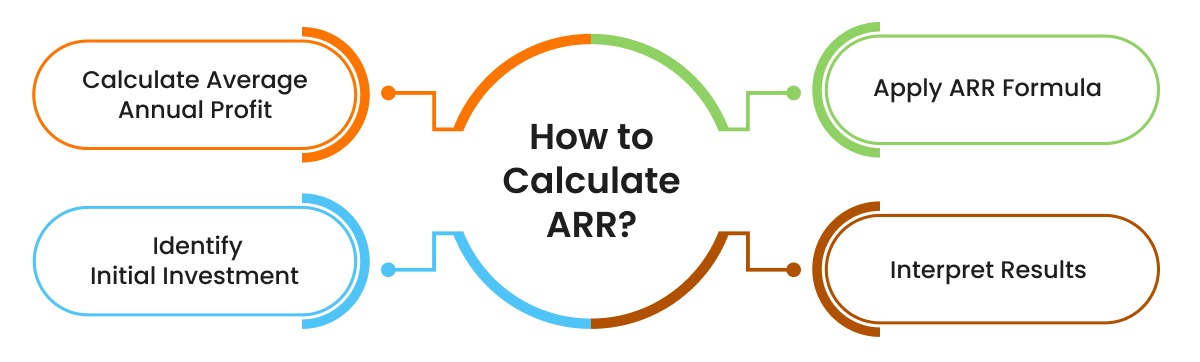
ARR is quite easy to calculate by using the easily available accounting data in a few simple steps. By calculating ARR, decision-makers can get reliable estimates about their investment profitability and make better decisions on resource allocation, risk management, and strategic planning. Let us look at the steps involved in calculating ARR below:
- Calculate the average annual profit
Calculate the total accounting profit that can be earned by the investment over its useful life and divide it by the projected number of years of operation. This calculates the average annual accounting profit.
Average Annual Profit = Total profit over Investment Period / Number of Years - Determine the initial investment cost
Determine the investment’s original cost, including any upfront expenses such as the purchase price, installation fees, and other associated costs. - Apply the ARR formula
Using the formula for ARR (ARR= Average Annual Profit/Initial Investment), divide the average annual profit by the initial investment, and express the final result as a percentage. - Interpret the results
Having computed the ARR, analyze the results to draw your conclusion about the profitability of the investment. A higher ARR implies a more profitable investment, whereas a lower ARR indicates a less profitable investment.
Example of Accounting Rate of Return
To demonstrate the actual application of ARR, take the following scenario: an organization is analyzing its operations and looking to make certain investments. Suppose they spend $200,000 on new manufacturing equipment. The equipment is estimated to provide an average yearly accounting profit of $40,000 over its five-year useful life.
Read Also: What is ARR in SaaS? A Beginner’s Guide
Applying the ARR formula:
ARR = (Average Annual Profit / Initial Investment) × 100
= (40,000/200,000) × 100
= 20%
In this case, the ARR for investing in manufacturing equipment is 20%. This indicates that for every $1 invested in the equipment, the corporation can anticipate to earn a 20 cent yearly return relative to the initial expenditure.
Advantages and Disadvantages of the ARR
Like any other financial indicator, ARR has its advantages and disadvantages. Evaluating the pros and cons of ARR enables stakeholders to arrive at informed decisions about its acceptability in some investment circumstances and adjust their approach to analysis accordingly. It’s important to understand these differences for the value one is able to leverage out of ARR into financial analysis and decision-making.
Advantages
- Simplicity
The ARR formula is simple and easy to grasp, making it accessible to a wide range of stakeholders, such as managers, investors, and analysts. - Ease of calculation
ARR can be calculated using basic accounting data, such as initial investment costs and predicted yearly returns, making it a practical and cost-effective financial statistic. - Focus on accounting data
ARR uses accounting profits and not cash flows. This enables firms to utilize the existing financial data from their accounting systems to easily evaluate their investment decisions. - Long-term perspective
ARR considers the entire lifespan of an investment and, therefore, gives the firms a long-term view of their profitability. Further, it allows the analysis of its sustainability over time. - Comparative analysis
ARR facilitates comparative analysis by standardizing profitability metrics across different investments. This enables businesses to seamlessly compare the relative returns of various projects or investments. - Performance benchmark
ARR serves as a performance benchmark for evaluating the profitability of investments against predetermined targets or industry benchmarks. This helps businesses monitor and improve their financial performance against industry standards.
Disadvantages
- Ignores the time value of money
ARR disregards time preference because it averages the profit over the life of the investment. This can sometimes give an inaccurate picture of investment profitability, especially when there are irregular cash flows. - Dependence on accounting policies
ARR is sensitive to accounting policies, which might affect the way accounting profits are calculated and distort ARR values. It is important to account for and consider the depreciation methods that the firm utilizes. - Risk of profitability misinterpretation
ARR cannot be considered the actual measure of the absolute profitability of a project. This is because ARR does not consider factors like risk, inflation, and opportunity cost, which will definitely impact the actual value of an investment, thus impacting actual profitability. - Incompatibility with discounted cash flow methods
ARR is incompatible with Discounted Cash Flow (DCF) methods, such as NPV or IRR, which take into consideration the time value of money. Hence, often these metrics measure the profitability of a project with a greater degree of accuracy. - Bias toward short-term investment
Focusing solely on ARR as the ultimate metrics to make investment decisions might lead to a tendency to prefer short-term investments with larger early returns over long-term investments with considerably better overall profitability but lower returns in the initial few years.This can lead to making inefficient resource allocation decisions. - Narrow scope of analysis
ARR is an oversimplified measure of an investment’s profitability that may overlook qualitative elements such as strategic alignment, market dynamics, and competitive positioning, all of which influence investment outcomes.











Comments