
 By

A business growth roadmap turns a growth plan into measurable initiatives and milestones. It connects budgets, forecasts, scenarios, and product strategy. A growth plan commonly covers a 12-36-month planning period. Longer-term goals can keep near-term choices aligned.
Growth targets need a clear link to resources and actions. A revenue goal, for example, should account for product changes, customer acquisition, team capacity, and budget assumptions. These elements help turn a target into practical growth priorities.
This guide shows how to set practical goals and build budgets and forecasts around them. You’ll learn to test scenarios before committing resources, assess product opportunities, set milestones, and assign owners. Regular performance reviews help keep the roadmap responsive to results and changing market conditions. The aim is a working plan that connects ambition with execution, cash flow, and capacity.
Key Takeaways
- Turn growth targets into owned milestones with clear deadlines and measures of progress.
- Use budgets, forecasts, and alternative scenarios to connect investment choices with cash flow and capacity.
- Separate strategic direction from the operational details needed to deliver it.
- Assess customer feedback, business operations, and financial health before choosing acquisition priorities.
- Prioritize product opportunities by customer value, market fit, and the resources required for execution.
What Is a Growth Roadmap?
A business growth roadmap turns a long-term vision into measurable goals, deadlines, and execution milestones. It connects each target to an owner, a way to measure progress, and the work needed to move forward.
-
Set Long-Term and Short-Term Goals
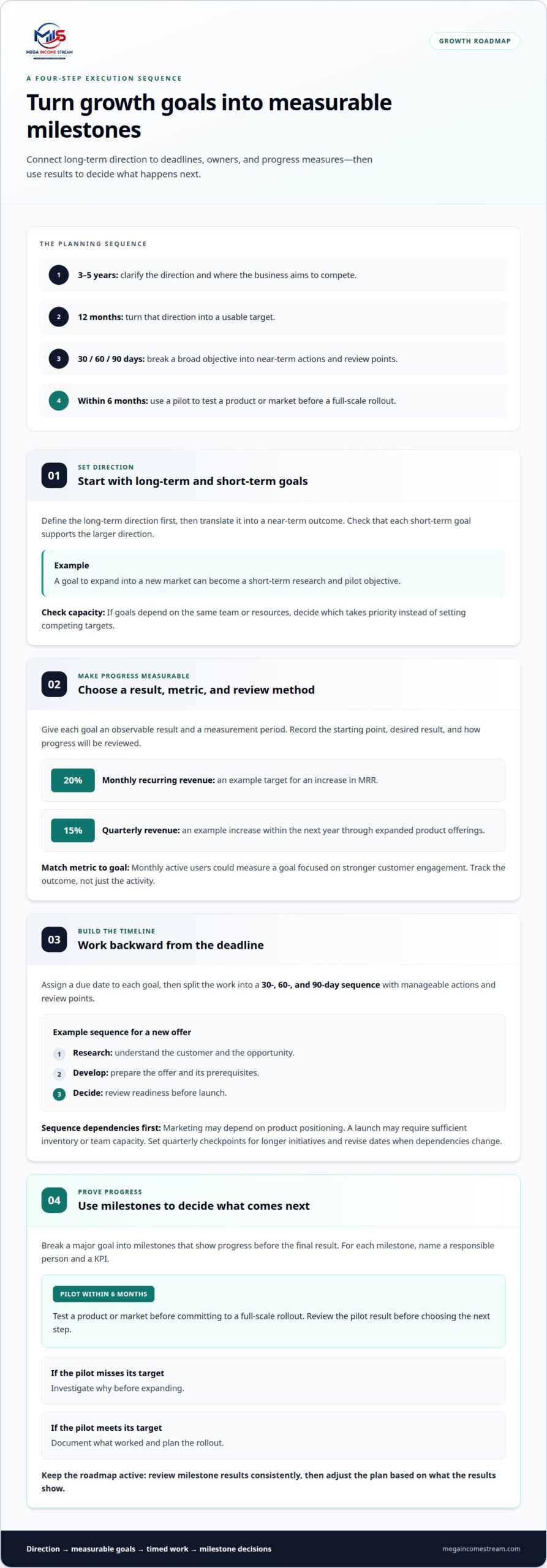
Set a long-term direction first, then break it into near-term outcomes. A planning horizon of 3 to 5 years can clarify where the business aims to compete, while a 12-month goal turns that vision into a usable target. For example, expanding into a new market can become a short-term research and pilot objective.
Check that every near-term goal supports the longer-term direction. Avoid setting competing goals that rely on the same capacity without deciding which takes priority. This keeps daily execution aligned with strategic aims while leaving room to revise short-term actions as customer needs or market conditions change.
-
Make Growth Goals Measurable
Define each goal with an observable result and a measurement period. For example, increasing monthly recurring revenue by 20% gives a team a specific outcome to track. Another measurable target is increasing quarterly revenue by 15% within the next year through expanded product offerings.
Choose a metric that reflects the goal, not just the activity. If the aim is stronger customer engagement, monthly active users could serve as a KPI. Record the starting point, desired result, and review method. Without them, the team cannot tell whether its actions are moving performance toward the target.
-
Set Timelines and Deadlines
Assign a due date to each goal, then map the work backward into manageable deadlines. A 30-, 60-, and 90-day sequence can turn a broad objective into near-term actions and review points. For a new offer, early work might cover customer research, development, and a launch decision.
Check dependencies before setting dates. A marketing campaign may depend on product positioning, while a launch may require sufficient inventory or team capacity. Put those prerequisites first in the timeline. Set quarterly checkpoints for longer initiatives, and revise deadlines when dependencies change instead of letting an outdated schedule disrupt execution.
-
Define Growth Milestones
Break each major goal into milestones that show progress before the final result. A pilot program within six months can test a product or market before a full-scale rollout. Assign a responsible person and a KPI to each milestone so ownership and progress stay visible.
Review milestone results consistently and use them to decide what to do next. If the pilot misses its target, investigate why before expanding. If it meets the target, document what worked and plan the rollout. This makes the roadmap an execution tool rather than a static list of ambitions.
Budgeting, Forecasting, and Scenario Planning
Connect every growth initiative to its resource needs, expected returns, and risks. A practical planning process compares potential paths before committing budget or capabilities.
-
Build Budgets and Forecasts
Build a budget that links planned spending to specific growth initiatives. Forecast revenue, operating costs, and cash needs using each initiative’s assumptions, such as customer demand or launch timing. Separate committed expenses from flexible spending, then compare actual results with the forecast during regular reviews.
Check whether the plan accounts for team capacity and operational demands. A marketing campaign may generate more leads, for example, but sales and customer support also need the capacity to handle the added volume.
- Model scenarios. Create a base case, an upside case, and a downside case for each major initiative. Adjust the assumptions that drive results, such as conversion, retention, delivery capacity, or launch timing. Then identify the decision each scenario informs: continue, adjust, pause, or reallocate budget.
Use the downside case to set a contingency before spending begins. If demand falls short, for example, the plan could delay a rollout or shift resources toward customer retention. This makes scenario planning a decision framework, not a collection of forecasts without operational consequences.
- Compare growth routes. Assess organic growth, partnerships, and acquisitions by required investment, speed, control, capabilities, and execution risk. Organic growth builds through existing operations; partnerships combine complementary reach or resources; acquisitions add another business and its assets.
A channel partnership go-to-market plan should define the target customer, each partner’s role, the offer, lead handoffs, and success measures. A checklist can coordinate launch tasks across both teams. Prioritize partnerships when they close a capability or distribution gap more efficiently than building internally.
-
Prepare for Risks and Requirements
Map expansion risks before approving a new market or channel. Identify the relevant legal, tax, and regulatory requirements in the target jurisdictions, including rules that may affect business structure, sales, hiring, data, and contracts. For international expansion, working with specialized corporate service providers such as Intercompany Solutions can streamline entity formation and local compliance. Assign owners to investigate each area, then include resulting obligations in timelines and budgets.
Make contingency actions specific. For example, define which costs can be paused if a launch is delayed and who approves the change. Requirements vary by jurisdiction and activity, so account for the actual markets and operating model in the plan.
- Prioritize strategically. Rank initiatives by expected customer value, strategic fit, required resources, and risk. Protect retention work if expansion could strain service quality, and prioritize acquisition only when delivery capacity can support new demand.
Use the ranking to sequence investments, not to fund every promising idea at once. A business growth strategy review can help connect priorities, budgets, and execution choices.
What Is a Business Growth Plan?
A growth strategy roadmap connects high-level objectives to initiatives, milestones, and metrics. In the United States, businesses may fund growth with retained earnings, loans, equity investment, or grants, depending on eligibility and funding needs.
-
Define the Growth Roadmap
Define the roadmap as the strategic layer showing where the business intends to grow and how key initiatives support that direction. For example, a startup entering a new market could map market entry, product positioning, and growth milestones.
Use the roadmap to coordinate choices across teams, not to document every operational task. A business roadmap can cover broader company priorities, while a growth roadmap focuses on expansion goals and how to measure them. Keep operational detail in the business plan.
-
Identify Growth Plan Components
Build a business growth plan around a clear target, supporting strategies, required resources, deadlines, and measures of progress. A common planning period is 12-36 months. For example, an online service might plan a new customer segment, the offer for that segment, and the delivery capacity needed to serve it.
Connect each initiative to assumptions about revenue, customers, and execution. A business plan typically gives more attention to operational detail, while a growth strategy roadmap emphasizes objectives and the steps toward them. Treat the documents as complementary, not interchangeable.
-
Define KPIs
Choose a KPI for each initiative, then specify how it will be measured and reviewed. Monthly active users can indicate customer engagement; revenue can track commercial results. Where useful, pair an outcome measure with a delivery measure, such as revenue alongside completed product improvements.
Assign an owner to each KPI and set a review rhythm that suits the initiative. If a launch aims to improve engagement, compare the metric before and after the change. Avoid measuring activity alone, such as posts published, when the goal is customer response.
-
Select Growth Strategies
Choose strategies that fit the business model, customer demand, and available capabilities. Practical routes for startups and small businesses include improving an existing offer, reaching a new customer segment, strengthening retention, or using partnerships to extend distribution. Prioritize the route that addresses the clearest growth constraint.
Test an initiative on a manageable scale before expanding it. For example, a small business could trial a revised service package with one customer segment, then use feedback and performance data to decide whether to refine or expand the offer. Match funding to the plan’s purpose and its repayment or ownership implications.
What Is a Business Roadmap?
Assess market demand through customer interviews, sales patterns, competitor offers, and small tests. Look for unmet needs your operations can serve. A business roadmap uses those findings to set direction and track progress across customers, operations, and finances.
-
Assess Customers, Operations, and Financial Health
Review customer segments, repeat purchases, support requests, and reasons prospects don’t convert. Repeated questions about setup, for example, may reveal friction in an online service’s onboarding. Compare these signals with delivery capacity, team workload, and cash flow before choosing an expansion move.
Check whether operations can support the growth opportunity. Map how an order moves from sale to delivery, then note delays, manual handoffs, or quality issues. Review revenue and expenses alongside the workflow. A roadmap based on customer demand but disconnected from capacity and financial health may point toward growth the business cannot execute.
-
Assess Market Demand
Test demand through direct customer conversations, existing sales data, and a focused offer. Ask prospective buyers about the problem, their current workaround, and what would make them switch. Compare their answers with support tickets and lost-sale notes. Repeated evidence across these sources is more useful than one enthusiastic comment.
Use a small test to see whether interest leads to action. For example, present a new service package to a defined audience and track inquiries, trial requests, or completed purchases. Distinguish curiosity from purchase intent, and don’t expand based on social engagement alone. Record what the test reveals about customer needs, offer fit, and delivery requirements.
-
Identify Growth Opportunities
Turn validated demand into opportunities the business can deliver. A digital service provider might improve onboarding, package a recurring support offer, or reach a customer segment with similar needs. Compare each option by customer value, operational effort, revenue potential, and fit with the business’s direction.
Plan customer acquisition around the audience and channel that fit the offer. For example, a specialist service could publish useful case studies for its target segment and direct interested prospects to a clear inquiry process. Track qualified leads by source and follow their progress from inquiry to sale. If interest doesn’t convert, refine the message or offer before expanding the campaign.
Product Growth Strategy and Roadmaps
A product strategy connects customer value with product choices and execution. A roadmap sequences those choices into work teams can test, review, and refine.
- Choose a product opportunity. Identify a product or service that could benefit from innovation. Start with a customer need, then describe how a change could improve the offer or make it easier to use. For example, a digital service might simplify onboarding if customers struggle to complete setup.
Check the opportunity against business priorities and delivery capabilities. A product change should create customer value and support the company’s intended direction. Don’t treat every feature request as a growth initiative; document the problem each proposed change addresses.
- Prioritize potential work. Rate each opportunity on a 1-5 scale for customer value, strategic fit, effort, and execution risk. Compare the ratings before committing resources. A high-value improvement that the team can deliver may deserve priority over a larger feature with unclear demand.
Use scores to make trade-offs visible, not to create false precision. If two initiatives rate similarly, consider which could generate useful customer feedback sooner. A strong product roadmap makes its assumptions clear and explains why selected work comes before alternatives.
- Translate priorities into action. Define two strategic business goals for the next year, then identify three action steps for each goal to implement during the next 30 days. Assign a responsible person to every action. For a new product feature, steps might include reviewing customer feedback, drafting the scope, and testing a prototype.
Connect each action to an observable result, such as completed customer testing or a release decision. This makes execution trackable without confusing busywork with product progress. Coordinate product development and customer acquisition priorities when both depend on the same launch.
- Review and adapt the roadmap. Use regular market research and customer feedback to assess whether product positioning still fits. Instead of relying on an undefined growth-vectors framework, assess momentum by reviewing customer demand, product performance, delivery capacity, go-to-market execution, and customer acquisition. Use the findings to identify bottlenecks and set priorities; don’t assume every area deserves equal investment.
Document decisions, results, and changes in the roadmap. Treat it as a living document, with regular check-ins that help teams adjust when performance or feedback shifts. Expand an initiative when evidence supports it; refine or pause it when results challenge its assumptions.
For support connecting product priorities with commercial execution, explore business strategy consulting.
Mega Income Stream
Mega Income Stream helps entrepreneurs connect growth priorities with practical business decisions. When product expansion, customer acquisition, and revenue initiatives compete for limited resources, strategic guidance can clarify trade-offs and strengthen the plan. The aim is a roadmap grounded in operating realities, not a promise of results.
Turn to the firm when you have a growth direction but need help translating it into focused priorities. This can include weighing market opportunities, assessing how an income stream fits the business, or deciding which initiatives deserve attention first. Clear priorities make it easier to align execution with available capabilities.
Business Strategies can support decisions about positioning, growth opportunities, and the actions that connect objectives with execution. This is useful when a business has several possible routes but needs a coherent direction. For example, an entrepreneur weighing a new customer segment against a revised offer can use strategic analysis to frame the decision.
Making Money Insights address the commercial logic behind revenue opportunities and sustainable income streams. They can help business owners consider how an offer creates value, reaches customers, and contributes to broader growth. Use this perspective when a roadmap identifies potential revenue but leaves open how the opportunity fits the business model.
Consulting Business is relevant when you want focused discussion about growth choices and implementation priorities. A conversation can center on the business context, the options under consideration, and unresolved decisions. Bring your goals, key assumptions, and constraints so the discussion stays grounded in execution.
Mega Income Stream makes business strategy more actionable through its Business Strategies, Making Money Insights, and Consulting Business offerings. These can help when your plan needs clearer priorities, stronger commercial reasoning, or a more coherent link between goals and initiatives. The right focus depends on the question your business needs to solve.
To discuss your growth priorities, contact Mega Income Stream.
Put Your Next Growth Decision Into Motion
A roadmap proves its value when it guides choices after planning ends. Treat your business growth roadmap as a decision system: when new information arrives, record what changed, which assumption it affects, and whether the next action still fits your available capacity.
Choose one unresolved decision that could unlock progress, such as refining an offer, entering a customer segment, or delaying a launch. Write down the evidence needed, who owns the decision, and the trade-offs each option creates. This turns strategic discussion into a clear action without forcing every opportunity into the plan.
Keep the document useful by updating it when performance, customer feedback, or operating conditions change. A roadmap that guides trade-offs helps you allocate attention deliberately and preserve room for sustainable execution. The next move need not be a full-scale expansion; it should address the most important constraint.
To discuss your growth priorities and next steps, contact Mega Income Stream. Bring the decision you’re working through and use the conversation to sharpen your direction. You can move forward with a clearer plan and deliberate action.
Frequently Asked Questions
What is a business growth roadmap?
A business growth roadmap gives everyone a shared view of how the company intends to pursue expansion. It connects product, marketing, and operational choices, especially when one team’s decision affects another. For example, entering a new region may require adapting the offer, preparing customer support, and updating sales materials. The roadmap makes these connections visible so teams can coordinate instead of planning in isolation.
What steps should a business growth roadmap include?
Start by defining the roadmap’s scope: the business area, market, or product it covers. Gather the relevant customer and operating evidence. Then map dependencies, such as research that must precede localization or a sales launch. Clarify who decides when priorities conflict. Finally, record the assumptions behind each major choice so teams can revisit them when new evidence changes the situation.
How do you set measurable growth goals and KPIs for a business?
Make sure the KPI’s definition matches the decision it should inform. A customer acquisition goal, for example, might track qualified new customers, while a retention goal could measure returning customers within a clearly defined group. Keep the measurement method consistent across reporting periods. Distinguish leading indicators, which signal activity or early response, from lagging indicators, which show outcomes after an initiative has had time to work.
How much does business growth planning and implementation typically cost in the US?
There is no single typical cost for business growth planning and implementation in the US. The total depends on the work involved, from market research and strategic planning to product changes, technology, and launch operations. To assess a proposed budget, separate planning expenses from implementation and ongoing operating costs. Identify the work, deliverables, and internal resources each estimate covers before comparing options.
What are the main risks of rapid business growth and how can companies manage them?
Rapid expansion can create coordination problems across regions, especially when customer expectations, product requirements, or partner responsibilities differ. Leadership attention can also become spread across too many initiatives. Reduce exposure by testing market assumptions locally, documenting decision ownership with partners, and phasing commitments. For example, confirm that an offer fits a new market before adapting every sales and support process around it.
How often should a business review and update its growth roadmap?
Review the roadmap when a decision point arrives or a material change affects its assumptions. Triggers may include a major product release, entry into a new market, a shift in customer demand, or a change in available resources. Use these moments to decide whether the current direction still fits. Record the reason for each revision so teams understand what changed and which choices it affects.










Comments