
 By
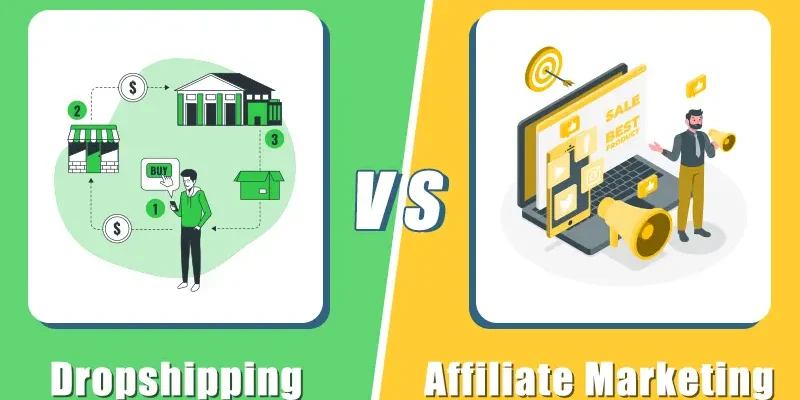
Affiliate marketing generally requires less upfront capital than dropshipping.
If your goal is to start an online business with the smallest possible financial investment, affiliate marketing is the clear winner. You can potentially begin with a social-media account, YouTube channel, email newsletter or inexpensive website and earn commissions by recommending other companies’ products.
Dropshipping eliminates the need to purchase inventory in advance, but running a competitive ecommerce store still involves expenses such as website hosting, a domain, ecommerce apps, product samples, payment processing and—potentially the biggest expense—customer acquisition.
Shopify estimates that a lean dropshipping operation can cost approximately $200 to $600 per month, depending on the tools and marketing strategy used.
Affiliate marketing, by comparison, can theoretically be started for close to $0 if you already have access to an audience and use free content platforms.
Here is the quick verdict:
| Question | Answer |
|---|---|
| Which requires less upfront capital? | Affiliate marketing |
| Which can potentially start for $0? | Affiliate marketing |
| Which requires an ecommerce store? | Dropshipping usually does |
| Which handles customer orders? | Dropshipping |
| Which handles shipping problems? | Dropshipping |
| Which requires inventory upfront? | Neither necessarily |
| Which gives greater control over pricing? | Dropshipping |
| Which is easier operationally? | Affiliate marketing |
| Which may require significant advertising spend? | Dropshipping |
| Which has greater control over customer relationships? | Dropshipping |
| Best for beginners with very little money? | Affiliate marketing |
What Is Affiliate Marketing?
Affiliate marketing is a business model in which you promote another company’s product or service and receive a commission when your referral generates an eligible transaction.
Imagine you operate a website about home offices.
You publish an article titled:
“10 Best Office Chairs for Working From Home.”
The article contains tracked affiliate links to retailers selling the chairs.
A reader clicks one of those links and makes a qualifying purchase. The retailer handles the transaction, payment, inventory, shipping, returns and most customer-service responsibilities.
You receive a commission according to the affiliate program’s rules.
Amazon Associates provides a useful example of how dramatically commissions can vary between categories.
Current standard Amazon.com commission rates include:
| Amazon Product Category | Standard Commission Rate |
|---|---|
| Amazon Games | 20% |
| Luxury Beauty | 10% |
| Amazon Haul | 7% |
| Digital/Physical Music | 5% |
| Physical Books | 4.5% |
| Kitchen | 4.5% |
| Apparel | 4% |
| Home & Furniture | 3% |
| Sports | 3% |
| Baby Products | 3% |
Source: Amazon Associates. Rates and eligibility can change, so affiliates should always check the current program terms.
The attraction is obvious: you don’t have to create, purchase or deliver the product yourself.
What Is Dropshipping?
Dropshipping is an ecommerce fulfillment model in which you sell products without keeping conventional inventory yourself.
A simplified transaction looks like this:
Customer → Your Store → Supplier → Customer
For example, suppose your online store sells a lamp for $60.
When a customer orders it, you purchase the product from your supplier for $30.
The supplier ships the lamp directly to your customer.
The $30 difference isn’t necessarily your profit. You still have to account for expenses such as:
- Advertising
- Payment processing
- Ecommerce platform fees
- Apps
- Refunds
- Chargebacks
- Customer service
- Taxes where applicable
Unlike affiliate marketing, however, the customer normally buys from your store.
That means you have substantially more responsibility for the transaction.
Affiliate Marketing vs Dropshipping: Startup Costs
This is where affiliate marketing establishes its biggest advantage.
Example Affiliate Marketing Budget
| Expense | Possible Beginner Cost |
|---|---|
| Social-media account | $0 |
| YouTube account | $0 |
| Affiliate-program application | Often $0 |
| Website | Optional |
| Domain | Optional |
| Email software | $0+ |
| Content creation | $0 if DIY |
| Paid advertising | Optional |
| Potential minimum | Close to $0 |
You don’t necessarily even need a website.
Affiliate links can be promoted through permitted channels such as social media, video, newsletters and websites, subject to each affiliate program’s terms and applicable disclosure rules.
Example Dropshipping Budget
Shopify’s 2026 guide estimates a lean dropshipping setup at approximately $200–$600 per month.
Its example costs include:
- Around $29 per month for a Shopify Basic annual-plan equivalent in the market used in its example.
- Approximately $16 for domain registration.
- $0–$100 for dropshipping tools.
- Around $100–$300 per month for paid advertising.
- Optional email and SEO tools.
Actual Shopify pricing varies by country and billing cycle. For example, Shopify’s Nigerian pricing page currently lists Basic at $19 per month when billed annually or $27 when paid monthly.
That makes the capital comparison fairly straightforward:
Affiliate marketing wins for low startup costs.
Why Dropshipping Costs More Even Without Inventory
People sometimes assume:
“If I don’t buy inventory, dropshipping should cost almost nothing.”
But inventory is only one ecommerce expense.
You still need to acquire customers.
Imagine your product generates $20 before advertising and other operating expenses.
You spend $500 on advertising and generate 20 sales.
Your advertising cost per sale is:
$500 ÷ 20 = $25
If your gross contribution before advertising was only $20 per order, advertising alone has already eliminated it.
This is why advertising metrics such as customer acquisition cost (CAC), conversion rate, average order value and return on advertising spend (ROAS) matter enormously in dropshipping.
Affiliate marketers need traffic too, but they have more options for building it organically before spending heavily.
Read Also: Leveraging AI to Supercharge Your Affiliate Marketing Strategy
Affiliate Marketing’s Biggest Financial Advantage
Affiliate marketing allows you to separate audience building from product fulfillment.
You can focus on:
- Creating useful articles.
- Producing YouTube videos.
- Building an email list.
- Growing social-media channels.
- Reviewing products.
- Publishing tutorials.
- Comparing competing products.
Someone else handles inventory and fulfillment.
This means a beginner can spend time instead of money.
That distinction is important.
Affiliate marketing is not necessarily easy—it is simply inexpensive to attempt.
But Affiliate Marketing Has a Major Weakness
You don’t control the product or commission.
Consider Amazon Associates.
Amazon’s standard commission schedule currently ranges from 1% for some categories to 20% for Amazon Games, with many common physical-product categories around 3%–4.5%.
If the retailer changes its commission structure, your income can change immediately.
You generally don’t control:
- Product pricing
- Commission percentages
- Product availability
- Affiliate-program rules
- Conversion process
- Customer service
- Returns policies
Dropshipping provides substantially greater commercial control.
Dropshipping Gives You More Control Over Revenue
Imagine you source a product for:
$20
and sell it for:
$60
Gross difference:
$40
That $40 isn’t pure profit, but you have significantly greater influence over pricing than an affiliate who simply receives a fixed commission.
You can also experiment with:
- Bundles
- Upsells
- Discounts
- Email promotions
- Subscriptions
- Cross-selling
- Loyalty programs
Most importantly, you are building your own storefront and customer relationship, rather than simply directing traffic elsewhere.
That additional control comes with additional responsibility.
Affiliate Marketing vs Dropshipping: Operational Difficulty
| Responsibility | Affiliate Marketing | Dropshipping |
|---|---|---|
| Create content/ads | Yes | Yes |
| Generate traffic | Yes | Yes |
| Build ecommerce store | Optional | Usually yes |
| Process customer orders | No | Yes |
| Manage suppliers | No | Yes |
| Handle customer complaints | Usually no | Yes |
| Handle shipping issues | No | Yes |
| Manage refunds | Usually merchant | Seller responsibility |
| Optimize conversion | Yes | Yes |
| Disclose commercial relationships | Yes | Advertising rules apply |
| Financial risk | Lower | Higher |
Affiliate marketing wins for operational simplicity.
Can Affiliate Marketing Really Be Started for Free?
Technically, yes. But free doesn’t mean effortless. If you don’t spend money acquiring traffic, you need another method.
That normally means creating content.
You could spend months publishing:
- Articles
- Reviews
- Tutorials
- Videos
- Short-form social content
- Product comparisons
before meaningful affiliate commissions appear.
Google also specifically warns against what it calls “thin affiliation”—affiliate pages that simply reproduce merchant descriptions or reviews without adding original value.
Google says good affiliate pages add value through features such as:
“original product reviews, rigorous testing and ratings”
along with additional pricing information, navigation and product comparisons. So copying product descriptions and inserting affiliate links isn’t a strong SEO strategy.
SEO Can Reduce Affiliate Marketing’s Capital Requirements
This is where affiliate marketing becomes particularly interesting for low-budget entrepreneurs. Instead of paying for every visitor, you can build search traffic.
Imagine creating detailed content answering questions such as:
- Best laptops for university students
- Best budget microphones for podcasts
- Running shoes for beginners
- Best project-management software for small teams
- Product A vs Product B
If those pages rank in search engines, they can generate visitors repeatedly without paying for every individual click.
However, Google explicitly recommends people-first content rather than articles created primarily to manipulate search rankings. Its guidance encourages first-hand expertise, depth of knowledge and content that leaves readers feeling they have learned enough to accomplish their goal.
That makes expertise increasingly valuable to affiliate marketers.
Five Advantages of Affiliate Marketing
1. Extremely Low Startup Cost
You don’t need inventory, warehouses or order-fulfillment systems.
2. No Customer Shipping Problems
The merchant handles delivery.
3. Huge Product Selection
You can promote products from numerous industries and affiliate networks.
4. Organic Traffic Is Possible
SEO, YouTube and social media can potentially generate customers without paying for every visitor.
5. Easy to Experiment
If one product doesn’t convert, you can promote another without being stuck with unsold inventory.
Five Advantages of Dropshipping
1. Greater Pricing Control
You determine your retail price.
2. Potentially Higher Revenue Per Transaction
You keep the remaining margin after product and operating costs rather than receiving only a predetermined affiliate commission.
3. You Build Your Own Store
Customers purchase from your business rather than immediately leaving for another retailer.
4. Customer Data Can Be Valuable
Subject to privacy laws and platform rules, customer relationships can support email marketing, repeat sales and remarketing.
5. Greater Brand-Building Potential
A successful dropshipping operation can potentially evolve into a traditional e-commerce brand with custom products and inventory.
Which Is Better for Beginners?
Choose affiliate marketing if:
- You have very little startup capital.
- You enjoy writing or making videos.
- You understand SEO or social media.
- You don’t want to manage customer service.
- You’re prepared to build an audience slowly.
Choose dropshipping if:
- You have capital you can afford to risk.
- You understand ecommerce.
- You’re comfortable dealing with suppliers.
- You want greater pricing control.
- You can manage customer-service problems.
- You understand paid advertising or have another strong traffic source.
Last Words
Affiliate marketing wins decisively.
You can potentially begin without purchasing inventory, building a sophisticated ecommerce operation or spending heavily on advertising. With a free social-media channel or inexpensive content website, your primary investment can initially be your time.
Dropshipping removes one major traditional retail expense—buying inventory before it sells—but it doesn’t eliminate the costs of running an ecommerce business. Shopify’s current guidance estimates approximately $200–$600 per month for a lean dropshipping setup, including tools and marketing.
But lower startup capital doesn’t automatically make affiliate marketing more profitable.
Affiliate marketers sacrifice control. Merchants determine commissions, products, checkout experiences and program rules. Dropshippers assume greater costs and responsibilities but gain much more control over pricing, customers and their brand.
The choice therefore comes down to your resources.
If you have more time than money, affiliate marketing is usually the better starting point.
If you have capital to invest, understand ecommerce and want greater control over each transaction, dropshipping may offer the stronger business-building opportunity.
FAQ
Which costs less to start: affiliate marketing or dropshipping?
Affiliate marketing. It can potentially be started for close to zero using free content platforms. Dropshipping normally requires ecommerce infrastructure and may require advertising expenditure.
How much does it cost to start dropshipping?
There is no universal figure, but Shopify’s 2026 guide estimates $200–$600 per month for a lean setup depending on marketing, apps and tools.
Can I start affiliate marketing without money?
Potentially, yes. You can create content using free social-media or video platforms and join affiliate programs that do not charge an application fee. However, you will effectively be investing your time instead of significant financial capital.
Which is more profitable?
Either can be profitable. Dropshipping offers greater control over retail pricing and potentially larger gross revenue per transaction, while affiliate marketing eliminates many ecommerce operating expenses.
Source: shopify.com





Comments