
 By
You have a folder called product, and inside it sits a half-finished template, a course outline, or a PDF you've rewritten four times. You've read enough launch threads to know people make real money at this. What you don't have is one buyer, one payment, and one piece of evidence that anyone wants the thing.
Launch advice usually misses because it treats selling as a creative problem. It's a sequence problem. Each stage has one question to answer, one artifact that proves you answered it, and one mistake that stalls it. The order matters more than how hard you push on any single stage.
Here's the path as I'd run it, with the fee math, the refund thinking and the failure points that keep first sales from happening.
Table of Contents
- The Sales Path From Idea to First Sale
- How to Create a Product Buyers Will Pay For
- Trust Tips for AI-Assisted Digital Products
- Pricing Digital Products With Real Fee Math
- How to Promote Digital Products Without a Big Audience
- Deliver, Measure and Review the First 30 Days
The Sales Path From Idea to First Sale
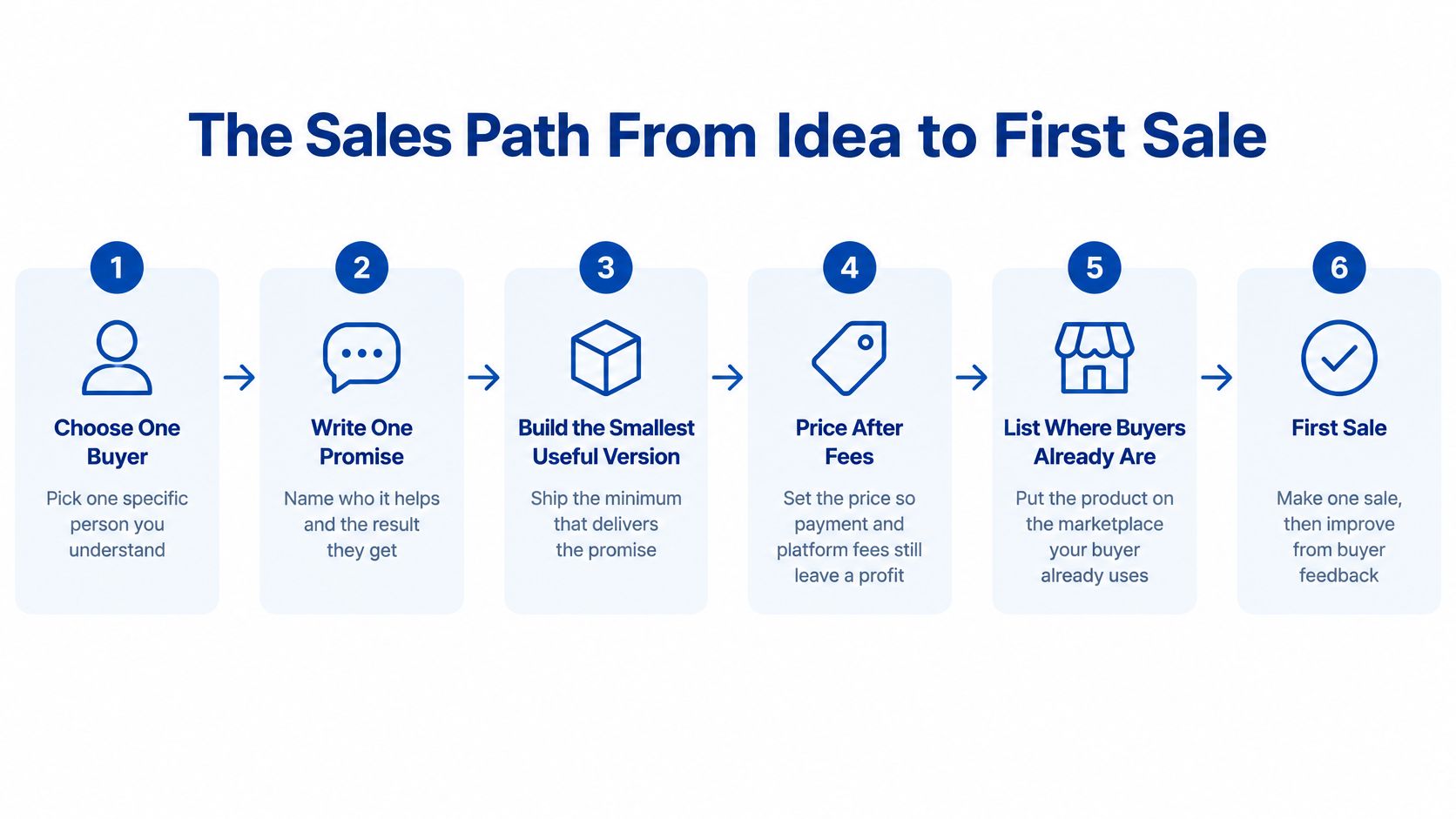
Sell a digital product by choosing one buyer and one promise, building the smallest useful version, pricing it after fees, listing it where buyers already shop, and delivering access automatically. That's the whole machine. The logo, the funnel diagram, the twelve-part content calendar: all decoration until those five parts exist.
The path runs in order, and each stage has a question, an output and a recurring mistake:
- Define the buyer. Who pays for this result, and why now rather than next quarter? The output is one sentence naming the person and the result. The mistake is writing for everyone, which produces copy that persuades no one.
- Build the smallest product. What's the minimum version a buyer can use to get the promised result? The output is a working product, version one. The mistake is polishing for months before a single person has paid.
- Set the price. What price covers platform fees, payment processing, refunds and support time? The output is a price with margin math behind it, chosen because the numbers work. The mistake is pricing by gut feel and discovering the margin problem after forty sales.
- Publish and promote. Where will buyers find this without you paying for every click? The output is a live listing plus one channel that sends traffic to it. The mistake is launching on a single marketplace and waiting.
- Deliver and support. How does the buyer get access within minutes, and where do they ask for help? The output is automatic delivery and a written FAQ. The mistake is manual delivery, which stalls buyers in the hours when their enthusiasm is highest.
The pricing stage deserves one worked example, because low-priced products break sellers without warning. Take a $12 template. Pull your platform's fee schedule and run it: marketplace cut, payment processing, and a currency conversion fee if the buyer pays in another currency all come out before you see a cent. Sales tax or VAT is collected on top and remitted, so it never belongs to you. Now assume one refund in every ten sales, which is what a realistic projection carries even for a good product. If fees and processing take roughly $2 and refunds average $1.20 per sale, you keep about $8.80 on a $12 sticker. Price by what survives the math, or raise the price until it does.
The commercial environment supports this without much special pleading. Businesses in 46 developed and developing economies, together representing roughly three-quarters of global gross domestic product, recorded nearly $28 trillion in e-commerce sales in 2024, according to UNCTAD's e-commerce statistics. That figure covers e-commerce broadly, not digital products alone, so treat it as proof that the payment rails, storefronts and cross-border buying habits already exist. Downloads, courses and templates cross borders without inventory or shipping. Payment access, taxes, consumer protection and language still differ by market, and those are your problems to solve, not the market's.
Candid note: Most first launches don't stall at the promotion stage. They stall between building and pricing, where the product stays unfinished because nobody has been asked to pay for it yet.
Run the path in order, and put a live test with real buyers at the pricing stage, before the full build is finished. Five paid buyers tell you more than three more months of building ever will.
How to Create a Product Buyers Will Pay For
The fastest way to make a product unsellable is to describe it by what it contains rather than who it helps. Everything downstream, the sales page, the pricing, the refund policy, gets harder when the promise is vague.
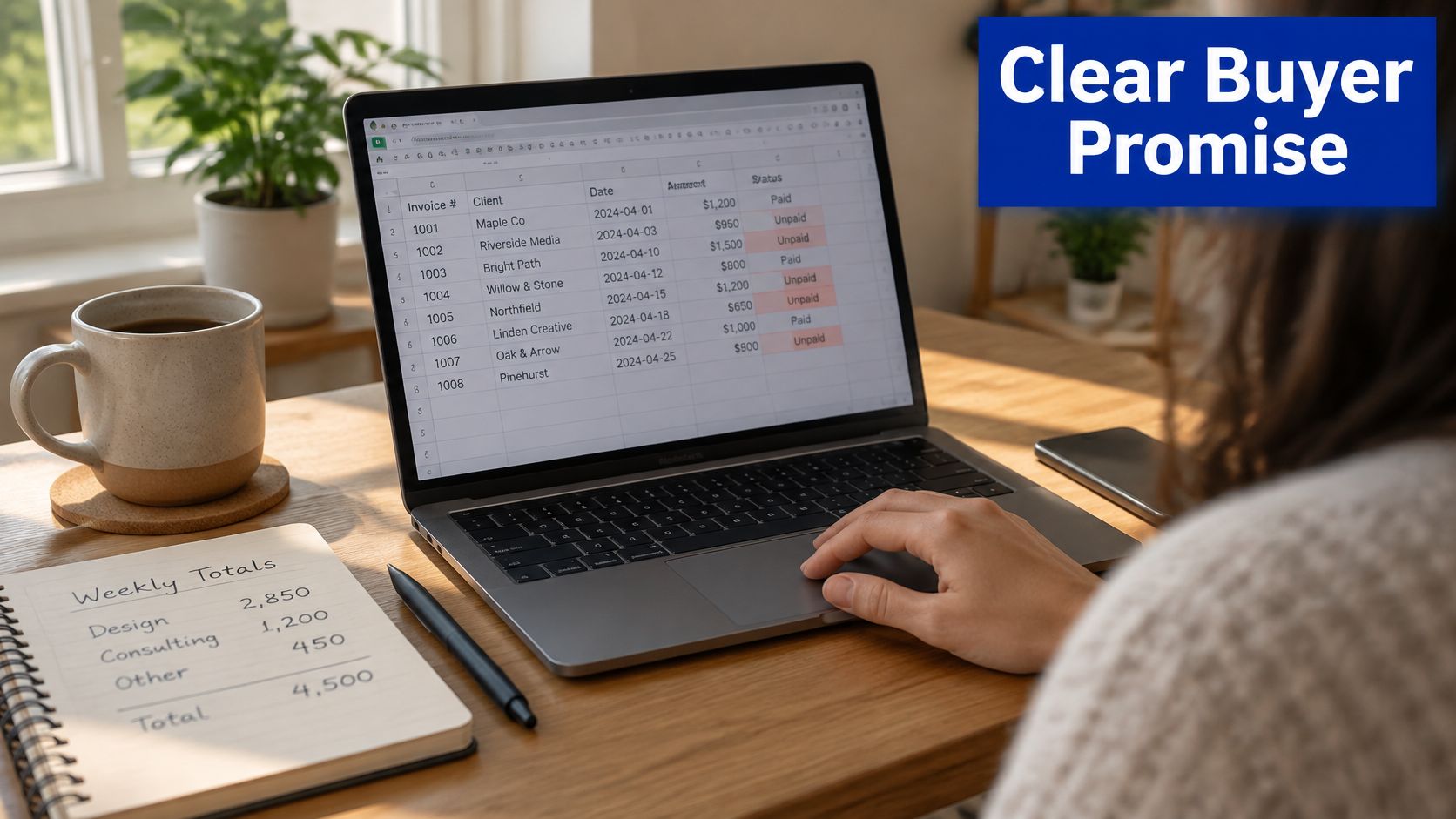
Step 1. Write the promise before the product. One sentence, naming the buyer and the result, such as "a budget tracker for freelance designers that shows unpaid invoices every Friday." That sentence decides the file format, the screenshots, the price and the audience. If you can't write it, you don't yet know what you're building.
Step 2. Check demand with people who spend money. Ask ten people in the target group what they paid for in the last month and what annoyed them about it. Then list three competing products with their review counts and read the critical reviews. Asking friends produces encouragement, not evidence, because they're answering a social question rather than a buying one.
Step 3. Choose the format by the effort the buyer is willing to give. Templates and checklists work for quick, contained wins. Short courses work when the buyer needs to change a skill. Ebooks earn trust and feed a list, which is why they're often the free product rather than the paid one. Picking a format your buyer resists, such as a twelve-hour video course for someone who wants a spreadsheet, kills conversion regardless of quality. If you're weighing formats, the breakdown of the best digital products to sell sorts them by buyer effort and price band.
Build One Complete Thing, Not a Library
Step 4. Ship the minimum useful version. One complete file or a three-module course beats a bundle of twelve half-related items. The minimum version has to deliver the full promise, once. Extra items add support load and dilute the promise without raising the price much.
Step 5. Test with five buyers at a discounted price. Not free. Free buyers give you gratitude; paying buyers give you objections. Write every objection down word for word, in their language, because those phrases become your sales page headlines.
Step 6. Fix the top two objections and rewrite the headline around the promise. If four of five buyers asked whether it works with their accounting software, that's the headline and the first FAQ answer. Feature lists don't answer objections; specific assurances do.
If the product involves video, especially a serialized one, the production workflow matters as much as the content, and this guide on how to make an AI series covers the structuring side without overbuilding.
A finished first version contains four files and one page: the product itself in a format the buyer can open without new software, a delivery page that explains what arrives and when, a refund policy written in plain sentences, and one FAQ entry for each of the two objections you fixed. Nothing more is needed to start. A version sold to five people beats a version admired by none.
Trust Tips for AI-Assisted Digital Products
Faster production isn't a competitive advantage. Abundance is the problem now, and buyers have learned to spot bulk output in about four seconds. What they can't easily fake-check is whether a human tested the thing and stands behind it.
The regulatory direction reinforces that. The U.S. Federal Trade Commission's comment to the Copyright Office flags risks where authorship doesn't match consumer expectations, and where AI output imitates a creator's style, likeness or performance. Public policy discussion has also moved toward labeling AI-generated content to protect consumer confidence. Neither point bans AI in your workflow. Both raise the cost of pretending it wasn't there.
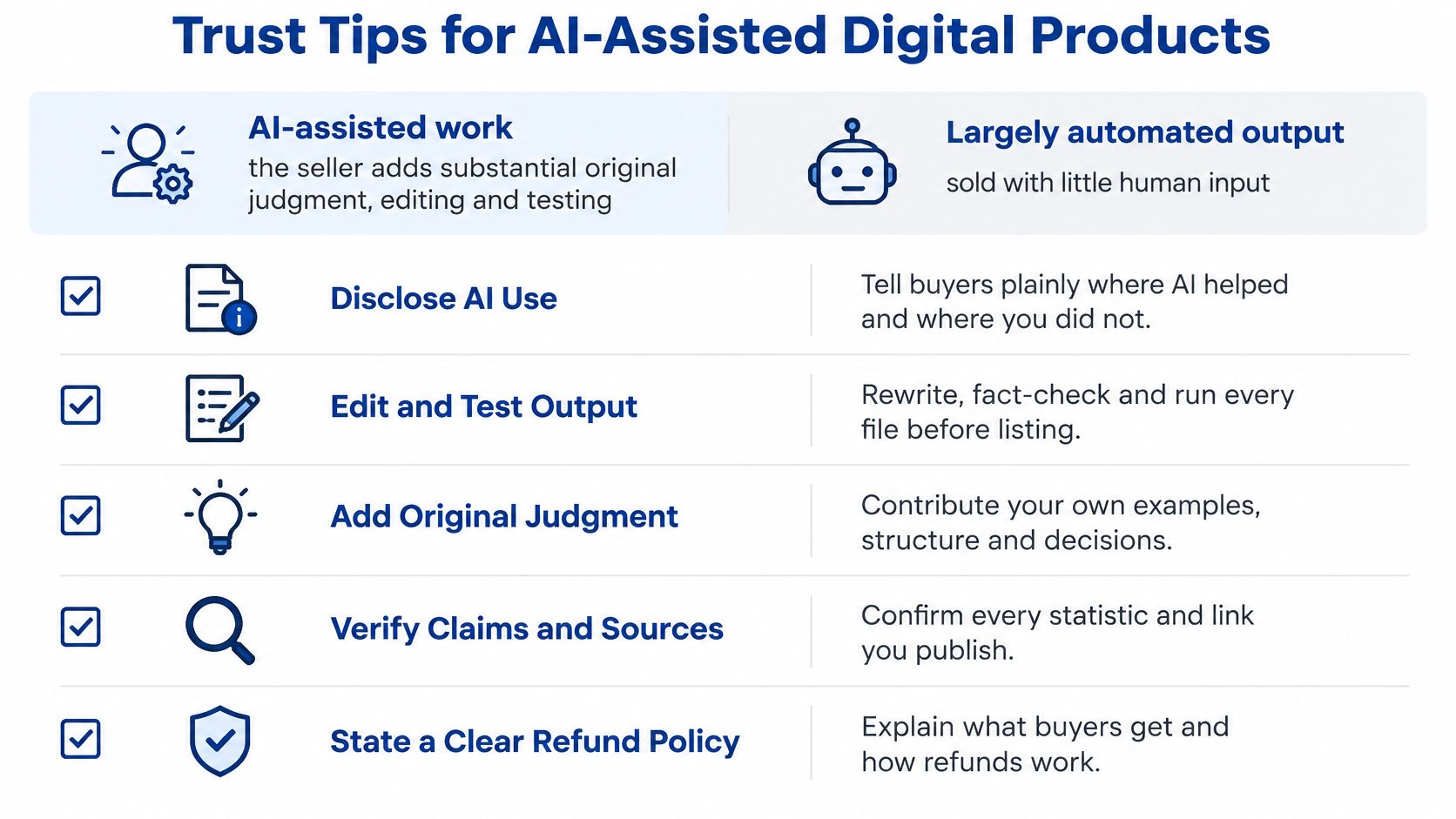
Disclose where it shapes the output. If AI drafted the copy, wrote the lesson scripts, or generated the illustrations, say so in the product description. A single line, "drafted with AI assistance, edited and tested by me," costs you nothing and removes the accusation that lands hardest if a buyer spots it first.
Keep a provenance log. Dates, drafts, prompts, source rights, and the version of each file you shipped. When a buyer asks where a chart came from, or a competitor claims you copied them, the log is your answer. It takes ten minutes per product and it's the single habit most sellers skip.
Stop using the words hand-made and original. Those words describe a claim about authorship, and if the output was largely automated, the claim is false. Describe what the buyer gets instead: hours saved, decisions simplified, the specific result.
Practical rule: Never imitate a named creator's style, voice or likeness in a paid product. The legal exposure is real, and the reputational cost arrives faster.
Review every license. Images, fonts, datasets and code snippets each carry terms. Commercial use, redistribution and attribution requirements differ, and a license that allows personal use doesn't allow resale inside your template. Check before you sell, not after a takedown notice.
Write a refund policy that covers quality expectations. "Not what you expected" is easier to refund than to argue about in public. The policy also disciplines your own marketing: if you can't describe the outcome precisely enough to defend a refund threshold, the product page is too vague.
Before a product goes live, I run a five-item check: disclosure written, provenance logged, licenses verified, claims tested against evidence, and a person has read the whole thing end to end. If you use AI anywhere in research, run output through a process to check AI-generated claims before sharing rather than publishing a confident paragraph with no source behind it.
Transparent authorship and visible testing are becoming the differentiator precisely because they're the expensive part. That's the moat.
Pricing Digital Products With Real Fee Math
Fees on a $10 digital product ranged from $0.57 to $2.09 across 13 platform plans, according to an independent platform fee comparison. That's up to 21% of the sale gone before you've paid for a single visitor. On the same set of plans, a $50 sale produced seller proceeds ranging from $42.75 to $48.35.
| Scenario | Reported figure | What it means |
|---|---|---|
| $10 digital product across 13 platform plans | Fees from $0.57 to $2.09 | Fixed per-sale fees take a large share of low prices |
| $50 digital product across platform plans | Seller proceeds from $42.75 to $48.35 | Headline percentage rates don't decide the winner alone |
| Merchant-of-record service | Higher per-transaction charge | Margin traded for handling sales tax and VAT |
Why the Cheapest Headline Rate Loses
A platform advertising 2% looks cheaper than one advertising 5% plus a fixed fee, until you run a $12 product through both. At low prices, the fixed component dominates, which is why the flat-fee structure of a marketplace can beat a lower percentage with a subscription attached. Run the same comparison at a $9 price point and the ranking flips again.
Merchant-of-record services change the terms rather than just the rate. They take on sales tax and VAT administration, which is valuable if you sell into multiple jurisdictions and don't want to register in each, and they generally charge more per transaction for it. You're buying administrative simplicity with margin. That's a fair trade for a seller at volume and a bad one for a seller testing a $12 template with forty sales.
The Break-Even Formula in Practice
Work it in two steps. First, net per sale: price minus platform fee, minus payment processing, minus expected currency conversion, minus expected refunds. Second, cost per sale from traffic: cost per visitor divided by conversion rate. If cost per sale exceeds net per sale, the price or the traffic is wrong, and ads will accelerate the loss.
Here's an illustrative worked example on a $12 template, using assumed rates rather than any platform's current published terms:
- Platform fee: 5% plus $0.50 = $1.10
- Payment processing: 2.9% plus $0.30 = $0.65
- Currency conversion: 1% = $0.12
- Expected refunds: 5% = $0.60
- Net per sale: about $9.53 before ads and support
At a 2% conversion rate and $0.15 per visitor, cost per sale from ads is $7.50, leaving just over $2 per sale to cover support and the refunds that exceed expectation. Raise the price to $19 and the fixed fees shrink as a share of revenue. Cut the refund rate by tightening the product description and the same $12 gets healthier. Most "why isn't this profitable" problems live in these details.
Before anything else, get the cost structure written down. The explanation of the accounting break-even formula covers fixed versus variable costs, which is the part sellers skip when they count a platform subscription as free because it's monthly.
Then test two or three price points with real buyers rather than guessing from a spreadsheet. Publish at $12, run the same offer to a comparable audience at $19, and compare net revenue per visitor, not units sold. Keep the price that survives refunds with margin intact.
When platform choice is the actual question: compare a direct store, a marketplace listing and a merchant-of-record service on three things only, fee structure at your real price, who handles indirect tax, and whether your buyer already shops there.
How to Promote Digital Products Without a Big Audience
A $12 product with a few dollars of margin per sale cannot afford to buy an audience. It has to borrow one, from search results, inboxes, communities and partners, while a real audience gets built in the background.
The buying habit is already established. Adjusted U.S. retail e-commerce sales reached $275.8 billion in the first quarter of 2025, or 15.9% of total retail sales, according to the U.S. Census Bureau's retail e-commerce report. The figures cover all online retail, where downloads and courses sit inside a much larger whole, but they confirm the behaviour a small seller relies on: people discover, evaluate, pay for and receive purchases online as a routine. The remaining work is commercial fundamentals, putting a paid offer where motivated buyers already look.
Channels That Work Before You Have an Audience
A free lead magnet that demonstrates the paid result. Build the smallest useful resource that produces a slice of the outcome the paid product delivers, and ask for an email in exchange. A one-page checklist that solves the first twenty minutes of the problem outsells a 40-page ebook nobody finishes, because the buyer sees proof of value before the price appears.
One search-intent article. Publish a single page answering the exact question the product solves, in the buyer's phrasing. Visitors arrive already looking for the fix, which is why this page converts better than broad social traffic. Write it before the sales page; the questions it answers become the sales copy.
Communities where your buyer already asks for help. Answer questions properly for a few weeks without linking anything. When the product fits a thread, mention it and say you sell it. Undisclosed promotion in a niche community costs you the community permanently.
Affiliate partners with an existing list. Offer a commission to people whose audience overlaps yours, and hand them ready-made copy, screenshots and a demo file so promoting takes an afternoon. One partner with a small engaged list can outperform a month of your own posts.
If your buyer browses visually, Pinterest behaves more like a search engine than a social network, and the Pin Generator blog on digital products covers how listings get found there. For the broader job of turning traffic into revenue, the guide on how to monetize a website covers the page-level basics.
Paid ads earn their place only after the organic conversion rate is known. Before that, every dollar buys a measurement the channels above produce for free. Run a live test first: put the listing in front of real buyers through the lead magnet, the article and community threads, watch what converts, and only then decide whether a paid click fits inside the margin a low-priced product leaves.
Thirty days, in order: week one, publish the listing and the lead magnet. Week two, send three useful emails to the list you already have, including everyone who downloaded the free resource. Week three, publish the search-intent article. Week four, review what each channel produced from first visit to completed sale, then decide what to change.
The recurring mistake is launching on a single platform and waiting for buyers to arrive. That is a distribution plan with the distribution removed.
Deliver, Measure and Review the First 30 Days
Delivery problems cost more sales than weak copy does, and they arrive at the worst moment. Check three things today: that the download link doesn't expire before a buyer opens it, that the file behind the link is the current version, and that the confirmation email contains a support address a frustrated buyer can reply to.
Access should arrive within minutes of payment, through a download link or a login, with the receipt. Anything slower invites a refund request before the buyer has opened the product. Manual delivery during a launch week is how sellers end up apologising to people who paid twelve hours ago.
Measure Each Funnel Stage Properly
Calculate every stage as completed events divided by the previous stage, using consistent event names in your analytics.
| Funnel stage | How to measure | Warning sign |
|---|---|---|
| Product-page view | Visitors who reach the product page | Traffic with almost no page views |
| Checkout start | Checkout starts divided by product views | Drop-off at price or form fields |
| Completed payment | Payments divided by checkout starts | Cart abandonment above the 70.19% global average |
| Successful delivery | Buyers who open the file or log in within minutes | Support requests about missing access |
| Refund or repeat purchase | Refunds divided by sales; repeat buyers divided by buyers | Rising refunds or chargebacks |
For the checkout stage, there's a useful external reference point. Baymard reports a global average cart-abandonment rate of 70.19%, meaning roughly 29.81% of initiated carts complete on average, drawn from its checkout usability research across 344 benchmarked ecommerce sites and multiple rounds of usability testing. Use it as a diagnostic, not a target. If you're at 85% abandonment, something in the form or the price presentation is broken. If you're at 60%, don't celebrate yet; check whether the traffic was warm.
A small launch cohort and a global benchmark aren't comparable without controlling for intent. Cold paid traffic, email subscribers and repeat buyers behave completely differently at checkout, and averaging them together hides which one is failing.
Fix in This Order
Transparent total price. Show the full amount, including tax or fees, before the payment step. Surprise charges at checkout are the most common self-inflicted abandonment cause.
Guest checkout. Forcing an account for a $12 download adds friction with no benefit to either side.
Immediate access after payment. The confirmation page should carry the download link, not just promise an email.
Mobile form usability. Test the whole flow on a phone with one thumb. Most of your buyers are on one.
Trusted payment options and a visible refund policy. Both reduce the risk the buyer is calculating while their card is out.
Change one variable at a time, segment results by device, traffic source, country and price, and don't call a winner from a sample of thirty visitors. Then track fulfilment, support requests, refunds and chargebacks alongside clicks. A page that converts beautifully while one in five buyers can't open the file is a funnel that leaks at the last step.
Set a review date thirty days after launch and check every row of the table. If no buyer has paid by then, revisit the buyer promise and the price before changing platforms. A platform almost never fixes a product buyers don't want; moving hosts is the most popular way to avoid that conclusion.
For extra context while planning your next offer, Mega Income Stream's Earn Living Online section compares income models, and its free best-selling ebooks help with starter planning.
The gap between a product you've half built and your first sale is mostly arithmetic and disclosure, not talent. Mega Income Stream covers the surrounding pieces in one place, from pricing and break-even math to promotion and platform comparisons, so you can run the path in order instead of guessing which stage is broken. Visit Mega Income Stream to work through the earning models, the sales funnel basics and the free ebooks before you set your first price.








Comments