
 By

Chase a single portfolio number and you'll miss the problem that breaks early retirement. Most advice tells you to hit 25 times spending, withdraw 4%, and stop work. That math was built for a shorter retirement, with Social Security and Medicare arriving much sooner.
When you retire at 50, the calendar works against you in two places. You need income long before Social Security starts, and you need health coverage long before Medicare starts. I would build the plan around those bridge years first, then set the savings target, the investment mix, and the spending rules to protect them.
Table of Contents
- Savings Targets for Retiring at 50
- How to Calculate Your Own Number
- Funding the Years Before Social Security
- Investing for a Retirement That Lasts Decades
- Covering Healthcare Before Medicare
- Spending Rules That Survive a Bad Market
- Confirm Your Bridge Plan Before You Resign
Savings Targets for Retiring at 50
One formula sets the target. Portfolio needed equals annual portfolio-funded spending divided by the starting withdrawal rate. If you'll spend $60,000 a year from savings and you start at 3.3%, you need about $1.82 million before taxes. That figure doesn't include a cash reserve or money earmarked for a known purchase.
The withdrawal rate you choose depends on how long the money has to last. A 50-year-old shouldn't borrow a 30-year assumption and hope longevity works out. Use a 40-year horizon as the baseline, then check what happens if you live longer.
The Targets by Spending Level
Morningstar's retirement income research gives you a useful comparison of starting rates across horizons. The longer horizon requires a lower starting rate, which pushes the required portfolio higher for the same spending.
| Annual portfolio spending | 40 years (3.3%) | 35 years (3.5%) | 30 years (3.9%) |
|---|---|---|---|
| $40,000 | $1.21M | $1.14M | $1.03M |
| $60,000 | $1.82M | $1.71M | $1.54M |
| $80,000 | $2.42M | $2.29M | $2.05M |
| $100,000 | $3.03M | $2.86M | $2.56M |
Read the table from your spending row, not from the portfolio you wish you had. If your household needs $80,000 a year from investments, the 30-year column understates the 40-year target by roughly $370,000. That gap isn't a rounding issue. It's the cost of funding an extra decade.
For a couple, run this comparison twice: once with both people living to 90 and once with the younger partner living to 95. If the second scenario requires a lower starting withdrawal, identify which expenses could fall after the first death and which may remain, such as housing and property taxes. A longer horizon is not necessarily 10 more years at today's full household spending, but you need to model the change rather than assume it.
Why the 40-Year Column Is the Baseline
Someone who stops work at 50 may need income into their late 80s or 90s. Planning only to age 80 leaves no margin for a healthy spouse, better medical care, or simple good luck. I would treat age 90 as the minimum planning endpoint for a single person and longer for a couple.
The stress case is more demanding. Stretch the plan to a 50-year horizon and the starting rate has to sit below the 40-year figure, which pushes the required portfolio higher still for the same spending. You don't have to fund the stress case on day one, but you should know how far your current target sits from it. Compare your baseline with a lower starting rate as a sensitivity test, not a promise of safety. For example, $60,000 divided by 3% is $2 million, about $180,000 above the 3.3% baseline. That difference tells you how much extra savings, lower spending, or future income would improve your margin.
For example, a household with $1.82 million and a $60,000 annual portfolio gap could compare the 3.3% baseline with a $2 million target at 3%. If they cannot close the $180,000 difference before leaving work, they can test whether a smaller annual budget or a few years of dependable earnings would give them enough room to handle a longer retirement. Neither choice makes the outcome certain, but both make the trade-off visible.
At 50, the extra decade matters more than the withdrawal percentage.
Applying the 4% rule mechanically gives $60,000 divided by 4%, or $1.5 million. It's a tidy answer, but it assumes a shorter period and gives you less protection against poor early returns. At 50, tidiness isn't safety.
What These Targets Exclude
These figures are before taxes. A dollar inside a traditional retirement account doesn't buy a full dollar of spending if tax is due when it comes out. A dollar of Roth contributions, taxable basis, or cash behaves differently. Two households can both show $1.82 million and have very different spendable wealth.
Keep three pools separate in your worksheet: the long-term invested portfolio, a cash or high-quality bond reserve for near-term spending, and bridge money you can reach before penalty-free retirement withdrawals begin. That third pool matters more at 50 than at 65. Before age 59½, taxable traditional IRA withdrawals generally face a 10% additional tax unless an exception applies. Roth IRA rules differ: regular contributions can generally be withdrawn tax- and penalty-free at any time, while converted amounts and earnings have separate rules. The IRS Roth IRA distribution rules explain the ordering and exceptions. Adding the pools together into one headline number hides access problems.
Don't count your home unless you have a firm plan to sell it, downsize, and bank the difference. Skip the emergency fund you still need for a roof repair or a car replacement, expected inheritances, a future business sale at an optimistic price, and income from work you haven't secured.
Your action is simple. Find the row closest to your annual portfolio-funded spending, then treat the 40-year column as the number to beat. If you're below it, you have three honest levers: spend less, save longer, or add income during the bridge years. Pretending the 30-year column applies to you isn't a fourth lever.
For example, a household targeting $60,000 of annual portfolio spending might compare the roughly $1.82 million baseline with $1.5 million already invested. At a 3.3% starting rate, $1.5 million supports about $49,500 in first-year withdrawals, leaving a $10,500 gap. Rather than assume better returns, they could identify $10,500 in spending cuts or dependable annual earnings, or keep working while they close the asset gap. Repeat the calculation after accounting for taxes and any reserve you plan to hold separately. If $120,000 of the $1.5 million is reserved for two years of withdrawals, clarify whether that reserve is part of the assets supporting the withdrawal-rate calculation. Do not subtract it from the portfolio and also count its spending as an additional unfunded expense. Label each dollar's role once, then test whether the remaining invested assets can support later withdrawals.
How to Calculate Your Own Number
Don't start with your salary. Your salary includes taxes, savings, commuting costs, and other amounts that may disappear when work stops. It may also exclude health insurance premiums your employer currently pays. Build the number from actual spending instead.
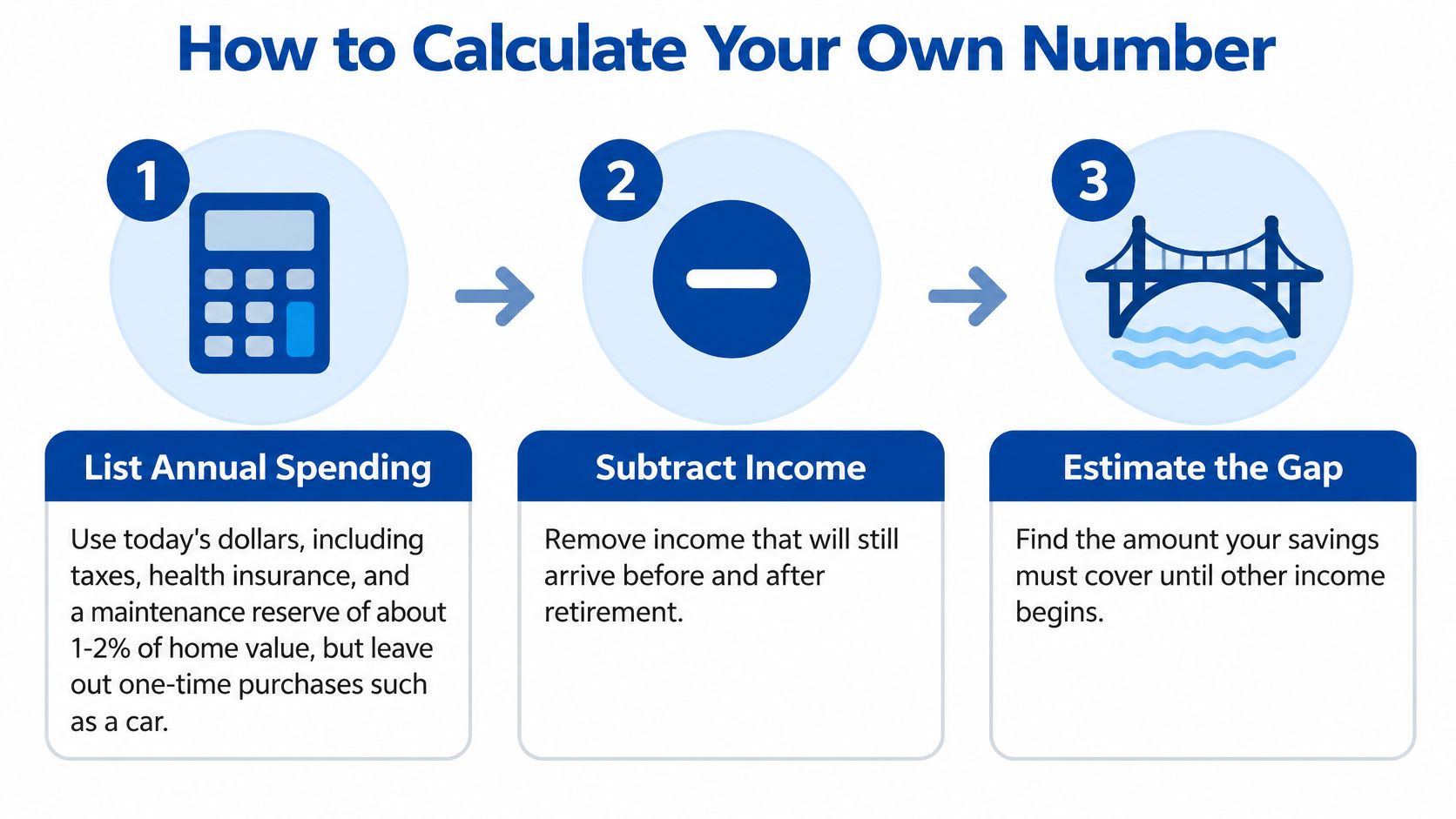
Step 1 List Spending in Today's Dollars
- Record core annual spending: Add housing, food, utilities, transport, insurance, taxes, and healthcare. Use today's dollars so you can compare the result with today's portfolio.
- Add irregular maintenance: Budget about 1% to 2% of home value a year in a worked example if you own a home, even though the bills won't arrive evenly. A roof, furnace, or major appliance can wreck a plan that only counts monthly bills.
- Leave out one-time purchases: Don't bury a replacement car or a major trip inside the recurring spending figure. Fund those separately, or place them in the specific year when they'll occur.
Look back at twelve months of bank and card statements instead of guessing. People usually remember the mortgage and forget gifts, subscriptions, car repairs, charitable donations, and help given to adult children. Small omissions compound because you're multiplying the annual figure by roughly 30. For example, overlooking $250 a month of car repairs, gifts, and subscriptions understates annual spending by $3,000. At a 3.3% starting rate, that recurring gap implies roughly $91,000 more in the portfolio target. Separately, check which work-related expenses truly disappear and which costs, especially healthcare, replace them.
Step 2 Subtract Reliable Income
Subtract income that will reliably arrive before or during retirement. That may include a pension, net rental income after vacancies and repairs, or part-time work you're willing to keep. Don't subtract gross rent, optimistic consulting revenue, or Social Security during years when you won't receive it.
Be conservative with business income. If a side business produced strong earnings during your peak working years, test whether it can continue with fewer hours and less attention. If it can't, treat it as temporary bridge income rather than permanent support. For instance, if consulting might bring in $20,000 in a good year but has no signed clients, build the essential-expense plan without it. Then model a separate upside case showing how that income could refill reserves or pay for travel. Treat a pension differently: enter its actual start age and payment terms rather than subtracting it from spending at age 50 if it begins at 65.
Step 3 Divide and Compare
Divide the remaining first-year spending requirement by investable assets to get your initial withdrawal rate. Exclude your home and emergency fund from investable assets. The Morningstar forward-looking retirement-income analysis estimates a 3.3% starting withdrawal rate for a 40-year horizon, targeting a 90% probability of not exhausting assets, compared with 3.5% for 35 years and 3.9% for 30 years.
Say a couple spends $72,000 a year and expects $12,000 of dependable rental income. The portfolio must fund $60,000. At 3.3%, the target is about $1.82 million, before taxes and excluding separately funded reserves. If they have $1.5 million, their starting rate is 4%, which is too aggressive for their horizon without flexibility or added income.
Step 4 Stress-Test the Result
Run at least four checks before you trust the answer. Test inflation-adjusted withdrawals, unfavorable returns in the first three years, higher healthcare costs, and living to 95. A plan that only works with smooth returns isn't a plan. It's a forecast with no bad weather.
Also test a delayed-income case. What happens if rental property sits empty, consulting work dries up, or a pension starts later than expected? Your cash reserve should absorb the delay without forcing you to sell depressed shares.
If the number comes up short, change a real input. Cut the spending target, add a bridge income source, or push the stop date by a set number of years and recompute. Each extra working year helps twice because you save more and shorten the period the portfolio must fund alone.
The most common error is using gross salary as the spending figure. The second is forgetting taxes on withdrawals. Work through your assumptions with the same care you'd use for a business budget, and use our financial planning resources to organize the tax, savings, and income pieces before you set a resignation date.
A useful worksheet has one row for each year from 50 onward. Put expected spending, reliable income, the amount needed from investments, and the account supplying that amount in separate columns. For instance, if spending is $72,000 and dependable rent supplies $12,000, the portfolio gap is $60,000. If a planned car purchase adds $25,000 at age 54, show it in that year's row instead of quietly increasing the recurring $60,000. The worksheet will expose years when a seemingly affordable average masks a cash crunch.
For a quick check, imagine $60,000 in annual portfolio-funded spending plus a $25,000 car purchase at 54. At a 3.3% starting rate, the recurring $60,000 points to a target of about $1.82 million. The car is a separate $25,000 obligation in its purchase year, not a reason to assume every retirement year will cost $85,000. Identify the account that will pay for it and test what happens if markets fall just before the purchase.
Funding the Years Before Social Security
The bridge is where an early retirement plan either holds together or falls apart. According to the Congressional Research Service summary on Social Security retirement age, Social Security retirement benefits cannot generally begin before age 62, so someone who stops working at 50 must plan for at least 12 years without those benefits. For people born in 1960 or later, full retirement age is 67. Under Social Security's claiming-age table, claiming at 62 pays 70% of the full-retirement-age benefit, before future cost-of-living adjustments. Waiting until 70 pays 124% of that benefit; delayed-retirement credits stop accruing at 70.
That same summary explains that legislation enacted in 1983 gradually raised the full retirement age from 65 to 67 for workers born from 1938 through 1960. It also reports that average life expectancy for men who reach age 65 has increased by nearly 4 years, to about age 81, while women reaching 65 gained nearly 6 years, to about age 84. Retiring at 50 therefore isn't a slightly earlier version of retiring at 65. It's a much longer funding obligation.
This image captures the practical work behind the bridge, year-by-year bills rather than one abstract target.

Compare the Bridge Sources
| Source | Penalty-free before 59½? | Tax treatment | Main risk |
|---|---|---|---|
| Taxable brokerage account | Yes | Capital gains on the gain only | Forced sales after a market drop |
| Roth IRA contributions | Yes, regular contributions | Generally tax- and penalty-free | Track contribution basis; converted amounts and earnings follow different rules |
| Roth conversion ladder | Generally, after the applicable five-tax-year period for each conversion | Previously untaxed converted amounts are generally taxable in the conversion year | Early withdrawal of taxable converted amounts may trigger a 10% additional tax; conversions can affect ACA subsidies |
| 72(t) SEPP payments | Yes, if the rules are followed | Taxable amounts generally face ordinary income tax | Improper changes before the later of five years after the first payment or age 59½ can trigger retroactive additional tax and interest |
| Part-time or consulting income | Yes | Ordinary income, plus self-employment tax if applicable | Depends on health and job market |
| Delayed Social Security | Not a withdrawal source | Larger benefit once claimed | Bridge must be funded for longer |
| Traditional 401(k) or IRA before 59½ | No, unless an exception applies | Ordinary income plus 10% penalty | Usually the costliest option |
Access matters as much as account size. Taxable traditional IRA and 401(k) withdrawals before 59½ generally face a 10% additional tax unless an exception applies; Roth IRA regular contributions generally do not. Under the IRS distribution ordering rules, Roth IRA withdrawals come first from regular contributions, then conversions and rollovers, and finally earnings. The Rule of 55 generally applies to an eligible employer plan when you separate from that employer in or after the calendar year you turn 55; it does not generally apply to IRAs or retroactively cover a separation at 50. Certain public-safety workers have different eligibility rules.
Put the Sources in a Sensible Order
I would usually draw from taxable assets first. You can sell selected holdings, manage capital gains, and use your cost basis without an early-withdrawal penalty. Keep enough cash inside or beside that account so a market decline doesn't dictate which shares you sell.
Roth IRA regular contributions can form a second layer because they can generally be withdrawn tax- and penalty-free at any age. Under IRS ordering rules, regular contributions come out before conversions and earnings, so keep records of how much you contributed. Nonqualified earnings withdrawals may be taxable and subject to the 10% additional tax unless an exception applies. The Roth IRA's five-year requirement for tax-free earnings is distinct from the separate clock for each conversion.
A Roth conversion ladder requires planning before you need the cash. Previously untaxed traditional money is generally taxable in the year you convert it. Each conversion has its own five-tax-year period starting January 1 of the conversion year; withdrawing its taxable converted amount before that period ends and before age 59½ may trigger a 10% additional tax. For example, a 2026 conversion generally clears that conversion's five-tax-year penalty period on January 1, 2031. After age 59½, that conversion-specific 10% penalty no longer applies, but earnings still have their own qualification rules. Check the IRS guidance on Roth IRA distributions before relying on converted funds for a particular year's bills.
72(t) substantially equal periodic payments can avoid the 10% additional tax, but taxable payments still face ordinary income tax. Under the IRS SEPP rules, an improper change before the later of five years after the first payment or age 59½ can trigger retroactive additional tax on prior payments plus interest. For example, a series started at 50 generally must continue until 59½. Check the calculation, account type, and payment schedule with a qualified tax professional before starting.
Model Taxes Year by Year
Don't treat your headline portfolio value as fully spendable. Taxes, early-withdrawal rules, and health-insurance income thresholds reduce effective cash flow. A withdrawal that looks efficient for income tax may raise your marketplace health insurance cost. A conversion that helps at 58 may hurt your subsidy at 53.
Sketch every year from 50 to 62 on one page. Give each year a funding source, an estimated tax cost, and a backup source if markets fall. If several years still say "retirement account" with no penalty solution, your bridge isn't finished.
Delayed Social Security belongs on that page, but not as bridge income. Delaying can strengthen later income, while claiming early reduces the monthly benefit permanently. The right claiming age depends on health, marital status, taxes, and how well the bridge is funded. Don't let an underfunded bridge force an early claim by default.
Make the bridge tangible with a hypothetical cash-flow map. From 50 to 54, one household might use taxable savings while keeping a cash reserve for a market decline. From 55 to 59, it might combine taxable withdrawals with modest part-time earnings. From 60 onward, it can reassess which accounts to draw from and when to claim Social Security. This isn't a universal withdrawal order: the point is to name the source for each year and check that taxes, access rules, and healthcare costs still leave enough money to pay the bills.
The table below shows one illustrative plan in today's dollars. Assume annual spending of $72,000 includes estimated taxes and healthcare costs. Dependable net rental income supplies $12,000. The household earns $15,000 a year from part-time work at ages 55 through 59 and chooses to claim Social Security at 67. Amounts are annual, not cumulative. For simplicity, spending stays at $72,000 throughout, but actual taxes, premiums, healthcare costs after Medicare begins at 65, inflation, and benefit amounts need their own year-by-year estimates. The funding sources are examples, not a prescribed withdrawal order.
| Age | Annual spending | Net rent | Part-time income | Social Security | Needed from portfolio | Illustrative funding source |
|---|---|---|---|---|---|---|
| 50-54 | $72,000 | $12,000 | $0 | $0 | $60,000 | Taxable account and cash reserve |
| 55-59 | $72,000 | $12,000 | $15,000 | $0 | $45,000 | Taxable account; Roth IRA regular contributions if needed |
| 60-61 | $72,000 | $12,000 | $0 | $0 | $60,000 | Taxable account and penalty-free eligible retirement withdrawals, subject to tax planning |
| 62-64 | $72,000 | $12,000 | $0 | $0 | $60,000 | Taxable and retirement accounts while delaying benefits |
| 65-66 | $72,000 | $12,000 | $0 | $0 | $60,000 | Taxable and retirement accounts; update costs for Medicare |
| 67 onward | $72,000 | $12,000 | $0 | $30,000 | $30,000 | Portfolio withdrawals alongside rent and benefits |
For example, at age 57, $72,000 of spending minus $12,000 of net rent and $15,000 of work income leaves $45,000 to draw from investments. At 65, the table still shows a $60,000 portfolio need only because the illustration holds total spending constant; replacing pre-Medicare coverage with Medicare could change healthcare costs and taxes. The $30,000 annual Social Security benefit at 67 is only an example, not a household benefit estimate. For one worker born in 1960 or later with a hypothetical $30,000 annual benefit at 67, claiming at 62 would pay about $21,000 a year, while claiming at 70 would pay about $37,200 a year, using Social Security's claiming-age percentages. Those amounts are before future cost-of-living adjustments, taxes, and Medicare premiums. This comparison does not mean the household in the table would receive those exact amounts at other claiming ages. Add a separate row for each actual year so you can model inflation, account balances, healthcare changes at 65, and any one-time expenses.
Stress test: one year without rent. Hold annual spending and other income at the table's illustrative levels, but set net rent to $0 for one year. At age 57, the portfolio need rises from $45,000 to $57,000 ($72,000 minus $15,000 of part-time income). At age 52, with no part-time income, it rises from $60,000 to $72,000. At age 67, assuming the illustrated $30,000 Social Security benefit is already being paid, it rises from $30,000 to $42,000. Each case requires an extra $12,000 from investments unless the household cuts spending or has another dependable source. Record that $12,000 in the affected year's worksheet row, name an accessible backup account or reserve, and estimate any resulting tax and healthcare-premium effects. If rent resumes the next year, return to the original income assumption; if the interruption lasts longer, stress-test those years too. Do not count the same $12,000 as both a reserve withdrawal and an additional portfolio withdrawal.
Copyable Retirement Cash-Flow Worksheet
Copy this table into a document or spreadsheet, then add one row for every year you plan to fund, including years after Social Security and Medicare begin. Use consistent dollars throughout: either estimate each future year's costs and income with inflation, or keep everything in today's dollars for an initial comparison. Put one-time costs in the year you expect to pay them.
| Age / year | Essential spending | Flexible spending | Healthcare and taxes | One-time costs | Reliable income | Social Security | Needed from portfolio | Account or funding source | Backup if income or markets disappoint |
|---|---|---|---|---|---|---|---|---|---|
| 50 / ____ | $____ | $____ | $____ | $____ | $____ | $____ | $____ | ____ | ____ |
| 51 / ____ | $____ | $____ | $____ | $____ | $____ | $____ | $____ | ____ | ____ |
| 52 / ____ | $____ | $____ | $____ | $____ | $____ | $____ | $____ | ____ | ____ |
| 53 / ____ | $____ | $____ | $____ | $____ | $____ | $____ | $____ | ____ | ____ |
| 54 / ____ | $____ | $____ | $____ | $____ | $____ | $____ | $____ | ____ | ____ |
| 55 / ____ | $____ | $____ | $____ | $____ | $____ | $____ | $____ | ____ | ____ |
| 56 / ____ | $____ | $____ | $____ | $____ | $____ | $____ | $____ | ____ | ____ |
| 57 / ____ | $____ | $____ | $____ | $____ | $____ | $____ | $____ | ____ | ____ |
| 58 / ____ | $____ | $____ | $____ | $____ | $____ | $____ | $____ | ____ | ____ |
| 59 / ____ | $____ | $____ | $____ | $____ | $____ | $____ | $____ | ____ | ____ |
| 60 / ____ | $____ | $____ | $____ | $____ | $____ | $____ | $____ | ____ | ____ |
| 61 / ____ | $____ | $____ | $____ | $____ | $____ | $____ | $____ | ____ | ____ |
| 62 / ____ | $____ | $____ | $____ | $____ | $____ | $____ | $____ | ____ | ____ |
| 63 / ____ | $____ | $____ | $____ | $____ | $____ | $____ | $____ | ____ | ____ |
| 64 / ____ | $____ | $____ | $____ | $____ | $____ | $____ | $____ | ____ | ____ |
| 65 / ____ | $____ | $____ | $____ | $____ | $____ | $____ | $____ | ____ | ____ |
| 66 / ____ | $____ | $____ | $____ | $____ | $____ | $____ | $____ | ____ | ____ |
| 67 / ____ | $____ | $____ | $____ | $____ | $____ | $____ | $____ | ____ | ____ |
| ____ / ____ | $____ | $____ | $____ | $____ | $____ | $____ | $____ | ____ | ____ |
Calculate each year's portfolio need: Add the four spending columns, then subtract reliable income and Social Security. If the result is below zero, enter $0 and note the surplus separately. Check whether the named account can supply that amount after any applicable taxes and access restrictions. Keep healthcare and taxes out of the essential and flexible columns to avoid counting them twice.
Annual Worksheet Review Checklist
Review the worksheet once a year and whenever a major expense, income source, or coverage plan changes. Update the current year's actual figures first, then revise the years ahead.
- Replace estimates with actual spending: Compare last year's essential, flexible, healthcare, and tax costs with your plan. Add recurring expenses you missed and put one-time purchases in their expected year.
- Update income and benefit dates: Confirm rent after vacancies and repairs, any work income, pension start dates, and your planned Social Security claiming age. Leave uncertain income out of the essential-spending plan.
- Recheck healthcare: Enter the coming year's premiums, deductible, out-of-pocket maximum, and expected prescriptions. Confirm when your current coverage ends and what replaces it.
- Recalculate each portfolio gap: Add that year's spending and one-time costs, subtract reliable income and benefits, and check whether the withdrawal still fits your plan after estimated taxes.
- Verify access to the named account: Check its balance, withdrawal rules, tax treatment, and any conversion waiting period. Name a backup if the planned source falls short.
- Stress-test the first few years: See whether the reserve and flexible-spending cuts can cover a market drop, a delayed income payment, or a high-cost healthcare year without forced stock sales.
- Record the decision: Note any change to spending, reserve refills, part-time work, or the retirement date, along with the date you'll review it again.
For example, if net rent comes in $4,000 below plan, increase that year's portfolio need by $4,000 or identify a specific expense to cut. Then check whether the same shortfall should be reflected in future rows.
For another bridge test, suppose the age-57 row calls for $45,000 from investments but part-time work ends unexpectedly. The portfolio need becomes $60,000 unless spending falls. Mark which account can cover the extra $15,000, estimate the resulting taxes, and check whether using that account changes marketplace health insurance costs. If the answer is unclear, that year needs a backup plan before retirement begins.
Investing for a Retirement That Lasts Decades
Getting conservative at 50 sounds prudent. It can be the riskiest move you make. If your money must support spending for roughly four decades, it still needs growth. A portfolio that avoids short-term declines but loses purchasing power year after year fails slowly instead of suddenly.
The immediate danger is sequence-of-returns risk. A steep drop during the first two or three years of withdrawals forces you to sell more shares at low prices to raise the same cash. Those shares aren't available for the recovery. The same decline at 75, after years of withdrawals and with fewer years left to fund, usually does less damage.
Build a Reserve Before You Chase Returns
Hold a cash or short-term, high-quality bond reserve covering about two to three years of portfolio-funded spending in a practical worked plan. This reserve isn't there to maximize return. It's there to buy time when stocks fall, so you're not forced to sell equities to pay the mortgage or insurance premium.
Refill the reserve after strong market periods, not during a panic. Set that rule while you're calm. If you wait until prices fall, you'll be deciding between selling low and cutting essential spending under pressure.
Your reserve is insurance against bad timing, not idle cash waiting for a better idea.
Keep the reserve separate from your long-term allocation in your reporting. If you blend everything together, a large cash balance can make the whole portfolio look too conservative. You'll then be tempted to invest the reserve and recreate the forced-selling problem.
Match Accounts to Jobs
Taxable assets often do the bridge work, so hold broadly diversified funds there and stay aware of embedded gains. Tax-deferred accounts can support the long run, while Roth assets give you flexible income later because qualified withdrawals don't add taxable income. No account is best in isolation. Each one gives you a different tax lever.
Think about which assets you'll sell first and which you'll leave alone. Frequent trading in a taxable account can create tax bills you didn't budget for. Concentrated stock from an employer or business sale adds another risk because your income, identity, and portfolio may all depend on the same company.
Your stock share should reflect guaranteed income that arrives later. A household with a meaningful pension and delayed Social Security can usually hold more equities than a household relying almost entirely on investments. The pension doesn't eliminate market risk, but it reduces the amount you must withdraw after it begins.
Keep the Habits That Built the Portfolio
Until the day you stop work, keep the basics in place. We advise entrepreneurs to establish automatic contributions, diversify their portfolio, and open a tax-advantaged account for retirement. Those habits still matter in the final saving years, when one more year of contributions can materially strengthen the bridge.
Rebalance once a year against a written target allocation. Don't rebalance because a headline frightened you or because a commentator predicted a crash. A written target turns rebalancing into maintenance rather than prophecy.
Review fees and overlap as part of that annual check. Several funds can own many of the same large companies while giving you the appearance of diversification. Our investing guides can help you compare account and asset choices, but your allocation still has to match your withdrawal schedule.
End with two numbers on paper. Write your reserve in months of spending and your target stock share. If you can't state both without opening an account app, you don't yet have an investment policy you can follow in a downturn.
Suppose your portfolio must supply $60,000 a year. A two-year spending reserve would be $120,000, held apart from the investments intended to support later decades. Document what counts as a reason to refill it and which holdings you'd sell when you do. Then test a rough first year: if stocks fall while the reserve pays the bills, can you stick to the allocation and spending rules you wrote down? A reserve helps only if you know how you'll use and replenish it.
Consider a household retiring with $1.82 million in total investable assets, including a $120,000 cash reserve. The other $1.70 million is invested, and the portfolio must provide $60,000 a year. For a simplified first-year stress test, suppose the invested assets fall 25% immediately and then stay flat for the rest of the year. Their value drops to $1,275,000. The household pays its $60,000 portfolio gap from cash rather than selling investments, leaving a $60,000 reserve and $1,335,000 in total assets at year-end. This illustration excludes interest, dividends, taxes, inflation, and any other cash flows.
If the household keeps drawing $60,000 a year, that amount is now about 4.5% of its remaining assets, well above the 3.3% starting rate used for its original target. The cash reserve avoided a forced sale, but it did not undo the loss or make that higher rate safe. If the household can cut $9,000 of flexible spending, its next-year portfolio need falls to $51,000, about 3.8% of the year-end balance. Before drawing the remaining reserve, it should decide what happens if markets stay down: whether to extend the spending cut, earn income, or rebalance under its written policy. Do not assume the reserve refills itself or count its cash as both available spending money and an additional asset outside the $1.82 million portfolio.
Covering Healthcare Before Medicare
Medicare eligibility at 65 leaves a 15-year gap for someone who stops working at 50. That gap is long enough for premiums, deductibles, prescriptions, and one serious diagnosis to reshape the entire retirement budget. Healthcare is one of the bridge plan's largest moving parts, and it deserves its own line rather than a footnote.
The scale doesn't shrink after Medicare begins. The Morningstar report on retirement healthcare worries cites Fidelity's 2025 estimate that average healthcare spending for a 65-year-old retiree is $172,500 over retirement, excluding long-term care. A 50-year-old funds fifteen years of private coverage before that figure even applies.
Compare Coverage Routes
| Option | Typical coverage period | Main cost driver | Watch for |
|---|---|---|---|
| COBRA from a former employer | Up to 18 months | Full premium plus administrative fee | Must elect within the deadline; costly for long periods |
| ACA marketplace plan | Until 65 | Premium subsidy tied to modified adjusted gross income | Large withdrawals or conversions can reduce the subsidy |
| Spouse's employer plan | Until 65 | Family premium share | Requires the spouse to keep working and the plan to stay available |
| High-deductible plan with HSA | Until 65 | Deductible and out-of-pocket maximum | Needs cash set aside for the deductible in the early years |
| Part-time job with benefits | Until 65 | Hours threshold and benefit eligibility | Benefits may stop if hours drop |
COBRA preserves an existing network during the transition, but eighteen months buys time rather than a fifteen-year answer. A spouse's employer plan may cost less, yet it ties your retirement date to someone else's job. Part-time work with benefits can solve income and coverage at once, but only if the hours and eligibility rules stay stable.
Manage Income for Marketplace Subsidies
Your withdrawal choices set your health insurance bill. Withdrawals from traditional accounts and Roth conversions generally count as income for marketplace premium subsidy calculations. One large conversion year can shrink the subsidy and turn a clever tax move into an expensive one.
Plan income year by year instead of looking only at lifetime taxes. Taxable-account withdrawals often produce less taxable income because part of each sale can be a return of basis. Roth contribution withdrawals can also help manage reported income. Coordinate those sources before open enrollment, not after you have already taken the distribution.
An HSA deserves special attention if you use an eligible high-deductible plan. Funds used for qualified medical costs come out tax-free at any age. Keep receipts and hold enough cash for the deductible, because the tax benefit does nothing if a medical bill forces you to sell investments at the wrong time.
Health coverage has limits that early retirees underestimate. A health policy may not pay for extended care at home or in a facility, and the Fidelity estimate above excludes long-term care entirely. Our insurance guides cover related protection questions worth pricing as a separate line.
Build the 15-Year Healthcare Line
List premiums, deductibles, expected prescriptions, dental and vision costs, and a realistic out-of-pocket amount for each year to 65. Inflate the line annually instead of copying today's premium fifteen times. Then run a bad-year test using the plan's out-of-pocket maximum.
The premium is the easiest number to find, which is why budgets stop there. A low-premium policy with a large deductible can cost more in a year when you need care. Compare total expected cost under both healthy and high-use scenarios before you pick a plan.
Finish with a confirmed route, not a hope. Know which coverage starts the month after employment ends, what it costs, when it expires, and what replaces it. If the answer depends on finding a benefits-eligible job later, your retirement date depends on that job too.
For example, write down the coverage choice for the first year after leaving work, then identify the replacement if that coverage ends. Compare a routine-care year with a high-use year that reaches the plan's out-of-pocket maximum. Add any family members who need coverage, since their eligibility and costs can change the answer. Finally, rerun the estimate if planned withdrawals or conversions change the income used to determine marketplace subsidies.
For example, compare two age-53 coverage years in your worksheet. In the first, enter premiums, expected prescriptions, and routine visits. In the second, assume enough care to reach the plan's out-of-pocket maximum. If the second year would require a larger traditional-account withdrawal, estimate both the tax cost and any change to marketplace premium assistance before deciding how large a healthcare reserve to hold. Use the plan details and subsidy rules applicable to that year rather than assuming today's figures will stay fixed until 65.
Spending Rules That Survive a Bad Market
A fixed withdrawal that rises with inflation every year feels disciplined. In a bad early market, it can become rigid in exactly the wrong way. You're withdrawing the same real amount from a smaller portfolio, which raises the withdrawal rate when the plan is most fragile.
This early image reflects the decision point you'll face repeatedly, spend, cut, or earn.

Separate the Floor From the Flexible Spending
Split spending into two layers. Essential spending covers housing, food, utilities, insurance, taxes, and basic transport. Discretionary spending covers travel, dining out, upgrades, gifts, and other choices you can pause without endangering health or shelter.
Your essential floor should be small enough to defend during a downturn. If nearly every dollar is labeled essential, you don't have flexibility. You've merely renamed your current lifestyle as untouchable.
Discretionary spending is where guardrails work. Decide the trigger before markets fall. For example, if your withdrawal rate climbs about 20% above its starting level because the portfolio has fallen, cut discretionary spending by a preset percentage until the rate recovers. The exact percentages matter less than defining them in advance and following them.
Define When Income Restarts
Flexibility can also come from earnings. Part-time work, consulting, seasonal work, or a small service business can cover discretionary spending or healthcare premiums during weak markets. Even modest income has an outsized effect because every dollar earned is a dollar you don't have to withdraw after a decline.
Write down the trigger for restarting income. It might be a portfolio value, a withdrawal-rate threshold, or two consecutive years of drawing from the reserve without refilling it. Also write down the amount you're trying to earn. "I'll work if needed" isn't a rule. "$15,000 a year covers travel and premiums" is a usable target in a hypothetical plan.
Keep skills and contacts warm if work is part of the backup. A consulting option has little value if your license lapses, your network goes cold, or your health no longer allows the work. Semi-retirement works best when you preserve the ability to earn before you need it.
The following video gives you another way to think through withdrawal decisions before you turn them into household rules.
Do Not Let Fear Set the Social Security Date
Later guaranteed income can stabilize the plan. Delaying Social Security beyond 62 increases the eventual monthly benefit compared with claiming early, but it also lengthens the bridge. For example, a worker born in 1960 or later with a hypothetical $2,500 monthly benefit at 67 would receive about $1,750 a month if claiming at 62 or $3,100 a month if claiming at 70, before future cost-of-living adjustments, taxes, and Medicare premiums, based on Social Security's retirement-age percentages. Those are monthly amounts, not a lifetime payout comparison. Model the withdrawals needed while waiting, expected lifespan, and, for couples, the effect on survivor income. Neither delay nor early claiming is automatically right.
Fear shouldn't make the decision for you. An AARP poll on early Social Security claiming found that 49% of adults age 50-plus who claimed early or considered doing so cited fear that Social Security would run out of money. That anxiety is understandable, but a permanently reduced benefit is a high price to pay for a decision made without comparing household outcomes.
Your written rule set needs four lines. State the essential floor, the discretionary range, the trigger for cuts, and the trigger for restarting work. Review them once a year when you rebalance. Flexibility isn't the backup plan when you retire at 50. It is the plan.
Here's what that could look like in a hypothetical $72,000 budget: $54,000 covers essentials and $18,000 covers flexible choices. If a downturn triggers the household's predetermined guardrail, it pauses $9,000 of travel and upgrades rather than cutting groceries or insurance. If the reserve is drawn down for two years without a refill, the household seeks a defined amount of part-time income. The numbers are examples, not prescriptions; the value lies in making the trade-offs explicit before markets test them.
Suppose that household cuts $9,000 of flexible spending after a bad market year. Its annual portfolio need could fall from $60,000 to $51,000 if other income stays the same. Write down how long the cut lasts and what would allow spending to rise again. Without a restart rule, a temporary guardrail can become a permanent cut driven by fear rather than the numbers.
Confirm Your Bridge Plan Before You Resign
Don't resign because you've reached a birthday. Resign when four conditions hold at the same time. If one fails, you're not being cautious by waiting. You're fixing the part of the plan most likely to fail.
The Go or No-Go Test
- Portfolio target met: Your investable assets support your spending at the 3.3% baseline for a 40-year horizon, after separating reserves and allowing for taxes.
- Bridge funded without forced selling: Cash, high-quality bonds, taxable assets, or dependable income cover at least the first two years without requiring stock sales in a downturn.
- Healthcare route confirmed: You have a written coverage path to 65, with current premium estimates and a replacement plan when any temporary coverage ends.
- Guardrails written down: Your essential floor, discretionary range, cut trigger, and work-restart trigger are documented before you leave.
Test the bridge under an unpleasant opening sequence. Assume poor returns arrive first, healthcare costs more than expected, and part-time income takes longer to restart. If the plan still pays essential bills without panic selling, it has real strength.
If a condition fails, choose a repair with a date attached. Delay the stop date, reduce the spending target, or add a defined part-time income source. Then recompute the target at the new date. Don't keep the old target and merely hope market returns close the gap.
Self-employed readers may have one useful final-years lever. Those aged 50 and older can add an additional $7,500 as a catch-up contribution to a Solo 401(k). Our retirement guides for entrepreneurs cover Solo 401(k) and SEP IRA mechanics, which can help you decide whether either account fits the last stage of saving.
Have a financial planner check the tax-sequencing plan before you resign. Partnering with a financial planner can help you determine the appropriate assets to reach your retirement goals, and an outside review is especially useful for conversion timing, subsidy effects, and 72(t) calculations. No template can see every household's tax brackets, account mix, health risks, and marital claiming choices.
Run the final check on one page. List the portfolio target, first two bridge years, coverage route, and guardrails. If any line contains a vague phrase such as "figure out later," the plan isn't ready.
For a rehearsal, pretend your last paycheck has already arrived. Identify the account that pays next month's bills, the date your new health coverage begins, the amount available for an unexpected repair, and the first expense you'd reduce if markets fell. Then walk through the same questions for the following year. If the answers depend on selling stocks at whatever price the market offers or obtaining work you haven't lined up, revise the bridge before setting a resignation date.
For example, a household may meet its $1.82 million portfolio target but have no confirmed coverage when employer insurance ends. That is a no-go until it prices a replacement and adds the cost to its annual worksheet. Another household may have coverage arranged but lack accessible funds for the first two years. In that case, the next task is to identify a workable funding source, not to treat the headline portfolio balance as proof that the bridge is ready.
The decision is about the 12-year bridge, not the date on the calendar.
Build your bridge year by year, test the taxes and healthcare costs before you resign, and keep refining the income side with practical guidance from Mega Income Stream. Visit us for retirement, investing, and entrepreneur-focused income resources you can turn into a written plan for life after 50.











Comments