
 By
The most popular advice about passive income investments is also the least useful: buy something that pays regularly, automate the deposits, and stop thinking about it. Automation can reduce administration. It can't prevent a company from cutting its dividend, a tenant from missing rent, or a lending platform from restricting withdrawals.
Every income stream comes from someone doing something economically useful. Companies sell products, borrowers pay interest, tenants occupy buildings, and audiences consume intellectual property. Your job is to understand that activity well enough to judge whether the payments can continue.
Passive income means less day-to-day work, not an absence of risk management. Some investments require little beyond account maintenance and periodic review. Others, particularly rental property and royalty interests, involve ongoing decisions even when you hire someone else to handle the paperwork.
An investment isn't low-risk just because its payments arrive automatically.
The practical comparison starts with how income is produced, how you recover your money, and what would hurt most in a bad year. A reliable payment schedule isn't the same as reliable purchasing power. An investment that looks stable on an account statement may also be difficult to sell.
You should also separate money you receive from money you earn. A distribution can contain investment income, realized gains, or returned capital. Selling an asset creates spendable cash, but it isn't the same as receiving interest or a dividend.
For each option below, examine the payment mechanism, exit route, and dominant downside before looking at the advertised yield. There's no universal winner. The useful choice is the one whose risks, workload, and withdrawal conditions fit the job you need your money to do.
Table of Contents
- 1. Dividend Stocks
- 2. Index Funds and ETFs
- 3. Real Estate Investment Trusts (REITs)
- 4. Bonds and Bond Funds
- 5. High-Yield Savings Accounts, CDs, and Treasury Bills
- 6. Rental Real Estate
- 7. Peer-to-Peer (P2P) Lending
- 8. Cryptocurrency Staking
- 9. Music and Intellectual Property Royalty Investments
- Passive Income Investments at a Glance
- Frequently Asked Questions
- Which passive income investment is easiest to start with?
- How much money do I need to begin?
- Can passive income cover monthly living expenses?
- Is a high yield a sign of a better investment?
- What is the difference between passive income and selling investments?
- Which options let me get my money back quickly?
- Choosing Your First Passive Income Investment
1. Dividend Stocks
A high dividend yield can mean a generous company. It can also mean investors expect trouble and have pushed the share price down. Start with the business's ability to fund the dividend, not the percentage displayed beside its ticker.
Dividend stocks pay shareholders cash declared by the company's board. You retain ownership of the shares, so your eventual return includes both distributions and changes in the share price. A dividend is never a contractual repayment schedule: the board can change it as conditions change.
A useful durability benchmark is the dividend-growth requirement behind the S&P 500 Dividend Aristocrats Index: constituent companies must have increased dividends annually for at least 25 consecutive years, according to S&P Dow Jones Indices. That history establishes a screening standard, not a promise that future payments will continue.
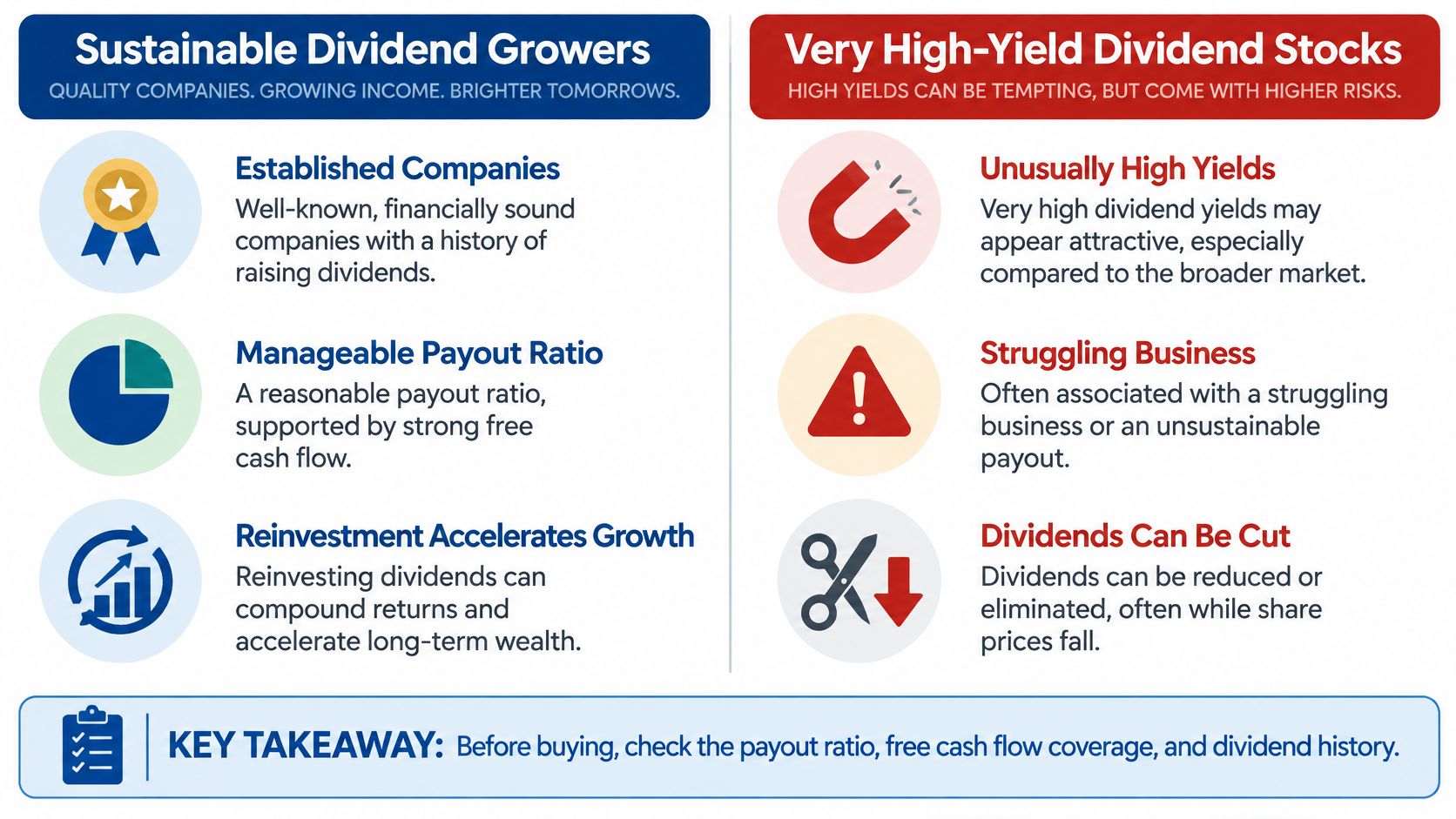
Check coverage before collecting income
Read the cash-flow statement alongside the dividend history. Compare dividends with free cash flow after capital spending, then examine debt repayments and whether recent earnings depend on unusual gains. A payout may look affordable relative to reported profit but leave little cash for debt reduction or essential investment in the business.
For example, imagine two companies with similar dividend yields. One has maintained its payout while funding routine spending and reducing debt. The other has kept its payout steady while borrowing to cover cash needs. The displayed yield doesn't show that difference; the cash-flow statement and debt schedule help you find it. Also check whether the company has a stated payout policy and whether its business depends heavily on a single product or customer.
A simple stress test is to ask what happens if sales weaken for a year. Could the company pay its suppliers, maintain its assets, meet debt obligations, and still fund the dividend? A company that can only manage all four in a strong year offers less room for error than its dividend history might suggest. Compare the answer across several years rather than drawing conclusions from one unusually profitable period.
Payment timing matters if you intend to spend the cash. A company may pay quarterly while your bills arrive monthly, and its board may announce a different payment next quarter. Keep enough accessible cash to bridge timing gaps instead of treating a projected dividend calendar as a household budget.
- Payment source: Operating cash generated by the underlying company, subject to the board's distribution decisions.
- Access to money: Listed shares can generally be sold during market hours, but the available price may be below your purchase price.
- Bad-year risk: Deteriorating business results can cause a dividend cut and a falling share price at the same time.
Say a freelancer wants investment income without adding another operating business. A diversified collection of profitable dividend payers may suit that objective better than concentrating in whichever stock currently advertises the largest yield. The freelancer should still decide whether a delayed client payment would force a share sale at an unfavorable price.
Practical tips: Diversify across industries and investigate payouts that exceed sustainable cash generation. If you don't need spending money yet, a brokerage dividend reinvestment plan can buy additional shares automatically, although reinvestment doesn't remove investment risk. Review the business when its debt, cash flow, or payout policy changes, not only when its share price moves.
Use our stock-market articles to build familiarity with company analysis before committing money. Individual dividend stocks work best when you're willing to keep evaluating the businesses behind the payments.
2. Index Funds and ETFs
For someone who doesn't want to analyze company accounts, a diversified fund is often a more practical starting point than individual stocks. You buy a portfolio through a single holding, while the fund handles security selection under its stated mandate.
An index fund follows an index's rules rather than relying on discretionary stock picking. ETF describes a trading structure, not necessarily a passive strategy: some ETFs track indexes, while others employ active managers.
Stock ownership already extends well beyond directly held shares. In 2022, 58% of U.S. families owned stocks directly or indirectly, including through funds and retirement accounts, according to Axios's coverage of household stock ownership. That breadth makes fund selection relevant even if you've never bought an individual company.
Distinguish diversification from income stability
A broad-market stock fund distributes dividends received from its holdings after applicable expenses. A bond ETF distributes income from its bond portfolio, while an accumulating share class may retain income rather than pay it out.
Check the distribution policy before buying. Vanguard's broad-market index funds and ETFs illustrate the pooled-investment approach, but the exact portfolio and share class determine what you own and how cash reaches you.
Imagine choosing between a broad stock-market fund and a fund focused on high-dividend companies. The first may spread your investment across more types of businesses but produce less cash today. The second may pay more now while concentrating in sectors that favor dividends. Compare both holdings lists before buying: owning several funds doesn't add much diversification if they hold many of the same companies.
Consider the difference between a fund's total return and its cash distribution. If your fund pays a modest distribution but its holdings rise in value, you may have a positive return without much spendable cash. If it distributes generously while its share price falls, the cash payment alone won't reveal your loss. Check both figures over the period that matters to you.
A distribution schedule can also create a false sense of predictability. A fund may pay on regular dates while the amount changes with the underlying holdings. If the purpose is a fixed monthly expense, compare the fund's variable cash payments with a separate reserve that can cover any shortfall.
- Payment source: Dividends or interest from underlying holdings, with distributions affected by expenses and fund policy.
- Access to money: ETFs trade on an exchange; mutual funds follow their dealing rules.
- Bad-year risk: Broad market declines can reduce portfolio value even when the fund remains diversified.
A salaried investor building future supplementary income could automate purchases into a broad index fund and reinvest distributions. Someone needing spending cash immediately would need to inspect the actual payment schedule rather than assume the fund covers household bills.
Practical tips: Compare expense ratios, tracking difference, holdings, and trading spreads. Read the fund's objective to see whether it holds stocks, bonds, or both, and check whether distributions are paid out or retained. Don't replace a diversified core with overlapping dividend ETFs that all concentrate in similar sectors.
A fund reduces company-specific work. It doesn't eliminate the need to choose an appropriate asset mix or maintain cash for near-term spending.
3. Real Estate Investment Trusts (REITs)
REITs offer property exposure without requiring you to arrange repairs or collect rent yourself. Equity REITs own income-producing properties, while mortgage REITs finance real estate and carry a different mix of credit and financing risks.
The income structure matters. U.S. REITs generally must distribute at least 90% of taxable income annually, according to the U.S. Securities and Exchange Commission's REIT guide, but that requirement doesn't guarantee profitability or uninterrupted dividends. Taxable income also isn't a substitute for reviewing the cash available to support a distribution.

Listed and non-traded REITs aren't interchangeable
Publicly traded REIT shares provide an exchange-based exit, although their prices fluctuate. Non-traded REITs can restrict withdrawals, and some distributions may come from offering proceeds or borrowing rather than property operations, as Investor.gov's REIT investor bulletin explains.
For a listed equity REIT, inspect funds from operations, distribution coverage, debt maturities, and tenant concentration. Read the reconciliation behind adjusted operating measures because management's exclusions can materially change the picture.
For example, two property REITs could report similar dividends while facing very different lease renewals. One may have tenants committed for longer periods; the other may have a large share of leases expiring soon. Look at the lease schedule alongside occupancy and upcoming debt repayments. A well-occupied portfolio today doesn't tell you what rents, financing costs, or distributions will look like after those contracts change.
Property type changes the questions you should ask. For an apartment REIT, examine rental demand, operating costs, and how quickly leases turn over. For an office REIT, consider how much space must be re-leased and what it could cost to prepare that space for the next tenant. Neither can be assessed solely by comparing its stated dividend yield with another REIT's.
Suppose you might need to fund a home purchase soon. A listed REIT gives you a way to sell shares, but not a guaranteed sale price. A non-traded REIT's stated redemption policy may not give you access when you need it. In both cases, liquidity should be evaluated separately from the property income.
- Payment source: Property income for equity REITs, or financing income for mortgage REITs.
- Access to money: Exchange trading for listed shares; potentially restricted redemptions for non-traded structures.
- Bad-year risk: Tenant failures, vacancies, refinancing pressure, or adverse interest-rate changes.
A reader seeking property exposure without becoming a landlord might compare an apartment REIT with a diversified REIT fund. The former offers a more concentrated property thesis; the latter spreads exposure but still carries real estate market risk.
Practical tips: Don't treat warehouses, offices, apartments, and mortgage portfolios as equivalent businesses. Read the debt maturity schedule alongside the lease schedule, and review the distribution's tax treatment and whether an available tax-advantaged account suits your circumstances.
A REIT can be operationally passive for its shareholder while remaining economically sensitive to property conditions and borrowing costs. Judge the combined income and share-price outcome, not the dividend alone.
4. Bonds and Bond Funds
Buying a bond makes you a lender rather than an owner. The issuer promises payments under the bond's terms, and your result depends on its ability to meet those obligations and the price you paid.
What it pays depends on the security. A conventional coupon bond pays interest and returns its face value at maturity if the issuer performs; a bond fund collects payments across its portfolio and distributes income under its policy.
Don't confuse the coupon with your investment yield. A bond purchased above or below face value has a different economic return from the rate printed in its terms. The amount and timing you pay for the bond belong in the calculation.
Match the structure to the spending date
An individual bond can be matched to a known future expense. A conventional bond fund continually manages a portfolio and usually doesn't promise to return your original investment on a personal maturity date.
For example, someone reserving money for a future home purchase might consider government securities maturing near the expected purchase date. A long-duration bond fund would introduce price sensitivity that may not fit that fixed spending need.
Suppose the purchase date moves forward. Selling an individual bond before maturity could also produce a loss if market yields have risen, even if the issuer remains able to repay it. Holding to maturity can make the repayment date more predictable, but only if the issuer performs and you do not need to sell early. For a bond fund, check its duration and portfolio holdings to understand how a change in rates or credit conditions could affect the amount available when you need it.
Another example is a planned series of tuition payments. Rather than treating a single high-yield bond as a solution, an investor could compare securities maturing near each payment date. That approach makes the intended repayment dates visible, but it still requires attention to issuer risk, purchase price, and what happens if the bills arrive sooner than expected.
Interest-rate risk and default risk are distinct. A strong issuer's existing bond can fall in market price when newer bonds offer higher yields; a weak issuer can fail to pay regardless of where rates move. If a yield looks unusually attractive, check which risk you are being asked to take before calling it extra income.
- Payment source: Interest paid by government or corporate borrowers.
- Access to money: Maturity provides a contractual repayment date for individual bonds; an earlier sale depends on market pricing and liquidity.
- Bad-year risk: Rising yields can lower existing bond prices, while weaker borrowers may default.
Practical rule: Match the investment's repayment structure to your spending commitment before reaching for extra yield.
Practical tips: Use duration to assess interest-rate sensitivity and review credit quality rather than treating all bonds as defensive. For a bond ladder, stagger maturities around expected cash needs instead of buying arbitrary dates. Check the total purchase cost and potential selling costs, particularly if you expect to trade before maturity.
Treasury securities and corporate bonds serve different purposes. Municipal bonds also require an after-tax comparison appropriate to your jurisdiction, not an assumption that a tax label automatically makes them the best choice.
A bond fund simplifies reinvestment and diversification. Individual bonds give you more control over maturity dates but require closer attention to pricing, concentration, and trading costs.
5. High-Yield Savings Accounts, CDs, and Treasury Bills
Cash reserves shouldn't have to compete with speculative investments on headline yield. Their primary job is to remain available when your income falls, an expense arrives, or another investment becomes difficult to sell.
High-yield savings accounts pay interest on deposits at a rate the bank can change. Certificates of deposit generally exchange a fixed commitment period for stated interest terms, while Treasury bills are short-term government securities whose purchase and redemption values determine the investment return.
These products aren't interchangeable cash drawers. Withdrawal rules, deposit protection, early-exit costs, and settlement arrangements determine how useful each one is during an emergency.
Choose access before chasing the rate
A freelancer with irregular client payments might keep operating cash in an accessible savings account and place money earmarked for later expenses into staggered CDs or Treasury bills. The objective is to avoid needing an early sale or penalty-bearing withdrawal.
Separate cash by when it must be spent. For example, money that may cover next month's rent belongs somewhere accessible, even if a CD advertises a higher rate. Funds reserved for a known expense several months away may be better matched to a maturity date. Before committing either amount, check how quickly withdrawals settle and whether an early exit changes the return you expect to receive.
Imagine you have money for an insurance premium due in several months and a separate buffer for an unexpected car repair. The premium has a predictable date, so you can compare a maturing bill or CD with an accessible account. The car repair does not have a predictable date. Locking that buffer away to earn a little more could leave you borrowing at exactly the wrong moment.
Rates also change the comparison over time. An accessible account can reduce its rate, while money committed to a fixed-term product has different reinvestment decisions when it matures. Ask what you will do with the proceeds at maturity instead of assuming today's advertised rate lasts indefinitely.
Compare these practical characteristics:
- Payment source: Bank deposit interest or the return embedded in a government bill's purchase and redemption terms.
- Access to money: Savings withdrawals follow account rules; CDs may impose early-withdrawal penalties; bills can be held to maturity or sold through a suitable brokerage arrangement.
- Bad-year risk: Falling rates reduce reinvestment income, while inflation can erode purchasing power.
Practical tips: Compare annual percentage yield rather than promotional wording. Check whether an attractive rate depends on a temporary offer, balance tier, linked account, or activity requirement. Test the transfer process with a small amount before relying on a new account for urgent expenses.
Confirm the applicable deposit insurance framework and how your ownership categories affect coverage. A bank account, brokerage cash sweep, and investment fund may look similar on a dashboard without offering identical protection.
Treasury bills bought through different channels can also have different transfer and sale procedures. Understand the exit process before treating the balance as immediately spendable.
These are useful passive income investments for capital preservation and planned expenses. They're less suitable as a complete long-term growth strategy when you need your future income to increase.
6. Rental Real Estate
Rental property is often described as passive because the tenant sends rent without buying anything new from you. The owner still has to maintain a habitable property, manage contracts, fund repairs, and make decisions when something goes wrong.
A property manager can handle leasing and maintenance coordination. You remain responsible for the asset, financing, reserves, and oversight of the manager. Ask what decisions the manager can make without approval and what reports you will receive, so delegation doesn't become a blind spot.
Rental income is the rent left after the property's costs, not the gross payment entering your bank account. Appreciation is separate and can't pay a repair invoice unless you sell or borrow against the property.

Underwrite the ordinary problems
Say you're evaluating a house whose advertised rent comfortably exceeds its mortgage payment. Add property taxes, insurance, management, maintenance, vacancy, and a reserve for major replacements before deciding that it produces surplus cash.
Calculate net operating income separately from financing costs. Then estimate cash flow after debt service and compare it with all the cash you must commit, including purchase costs and initial work.
Run a less comfortable version of the calculation, too. What happens if the property sits empty between tenants, insurance costs rise, and a major appliance fails in the same year? Compare that result with your repair reserve and monthly loan obligation. If the deal works only when rent arrives every month and repairs stay minimal, its apparent surplus gives you little room for ordinary ownership problems.
Here's a simplified illustration, not a forecast. Suppose a property collects $2,000 in monthly rent and has a $1,200 monthly mortgage payment. That leaves $800 before taxes, insurance, management, vacancy, repairs, and replacement reserves. If those other costs and allowances total $700 per month, the estimated cash surplus is only $100. One missed month of rent or a large repair can overwhelm that thin margin. Use the actual property's records and local costs rather than adopting these example amounts.
The purchase decision should also account for concentration. A single house depends on one location and, often, one tenant at a time. If that tenant leaves, your rent may stop while most ownership costs continue. Compare the amount you could lose during an extended vacancy with the cash you have reserved specifically for the property.
- Payment source: Tenant rent, reduced by ownership and operating expenses.
- Access to money: Usually a property sale or refinancing, both dependent on market conditions and execution.
- Bad-year risk: Vacancy or nonpayment combined with repairs and continuing loan obligations.
Practical tips: Inspect the building, verify existing leases, and investigate local landlord-tenant requirements before buying. Keep repair reserves separate from personal emergency savings, and don't assume refinancing will always be available on attractive terms. If hiring a manager, review the management agreement and how expenses will be approved and reported.
Our rental-income coverage provides further reading on the ownership decisions behind rental cash flow. The important distinction is between buying a profitable asset and buying yourself a demanding second job.
Rental property can suit an investor who wants control and accepts operational responsibility. It's a poor fit if your definition of passive means you won't answer questions, approve spending, or supervise anyone.
7. Peer-to-Peer (P2P) Lending
The interest rate attached to a borrower's loan isn't your realized return. Defaults, servicing charges, idle cash, collection delays, and losses can leave you with much less than the advertised rate.
P2P lending platforms arrange borrower funding and usually handle administration or servicing. The investment may represent a loan interest, a platform-issued note, or another contractual claim, so read what you legally own before funding it.
Platform business models change. LendingClub is a historical example of the consumer-lending marketplace model, not a reason to assume that a particular retail investment product remains available to you.
Follow repayments through the full loan cycle
A payment can contain both interest and returned principal. Spending the entire payment as income gradually consumes your lending capital unless you replace the principal portion.
For a practical trial, an investor could spread a limited allocation across eligible borrowers and track repayments, overdue balances, recoveries, and fees. The meaningful result is the completed lending outcome, not the initial dashboard projection.
Imagine receiving a series of monthly payments and treating each one as profit. If some of that cash is repayment of the money you originally lent, your outstanding loan balance is shrinking. Meanwhile, a borrower who becomes late may stop contributing expected interest. Record principal returned, interest earned, fees, and write-offs in separate columns so you can see whether the portfolio actually generated income.
Diversification helps only within limits. Holding many small loans reduces dependence on any one borrower, but a weak economy could affect several borrowers at once. Check how the platform evaluates borrowers, what information you can review, and whether past performance figures account for loans that have not yet completed their term.
- Payment source: Borrowers' interest payments, net of defaults and investment costs.
- Access to money: Often dependent on borrower repayments; any resale facility may be limited or unavailable.
- Bad-year risk: Borrower defaults can rise while recoveries weaken and buyers disappear.
Returned principal is money coming back to you. It isn't investment income.
Practical tips: Read the servicing and wind-down arrangements. Establish who collects payments if the platform stops operating and whether your claim depends on the platform's own solvency.
Diversify across borrowers, but don't mistake borrower count for protection against a shared economic shock. Loans to different people can still depend on similar employment conditions or lending standards.
Avoid automatically reinvesting every repayment until you understand how long that keeps capital committed. A portfolio that continually buys fresh loans may never become liquid on the date you originally expected.
P2P lending is better treated as credit exposure requiring monitoring than as a savings-account substitute. Use money you can leave committed and afford to lose.
8. Cryptocurrency Staking
Staking can increase the number of tokens you own while reducing the value of your investment in spending currency. That's the central trade-off, and it matters more than the reward rate displayed by a platform.
In proof-of-stake networks, participants commit eligible tokens to support network validation and receive protocol-based rewards. Ethereum is a familiar example, while exchanges such as Coinbase offer service-based routes whose availability and terms depend on location.
Staking isn't the same as lending crypto to a borrower. Some products marketed as yield involve lending, borrowing, or additional contracts rather than straightforward participation in network validation.
Examine the exit and custody arrangements
Direct staking, validator delegation, exchange staking, and liquid-staking tokens create different responsibilities. A liquid-staking token may be tradeable, but selling it isn't identical to redeeming the underlying staked asset.
An existing token holder might stake part of a position they already intend to keep. Buying an unfamiliar token solely because its displayed reward rate is high adds price exposure before the investor has assessed the staking mechanism.
For a simplified example, suppose staking increases your token balance by 5% while the token's price in your spending currency falls by 30%. You own more tokens but the position is worth less in that currency, before any fees or taxes. The example is hypothetical; its purpose is to separate token rewards from investment returns.
Also consider where control sits. With direct participation, you may be responsible for more of the technical setup and safekeeping. With an exchange or other service, you depend on its custody practices, fees, and withdrawal terms. Write down how you would exit, including any waiting period, before committing tokens.
- Payment source: Protocol rewards and, depending on the network, transaction-related revenue.
- Access to money: Network withdrawal rules, validator arrangements, exchange terms, or secondary-market liquidity.
- Bad-year risk: Token price declines, custody failure, technical exploits, or protocol penalties.
Practical tips: Investigate validator conduct, reward deductions, withdrawal queues, and slashing exposure where applicable. If you use a liquid-staking product, understand the additional smart-contract and market-price risks. Distinguish the network's reward mechanism from a platform's promotional return figure.
Keep transaction records that show rewards, fees, transfers, and disposals. Tax treatment depends on jurisdiction, and receiving more tokens doesn't necessarily provide cash to cover a related liability.
Use our cryptocurrency articles to distinguish staking mechanics from other crypto-income products before committing funds. Don't stake emergency reserves or money needed for a fixed near-term expense.
This is a speculative asset allocation with a reward mechanism attached. It shouldn't be presented as a stable substitute for interest-bearing cash.
9. Music and Intellectual Property Royalty Investments
Owning a share of song royalties sounds hands-off because you don't need to perform the music. You still need to verify the rights, reconcile statements, monitor collections, and understand why listeners or licensees will continue generating revenue.
Royalty investments can involve music publishing, sound recordings, books, patents, or other intellectual property. The contract determines what gets paid, not the popularity of the underlying work by itself.
Royalty Exchange illustrates the marketplace approach to buying royalty interests. A listing should be evaluated as a specific contractual cash-flow claim, not as ownership of everything associated with a song or creator.
Buy the rights, not the headline
For a music interest, distinguish publishing rights from recording rights. Establish whether you receive an entire interest or a limited participation, how long it lasts, and what deductions apply before money reaches you.
Say a catalog earns money from a mixture of streaming and licensing. Separate recurring usage from an exceptional licensing payment before projecting future income, and investigate whether revenue depends heavily on a particular work or outlet.
Imagine a catalog whose latest statement includes a one-time placement that accounts for much of the period's receipts. Projecting that period forward as if the placement will recur could make the purchase look more profitable than the underlying usage supports. Review several statements, reconcile what was actually paid, and ask which contract terms determine your share of future receipts.
There is also a difference between an asset generating revenue and you receiving it promptly. Payments can pass through administrators and other parties before reaching the rights holder. Examine reporting frequency, permitted deductions, dispute procedures, and audit rights so you know how you would identify and challenge a missing payment.
- Payment source: Contractual shares of licensing, usage, sales, or other intellectual-property receipts.
- Access to money: A negotiated resale, marketplace transaction, or contractual termination, with no assured buyer.
- Bad-year risk: Falling usage, rights disputes, collection failures, or an unfavorable contract interpretation.
Practical tips: Reconcile historical statements with actual receipts and inspect ownership documentation. Check reversion provisions, collection arrangements, administration fees, audit rights, and any restrictions on transfer. If the contract or ownership chain is unclear, don't treat an attractive historical payout as a substitute for verification.
For patent royalties, the underlying commercial agreement and enforceability matter more than the invention's appeal. For book royalties, distinguish a durable backlist from income driven by a temporary promotional surge.
Hiring an administrator reduces collection work but doesn't remove the need for oversight. Royalty catalogs are passive in name only when the owner must continually resolve missing payments or defend rights.
This option suits investors capable of evaluating contracts and tolerating illiquidity. It's a difficult first investment if you can't independently verify what you're buying.
Passive Income Investments at a Glance
Use this table as a first filter, not a ranking. If you need cash on a fixed date, start with the liquidity column. If you cannot absorb a payment interruption, focus on the main risk before comparing potential income.
| Item | Income Source | Liquidity | Main Risk |
|---|---|---|---|
| Dividend Stocks | Company dividend payments | Generally liquid; publicly traded | Dividends can be cut and share prices can fall |
| Index Funds and ETFs | Dividends or interest distributions | Generally liquid; publicly traded | Market downturns can reduce value |
| Real Estate Investment Trusts (REITs) | Real estate income distributed as dividends | Public REITs are generally liquid; non-traded REITs may be illiquid | Interest rate sensitivity and falling property values |
| Bonds and Bond Funds | Coupon interest or fund distributions | Bonds vary; bond funds are generally liquid | Interest rate changes, default, and inflation |
| High-Yield Savings Accounts, CDs, and Treasury Bills | Interest or return at maturity | Savings accounts are accessible; CDs may restrict access; T-bills are short-term | Inflation, falling savings rates, or CD withdrawal penalties |
| Rental Real Estate | Rent payments | Illiquid; selling property can take time | Vacancies, repairs, and other ownership costs |
| Peer-to-Peer (P2P) Lending | Interest on borrower repayments | Limited liquidity; loan notes may be difficult to sell | Borrower defaults and platform disruption |
| Cryptocurrency Staking | Rewards paid in cryptocurrency | May be restricted by withdrawal rules or lock-up periods | Token volatility, technical failures, and regulatory changes |
| Music and Intellectual Property Royalty Investments | Royalties from streaming, licensing, and sales | Generally illiquid; resale options may be limited | Declining royalty income and uncertain valuations |
For example, accessible savings and a listed stock may both be easy to turn into cash, but only the stock exposes you to an uncertain sale price. A rental property and a royalty interest may both pay periodically, yet one requires physical asset oversight while the other calls for contract and collection oversight. The label "passive" doesn't capture those differences.
Frequently Asked Questions
Which passive income investment is easiest to start with?
For money you may need soon, an accessible savings account is simpler to manage than an investment you must sell. For long-term money, a diversified fund can reduce the work of choosing individual securities. Neither choice removes the need to check account terms, fees, and when you might need the cash. If you're unsure which category fits, first label the money as emergency cash, money for a known purchase, or long-term capital; then compare products within that category.
How much money do I need to begin?
There is no single minimum across these options. Account providers and investment products set their own requirements, while buying property or a negotiated royalty interest involves much larger commitments. Start with an amount that does not compromise your emergency savings, then check the specific product's minimum and costs. A small trial can also reveal whether the recordkeeping and withdrawal process are manageable before you commit more.
Can passive income cover monthly living expenses?
It can contribute, but payment amounts and dates may change. Dividends can be cut, properties can sit vacant, and interest income can fall when rates change. If you depend on distributions for essential bills, keep a separate cash buffer and plan for interrupted payments rather than assuming the advertised yield will arrive every month. Compare your essential expenses with cash actually received after costs and taxes, not a projection based on the current yield.
Is a high yield a sign of a better investment?
Not necessarily. A high yield may reflect a falling asset price, greater credit risk, or a distribution that includes returned capital. Compare cash received with fees, potential losses, changes in principal, and the effort required to manage the investment. For instance, a dividend that looks generous after a steep share-price decline deserves a closer look at the company's finances, not an automatic purchase.
What is the difference between passive income and selling investments?
Interest, dividends, rent, and royalties arise from an asset's payment mechanism. Selling part of an investment also provides spendable cash, but reduces what you own. Some distributions return part of your invested capital, so check their composition before treating the entire payment as income. Track your remaining investment value alongside each withdrawal to understand what is funding your spending.
Which options let me get my money back quickly?
Accessible savings and publicly traded securities generally offer clearer exit routes than property, private loans, or royalty interests. A quick exit is not always a loss-free exit: a listed investment may have to be sold at a lower price, and a CD may impose an early-withdrawal penalty. Check both the time needed to access cash and the amount you might recover. If you need the full amount on a specific date, an easy-to-sell asset with a volatile price may still be the wrong fit.
Choosing Your First Passive Income Investment
Start with the job the money must perform. Emergency reserves need accessibility, planned purchases need dependable timing, and long-term supplementary income needs room for growth as well as current payments.
Write down your expected withdrawal date and whether you can postpone it. If you cannot delay spending, do not rely on selling volatile shares, finding a property buyer, or waiting for approval on a restricted redemption.
Risk tolerance includes the ability to cope with interrupted income. A person with stable employment can absorb a distribution cut more easily than someone using investment payments to cover everyday bills. Also ask whether you have the time and skills to investigate a business, oversee a manager, or read a royalty contract.
Compare spendable income rather than advertised yield
Build your comparison from cash received after fees and taxes, and track changes in principal separately. Identify whether each distribution represents earned income, realized gains, or returned capital. A payout funded by returned capital can hold the advertised yield steady while shrinking the investment behind it, so ask two different questions: what did it pay, and what is it still worth.
Private-market return figures show why labels matter: McKinsey's Global Private Markets Report 2026 reports pooled net IRR of 8.5% in 2025, but that performance measure is not a promise of cash distributions or a substitute for evaluating credit losses. A pooled investment-return figure and a savings account's advertised interest rate answer different questions; compare them directly and you will misjudge both.
Liquidity deserves its own decision. In FTSE Russell's May 2026 U.S. wealth survey, 57% of U.S. retail investors said they would sacrifice some liquidity for moderately higher returns. That preference does not establish whether a particular restricted investment compensates you adequately, so price the trade-off against your own situation rather than against what other investors accept.
Consider two hypothetical opportunities with similar projected cash payments: a listed fund and a private loan. You might be able to sell the fund promptly, though its price could have fallen. The loan might continue paying as expected, yet your principal could remain committed until borrowers repay. The amount of cash projected is only one part of the comparison; your ability to change plans matters too.
- Allow for interruption: Consider whether you could cover core expenses after a dividend cut, missed rent, or borrower default.
- Price the exit: Include withdrawal penalties, selling costs, possible discounts, and the time required to obtain cash.
- Count your work: Treat tenant oversight, contract review, and platform monitoring as real obligations rather than free inputs.
- Track your principal: Record the value still invested after receiving distributions, particularly when payments may include returned capital.
A lower-yielding liquid investment may serve you better than a higher-paying asset that forces you to borrow during an emergency. Keeping all long-term money in cash carries its own cost: dependence on changing deposit rates and a steady loss of purchasing power.
Start with a limited allocation and measure results
Choose a single manageable allocation rather than opening accounts across every category. A diversified fund can simplify the first step for long-term money, while accessible interest-bearing cash suits money you will need soon.
Before buying, write a brief investment note: why this asset fits the money's purpose, where its payments come from, how you can exit, and what would make you reconsider. This gives you something concrete to revisit when an advertised yield changes or a payment disappoints.
Keep a record of contributions, withdrawals, distributions, fees, taxes, and current value. For property or royalties, also record the time you spend supervising the asset; those hours are part of what the yield really costs you. For loans, separate principal repayments from interest. For staking, record token rewards and the value of the overall position in the currency you spend.
Review the portfolio annually and whenever your financial circumstances change. Compare realized results with the purpose you originally assigned to the money, not with whichever investment recently attracted the most attention. If the asset no longer fits your spending date or workload, reassess it even if its most recent payment arrived on time.
The useful investment is the one you can hold, understand, and manage through an unfavorable period.
Pick an option from the list, read its practical tips, and verify its payment and withdrawal terms. Set a small recurring contribution where the structure supports it. For assets bought through negotiated transactions, hold the allocation in accessible cash until you can complete proper due diligence.
Mega Income Stream publishes educational articles on investing, personal finance, and income generation to help you understand the trade-offs behind different earning methods. Visit Mega Income Stream to explore those guides and prepare a practical plan for your first passive income allocation.











Comments