
 By

The number on a survey invitation is a receipt for one questionnaire, not a wage. Even a well-run research panel pays after you finish a specific study, and plenty of the minutes you spend never turn into cash at all. If you want to know how to earn money from surveys without fooling yourself, judge every panel by net pay per hour after screen-outs, reversals, fees, and the personal data you hand over.
Table of Contents
- What Survey Income Really Looks Like in 2026
- Warning Signs of Survey Scams and Data Harvesting
- How to Set Up Your First Survey Accounts
- Calculating Your Real Hourly Survey Rate
- Taxes and Account Rules to Check Early
- Tips to Get More Qualifying Surveys
- Decide Whether Surveys Fit Your Time
What Survey Income Really Looks Like in 2026
Surveys are supplementary income, not a job. Legitimate research does pay people, and the amounts are modest on purpose.
A clear benchmark is Pew Research Center's American Trends Panel, a nationally representative U.S. research panel, not a points website. In a 2023 methodology report, 11,004 panelists responded from a sample of 12,448, an 88% survey-level response rate, while the panel's cumulative response rate, which also counts recruitment nonresponse and later attrition, was 4%. Participants were offered post-paid incentives from $5 to $20, with higher amounts for groups considered harder to reach. That $20 is a one-time payment for one questionnaire. It is not an hourly wage, and it is not something you can book every afternoon.
Commercial sites often pay less than that research range, screen you out after a few questions, and hold money until you hit a cash-out minimum. Treat every advertised maximum as a ceiling you will rarely touch.
Three gaps between the sticker and the deposit
Screen-outs are the first leak. You open an invite, answer a screener, and get told you don't qualify. Those minutes are real work with a $0 reward.
Cash-out thresholds are the second. A balance of a few dollars can sit for weeks if the panel won't pay until you reach $10, $15, or more, and some payout methods add a fee that eats the last survey.
Reversals are the third. A finished survey can be rejected later for speeding, inconsistent answers, or a quality flag. The reward disappears after you already spent the time.
Read the rows below as a filter, not a promise. A short screener that kicks you out pays nothing. A standard market-research survey only looks decent if you ignore the invites you failed. Longer health or business studies can match the research range, but you will qualify rarely. The Pew row is a reference for what serious research pays, not an average you should expect from reward apps.
| Survey type | Typical reward | Typical length | Effective pay per hour |
|---|---|---|---|
| Short screener that disqualifies you | $0 | 1–3 minutes | $0 |
| Standard market research survey | Smaller than a $5–$20 research incentive | 10–20 minutes | Printed reward overstates pay once failed screeners are included |
| Longer specialised panel (health, business) | $5–$20 | 20–45 minutes | About $7 to $60 for the minutes you are actually answering; far less once failed invites count, because qualification is rare |
| Pew Research Center panel study (research benchmark) | $5–$20 post-paid | Set by each study | Reference only, not a commercial platform average |
A casual member who qualifies now and then will see a small monthly total. Someone whose job, health, or buying habits match a narrow brief can do better, and still will not replace a paycheck. I would not scale time on surveys until the log shows a rate you would accept for any other hour.
Practical rule: Add every minute, including invites you never finish, then divide cash actually received by those hours. That net hourly figure is the only number that matters for the rest of this guide.
If that rate stays near pocket change, put the same blocks of time toward work that pays for output rather than for a lucky match. People comparing options often look at how to find remote data entry jobs that don't vanish when a screener says no. Broader routes for earning money with online jobs and small businesses belong in the same comparison, because a survey balance is a supplement, not a plan.
Warning Signs of Survey Scams and Data Harvesting
A survey's advertised payout is only part of its cost. A suspicious offer can also cost you money, expose personal information, or waste time on a payout that never arrives. Judge the offer by what you keep after screen-outs and other losses, and by what information you must hand over.
Unsolicited “paid survey” messages deserve caution. Pew Research Center reports that many U.S. adults receive scam calls, emails, and texts seeking personal information. Survey offers can arrive through the same channels, so check the sender and destination before responding.
If a site can't explain how it pays before asking for sensitive information, leave.
What crosses the line
A panel may ask for your age, region, household size, and broad shopping habits to match you with studies. Those details can help determine eligibility. A survey profile does not need your bank password, and a request for government ID before the site explains its payment terms is a warning sign.
Watch for pressure to pay a fee to join or withdraw earnings, unsolicited messages pushing you to act quickly, requests to install apps with broad phone permissions, or demands to move payment and conversation off-platform. Each can put your money or personal data at risk.
| Red flag | What a legitimate panel does |
|---|---|
| Asks for a fee to access surveys or withdrawals | Pays respondents and explains any cash-out conditions before you participate |
| Requests government ID or bank log-ins before explaining pay | States rewards, thresholds, and payment methods first |
| Sends unsolicited texts or messages offering work | Directs you to its own site or an account you can confirm |
| Asks for broad phone or app permissions | Requests only permissions needed for the survey or profile |
| Pushes you to chat or pay off-platform | Keeps communication and payment within its own system |
Read the privacy policy before completing a profile. Look for a clear explanation of what the panel collects, how it uses or shares responses, and how to close your account. If those details are missing or hard to understand, don't provide more information.
Use a separate email, a unique password, and multifactor authentication. Skip optional profile fields that don't affect study matching. If you've already shared an ID image or banking login with a site that has gone quiet, act quickly to secure the affected accounts and follow these steps to recover from identity theft.
How to Set Up Your First Survey Accounts
Eligibility is uneven, which is why one favorite app is a bad test. Pew Research Center's 2025 methodology for its American Trends Panel recorded 3,605 respondents out of 4,045 sampled adults, an 89% survey-level response rate. Every respondent received a post-paid incentive, payable by check or a gift code for Amazon.com, Target.com, or Walmart.com, and the amount rose when the person was harder to reach. A high response rate inside a recruited panel does not mean you can turn commercial apps into a salary. On those apps, location, age, job, household, and what you buy decide who gets in. You may see many invites and finish few. Someone with a narrow profile may see fewer invites and better ones.
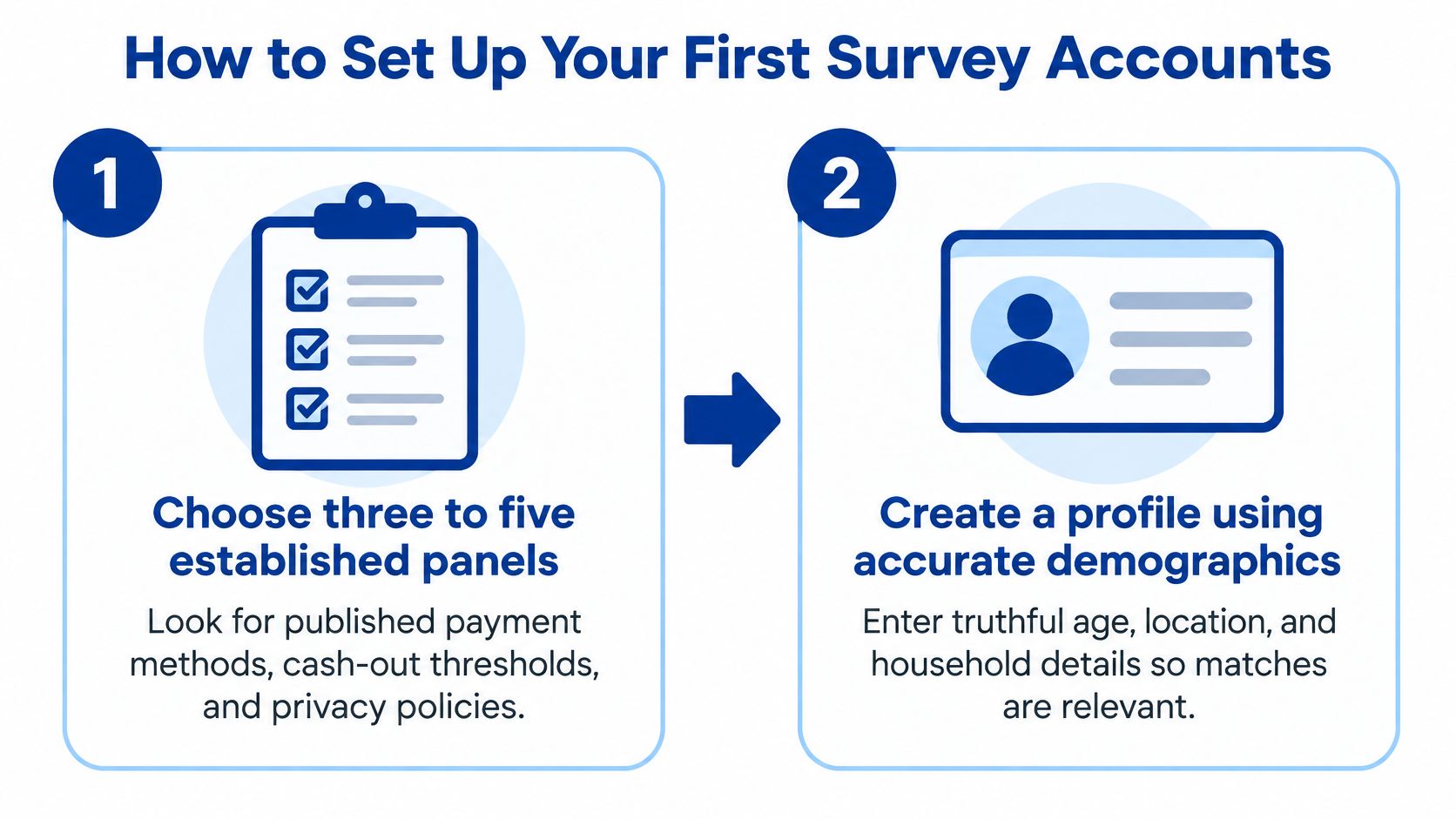
Never pay a fee to “activate” surveys, and don't hand over financial logins. The panel pays you.
- Pick three to five established panels that publish payment methods, cash-out minimums, and a privacy policy you can read. The slip is joining ten apps in one night because a listicle ranked them. You won't remember which terms you accepted.
- Enter true demographics. Screeners check location, age, employment, household, and purchasing. A mismatch gets you screened out or flagged. The slip is rounding your age or inventing a job because a forum said it “opens more surveys.”
- Use a separate email, a unique password, and multifactor authentication. Wait to connect a bank until you have seen how that panel pays, and prefer a gift card or PayPal if the terms allow it. The slip is using the same inbox as your banking mail, which makes phishing harder to spot.
- Answer extra profile questions only when the panel says why. Household brands you buy can improve matches. A full account number never should. The slip is filling every optional box to “look complete.”
- Tell the truth on screeners and skip studies that don't fit. Guessing to stay in raises quality flags and later reversals. The slip is changing an answer midway because the progress bar looks long.
- Log each invite, qualification, finish, and screen-out. A notes app or spreadsheet is enough. The slip is trusting the rewards page, which hides the time you spent on failures.
- Cash out at the threshold by the cheapest method the panel offers. The slip is letting a balance sit because you wanted a slightly higher gift-card tier and then losing the account.
Phone apps can be part of that set if the same rules hold. Our notes on the best apps for earning real money on your smartphone are a useful cross-check before you install anything that wants extra permissions.
A short walkthrough of a careful first session helps if you would rather see the clicks than read another list.
After the first week, keep the panels that explain pay clearly and drop the ones that mostly screen you out. More accounts are not more income.
Calculating Your Real Hourly Survey Rate
A survey's advertised reward is not your hourly rate. Screen-outs, time spent opening invitations, reversals, and cash-out fees all reduce what you keep. Track the full session, then calculate net earnings per hour.
The log that replaces the rewards page
Record seven fields for every session. Include the time spent reading and opening invitations, every screener, and each completed survey. Count screen-outs and subtract reversals and fees from the rewards total.
| Log field | What to record | Example entry |
|---|---|---|
| Invitation time | Minutes spent reading and opening invitations | 15 minutes |
| Qualification time | Minutes spent on screeners, including failed ones | 40 minutes across five screeners |
| Completion time | Minutes spent on surveys you finished | 1 hour 45 minutes |
| Screen-outs | Number of screeners you failed | 5 |
| Rewards | Total value of completed surveys | $6.75 |
| Reversals and fees | Rejected responses and cash-out fees | $0.50 reversal and $0.30 cash-out fee |
| Net hourly pay | Net reward divided by total hours | About $2.23 |
A worked evening
Suppose a session includes 15 minutes opening invitations, 40 minutes across five failed screeners, and 1 hour 45 minutes completing three surveys. That is 2 hours 40 minutes of work.
The three surveys pay $6.75 in total. After a $0.50 reversal and a $0.30 cash-out fee, you keep $5.95. Divide that by 2.67 hours: your net rate is about $2.23 an hour.
A single $8 study can look attractive while screen-outs and reversals pull down your actual rate. Compare the result in your log with what you would accept for other evening work. If it falls short, treat surveys as occasional extra income, not dependable hourly work.
Count screen-out time. A high advertised reward means little if you rarely qualify or keep the payment.
Survey payments are also taxable gig income, even when no information form is issued. That includes payment in cash, goods, property, or virtual currency.
Taxes and Account Rules to Check Early
Small survey totals are easy to shrug off until a year of gift cards is sitting in a drawer with no dates on them. Build the file while the amounts are still small.
A monthly routine you can copy
Export payments from each panel at month's end. Save the CSV or a screenshot of the rewards ledger with the panel name in the filename.
Write down every cash-out with the date, the dollar value, and whether it arrived as a deposit, a gift card, or points you converted. Points still need a value on the day you redeem them.
Park a set share of each cash-out in a separate savings bucket once the monthly total is more than spare change. Pick a percentage you can keep, and don't raid it for the next payout fee.
Save any annual summary a panel emails. Some send one, some don't. Your own log is the backup.
Check your state. Filing details are not the same everywhere, and a panel based in another country will not sort that out for you.
Thin records cause more trouble than the surveys themselves. If spending and deposits don't line up, accountants who handle lifestyle expense audits spend their time reconstructing a year you could have logged in ten minutes a month.
Rules that keep the account alive
One account per person. A second profile, a relative's name, or a VPN to look local is how panels close balances.
Answers should match the profile you already gave. Contradictions read as fraud even when you were just careless.
Read the threshold and the payout method before you depend on them. A panel can change a minimum or drop a payment option. If the terms don't say when you get paid, don't build a routine around that site.
People who are earning amounts that would matter on a return should talk with a qualified tax professional about their own situation. A blog can't see your other income, your state, or how you were paid.
Tips to Get More Qualifying Surveys
More invites are not the goal. More finished surveys that survive review are. These habits sit on top of a clean profile, and they are about where you spend the next hour.
- Keep screener answers consistent with your profile. Panels compare what you said at signup with what you say today. A contradiction doesn't just fail one study. It can thin the invites that follow. If your job or household changed, update the profile first, then take surveys.
- Batch the work into two or three sittings a week. Invites clump. Logging in the moment one email arrives burns time on passwords and empty dashboards. A planned block catches the clump and lets you stop when the screeners turn sour.
- Close a panel when screeners run long and you fail most of them. Five minutes to a “not a match” is unpaid. One bad week can be noise. A month of the same pattern means that panel's sample doesn't include you.
- Ignore sign-up bonuses that don't spell out the condition. “$10 free” usually means a stack of studies, a waiting period, or a referral that never clears. If the page won't say what you must finish, the bonus is advertising.
- Drop the weakest panel after you review the month. Sort by net hourly pay, not by how many emails they sent. Move that time to the panel that qualified you.
- Stop joining new sites until the log shows a real gap. Three panels you match will beat twelve you opened because a roundup said they pay well. Add another only when your current set has gone quiet for reasons that aren't your answers.
A scattered membership list feels productive and pays like clutter. The insight worth keeping is that fit beats volume. A few panels that already know your household will send better matches than a fresh signup that has to learn you from zero.
Decide Whether Surveys Fit Your Time
Surveys fit a narrow kind of spare time. They fit poorly as a plan to cover rent. Use a short test, then keep or quit on the hourly number, not on a single good invite.
You are a reasonable candidate if most of these are true.
- You have short blocks you would otherwise scroll away, not hours you need for paid client work.
- You can live with irregular totals. Some weeks qualify, some don't.
- You will keep the worksheet, including failures, instead of remembering the one survey that paid well.
- You will walk away from fee demands, ID grabs, and off-platform chat.
- Your target rate is honest next to other uses of the same hours. Our Earn Living Online coverage is there for people weighing those other uses, and the site's Earn Living Online section is where that comparison lives.
Run two weeks with three panels. Log every session. Count screen-outs and reversals. At the end, divide net cash by total hours.
If that figure sits under your target, or rejections and screen-outs are climbing, stop. Reallocate the blocks. Don't “try one more app” to rescue a rate the log already settled.
Judge surveys by net pay per hour after time, fees, and privacy risk. The reward printed on one invitation is not the decision.
Mega Income Stream publishes practical guides on earning online, including how paid surveys fit beside other income methods, plus plain explanations of personal finance and small-business choices. If you are weighing surveys against work that builds a skill or a client list, visit Mega Income Stream and use the Earn Living Online articles to compare the next option before you give the panels another month.











Comments