
 By

Revenue optimization consulting uses data and forecasting to guide pricing, marketing, positioning, and other decisions that affect revenue. The goal is to identify practical changes that strengthen revenue performance without relying on guesswork.
Revenue can look healthy while discounts erode margins or customer retention weakens. The U.S. Small Business Administration’s market research and competitive analysis guidance can help frame questions about customer demand and market conditions.
This guide explains how forecasting and analytics support revenue decisions, how pricing and discount strategies work, and which performance metrics help track results. The SBA’s business planning guidance can also help organize market and financial assumptions as you assess your next move.
You’ll get a practical overview of what consulting engagements can involve, what shapes their scope, and how to decide whether strategic support fits your growth priorities.
Key Takeaways
- Use forecasting to connect historical sales, current demand, and pricing decisions before revenue gaps widen.
- Assess consulting outcomes through measurable changes in pricing, margins, customer acquisition, and retention.
- Track a focused set of performance metrics so you can spot shifts and adjust tactics promptly.
- Evaluate discounts and loyalty offers by their effect on customer behavior and profitability, not sales volume alone.
- Build a KPI framework that links revenue targets to clear operational decisions and supports your next growth move.
Data-driven revenue forecasting and analytics
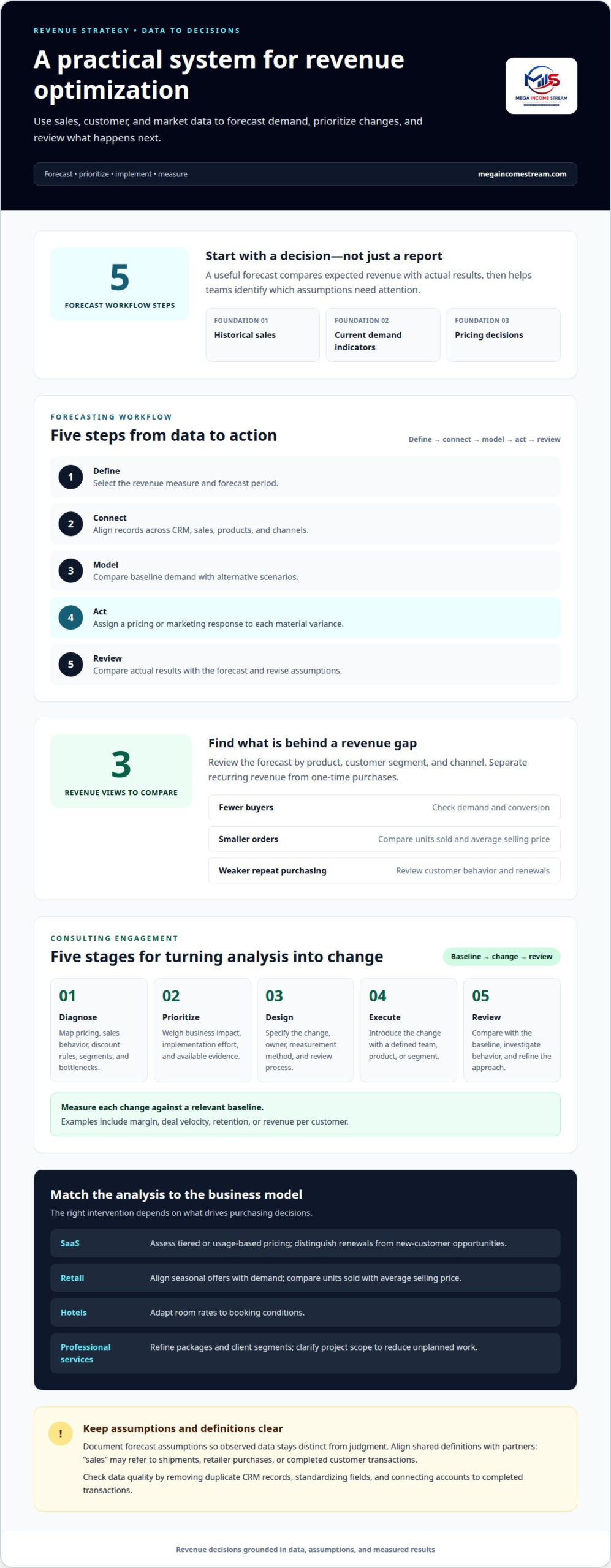
Revenue optimization consulting uses sales, customer, and market data to forecast demand and guide commercial decisions. A forecast helps teams compare expected revenue with actual results and identify which assumptions need attention. For example, a seasonal retailer can compare past winter-coat sales with current demand before planning promotions. Analytics is most useful when it informs a specific decision rather than simply appearing in a report.
Combine historical transactions with current indicators such as conversion rates, sales pipeline activity, inventory, and customer behavior. Separate recurring revenue from one-time purchases, then review the forecast by product, customer segment, and channel. A SaaS business can distinguish subscription renewals from new-customer opportunities. A retailer can compare units sold with average selling price. These views help explain whether a revenue gap stems from fewer buyers, smaller orders, or weaker repeat purchasing.
SaaS teams can assess tiered or usage-based pricing, while retailers can align seasonal offers with demand. Hotels can adapt room rates to booking conditions, and professional services firms can refine packages and client segments. The strongest approach depends on what drives purchasing decisions in each business model.
Statistical forecasting turns inputs into scenarios. Compare a baseline forecast with alternative demand assumptions, then identify which variables change the expected result. For example, a subscription company can model how renewal patterns affect its revenue outlook, while a retailer can test how shifts in product demand affect inventory and promotional plans. Document each assumption so teams can distinguish observed data from judgment.
Collaboration with retailers provides visibility beyond a company’s own sales records. A supplier and retailer can align product, promotion, inventory, and sell-through data to identify changes in demand. If a promotion increases retailer orders but leaves unsold stock afterward, both sides can reconsider its timing, price, or volume. Agree on shared definitions first. “Sales” could mean shipments, retailer purchases, or completed customer transactions. Consistent definitions make partner forecasts comparable.
CRM data quality also affects customer segmentation and pipeline forecasts. Start by removing duplicate records, standardizing fields, and connecting accounts to completed transactions. Enrichment can add relevant firmographic or behavioral attributes, but retain only fields that inform a decision. A sales team forecasting renewals needs accurate contract dates and account status. A retailer planning customer campaigns needs purchase history linked to the correct customer profile.
Build a practical technology stack around CRM, transaction, product, and channel data. Use analytics tools to support forecasts, segments, and scenario comparisons. Follow this workflow:
- Define: Select the revenue measure and forecast period.
- Connect: Align records across CRM, sales, products, and channels.
- Model: Compare baseline demand with alternative scenarios.
- Act: Assign a pricing or marketing response to each material variance.
- Review: Compare actual results with the forecast and revise assumptions.
Consulting engagement outcomes
A revenue optimization engagement turns commercial questions into prioritized changes, then tracks their effect on business performance. It commonly moves through diagnosis, opportunity assessment, strategy design, implementation, and review. Each stage should connect a proposed action to a relevant baseline, such as margin, deal velocity, retention, or revenue per customer.
- Diagnose: Map pricing, sales behavior, discount rules, customer segments, and operational bottlenecks. Separate symptoms from causes. For example, slow deals may reflect unclear package options rather than weak demand.
- Prioritize: Compare opportunities by potential business impact, implementation effort, and available evidence. If customers struggle to compare similar plans, simplifying the offer may deserve attention before adding another product tier.
- Design: Specify the change, owner, measurement method, and review process. A discount redesign, for instance, needs clear approval criteria and a way to assess its effect on deal quality.
- Execute: Introduce the change with a defined team, product, or customer segment. Give sales and support teams practical guidance so they can explain updated pricing consistently.
- Review: Compare results with the baseline, investigate unexpected behavior, and refine the approach. Retain changes that support the target and adjust those that create unwanted trade-offs.
Outcomes depend on the starting conditions and implementation. A SaaS company might simplify its pricing meters to make plans easier to compare. A retailer could coordinate promotions with inventory planning to avoid stimulating demand for products it cannot supply. A professional services firm might clarify project scope to reduce unplanned work. Each intervention addresses a different revenue mechanism, so assess results against the relevant business goal.
Other engagements can focus on sales processes, customer acquisition, or margin management. A fintech business could review whether its marketing attracts customers who continue using its product. A food and beverage company working with a retail partner could examine how promotion planning affects product mix and margins. A holiday rental operator could evaluate whether rate changes align with booking demand. These are questions to test, not promised outcomes.
Use examples as prompts, not templates. A SaaS company may need clearer packaging, while a service firm may need tighter scope control. Choose an intervention based on customer behavior, cost structure, buying friction, and the team’s ability to implement it. Define the baseline before launch, then monitor leading indicators and financial outcomes. This helps distinguish early adoption from lasting commercial impact.
To maximize the value of an engagement, assign an owner to every action and record the intended behavior. For example, a discount process change should specify who approves exceptions and how the team will evaluate deal quality. Keep a decision log that links recommendations to actions and results. A practical revenue strategy execution framework can help teams make that link explicit and keep implementation focused.
Continuous monitoring and agile adjustment
Revenue optimization consulting should connect live performance signals to clear decisions, rather than leaving dashboards as passive reports. A team can track customer acquisition cost, customer lifetime value, monthly recurring revenue, and retention rates in real time. Each metric answers a different question: Are acquisition costs rising? Do customers generate value over time? Is recurring income shifting? Are existing customers staying?
Choose metrics that match the business model. A subscription company might compare new sign-ups with cancellations and expansion revenue. A retailer could monitor product conversion, average order value, and stock availability. A hotel can track booking pace and adjust room rates in real time as demand changes. The right signal depends on the decision it informs.
Make the monitoring loop operational:
- Set a baseline: Record current results for each chosen metric and define the period the team will review.
- Assign ownership: Name the person who investigates a material change and coordinates a response.
- Diagnose the cause: Segment results by customer group, product, channel, or geography to locate the shift.
- Choose a response: Adjust a price, campaign, offer, sales process, or inventory decision based on the evidence.
- Review the effect: Compare later results with the baseline and retain, revise, or reverse the action.
Segmentation turns an overall movement into a useful signal. If customer acquisition cost rises, separate paid channels from referrals and organic traffic. If retention weakens, compare customer cohorts, plan types, and onboarding paths. A company-wide average can hide a strong segment alongside a declining one. Review both the total and its components before changing pricing or marketing.
Set decision rules before teams react to daily noise. For example, a retailer can define which inventory and demand signals trigger a promotion review. A SaaS team can route a drop in renewals to account analysis before changing subscription terms. These rules should identify the metric, owner, diagnostic step, and action. They should also explain when a change needs leadership approval.
Expect different signals to move at different speeds. Bookings may respond quickly to a hotel rate change, while customer lifetime value takes longer to assess. Match the review cadence to the metric and sales cycle. Short-cycle campaigns support frequent checks; renewals and retention need cohort-based comparisons over time.
Keep a decision log alongside the dashboard. Record the date, segment, change, expected behavior, and observed outcome. This helps teams distinguish a pricing effect from seasonality, channel shifts, or a product change. It also prevents repeated experiments from producing conflicting conclusions.
Where practical, agile adjustment means changing one meaningful lever at a time. If a SaaS team changes price, packaging, and discount rules together, it becomes harder to identify which change influenced conversion or retention. Run a focused test, monitor customer response, and update the operating plan when the evidence supports it.
Discounting, loyalty programs and trade spend
Revenue teams can improve pricing, sales, and retention by connecting each discount or reward to a specific customer behavior. A lower price can encourage trial or clear seasonal stock, but broad discounts can reduce margin without changing purchase decisions. Set an objective first, such as winning first-time buyers, increasing repeat orders, or moving excess inventory. Then measure whether the offer produced that behavior.
Set discount rules that reflect customer value and buying context. A bundled offer gives customers several products or services at a slight discount, which can raise order value while simplifying the purchase. An insurance company discount for customers with multiple policies illustrates bundling. Compare the bundle’s contribution margin with separate purchases, including any extra servicing or fulfillment costs. If customers would have bought every item anyway, the discount may reduce revenue without creating additional demand.
Penetration pricing takes a different approach. It introduces a product to a market segment at a lower price, then raises the price after the brand secures market share. Treat the lower price as a defined market-entry tactic, not a permanent default. Track customer acquisition, repeat purchases, and responses to later pricing. The key test is whether early buyers continue purchasing when the introductory offer ends.
Dynamic pricing adjusts prices as demand changes. Airlines, ride-share companies, and vacation rental businesses such as Airbnb use this approach. A hotel can review booking demand and adjust room rates as conditions shift. Retailers selling seasonal goods can also align prices with changing demand. Set boundaries for adjustments so teams can explain changes and avoid reacting to short-term noise.
Loyalty programs should reward actions that support lasting customer value. A retailer might offer points for repeat purchases, while a subscription business could provide benefits tied to renewal or plan upgrades. Use purchase history and customer preferences to identify which rewards matter to each segment. Hotels can use past guest preferences to shape personalized marketing and encourage repeat bookings. Compare repeat-purchase behavior among participating customers with the program’s costs and redemption patterns.
Trade spend needs the same accountability. For a retailer promotion, agree on its purpose, eligible products, timing, and how sales results will be assessed. Compare promotional sales with ordinary sales patterns, then account for discounts and support costs. This separates genuine additional demand from purchases shifted forward or diverted from other products. Record the result before renewing a promotion.
Recurring revenue models, including monthly recurring revenue (MRR) and annual recurring revenue (ARR), make retention especially relevant in B2B and B2C markets. Review whether loyalty programs improve renewals or expansion, rather than measuring enrollment alone. Use this workflow:
- Define: Name the target behavior and customer segment.
- Model: Compare expected revenue with discount and delivery costs.
- Test: Run a focused offer with clear eligibility.
- Assess: Review margin, repeat purchases, and retention before extending it.
Revenue consulting KPIs
Useful revenue management KPIs connect a commercial goal to a decision someone can act on. Choose measures that show both financial outcomes and their operating drivers. A revenue increase can conceal weaker margins, while higher conversion can result from discounts that undermine customer value. Review metrics together, then identify the action each should trigger.
Hotel revenue management commonly uses revenue per available room (RevPAR), gross operating profit per available room (GOPPAR), and average rate index (ARI). RevPAR relates room revenue to available room capacity. GOPPAR includes operating profit. ARI compares a hotel’s average rate with a relevant market benchmark. These measures answer different questions, so a rate increase alone does not establish stronger performance.
For other business models, pair revenue measures with useful drivers. A SaaS team can compare recurring revenue with renewal and expansion trends. A retailer can review gross margin by product alongside returns and sales mix. A professional services firm can track revenue by service line against delivery capacity and realization. Keep definitions consistent across teams: “revenue” should refer to the same transaction stage in every report.
How does revenue optimization consulting differ from revenue management consulting? Revenue optimization typically examines broader commercial levers, including pricing, marketing, and customer mix. Revenue management often centers on demand, capacity, pricing, and distribution, particularly in sectors such as hospitality.
Choose a consultant or firm whose experience fits your business model and the decision you need to improve. Ask for a clear diagnostic approach, defined KPIs, an implementation plan, and reporting that separates observed results from assumptions. A useful proposal names owners and explains how success will be evaluated.
What does consulting typically cost in the United States? Cost depends on project scope, data readiness, stakeholder requirements, and the level of implementation support. A focused pricing review requires different inputs from a cross-functional redesign involving analytics, sales processes, and ongoing execution.
How do firms charge? Common structures include hourly billing, a fixed project fee, or performance-based compensation. Compare them by deliverables, included work, measurement rules, and how the agreement handles changes in scope or external factors.
Risks include optimizing one KPI at the expense of another, relying on inconsistent data, or attributing market shifts to a consulting intervention. Set a baseline, define metric ownership, and assess financial outcomes alongside customer and operational effects. Avoid rewarding a short-term lift that harms retention or margin.
Use this review sequence to make KPIs operational:
- Define: Write each metric’s formula, source, and owner.
- Connect: Link the KPI to a commercial decision.
- Compare: Review results by product, channel, or customer segment.
- Act: Assign a specific response when results shift.
- Reassess: Check whether the action improved the target without harming related measures.
Mega Income Stream: Business Strategies
Mega Income Stream provides Business Strategies for entrepreneurs who need to turn revenue findings into practical decisions. Use this support when pricing, customer retention, or sales processes need a clearer plan, or when your business needs to identify sustainable income opportunities. Its Making Money Insights and Consulting Business offerings connect strategic thinking with commercial questions, helping you focus on actions suited to your business model.
Bring a specific challenge, such as discount rules that weaken margins or customer segments with different purchasing patterns. A focused starting point helps turn analysis into priorities and execution steps. The aim is a workable strategy, not a promise of a particular financial result.
To discuss a business strategy for your revenue goals, visit Mega Income Stream.
Make your next revenue decision testable
The next advantage comes from turning an unresolved commercial decision into a focused operating test. Choose a question with a clear business consequence, such as whether a new offer attracts the right customers or whether a sales process creates avoidable friction. Define what evidence would change your decision before changing the process. This keeps new initiatives tied to a business purpose instead of adding activity without direction.
Revenue optimization consulting can help shape that decision into a practical plan, especially when several teams influence pricing, sales, and retention. Assign an owner, clarify the intended outcome, and decide how the business will use what it learns. Then move from analysis to a deliberate next action rather than waiting for perfect information.
If you’re ready to turn a revenue challenge into a workable business strategy, contact Mega Income Stream. Start with the decision that matters most, and build your next move around evidence.
Frequently Asked Questions
What is revenue optimization?
Revenue optimization improves how a business earns from its customers, products, and sales channels. It connects decisions such as offer design, customer targeting, and sales processes to financial outcomes. For example, a software company might find that a feature customers value is buried in a low-tier plan. Restructuring the offer can better align the product’s value with what customers are willing to pay.
What is revenue optimization consulting and what services does it include?
Revenue optimization consulting helps a business identify commercial barriers and build a plan to address them. Work can include reviewing business models, evaluating market opportunities, refining offers, and setting an implementation roadmap. For example, a freelance agency with inconsistent project scopes could assess which services attract repeat clients, then clarify its packages and sales messaging around the strongest demand.
What ROI and revenue gains can businesses expect from consulting?
ROI comes from comparing the financial value of a change with the resources needed to implement it. A business might assess whether a revised service package generates more gross profit after delivery costs, rather than judging success by sales alone. Gains depend on the opportunity addressed, customer response, and execution. Track the starting position and measure changes against it to understand the contribution.
How do you measure consulting results and key performance indicators?
Measure results by pairing each initiative with a baseline, an owner, and an outcome metric. For a revised service package, track qualified inquiries, close rates, average contract value, and delivery margin. Compare results across relevant customer groups and sales channels. Then review whether the change improved the target outcome without causing a decline elsewhere, such as lower retention or profitability.










Comments