
 By
A brand doesn't sponsor you as a favor. It buys a chance to reach people who might purchase, then asks whether it can measure that chance and stay clear of a messy endorsement.
That is the practical version of how to get sponsored by a brand. A smaller creator who documents audience fit, splits fees, and labels every material connection is often easier to buy than a larger creator with no reporting and sloppy compliance.
Treat the pitch as a short media proposal. Show who you reach, what you will publish, what each fee covers, and how you'll label the relationship before anyone pays you or sends a product.
Table of Contents
- Why Brands Buy Creator Sponsorships
- What a Brand Ready Media Kit Includes
- How to Pitch Brands That Fit
- How to Split Fees for Usage and Exclusivity
- Checks Before You Accept a Paid Deal
- Send a Low-Risk Pilot This Week
Why Brands Buy Creator Sponsorships
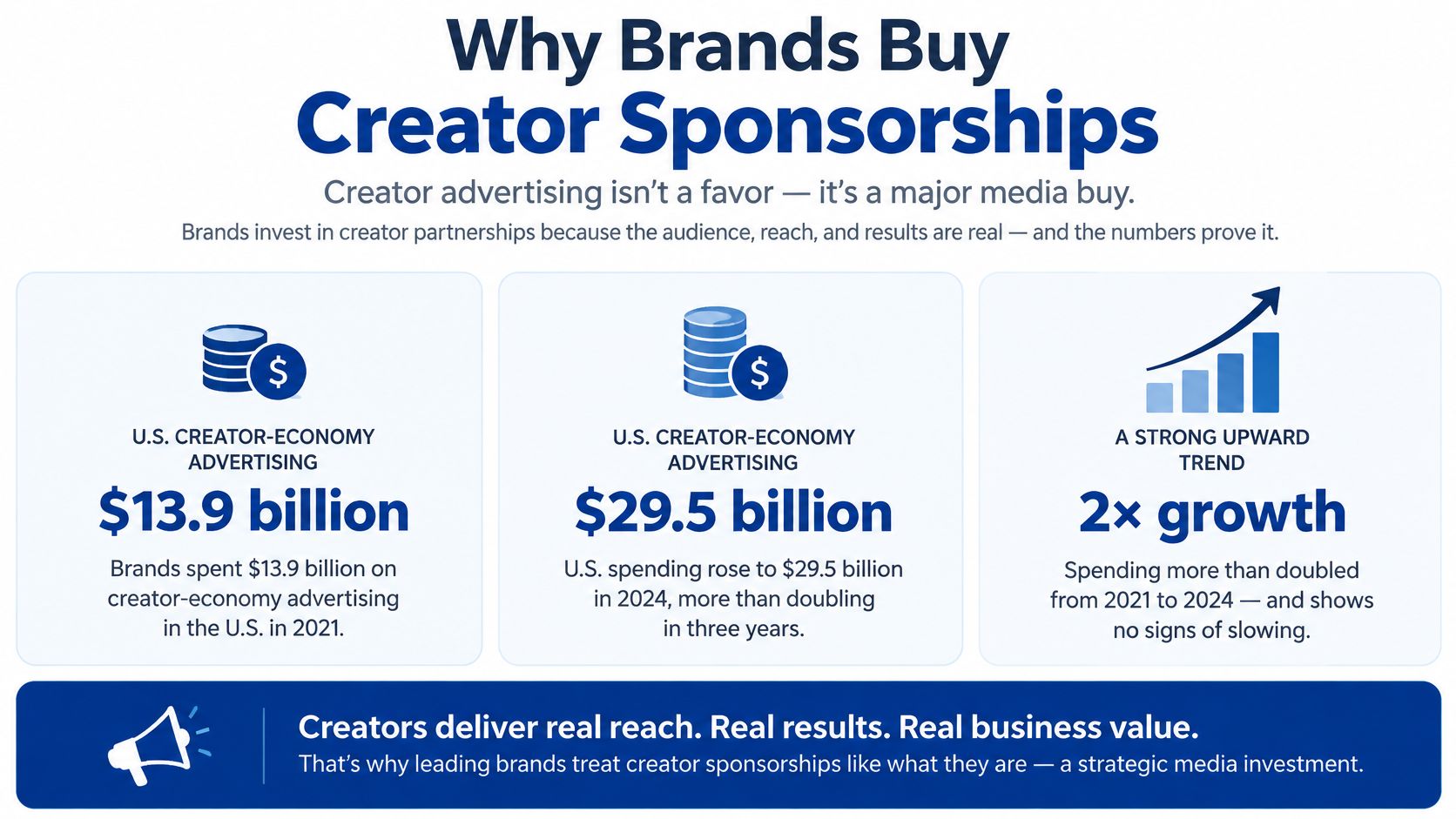
U.S. creator advertising is a media line item, not a celebrity side deal. The Interactive Advertising Bureau research reported that U.S. creator-economy advertising increased from $13.9 billion in 2021 to $29.5 billion in 2024, and it projected creator advertising would reach $37 billion in 2025, 26% year-over-year growth, about four times the overall media industry's projected growth rate of 5.7%. The same research found that 48% of advertising buyers considered creators a "must buy," while 40% ranked overall return on investment as the leading performance indicator for creator campaigns.
Buyers are scoring risk. Follower count doesn't answer whether the people watching match the product, or whether anyone clicked. Your job in the pitch is to shrink that uncertainty with a short proof pack from the last 30 to 90 days.
- Who they are: location, age, interests, platform, and the moment they buy.
- How much attention you get: median reach, impressions, engagement rate, video completion, and click-through rate.
- Whether anyone acted: clicks, conversions, newsletter performance, or a prior campaign result.
A large undocumented following still forces the buyer to guess. A smaller audience that clearly matches the product's customers, with a tracked link or a code, is a cleaner buy. If you need a simple way to turn those clicks into a number a marketer already understands, the social media ROI guide from SleekPost is a useful companion to the metrics that matter in digital marketing.
Practical rule: If you can't show who saw it and what they did next, you're asking the brand to fund a hope.
The kit, the short outreach list, the split quote, and the disclosure checks below are how you package that proof so a buyer can say yes to a small first test.
What a Brand Ready Media Kit Includes
Send a one-page PDF, or two pages at most. It is a decision tool, not a biography. A buyer should be able to match your audience, see one activation, and accept or decline a pilot without a call.
Walk the rows in this order. Each one answers a buying question.
| Kit line | What to show | Buyer question it answers |
|---|---|---|
| Audience snapshot | Location, age, interests, platform, buying context | Does this audience match our customer? |
| 30 to 90 day performance | Median reach, impressions, engagement, completion, click-through rate | Can we estimate attention without guessing from followers? |
| Proof of action | Clicks, promo codes, conversions, or newsletter results | Is there any sign the audience acts? |
| One activation | Tutorial, comparison, newsletter placement, or tracked lead campaign | What exactly would we buy? |
| Operating terms | Dates, deliverables, usage, exclusivity, revision cap, disclosure | Can we run this without open-ended risk? |
| Pilot | Small first campaign with explicit success criteria | Can we test before a larger commitment? |
Audience, performance, and proof
Name the audience in market terms. Say you reach U.S. renters in their thirties who compare kitchen gear on YouTube before they buy, not "lifestyle fans." Then show the 30 to 90 day window: median reach, impressions, engagement rate, video completion rate, and click-through rate. If a platform hides a metric, write "not provided by the platform" and use the next best number you can export.
Proof of action is tracked clicks, promo-code redemptions, conversions, or newsletter opens and clicks. It is not a promise of sales. Results also depend on the offer, the creative, audience fit, attribution, and the brand's landing page. Attach one recent example, a screenshot of analytics plus the post, so the numbers have a home.
One activation, terms, and a pilot
Propose one concrete piece. A tutorial, a comparison, a newsletter placement, or a tracked lead campaign is enough. Put the publish date and the deliverable list next to it. Terms should name usage rights, any exclusivity, a revision cap, and the disclosure language you'll use on the asset.
A meta-analysis of sponsorship disclosure covering 288 effect sizes from 37 studies and 12,721 participants found that sponsorship disclosure increased persuasion knowledge and brand recall, while reducing credibility, and that overall effects on attitudes and purchase-related responses were insignificant. Put the label in the kit as part of how you'll measure a clean campaign, not as a footnote you hope nobody reads.
Leave unsupported health, income, and "best" claims out of the file. Close the page with a pilot the brand can accept or decline, such as one placement and a success line like "100 tracked clicks or 15 code redemptions." Stronger engagement on your own posts makes that pilot easier to defend, which is why it helps to raise engagement before you quote a sponsor. Export the PDF this week. That's the file you attach.
How to Pitch Brands That Fit
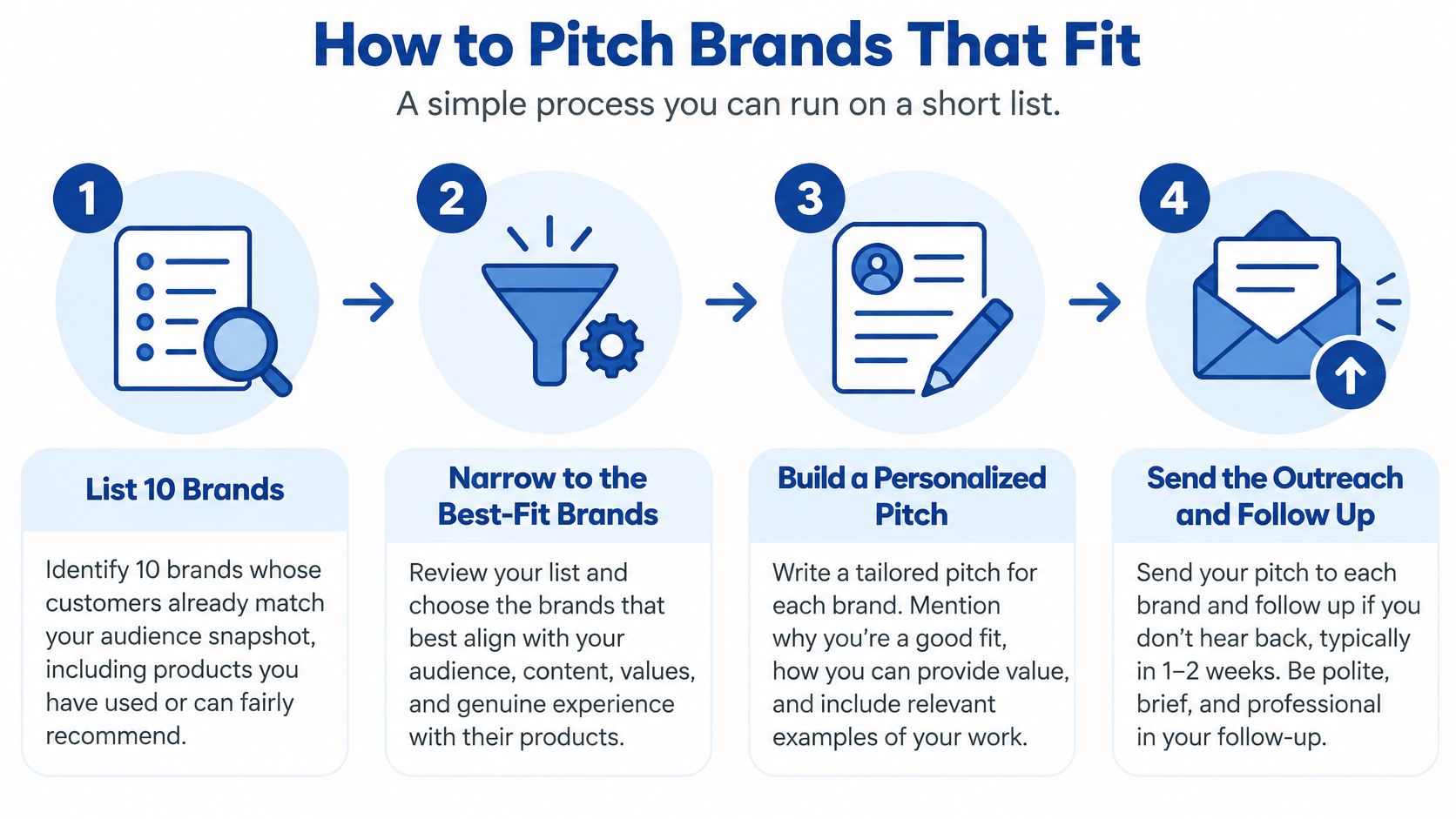
Work a short list. Ten brands whose customers already match your audience snapshot will beat a blast to fifty names that don't.
Run the list in order
- List 10 real fits. Include products you've used or can review fairly. If your readers are first-time home cooks, a mid-price skillet brand belongs on the list. A luxury watch brand doesn't.
- Find one person and one recent campaign. Look for marketing, partnerships, or the founder. Note a launch, an ad, or a creator post from the last few months so the email isn't generic. FindClout's guide to sponsorship deals is a solid extra pass on how those conversations usually start.
- Send a short email. State the audience match in two lines, name one activation, give dates, and attach the kit. Don't attach a life story.
- Offer a pilot, not a year-long exclusive. A single placement with a tracked link is a decision. A category lock for twelve months is a negotiation you haven't earned yet.
- Follow up once after about a week, then move on. Log the send, the reply, and the reason for no. The next ten pitches should fix whatever kept failing.
Say a newsletter creator with a few hundred subscribers pitches a specialty coffee roaster whose buyers already read that letter. The note offers one sponsored mention, a unique code, and a publish date two weeks out. That's a complete ask. Or say a small video creator proposes one tutorial for a hand tool they've already used on camera, with the kit's median views attached. Neither pitch needs a celebrity case study. Both need a match.
Skip mass emails with no product fit, messages that only ask for free product, and any line that guarantees sales. Also skip a brand whose buyers aren't in your audience, even if the fee sounds attractive. A campaign aimed at the wrong people wastes the brand's landing page, which is the same problem as a campaign built without a clear return path.
Watch a tight walkthrough of how a first brand note is structured before you send yours.
When a brand replies with interest, stop pitching and move to price. Interest is not a signed deal, and the next email should clarify what they are buying.
How to Split Fees for Usage and Exclusivity
One bundled number hides the expensive parts. A brand that only needs a newsletter mention shouldn't pay the same as a brand that also wants to run your face in ads for half a year. Quote separate lines so they can drop what they don't need.
| Fee line | What it covers | When to charge it |
|---|---|---|
| Production | Research, scripting, filming or writing, and edits within the cap | Every original asset |
| Distribution | The agreed organic post, video, story set, or newsletter placement | Every placement on the creator's channel |
| Paid usage | Whitelisting, boosting, or running the asset as an ad | Only if the brand reuses it in paid media |
| Exclusivity | A named category locked for a stated period | Only when competitors are blocked |
| Extended rights | Perpetual or broad reuse beyond the campaign | Separate from the original post fee |
What each line is really selling
Production is the cost of making the asset. Research, a script, filming or writing, and the edits inside your cap live here. Distribution is the organic placement on your channel, whether that's a post, a video, a story set, or a newsletter slot. Paid usage is whitelisting, boosting, or running that asset as an ad. It is not included in a one-off post. Exclusivity is a named category locked for a stated period, not a vague promise to "stay loyal." Extended rights cover perpetual or broad reuse beyond the campaign, and they sit on their own line.
A three-line conversation
Say a skincare brand wants one newsletter mention, 90 days of ad reuse, and a six-month lock on competing moisturizers. Quote three lines: distribution for the mention, paid usage for the 90 days, and exclusivity for the six months. If they only want the mention, they delete the other two lines and you don't give away reuse for free.
A modest first pilot can sit below a later package once you have reporting from that test. Don't guarantee sales in any line. The offer, the creative, the audience match, the tracking, and the brand's own page all move the result.
Negotiation moves that protect the next deal
Cap revisions in the quote, such as two rounds, so a "quick tweak" doesn't become a reshoot. Set payment timing before publication, ideally on invoice before you schedule. Decline exclusivity that blocks most of your future income for a small add-on. A six-month lock across every product you might review is a business decision, not a courtesy.
If the brand can't point to the line they're buying, you don't have a price yet. You have a bundle they'll reinterpret later.
Put those lines in the reply as soon as they show interest. The contract checks come next, before you accept money, a gift, or a code.
Checks Before You Accept a Paid Deal
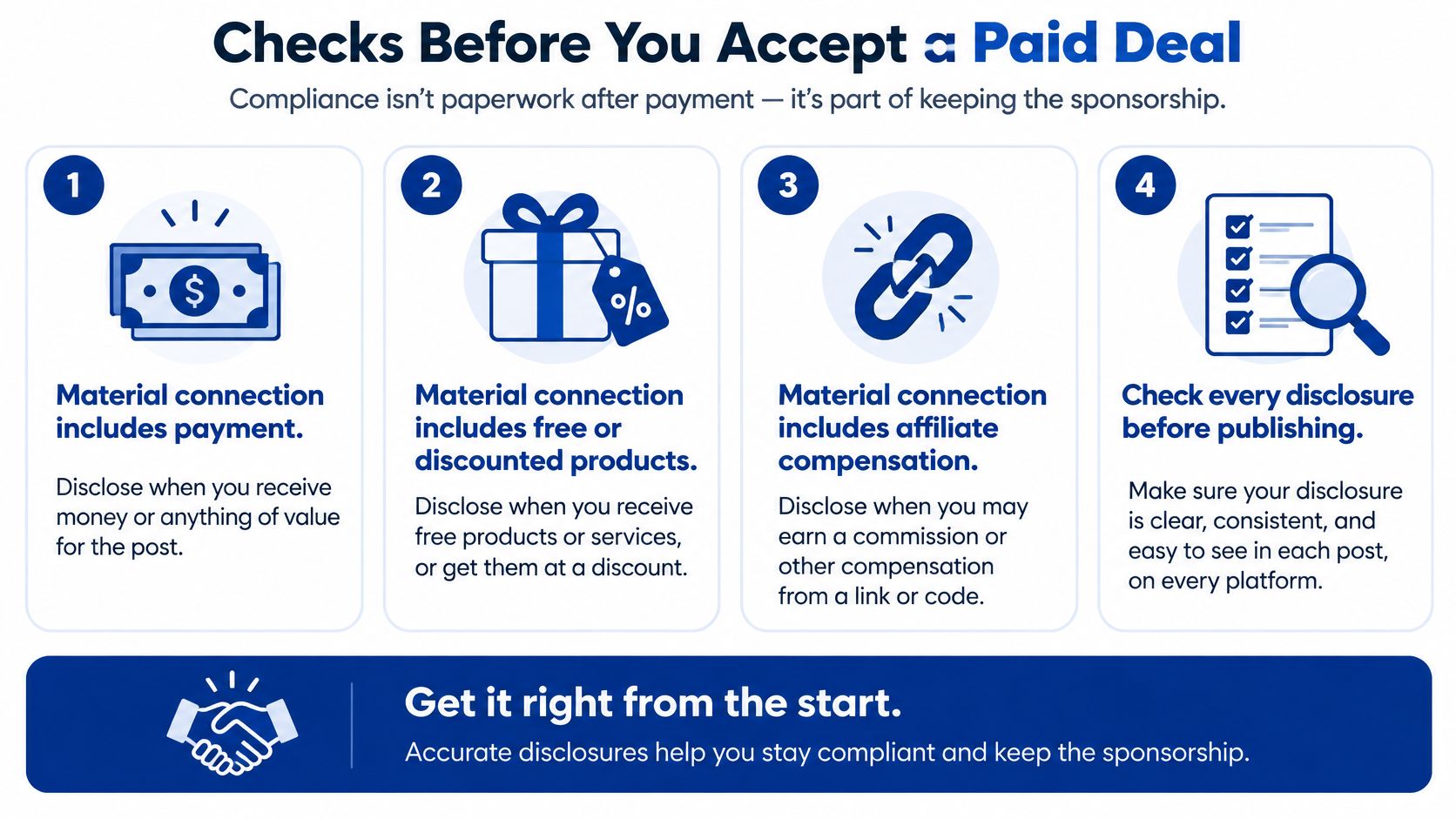
Compliance is how you keep the sponsorship, not paperwork you handle after the payment lands. A free product is still a material connection. So is a discount, affiliate compensation, a job tie, or a personal or family relationship that could change how someone reads your recommendation.
The FTC's guidance on endorsements says a financial, employment, personal, or family relationship that could affect how consumers evaluate an endorsement should be disclosed clearly and conspicuously, with the endorsement itself. Labels such as "Ad," "Paid ad," or "#ad" are likely to work when they're easy to notice. Don't bury the label after a "more" break, and don't rely only on a platform's paid-partnership toggle.
Why the label protects the asset brands are buying
People trust a creator recommendation more than they trust a banner, which is exactly why a hidden payment is costly. Nielsen's 2021 Trust in Advertising study found that 71% of consumers trusted advertising, opinions, and product placements from influencers. In measurement of nearly 200 influencer campaigns, first-quarter 2022 norms showed that an average of 80% of viewers recalled seeing the featured brand, and influencer advertising produced a 9-point increase in brand affinity and purchase intent compared with consumers who weren't exposed, context that belongs next to the FTC's Endorsement Guides.
That trust is the asset. Don't invent personal use you didn't have. Don't repeat health, income, performance, or "best" claims the brand can't support. If you think the product is terrible, you don't call it excellent. The same FTC guidance places clear disclosure on the influencer and the brand, not only on the platform, and it notes that disclosure effects vary by format, with stronger effects reported for hashtags, longer disclosures, video placements, and adult audiences. U.S. principles aren't a universal hashtag formula. Local rules can differ, so check the country where the audience sits.
Pre-publish checklist
- Match every factual claim to evidence the brand supplied, and cut the rest.
- Label the relationship in the first visible frame or the opening text, including gifted items.
- Get written approval that doesn't erase your honest experience.
- Archive the final copy and the analytics export after it runs.
Contract controls
Cap revisions. Define cancellation and late payment. Say whether the brand may reuse the asset in advertisements. Charge separately for perpetual or paid-media rights. Those lines stop a "we loved the post" email from turning into an ad campaign you never priced.
Send a Low-Risk Pilot This Week
Pick one brand whose customer matches your audience snapshot. Send a pilot, not a blanket request to "partner."
The minimum packet is short. Include the audience snapshot, one activation, separate fee lines, the disclosure language you'll use, and a success measure such as tracked clicks or a promo code. Give yourself a one-week personal deadline and keep a list of ten prospects so a non-reply doesn't stall you. If brand three is silent, brand four gets the same clean packet.
Keep the first deal small enough to report. One placement, one tracking method, one archive of the approved copy. Those results go into the next kit, which is what makes the second conversation faster than the first.
Creators who also publish on their own sites can pair a sponsorship test with other audience proof. We publish articles in the Affiliate Marketing category, and our December 28, 2023 post, "How to Boost Engagement Rates," covers the engagement side of that proof. The sponsorship pitch itself still goes to the brand that fits, not to a general marketplace. Once the dates are agreed, a tool that lets you schedule social media posts keeps the organic placement on the day you promised.
Draft the one-page kit tonight. Tomorrow, send it to the single best-matched brand on your list of ten, with a pilot and a tracked success line. That's the send.
Mega Income Stream publishes practical guides on earning online, from audience proof and engagement to affiliate marketing and sponsorship-ready pitches. If you're building a creator income that a brand can buy, start with the reporting and disclosure habits in this guide, then browse more playbooks on Mega Income Stream. We'd rather you send one clean pilot this week than collect another unread thread about "collabs."








Comments