
 By
Yield farming means supplying cryptocurrency to a smart-contract protocol in exchange for interest, trading fees, or newly issued tokens, but the advertised annual percentage yield, or APY, isn't the same as profit.
If a farm advertises a higher return, why might you finish with less money than someone who held the same coins? The answer starts with separating what the dashboard projects from what you can withdraw.
Table of Contents
- What Yield Farming Is in Plain Language
- Where Each Kind of Yield Comes From
- How a Deposit Turns into a Quoted APY
- Why a Higher APY Can Pay You Less
- Worked Example of Quoted APY Versus Holding
- Where Yield Farming Came From
- Check the Payer and Decide Before Depositing
What Yield Farming Is in Plain Language
Think of yield farming as letting a program use your coins, rather than letting a tenant use your spare room. The program follows a smart contract, meaning code that manages deposits and transactions on a blockchain. Your rent might come from customers paying to use those assets, or it might arrive in a token the protocol itself can issue.
That distinction matters. A payment funded by borrowers isn't the same as an incentive paid in a newly created token, even if a dashboard combines them into one attractive percentage.
Say you own cryptocurrency that you're not planning to sell. You could keep it in your wallet, or deposit it into a protocol, a financial application governed by rules encoded in smart contracts. A lending protocol makes supplied assets available to borrowers; a trading pool makes assets available to people exchanging tokens.
What you're putting to work
Decentralized finance, usually shortened to DeFi, describes financial applications that operate through blockchain-based contracts rather than conventional account providers. Yield farming is a strategy within that system, not a particular coin or account type.
The word farming can make the process sound more productive than it is. You're taking financial and technical risks in return for payments that may change, stop, or lose value.
- Your deposit: The cryptocurrency committed to the application.
- Your reward: Interest, a share of fees, incentive tokens, or a combination.
- Your result: What you can recover after price changes, costs, and any losses.
You still control your wallet, but you don't personally control the assets while they're inside the contract. Recovering them depends on the application's rules, its available assets, and the systems it relies on.
Start with the payment: A yield figure is easier to understand when you can name the person or mechanism funding it.
For anyone asking what is yield farming, the useful answer isn't just earning crypto with crypto. It's supplying assets to a financial mechanism and accepting its failure points in exchange for compensation. The first task is identifying which kind of compensation you're being offered.
Where Each Kind of Yield Comes From
| Pattern | Who pays | What you receive | What can erase it |
|---|---|---|---|
| Supply a lending market | Borrowers | Interest on the deposit | Defaults and falling collateral |
| Provide pool liquidity | Traders through swap fees | A share of trading fees | Impermanent loss versus holding |
| Liquidity mining | The protocol via new tokens | Governance or reward tokens | Reward-token price crash |
| Borrow in order to farm | Protocol incentives on the debt | Extra tokens while interest is owed | Emissions end and the debt remains |
Borrowers pay lending interest
A money-market deposit is the most straightforward pattern. You supply an asset, borrowers pay to access the market's available funds, and suppliers receive interest according to the protocol's rules.
Borrowers generally pledge collateral, assets that support their debt. If that collateral becomes insufficient, the protocol may sell it through liquidation, a process intended to repay the borrowing.
The catch is that liquidation isn't a promise of full recovery. Fast price changes, malfunctioning pricing systems, or a shortage of buyers can leave unpaid debt. Check whether the protocol's loss rules can pass that shortfall to suppliers.
Traders pay pool fees
A liquidity pool holds assets that traders can exchange against. In a familiar two-asset pool, liquidity providers contribute a pair of tokens and receive a claim on the pool.
When traders make a swap, an exchange of one token for another, they pay a fee. The provider's compensation comes from the share of those fees allocated to liquidity providers.
This is payment for a service, but the service changes what you own. As traders exchange assets, your claim represents a changing mix of the tokens. Fee income therefore doesn't establish whether supplying the pool was better than keeping the original assets.
Protocols distribute incentive tokens
Liquidity mining adds rewards for supplying liquidity or participating in another designated activity. A governance token may give holders voting rights over protocol decisions; a reward token may serve mainly as an incentive.
These payments can sit on top of lending interest or trading fees. They're separate income sources, even when a dashboard displays a combined rate.
Receiving more reward tokens doesn't necessarily mean receiving more purchasing power. To realize their displayed value, you need buyers willing to pay that price when you sell.
Borrowing creates an expense as well as a reward
Some incentive programs reward borrowing, so a farmer takes on debt to qualify for additional tokens. That isn't free income: borrowing interest continues to accrue while the farmer hopes rewards cover the expense.
If incentives stop, the obligation doesn't disappear. A position that looked profitable can become an ongoing cost, and collateral may still be exposed to liquidation.
The table's purpose is to make the payer visible. Does someone pay for a useful service, or does the strategy primarily distribute tokens that recipients must sell? Both can produce receipts in your wallet, but they don't offer the same durability.
How a Deposit Turns into a Quoted APY
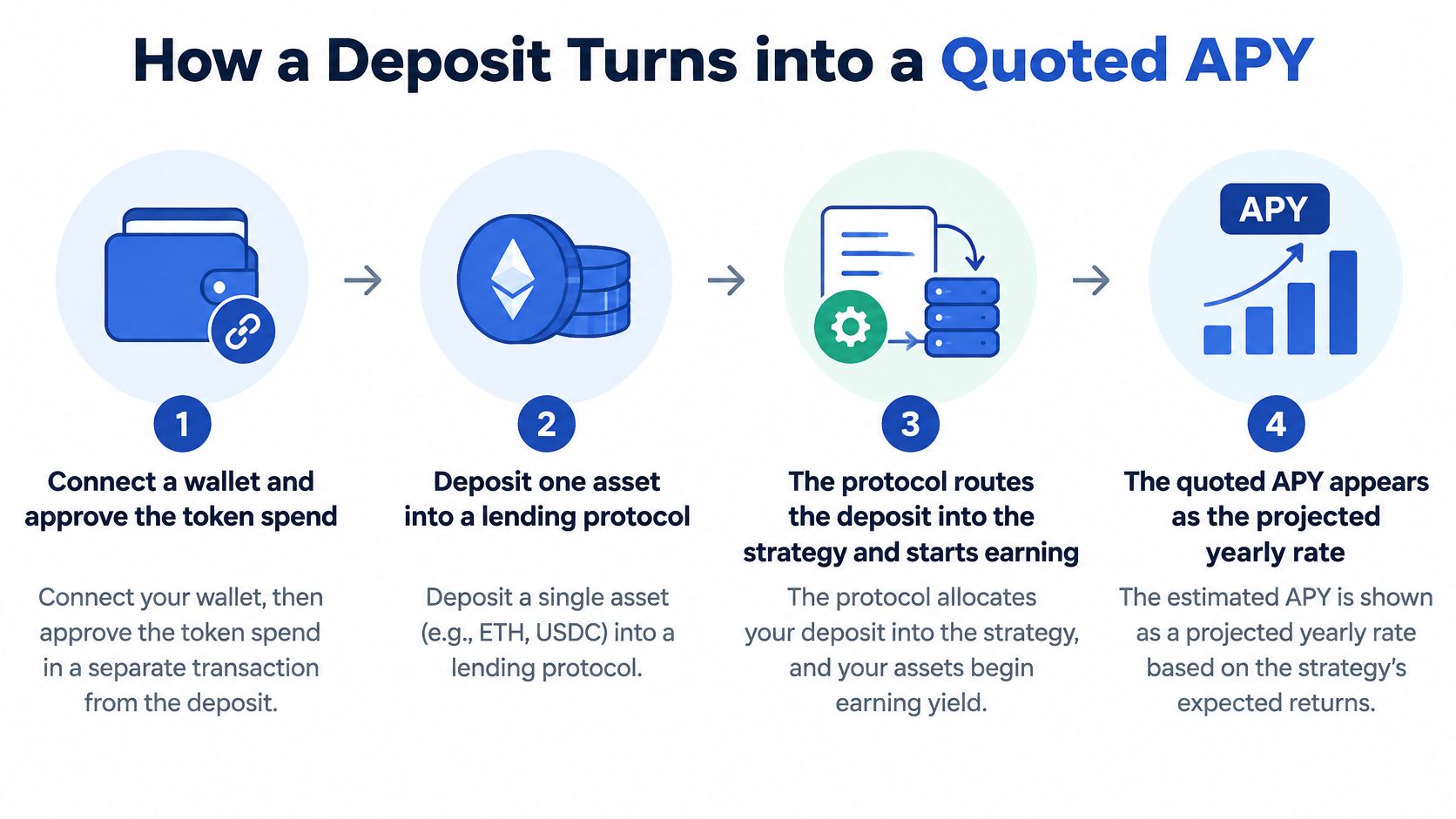
A dashboard compresses several transactions into a percentage. Understanding those transactions helps you distinguish ownership, permission, and projected earnings.
Follow the assets through the contract
Connect your wallet and approve spending. Connecting lets the application request interactions; it doesn't itself deposit your assets. Where a token approval is required, that permission is normally separate from the deposit, so inspect the spender and allowance before signing.
Deposit the required asset or pair. Many protocols issue a receipt token, a transferable record representing your claim, while others record the position differently. Save the transaction details so you can identify exactly which contract holds your deposit.
The assets support borrowing or trading. The contract accounts for the interest or fees attributable to your position. Those earnings might increase your receipt's redeemable value rather than appear as a separate wallet payment.
An incentivized farm also calculates reward tokens. Your allocation follows its distribution rules, including your qualifying share and the emission schedule, the timetable for issuing rewards. More participants can change the amount allocated to each participant.
Claim, sell, or reinvest rewards. Claiming transfers available rewards; selling converts them; reinvesting adds assets to the earning position. These are distinct actions and can require separate transactions.
Withdraw according to the contract's rules. Redemption typically burns a receipt or updates the recorded position and returns the available underlying assets. Locks, available balances, or an additional withdrawal process may restrict when you can exit.
Where compounding enters the display
Compounding means earning returns on reinvested earnings. If rewards sit outside the earning position, they aren't automatically generating additional yield, although some protocols compound earnings internally.
A dashboard may calculate APY by assuming rewards are regularly converted and reinvested. The mathematics behind calculating compound investment growth explains that projection, but executing it in DeFi can require paid transactions.
Gas is the blockchain fee for executing a transaction. Reinvesting frequently can increase these costs, so the compounding schedule that produces an impressive displayed rate may not be economical for your deposit.
The projection also depends on assumptions about continuing rates and token prices. Before signing, identify what you'll hold afterward: the original coins, a receipt representing a claim, unclaimed rewards, or tokens already transferred to your wallet.
Why a Higher APY Can Pay You Less
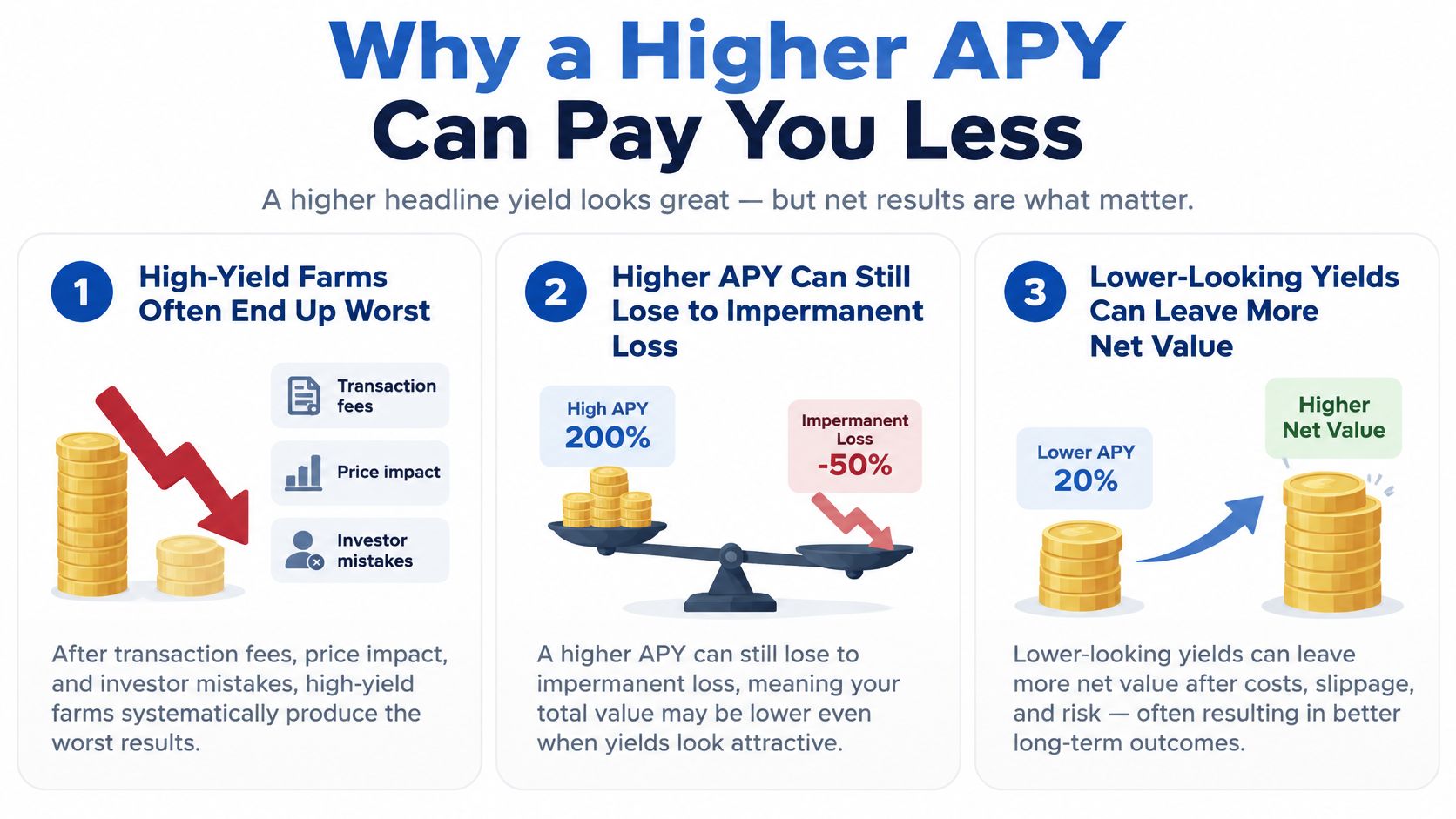
The academic paper Reaching for Yield in Decentralized Financial Markets estimates that farmers underperform by an additional 23 basis points for every 100% increase in advertised yield, finding that high-yield farms systematically produce the lowest returns because of greater impermanent-loss exposure, with transaction fees, price impact, and investor mistakes further reducing risk-adjusted results.
That's evidence against treating a bigger quoted percentage as a better paycheck. It isn't a formula for predicting any particular pool's outcome.
| Component | Effect versus holding | What to check |
|---|---|---|
| Trading-fee or lending interest | Adds if users pay it | Real volume or borrow demand, not just the display |
| Token-emission rewards | Adds, then can reverse | Emission end date and reward-token price |
| Gas and slippage | Subtracts | Chain fees and deposit size |
| Impermanent loss | Subtracts as prices diverge | How far the two assets can move apart |
| Failed compounds and panic exits | Subtracts further | Gas on each compound and exit size at a falling price |
Income isn't the whole return
Fees add value only when customers generate them. Incentive tokens contribute realizable value only at the price you can obtain, not necessarily the price the dashboard used.
Slippage is the difference between the expected trade price and the execution price. Your own transaction can also move the available price, especially when trading against a shallow pool. Converting rewards and preparing assets for deposit can therefore cost more than the visible network fee.
A failed transaction can consume gas without completing the intended action. Repeatedly trying to compound or exit may turn small operational mistakes into meaningful deductions.
The comparison that exposes impermanent loss
Impermanent loss is the shortfall between the value of a liquidity-pool position and the value of holding the deposited assets, before compensation such as fees. In common paired pools, that gap grows nonlinearly as relative prices diverge.
Suppose one deposited asset rises sharply while the other stays flat. Traders exchange against the pool, leaving providers with less exposure to the rising asset than they would've retained in their wallets.
Fees may offset that difference, but they aren't guaranteed to. The name impermanent doesn't mean harmless or certain to reverse; withdrawing can lock in the shortfall.
A positive account gain and a poor investment decision can exist at the same time.
Keep absolute profit separate from performance versus holding. Rising token prices can make a farm profitable in money terms even while the farming strategy reduces your wealth relative to doing nothing.
For broader context, evaluating cryptocurrency reliability in business involves a related distinction: an asset's potential usefulness doesn't make its price or its cash flows dependable. For a farm, write down the benchmark before depositing: what would the same coins be worth outside the strategy?
Worked Example of Quoted APY Versus Holding
Consider a hypothetical deposit of $1,000 into a 50/50 pool, with an 80% advertised APY. Every number in this example is illustrative, not a forecast or a claim about a real pool; assume a basic constant-product pool, which maintains a fixed product of its asset balances before fees.
A naive reading suggests $800 of annual earnings. That interpretation overlooks how the deposited assets change in value and composition.
Follow the hypothetical money
| Stage | Illustrative calculation | Illustrative value |
|---|---|---|
| Deposit | Equal starting allocations to tokens A and B | $500 in each, $1,000 total |
| Price move | A rises fourfold; B stays flat | Original holdings become $2,500 |
| Pool rebalancing | Constant-product position before rewards | About $2,000 |
| Trading fees | Assumed additional fee value | Add $150 |
| Reward tokens | Assumed realized value after their price falls | Add $40 |
| Gas | Assumed deposit, compounding, and withdrawal costs | Subtract $60 |
| Final farm result | $2,000 + $150 + $40 − $60 | $2,130 |
| Holding comparison | $2,500 − $2,130 | Farm finishes $370 behind |
In this hypothetical, holding the original allocation leaves $2,000 in A and $500 in B. The pool instead finishes with a different asset mix because traders have exchanged against it during the price move.
The assumed pool value excludes fees, which are added separately to avoid counting them twice. The example also treats reward value and transaction costs as realized amounts, rather than projecting them from the dashboard.
Interpret the result correctly
The hypothetical farm gained $1,130 relative to its starting deposit. Holding gained $1,500, making farming the weaker choice despite the positive account result.
The advertised rate didn't describe either outcome. Much of the final value came from the assets' price movement, while the strategy altered how much of that movement the depositor captured.
This example isn't a universal pool formula. Different pool designs, trading ranges, and withdrawal rules require different calculations.
Benchmark before depositing: Record the quantity of each coin you contribute, then track what those untouched quantities would be worth.
That record gives you a practical answer to the question a dashboard rarely emphasizes: what would these coins be worth if they had been held?
Where Yield Farming Came From
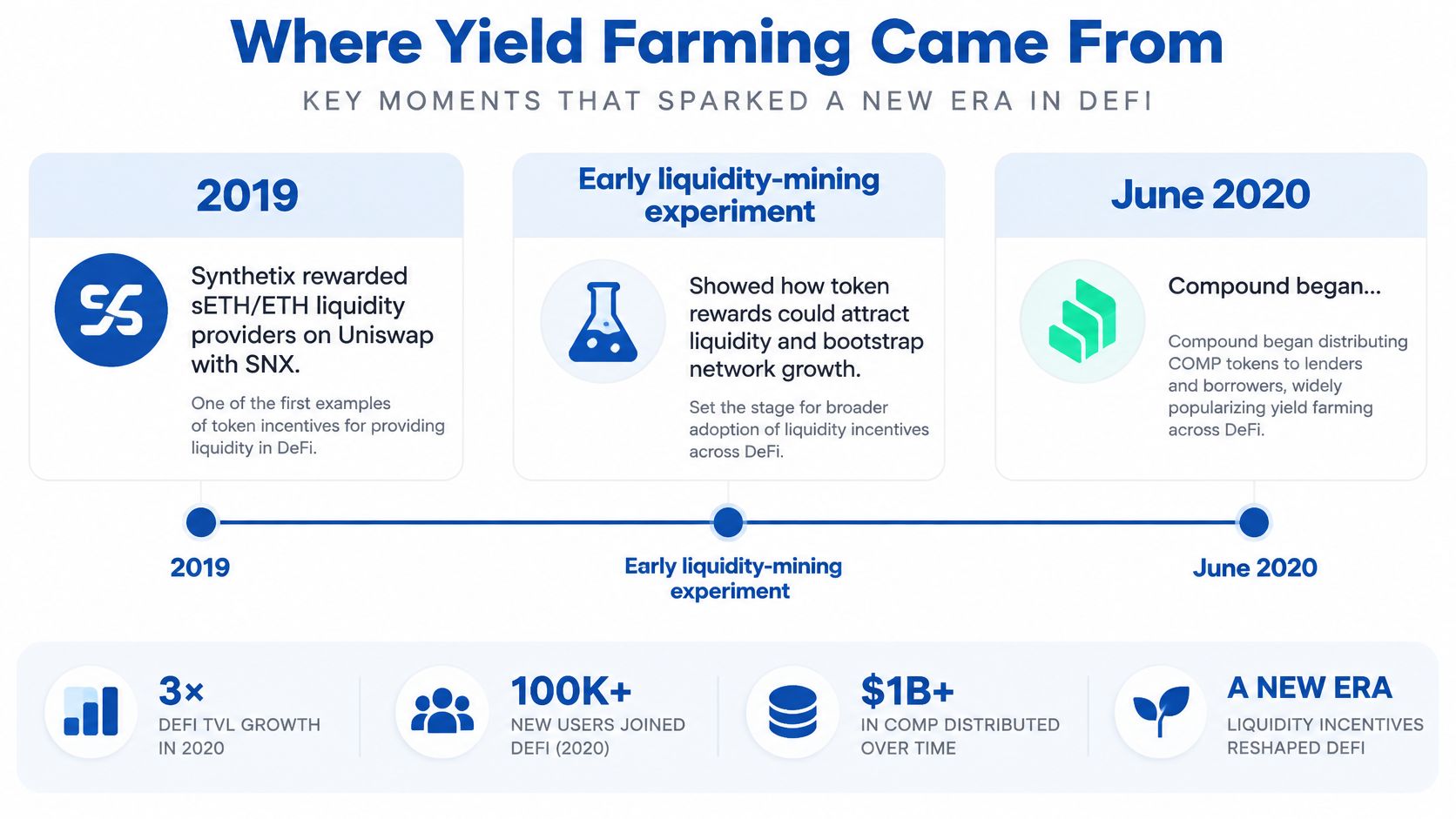
Yield farming's modern history is closely associated with token incentives: a historical account of DeFi Summer describes Synthetix's 2019 experiment rewarding sETH/ETH liquidity providers on Uniswap with SNX and Compound's June 2020 distribution of COMP to both suppliers and borrowers.
The design let participants receive a governance token alongside ordinary lending activity. It also gave protocols a way to attract capital before fee income alone could persuade users to deposit.
Deposits grew, but deposits weren't profits
An academic analysis of decentralized finance reports total value locked of approximately $600 million in March 2020, about $10 billion by the end of September 2020, and more than $100 billion on Ethereum alone by November 2021.
Total value locked, or TVL, measures assets committed to smart contracts. It doesn't measure farmers' profits, and rising asset prices can increase the money value of locked assets without equivalent new deposits.
- Protocols sought liquidity: Incentives encouraged users to commit assets.
- Users sought rewards: Participants moved capital toward attractive quoted rates.
- Token buyers influenced the display: Higher incentive-token prices could make projected rewards look more valuable.
The attraction can reverse
A protocol can attract deposits while its reward token is popular, then lose that advantage when recipients sell or incentives become less generous. Farmers who borrowed to participate can face an additional obligation to repay or restore collateral.
Falling collateral values can also force sales rather than merely reduce an account balance. That makes participation under borrowed funds more fragile than a dashboard's income-focused presentation suggests.
This history is why a headline rate should be treated as a claim to test, not a payment.
Check the Payer and Decide Before Depositing
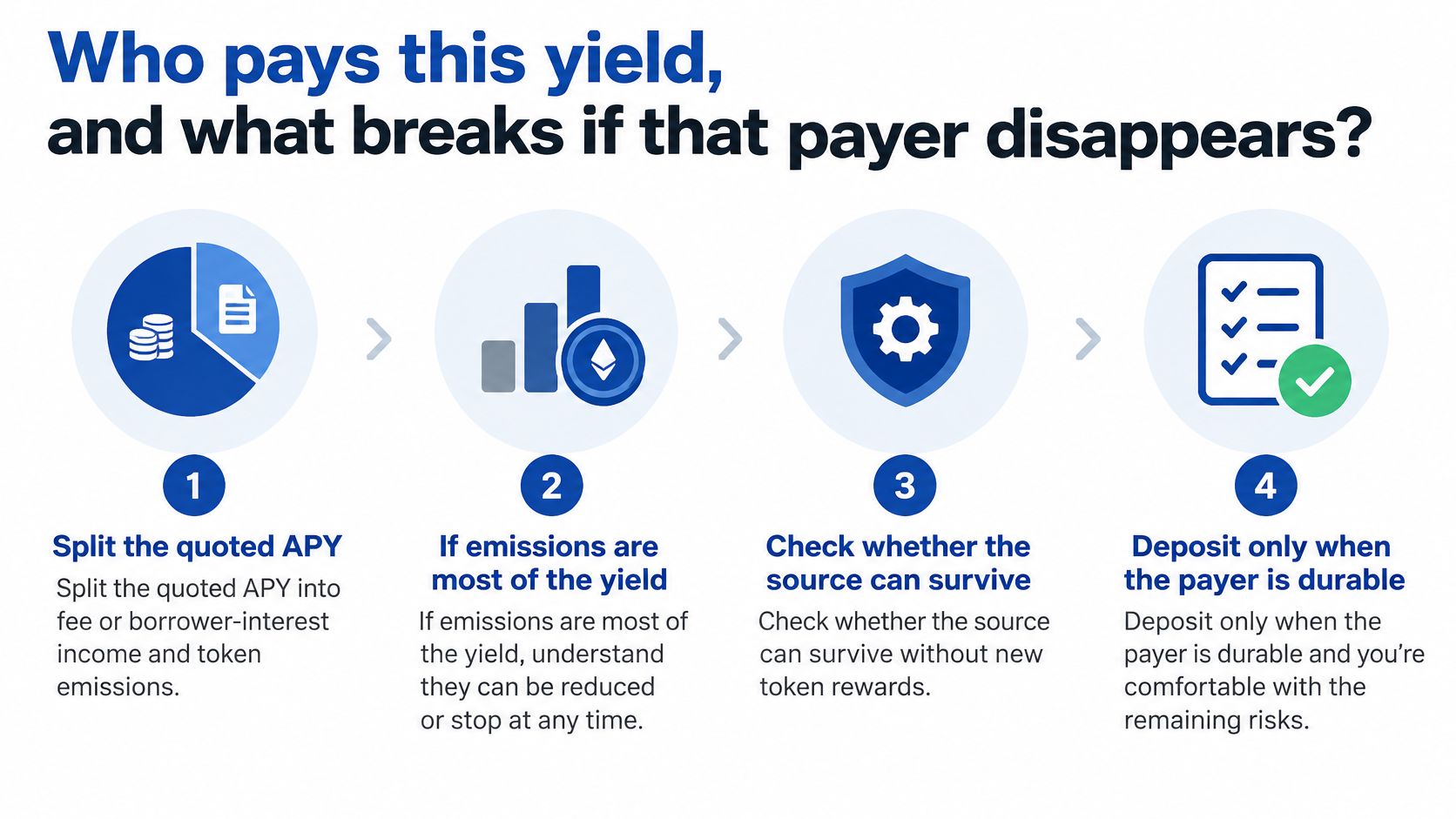
Who pays this yield, and what breaks if that payer disappears? Start by separating borrower interest and trading fees from newly issued rewards, rather than evaluating their combined percentage.
The distinction between transaction-fee returns and liquidity-provider incentives is a useful starting point in Lorenzo Schoenleber's DeFi research collection. Your decision also needs to account for the external systems the strategy uses.
Test the reward and the exit
Check the reward schedule in the protocol documentation, then compare it with distributions recorded on the blockchain. Look for buyers and uses beyond farmers receiving and selling the token; don't assume a quoted market price means your entire reward balance can sell at that price.
Treat an emission-heavy return as temporary compensation, not a salary. Even genuine customer demand doesn't remove the possibility of losing the deposit.
| Failure point | Effect on the deposit | Check |
|---|---|---|
| Smart-contract bug | Deposited assets can be drained | Audit scope and what the audit does not cover |
| Oracle or bridge dependency | Bad prices or frozen funds from another system | Which outside contracts the farm relies on |
| Thin exit liquidity | Withdrawal moves the price or cannot clear | Pool depth versus deposit size |
| Governance change | Rewards or upgrades can be redirected | Who can change the contract or emissions |
An oracle supplies external information, such as asset prices, to a contract. A bridge transfers assets or representations of assets between blockchains; either can introduce dependencies beyond the application you're viewing.
Use the table as a pass-fail screen. An audit isn't a guarantee, particularly if deployed code, administrator permissions, or external dependencies fall outside its scope.
Make the decision explicit
Wallet selection is another operational task, separate from judging the investment. Our cryptocurrency wallet guide provides further reading, but wallet security can't repair a flawed farm.
Keep records of reward receipts, dates, quantities, values, sales, and transaction costs. Tax treatment depends on your jurisdiction, so don't assume rewards become relevant only when converted to ordinary currency.
Before depositing, complete this short decision record:
- Payer: Name who funds the compensation and why they pay.
- Revenue share: Separate fees or borrower interest from newly issued tokens.
- Holding comparison: Estimate the net result after costs and a plausible divergence in asset prices.
If you can't identify the payer or understand the withdrawal conditions, don't deposit. If emissions dominate, use only money you can afford to lose entirely, and don't mistake that sizing rule for evidence that the strategy is sound.
We publish explanations of income generation, finance, investing, and taxes to help readers compare earning methods rather than judge them by headline returns. Visit Mega Income Stream for further reading, then choose one pool and complete the payer, revenue-share, and holding-comparison checks before committing funds.










Comments