
 By

To find new markets for a business, identify unmet customer needs, then test whether demand can support a profitable entry. Seventy-three percent of US business leaders say identifying and entering new markets is a challenge. A promising idea alone does not prove that buyers will act.
Market expansion takes more than spotting a trend or estimating a large audience. Look for recurring customer problems, signs of buying intent, and clear gaps in existing offers. Then compare the cost of reaching a segment with its revenue potential.
This guide explains how to spot unmet needs, identify customer segments, assess demand and competition, and evaluate entry economics. Use the process to test opportunities before committing resources.
- Spot recurring pain: Track customer complaints and workarounds to identify problems worth solving.
- Profile segments: Use usage and retention patterns to find promising customer groups and sales channels.
- Adapt the offer: Match product details and messaging to each segment’s needs and buying process.
- Validate demand: Set test criteria and look for multiple signals pointing toward the same opportunity.
- Check entry economics: Assess local requirements, operating costs, and business risks before expanding.
1. Finding market gaps through unmet needs, workarounds, and complaints
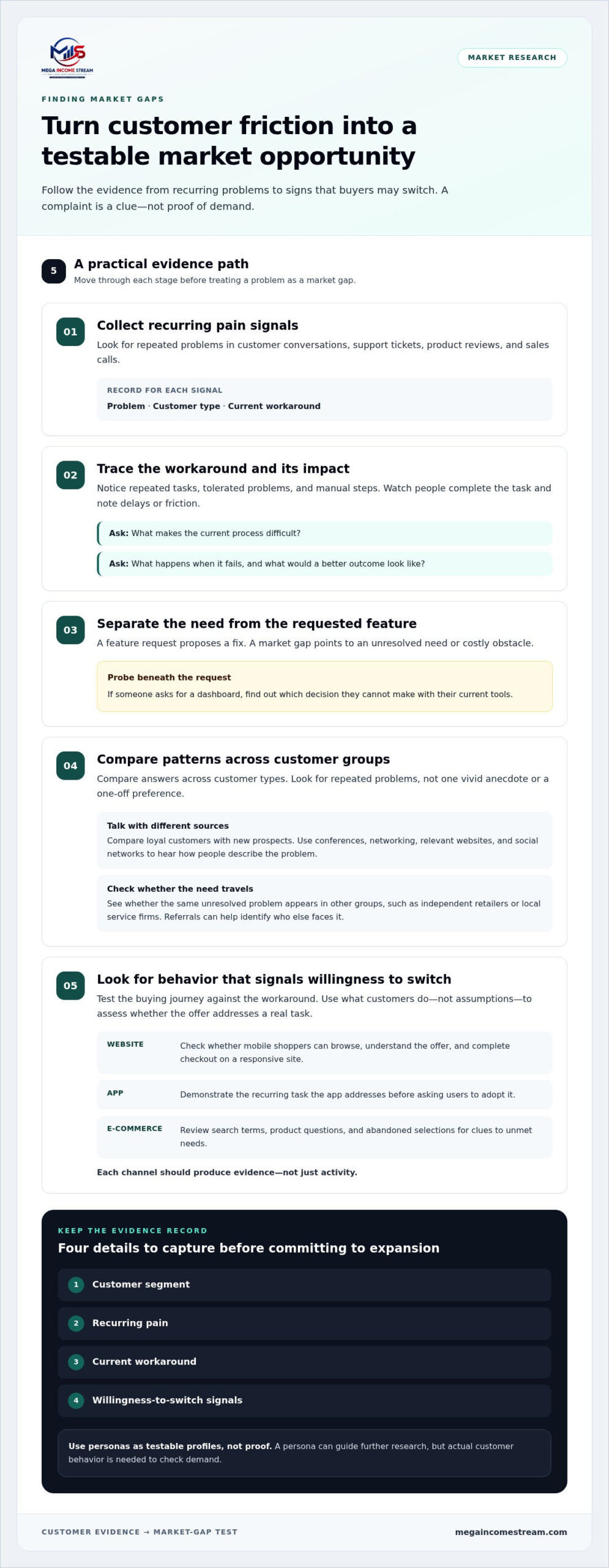
Seventy-three percent of US business leaders say identifying and entering new markets is a challenge. Customer friction is a practical place to start. Track tasks people repeat, problems they tolerate, and workarounds they create. For example, a freelancer tracking leads across scattered spreadsheets may need a simpler workflow. A complaint alone is not an opportunity: look for a recurring problem and a reason customers would change.
Gather evidence from customer conversations, support tickets, product reviews, and sales calls. Record who experiences the problem, how often it occurs, and what they do now. A restaurant owner using paper logs to track inventory, for example, is relying on a workaround. Ask what makes the process difficult, what happens when it fails, and what a better outcome would be. Compare answers across customer types. Repeated patterns matter more than a single vivid anecdote.
Distinguish a market gap from a feature request. A request proposes a fix; a gap points to an unresolved need or costly obstacle. If customers ask for a dashboard, ask which decision they cannot make with their current tools. Then check whether the problem appears in other groups, such as independent retailers or local service firms. A need shared across segments may support a new offer; a one-off preference may not.
- Capture complaints: Tag support messages by problem, customer type, and current workaround.
- Interview buyers: Ask loyal customers to describe the last time the issue disrupted their work.
- Observe behavior: Watch users complete a task, then note repeated delays or manual steps.
- Look for referrals: Ask satisfied customers who else faces the same problem; consider a formal referral program.
Use conferences and networking to hear prospects describe problems in their own words. Ask loyal customers about related needs, then compare their feedback with comments from new prospects. Maintain a presence on relevant websites and social networks. Assess whether existing social platforms reach customer groups connected to the opportunity. Each channel should produce evidence, not just activity.
For website, app, or e-commerce sales, test the buying journey against the workaround you identified. A mobile shopper should be able to browse, understand the offer, and complete checkout on a responsive website. If an app addresses a recurring task, demonstrate that task before asking users to adopt it. On an e-commerce platform, review search terms, product questions, and abandoned selections for clues to unmet needs. Customer behavior is more reliable than assumptions.
Build an evidence record before committing to expansion: customer segment, recurring pain, current workaround, and willingness-to-switch signals. A persona can make the segment concrete, such as a 30-year-old stay-at-home mother managing household purchases on her phone. Treat the persona as a testable profile, not proof of demand. Use it to guide further research, then look for evidence from actual customer behavior.
2. Using customer usage and retention data to identify new segments
Start with customer records, not assumptions about who might buy. Group current customers by industry, location, company size, use case, purchase frequency, and renewal behavior. A software business, for example, might find that small accounting firms use one feature weekly, while larger firms use several features daily. That contrast may point to different needs and segment fit.
Compare usage and retention across groups. Note which customers return, expand their use, refer others, or disengage after onboarding. Then identify behaviors linked to stronger retention, such as repeat orders or regular use of a particular workflow. These patterns help define an ideal customer profile based on observed behavior, rather than broad labels such as “small business.”
Choose an expansion type that fits the evidence: geographic expansion tests demand in a new place, demographic expansion targets a different customer profile, and product expansion serves an additional need among current or adjacent buyers. If existing users cluster in one region, geography may be the natural test. If one profile retains better, target that group. If users request related capabilities, assess product expansion.
Customer relationship management records, website analytics, point-of-sale histories, support logs, surveys, and public procurement notices can reveal segments and buying patterns. Combine them with customer interviews and industry reports, comparing what people say with their actual usage. Track customer, regulatory, and technology trends that could change buying priorities, access, or delivery. For example, a shift to online scheduling may create demand for tools that connect appointments with reminders.
Map the current offer against four buyer types before selecting a segment:
- B2C: Check which consumer profiles use the product, repeat purchases, and respond to existing messages.
- B2B: Test whether companies face the same need, with different purchasing steps, workflows, or decision-makers.
- Government: Assess whether public agencies have a relevant use case and established purchasing processes.
- Education: Explore whether schools or training organizations can use the offer for learners, staff, or operations.
Set a research goal, such as finding a segment with repeat usage or a clear distribution route. Define the ideal customer through observable traits: role, organization type, problem, current solution, and buying trigger. Then compare that profile with customer and retention data. A business selling directly to consumers may find that its product also serves a company or education need, but the buyer and buying process will differ.
Turn the evidence into a focused segment strategy, not a broad expansion plan. A business expansion strategy can help connect customer patterns with a testable route to growth.
Profile existing customers to clarify target consumers and identify direct sales, retail outlets, and wholesale businesses as possible distribution channels. Consumer-focused businesses can also assess whether their offerings could serve businesses, government, or education sectors.
3. Adapting offerings and marketing for new segments
A segment may share your problem but need a different solution format. Individual users, for example, may want a simple self-serve tool, while a company may need team access and a clear implementation process. Map each segment’s pain points, priorities, and buying process before changing your offer. Keep the core outcome consistent, then adapt the features and support that help each group achieve it.
Separate essential changes from cosmetic ones. If freelancers use a workflow tool but a small agency is considering it, test whether shared projects or team permissions address a real barrier. Do not add features just because one prospect requests them. Link each change to a recurring task, buyer requirement, or obstacle to adoption.
Frame the value proposition around the new buyer’s desired result. A consumer may want to save time on meal planning; a grocery business may want to reduce manual order handling. Tailor landing pages, product demonstrations, and sales materials to each use case. Keep the product description accurate, but lead with the outcome most relevant to that segment.
- Adjust packaging: Present a solo workflow separately from a team workflow when buyers need different access or support.
- Adapt onboarding: Guide an individual through the first task, while showing a business buyer how the tool fits existing operations.
- Change proof: Use a relevant case example, such as a freelancer’s faster invoicing process or a retailer’s simplified order tracking.
- Match channels: Reach consumers through product content, while testing direct outreach or industry events for business buyers.
For an international segment, localize the customer experience, not just the wording. List prices in local currency when entering an international market. Review terminology, payment expectations, support content, and product examples with local buyers. A translated checkout that still displays an unfamiliar currency can create friction at the point of purchase.
Test changes with a clearly defined group before applying them across all channels. Show the revised offer to target buyers and record their questions, objections, purchases, and follow-up requests. If business buyers repeatedly ask how deployment works, clarify the implementation steps. If consumers leave because the offer feels too complex, simplify the first-use experience. Compare these responses with the original version to see which adaptation better fits the segment.
Keep a change log for each segment. Record the audience, offer variation, message, channel, and response. This helps distinguish a product mismatch from a weak campaign. For example, if a revised message attracts attention but prospects still reject the same onboarding process, the problem is likely in the experience, not the headline. Use the evidence to refine one element at a time.
4. Assessing demand, market size, growth, and competition
In the United States, estimate market size by defining a specific buyer, need, and reachable location. Compare that estimate with demand signals, growth patterns, and existing alternatives before deciding how to serve the segment. A practical answer to how to find new markets for a business is to test whether a defined group has a relevant need and a reason to buy.
Start with a bottom-up estimate. Define the potential buyers, the share your business can realistically reach, and how often your offer can be purchased. For a scheduling tool, count relevant businesses in a target area, then narrow the total to those with the workflow problem it addresses. Treat the result as a working estimate, not proof that buyers will purchase.
Use U.S. Census Bureau data to examine business and population patterns in prospective locations. Compare those figures with search interest in Google Trends, customer interviews, industry publications, competitor offers, and direct responses to a test campaign. Each source answers a different question: public data describes the market, while buyer behavior helps show whether the need translates into action.
Research demand in each potential location before deciding how to serve customers there. Look for evidence such as repeated inquiries, active purchases, waitlists, or buyers relying on an imperfect alternative. For example, a service business exploring a new city could compare local customer interviews with competitor coverage and search interest. High online interest alone does not establish a viable market; test whether target buyers will take a meaningful next step.
Assess competition by mapping direct alternatives, indirect substitutes, and the option of doing nothing. Compare each alternative’s audience, offer, sales channel, and customer reviews. A crowded category can still have an underserved segment, such as independent clinics looking for a simpler booking workflow. A competitor gap matters only if buyers value the difference and can access your offer.
Before testing, set validation criteria based on buyer behavior. Choose actions that count as evidence, such as qualified inquiries, completed trial sign-ups, or purchase commitments. Define the target segment and conditions for continuing or stopping. Clear criteria keep a few enthusiastic comments from outweighing weak commercial signals. To make how to find new markets for a business actionable, specify what evidence would justify entering a market.
Three or four data points pointing in the same direction may indicate an early market shift. Rising search interest, repeated buyer requests, new competitor offers, and stronger usage from one customer segment may align. Treat that combination as a reason to investigate, then test the offer against your preset criteria.
Use this sequence to compare opportunities:
- Size the reachable segment: Specify buyer type, location, need, and likely purchase pattern.
- Triangulate demand: Compare public data, search behavior, interviews, and customer actions.
- Map alternatives: Identify direct competitors, substitutes, and unmet needs in their offers.
- Set the decision rule: Define validation criteria before launching a test.
A market is more compelling when independent signals support the same buyer need and your test meets its preset criteria. Keep the estimate, evidence, and decision rule together so you can compare opportunities on the same basis.
5. Evaluating entry barriers and local unit economics
A market may show demand and still strain your business model. Map the practical barriers, then calculate whether each sale can cover acquisition, delivery, and ongoing operating costs. For a subscription service, compare expected revenue per account with onboarding time, support needs, and payment costs. For a physical product, include shipping, returns, storage, and local distribution.
In the United States, legal, licensing, and regulatory requirements depend on the industry, business activity, and jurisdiction. Before launch, identify relevant registrations, permits, licenses, tax obligations, and operating rules through the appropriate government authorities.
Build a local unit-economics model using the same assumptions for every potential market. Estimate revenue per customer, subtract the variable costs of serving that customer, then account for acquisition and ongoing operating costs. Strong sales potential may still underperform if delivery, support, or customer acquisition consumes the contribution.
Evaluate market-entry costs, pricing, and profitability by listing the expenses required to reach and serve buyers, then comparing them with realistic revenue per sale. Test local pricing against customer expectations, competitor offers, payment practices, and currency effects. Model conservative, expected, and stronger sales scenarios to see which assumptions have the greatest effect on break-even.
A business is ready to enter when it can serve the target segment consistently, manage the added workload, and fund the market test without disrupting core operations. Check whether fulfillment, customer support, cash flow, and decision ownership can accommodate new demand. For example, a service firm should confirm that its team can onboard new accounts while maintaining delivery to current clients.
Expansion risks include weak demand, unexpected operating costs, local competition, regulatory barriers, and execution gaps. Limit exposure with a focused market test, explicit stop-or-scale criteria, and regular reviews of sales, costs, and customer feedback.
Exporting adds location-specific complexity. Conduct thorough on-the-ground research in prospective countries and investigate local regulations, tariffs, and business risks before choosing a route to market. A local distributor may affect margins and customer access; direct sales may require more operational capacity. Include these differences in the economics model.
- Entry barriers: Record approvals, capabilities, channel access, and operating requirements that could delay launch.
- Unit contribution: Compare revenue per customer with the variable costs of acquisition and service.
- Readiness: Check delivery capacity, support, cash flow, and accountable ownership.
- Risk controls: Set test boundaries and review triggers before committing resources.
Use this assessment to shape a grounded market-entry business strategy before committing to expansion.
Maintain a presence on relevant websites and social networks, and evaluate and improve your existing social media platforms. Include this work in customer-acquisition planning.
Mega Income Stream: Business Strategies
Mega Income Stream helps entrepreneurs turn market research into practical growth decisions through Business Strategies and its Consulting Business. Consider this support when customer evidence points to an opportunity, but you need to connect segment choice, market-entry economics, and a workable revenue plan. Its Making Money Insights can also help you assess ways to build sustainable income streams around a validated need.
Bring a clear picture of your target customer, the problem they face, and the evidence of demand. That gives a strategy discussion a concrete starting point, from refining the offer to choosing a focused route into the market. Contact Mega Income Stream to discuss a business strategy for your market opportunity.
Turn Market Evidence Into Your Next Move
A market opportunity matters when it informs what you do next. Use your findings to choose a segment, define a focused test, and decide what evidence would justify further investment. This keeps expansion tied to buyer behavior rather than internal assumptions and gives your team a clear basis for comparing opportunities as customer needs and market conditions shift.
The process of learning how to find new markets for a business is not a one-time research exercise. Treat each launch as a feedback loop: test the offer, study the response, and adjust your plan based on what customers actually do. If you want help turning market evidence into a practical growth strategy, contact Mega Income Stream today. Choose a focused next step, keep measuring, and build from what the market shows you.
Frequently Asked Questions
Is there real demand?
Real demand shows up when target buyers take meaningful action, not just praise an idea. Look for paid orders, repeat usage, qualified inquiries, or time spent on a workaround. For example, property managers who repeatedly request a demo and share sample maintenance records show stronger intent than survey respondents who say a tool sounds useful. Compare actions across customer types and note whether buyers return after their first interaction.
What’s the market size, and is it growing?
Estimate market size by defining the buyer, use case, and reachable geography, then count only prospects that meet those criteria. To assess growth, compare consistent indicators over time, such as relevant business openings, category searches, or customer inquiries. Keep your definitions stable: changing the target buyer between comparisons can make growth appear stronger or weaker than it is. Treat broad industry totals as context, not as your forecast.
Who else is already in the space?
Consider more than companies selling a similar product. A spreadsheet, in-house process, consultant, or decision to postpone the task can compete for the same budget. For example, a scheduling app competes with shared calendars and reception staff, not just other apps. List the alternatives buyers use now, then note what each does well and where users resort to manual work. This map can reveal crowded offers as well as overlooked needs.











Comments