
 By

Popular advice tells you to pick the cheapest filing service, submit one form, and move on. That’s backwards. When you ask how do you incorporate a business, the filing is the easy part. The expensive mistakes happen in the months after approval, when owners discover that taxes, licenses, payroll, bank accounts, and annual reports don’t happen automatically. Don’t buy speed first. Build a system you can run.
Table of Contents
- Why Incorporation Is a System, Not a Single Form
- Choosing the Right Legal Structure First
- Filing the Formation Documents Step by Step
- Setting Up the Entity After Approval
- Comparing Jurisdictions and Total First-Year Cost
- Keeping Up With Changing Ownership Reporting Rules
- Recurring Compliance and Common Questions
Why Incorporation Is a System, Not a Single Form
Incorporating means creating a legal entity separate from its owners. In the United States, corporations are formed under state law, while federal tax law determines how the entity and owners are taxed, as the IRS guidance on business structures and corporate taxation explains. The entity can own assets, sign contracts, borrow money, be sued, and be held liable in its own name.
That separation generally helps protect owners from personal liability for corporate debts. It doesn’t forgive fraud, misconduct, or sloppy maintenance. If you mix funds, skip records, or ignore filings, you’ve weakened the very shield you paid to create.
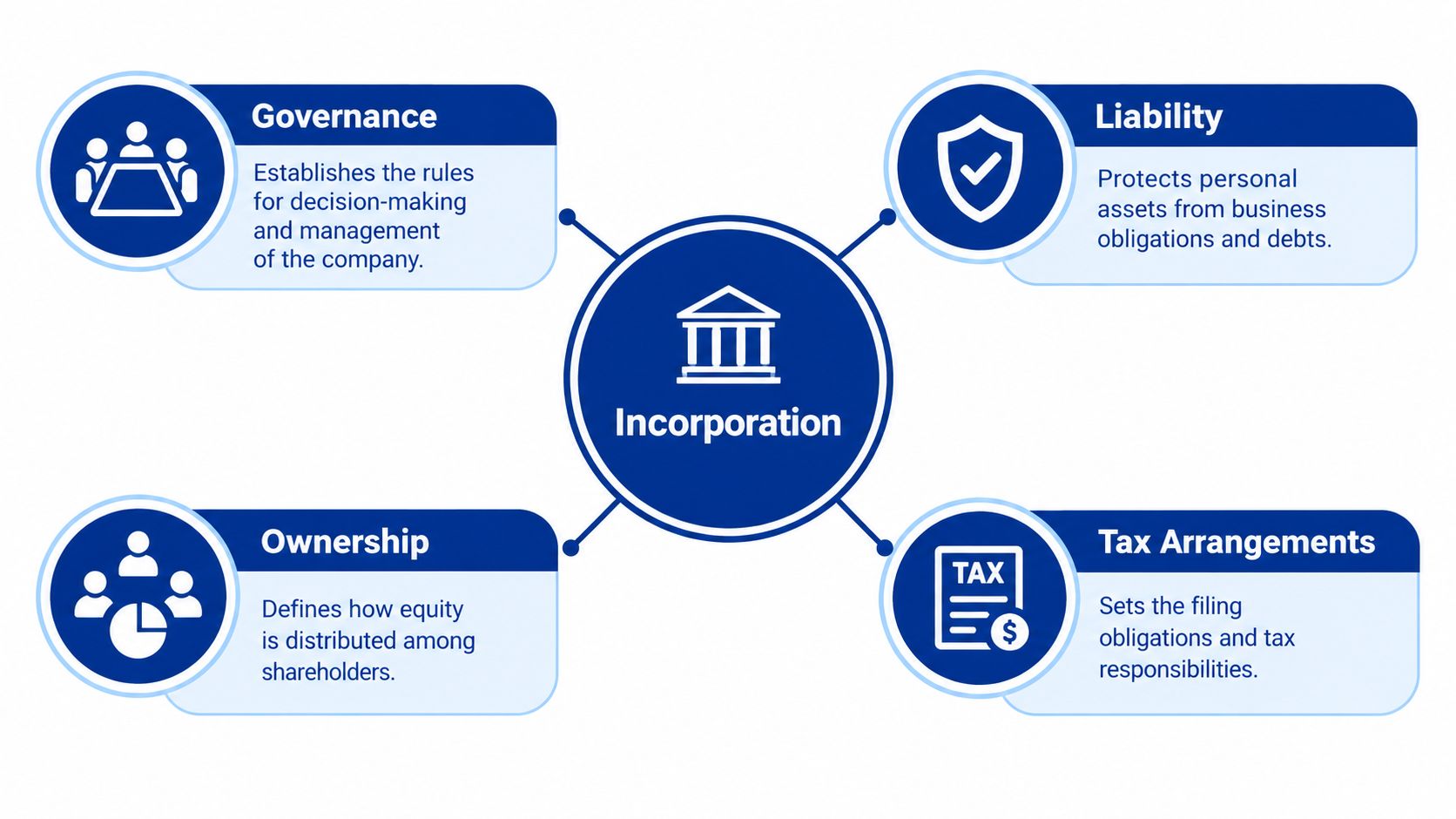
What You Are Actually Creating
You’re setting up four things at once. Governance decides who can approve spending, hire managers, and sell the company. Liability rules separate business obligations from personal assets. Ownership records show who owns what. Tax arrangements determine who pays, when, and on which return.
A C corporation generally pays tax at the corporate level, and dividends to shareholders may be taxed again individually. That’s not a surprise you want at year end. Decide that treatment before you file, not after revenue arrives.
Treat the formation certificate as day one of administration, not as the finish line.
Scale also matters. The Census Bureau Business Formation Statistics methodology documentation shows the series begins in July 2004 and tracks EIN applications. In March 2025, the United States recorded 452,255 seasonally adjusted total business applications, up 6.4% from February, including 69,559 applications from corporations in that same release. Those are applications, not proof every business launched.
That’s why state specific detail matters. Founders considering Delaware, for example, should review advice from Coto & Waddington alongside the cost of maintaining registration where they operate. A cheap filing in the wrong place creates a second registration later.
Compare total first-year cost and time, not the advertised fee. Include accounting, registered agent renewal, licenses, tax preparation, and your own administration hours. If you can’t maintain it, don’t form it yet.
Choosing the Right Legal Structure First
Don’t start with a form. Start with how you’ll earn, hire, and raise money. The SBA launch guidance on choosing a structure before registration puts structure selection before state filing for a reason. Change later is possible, but it costs time, legal work, and sometimes a new tax analysis.
For most solo freelancers and small online sellers, an LLC is my default recommendation. It’s flexible, requires less formal governance than a corporation, and lets owners choose how it’s taxed under applicable rules. You still need an operating agreement, separate finances, and state renewals. Simple doesn’t mean casual.
Choose a C corporation when outside investors, stock plans, or a clear venture path drive the business. Investors understand shares, boards, and bylaws. They don’t want to negotiate around an entity that wasn’t built for investment.
An S corporation isn’t a separate state formation type in the same way. It’s a tax election for an eligible corporation or LLC. It can make sense for profitable owner operated businesses, but eligibility limits, shareholder rules, payroll, and administrative discipline matter. Don’t elect it because a social post promised tax savings.
LLC vs C-Corp vs S-Corp at a Glance
| Criterion | LLC | C-Corporation | S-Corporation |
|---|---|---|---|
| Liability | Separate entity, owners generally protected if maintained properly | Separate entity, shareholders generally protected if maintained properly | Corporate protection, subject to eligibility and proper maintenance |
| Taxation | Flexible tax treatment depending on election and owners | Tax at corporate level, dividends may be taxed again to shareholders | Generally pass through treatment if election and eligibility are maintained |
| Governance | Operating agreement, fewer formal meetings typically required | Bylaws, directors, officers, resolutions, formal records | Corporate formalities plus election compliance |
| Fundraising | Harder for venture investors, membership interests are less standard | Best fit for outside equity investors and stock issuance | Ownership restrictions can limit investors |
| Best fit | Freelancers, agencies, online sellers, small partnerships | Startups seeking investment or broad share ownership | Profitable closely held businesses with eligible owners |
Use a Direct Decision Rule
- You’re solo and testing income: Start by pricing an LLC and its annual upkeep where you operate.
- You’re selling online across states: Ask about sales tax, foreign qualification, and permits before choosing.
- You’re raising venture capital: Form the corporation investors expect instead of planning a conversion.
- You’re profitable and paying yourself: Model S corporation payroll and compliance with your accountant first.
My rule is simple. Pick the simplest structure that supports your next two years of hiring, funding, and tax needs. Don’t pay for corporate complexity to look serious. Don’t choose an LLC to save a filing fee if investors are already in the room.
Filing the Formation Documents Step by Step
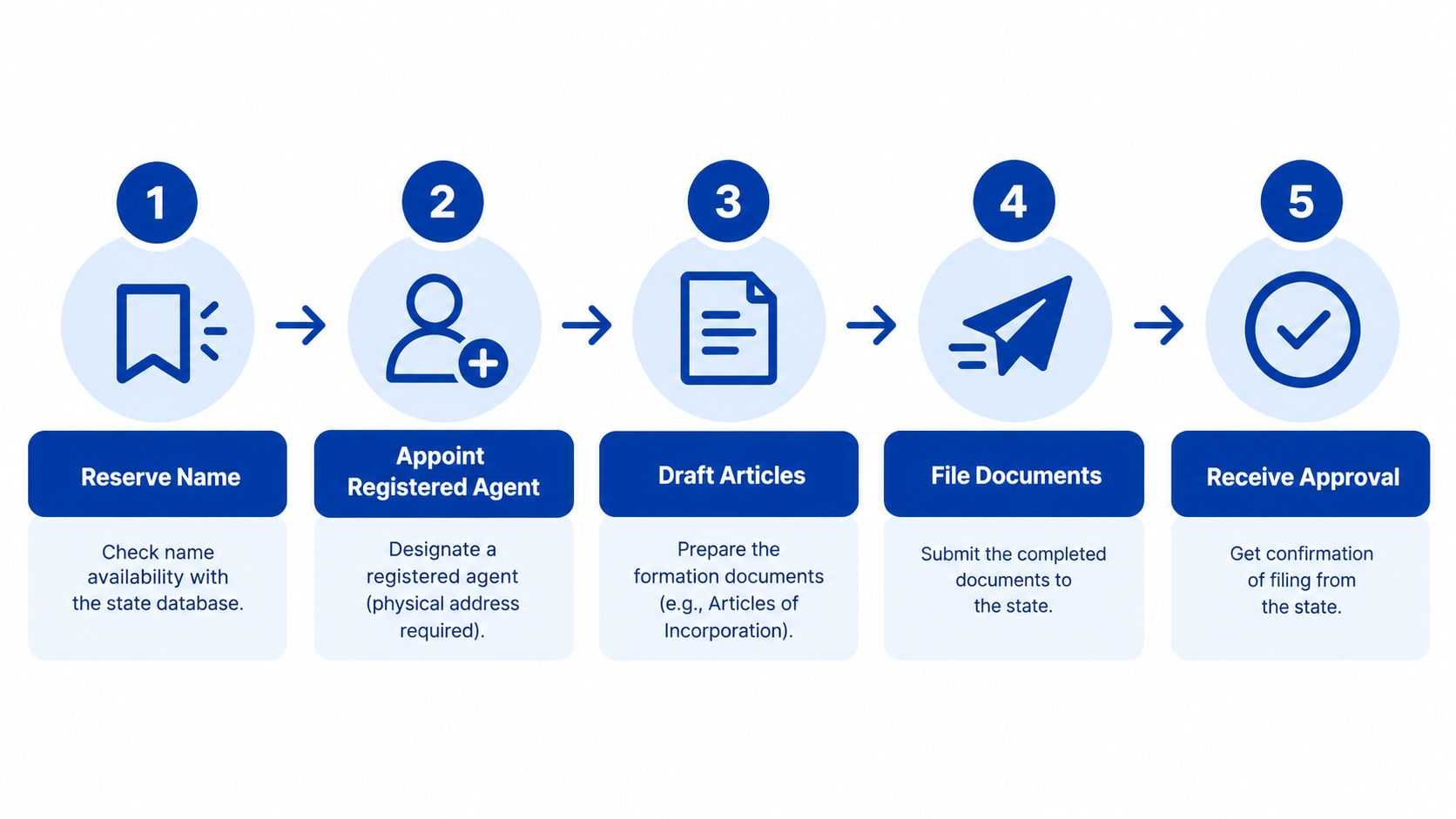
File in this order. Skipping ahead creates rejected documents and mismatched records.
Start by checking name availability in the formation state. Search the registry, check confusingly similar names, and confirm the required ending such as Inc., Corp., or LLC. Then search trademarks and domain names separately. State approval doesn’t grant trademark rights.
Next, appoint a registered agent where required. This person or service receives legal and state notices at a reliable address during business hours. Don’t list an address you rarely check. Missing a lawsuit notice or annual report warning can cost far more than an agent fee.
The visual sequence below condenses the filing order I give clients.
Prepare the Formation Document
For a corporation, prepare the articles of incorporation or certificate of incorporation. The SBA identifies this as a document required by every state when forming a corporation, and it commonly states the company name, purpose, number and value of shares, directors, and officers. For an LLC, states typically use articles of organization or a certificate of formation.
Before drafting yours, read Miles Hansford Law Firm’s incorporation guide for a practical walkthrough of what the filing covers. Then verify every field against your own state’s current form because names, share details, and incorporator requirements vary.
- Reserve or confirm the name: Save the registry search result.
- Confirm the agent: Get consent and the exact address before filing.
- Identify people and ownership: List directors, officers, managers, or members as required.
- File with the competent registry: Submit and pay through the state or national registry.
- Save stamped approval: Store it with your permanent entity records.
Online founders often file wherever marketing sounds attractive. That’s a mistake. If you live, hire, store inventory, or run operations elsewhere, you may also need foreign qualification there. Form where the legal and tax footprint makes sense.
The short video below is useful as a visual checklist before you submit.
Don’t announce that you’re incorporated until approval arrives. A pending filing isn’t an active entity, and signing contracts in the wrong name can put the obligation back on you personally.
Setting Up the Entity After Approval
Approval is a starting gun. The entity exists on the registry; your job now is to make money, ownership, and tax data run through it every month without leaks.
A workable first-week order looks like this:
| Order | Action | Why it matters |
|---|---|---|
| 1 | Hold the organizational meeting or sign written consents; adopt bylaws or an operating agreement; appoint officers or managers. | It creates evidence that decisions came from the entity. |
| 2 | Approve banking authority and contract signers. | It stops one inbox or card from becoming the real company. |
| 3 | Issue shares or membership interests and open the cap record with amount paid, date, and percentage. | Verbal ownership collapses during diligence and disputes. |
| 4 | Apply for the EIN directly with the IRS and record the responsible party. | The IRS says an EIN is generally needed even without employees and is free to obtain directly. |

Keep the responsible party current. The IRS requires EIN holders to report changes within 60 days, a step founders miss after a co founder exits or control shifts.
Hard rule: An EIN identifies the taxpayer. It does not create the legal entity.
Match controls to the business model. A solo freelancer needs a dedicated account, a monthly owner draw, and a clean receipt habit. An online seller needs sales tax or VAT registrations where activity creates obligations, marketplace payout reconciliation, and refund tracking. A cross-border operator needs foreign qualification where operations sit, currency records that agree with invoices, and a calendar for local filings.
Open the bank account before spending. Route capital in, pay vendors out, and stop personal card use for routine costs. Once statements reconcile cleanly, use the steps for opening business credit after formation to build borrowing capacity without contaminating the file.
Set deadlines the same week: annual report, estimated taxes, licenses, agent renewal, payroll deposits, and sector permits. Formation does not authorize regulated activity. When the records can survive an auditor, a bank, and a bored marketplace risk review, sign in the entity name and keep the name identical everywhere.
Comparing Jurisdictions and Total First-Year Cost
Founders shop for the cheapest filing fee. That fee is the smallest check they will write.
The cost of a jurisdiction shows up later: quarterly tax filings, annual reports, agent renewals, bookkeeping, and the hours spent maintaining registrations you never needed. A registry that looks cheap on day one can drain time and money every quarter after.
So compare like an operator, not a tourist. Before you pick a state or country, price procedures, calendar time, paid-in minimum capital, local representation, tax filings, and annual account obligations. The World Bank Doing Business data archive measured exactly those variables for a standardized firm, and it remains a useful benchmarking framework even though the project was discontinued in 2021. Verify current rules against the live registry and tax authority before you commit. Stale country tables make bad launch plans.
Digitization proves process beats sticker price. World Bank examples report Turkey cutting startup time from 38 to 9 days and Italy from 23 to 13 days after online and integrated registration reforms. Those are system-level outcomes, not promises for your filing, but they show how much of a jurisdiction’s cost is administrative drag rather than fees.
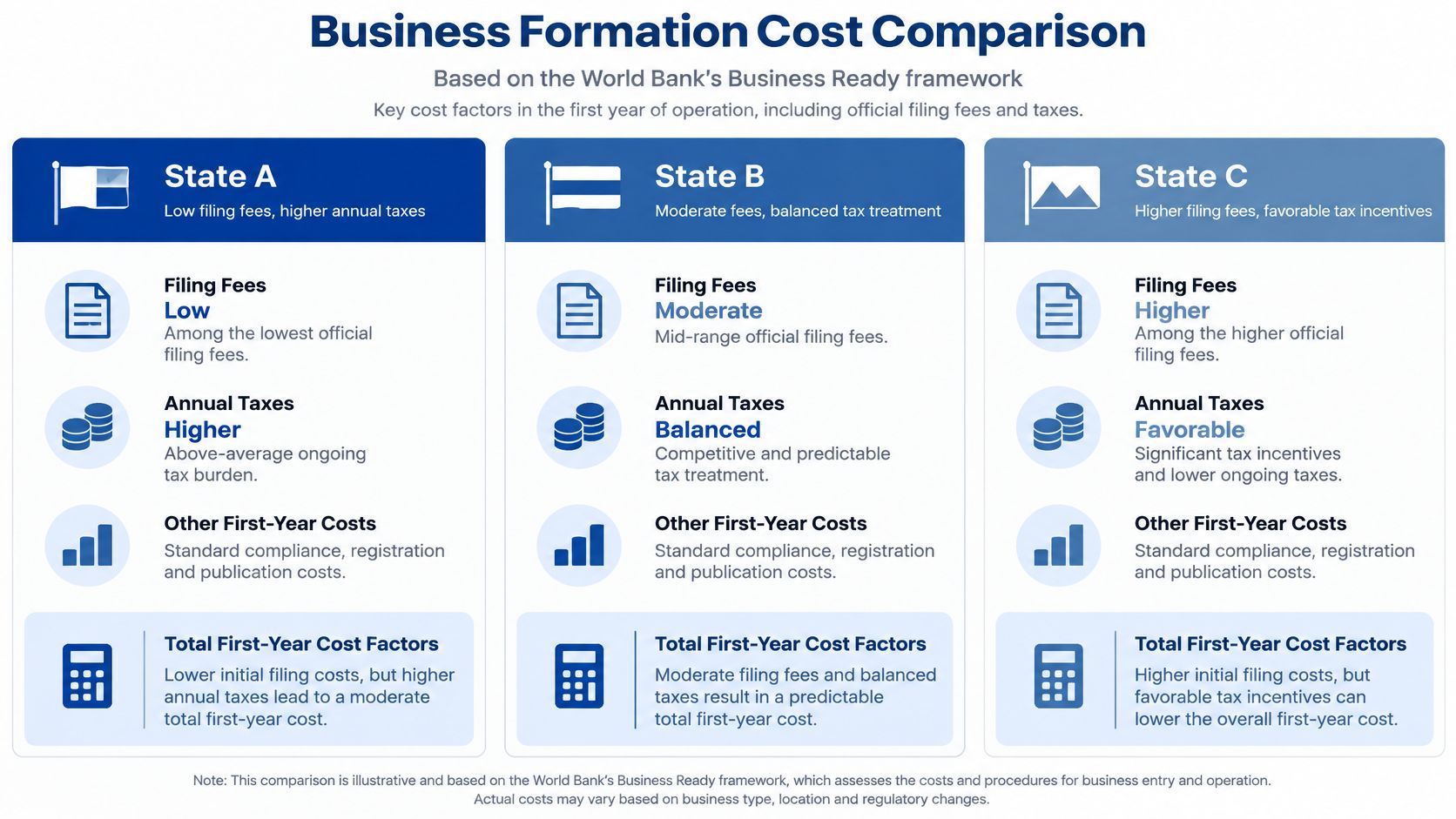
Where the First-Year Money Actually Goes
| Cost layer | What it covers | Where founders get surprised |
|---|---|---|
| Formation | Registry fees, notarization, translation, legal drafting, name checks | Translation and notarization can outrun the filing itself |
| Launch | Bank setup, licenses, accounting software, insurance, local representation | Banks and licensing bodies demand paperwork the registry never asked for |
| Recurring | Annual returns, registered agent, bookkeeping, payroll, tax filings, accounts | Renewal bills arrive whether the entity earned anything or not |
| Expansion | Foreign qualification, extra state registrations, new market permits | Selling into a second state can double the compliance calendar |
Entity approval is not trading permission. A food seller still needs operating permits, so check which permits apply to farmers market selling before assuming the corporation alone lets you trade. The same gap hits health services, finance, construction, childcare, and transport.
Cross-border operators face a second test: foreign owner eligibility, banking access, tax residency, and whether customers or staff create a taxable presence somewhere else. Remote formation does not erase local obligations.
My recommendation is boring on purpose. Form where you operate unless a lawyer or accountant gives you a documented reason not to. Paying for two registrations to dodge a small filing fee buys clutter and doubles your compliance calendar.
Keeping Up With Changing Ownership Reporting Rules
A client laminated a compliance checklist in January and hung it next to her desk. By spring, one line on it was already wrong.
Under FinCEN’s March 26, 2025 interim final rule, entities created in the United States and their U.S. beneficial owners were exempted from Corporate Transparency Act beneficial ownership reporting, while reporting generally remained for certain foreign entities registered to operate in the country, according to the FinCEN release on removing reporting for U.S. companies and persons. Earlier guidance had described much broader obligations for many small businesses. Anyone still quoting that guidance is giving last year’s answer.
Who feels the shift depends on how you operate. A solo freelancer with a domestic entity and no partners may have just lost a filing she spent an afternoon preparing for. An online seller with foreign owners gets a different answer entirely. Cross-border operators carry the heaviest load, because one rule can free a domestic entity while a foreign registration still has duties attached.
My fix is a one-page matrix, dated by hand. Write down where the entity is formed, every place it operates, who owns and controls it, and which agencies govern it. Put the date you last checked beside each line. Recheck it when ownership changes, you enter a new market, you hire in another jurisdiction, or a regulator announces a rule change. Save the agency page you relied on, because screenshots from blogs age badly.
The World Bank Business Ready frequently asked questions reflect the same direction. Business Ready measures registration across pre-incorporation, incorporation, and post-incorporation procedures. Your records should cover all three. One filing date doesn’t describe the compliance burden.
Relief from one disclosure rule doesn’t cancel tax records, licenses, payroll duties, or bank due diligence.
Banks may still ask who owns and controls the company. Tax authorities still expect accurate responsible party and ownership records. Keep passports, addresses, share ledgers, operating agreements, and control changes current even when a specific report is no longer due.
Confirm the current rule with the registry, tax authority, or your attorney before filing anything ownership related. Filing under last year’s law costs more than checking.
Recurring Compliance and Common Questions
Good standing is maintenance. Put the calendar in place before revenue distracts you.
Your Recurring Calendar
- Monthly: Reconcile bank and card accounts, file sales tax where required, run payroll, save receipts, and review cash reserves.
- Quarterly: Pay estimated taxes where applicable, review payroll filings, update ownership records, and check license conditions.
- Annually: File annual reports, renew the registered agent, hold required meetings, renew permits, and prepare entity tax filings.
- Immediately after changes: Update officers, addresses, ownership, responsible party details, banking signatories, and state records.
Use the company tax return process on Mega Income Stream to plan year end records before filing season forces rushed cleanup. Quarterly bookkeeping is cheaper than reconstructing a year from bank statements.
Three Questions Every Founder Asks
How long does it take?
It depends on the jurisdiction, document accuracy, name conflicts, notarization, banking checks, and permits. Entity approval can arrive before you’re legally ready to sell. Measure the timeline to ready to operate, not just approved.
What does it really cost?
Add formation, agent, banking, licenses, accounting, insurance, tax preparation, payroll setup, and renewals. If another state or country is involved, add that registration too. The filing fee is only the entry ticket.
What’s the difference between forming and operating?
Formation creates the entity. Operating legally requires tax registrations, permits, contracts in the entity name, separate finances, employment compliance, and consumer rules for your market. Miss those, and you’re exposed despite the certificate.
Pin this rule above your desk: formation creates the shield, maintenance keeps it credible. Review the calendar monthly, delegate bookkeeping before you’re behind, and ask for advice before ownership or location changes. That’s how incorporation keeps working after the paperwork is approved.
If you’re turning freelance work, online sales, or a service idea into a properly run company, use the business formation, tax, credit, and operating guides at Mega Income Stream to map your next filing and compliance deadline before you spend. Start with the resources at Mega Income Stream, build your jurisdiction checklist today, and get a qualified local review before you submit your formation documents.
Crafted with Outrank app











Comments