
 By
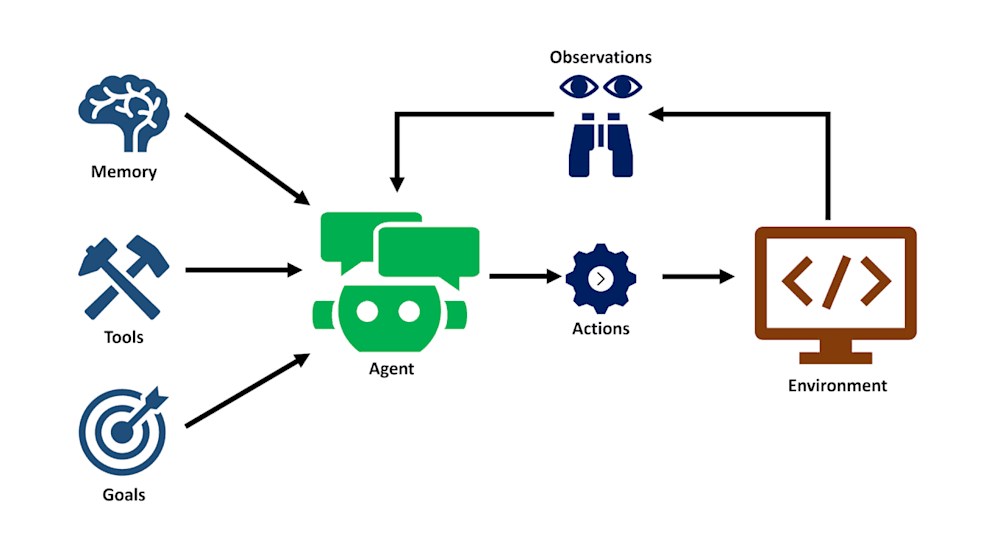
Agentic systems, which autonomously plan and realize high-level goals, rely on core ideas that set them apart from passive or generative AI. They do more than just create content; they take action to accomplish results.
The core principles behind effective agentic systems are:
1. Goal-Oriented Autonomy and Reasoning
- Goal-Driven Behavior: Agents are driven by specific objectives, not just prompt-and-response interaction.
- Reasoning and Planning: Agents use models (like LLMs) to break down complex goals into actionable, multi-step plans.
- Continuous Improvement: They possess self-reflection capabilities, allowing them to evaluate their own performance and refine their strategies over time.
2. Cognitive Architecture and Memory
- Long-Term and Short-Term Memory: Effective agents maintain state across interactions, enabling them to remember past actions and user context over long-horizon tasks.
- Closed-Loop Operation: They operate in a “Perception → Reasoning → Action → Observation” loop.
- Grounding in Reality: They use RAG (Retrieval-Augmented Generation) to access up-to-date, domain-specific data, reducing hallucinations.
3. Tool Use and Action Execution
- Empowerment Stack: Agents interact with external tools, APIs, and databases to turn decisions into actions (e.g., sending emails, updating CRM).
- Agent-Computer Interface (ACI): Effective systems have well-documented interfaces for tools, making them easy for models to use correctly.
4. Modular and Distributed Design
- Modularity: Instead of monolithic systems, effective AI is built using small, interchangeable, and purpose-built components.
- Multi-Agent Orchestration: Complex tasks are broken down and delegated to specialized agents (e.g., a “Manager” agent coordinating “Worker” agents).
- Interoperability: Standardized protocols (like Agent-to-Agent or MCP) allow agents to interact with each other and existing software systems.
5. Reliability and Human Oversight
- Safety and Guardrails: Systems are designed with risk-based guardrails, including clear permissions, approval flows, and human-in-the-loop (HITL) for high-stakes actions.
- Transparency and Observability: Agents must expose their reasoning steps, allowing users to understand how a decision was reached.
- Error Handling: Robust systems expect failure and include mechanisms for fallback, retries, and circuit breakers to handle unexpected outcomes.
6. People-First Design and Context
- Workflow Integration: Agents are designed for specific, existing business workflows, rather than being “demos” with no practical application.
- Human-AI Collaboration: The interface must support collaboration, not just automation, allowing users to edit outputs and provide feedback.
The majority of corporate “agents” fail because to a lack of integration rather than a lack of intelligence. Demos are impressive; yet, manufacturing has stalled. Answers lack context, workflows fail, owners are unclear, and feedback loops are absent. Based on dozens of Talan installations, we’ll outline eight factors that distinguish long-lasting solutions from tech demos.
The majority of corporate “agents” fail because to a lack of integration rather than a lack of intelligence. Demos are impressive; yet, manufacturing has stalled. Answers lack context, workflows fail, owners are unclear, and feedback loops are absent. Based on dozens of Talan installations, we’ll outline eight factors that distinguish long-lasting solutions from tech demos.
Most enterprise AI initiatives have stopped. Almost everyone is investing in AI, but only about 1% of CEOs believe it is fully integrated into day-to-day work with significant consequences [1], and more than 90% of generative-AI pilots never reach production [2]. Even after a product is put into production, adoption is often low. Answers lack depth, context is lacking, or the technology disturbs established workflows by adding steps, disrupting handoffs, or requiring staff to use unfamiliar technologies.
Here are the eight guiding principles that distinguish systems with genuine impact from tech demos.
Focus on everything but the model
Training or fine-tuning your own models is rarely a worthwhile investment for most enterprises today. Models are improved on a quarterly cadence and get cheaper even faster. Everyone can rent the same model intelligence. More importantly, trying to out-develop a frontier lab like OpenAI is a losing game.
Your competitive edge lies elsewhere in the corporate agentic AI stack: the data you can rely on, the workflow you redesign, and how your system converts “call a model” into “get the right outcome.” Consider the model to be a raw nerve: it is powerful, general, and easily replaced. The value lies in how you integrate it into your business.
According to Benedict Evans, a venture partner at Mosaic Ventures, generative models thrive in situations where “there aren’t necessarily wrong answers” [3], such as producing marketing content or testable code. Most enterprise tasks require deterministic and explainable results, which are frequently binary answers that are either correct or incorrect. Consider policy exceptions, regulatory provisions, and SKU prices. In those cases, a more powerful model isn’t what will drive impact.
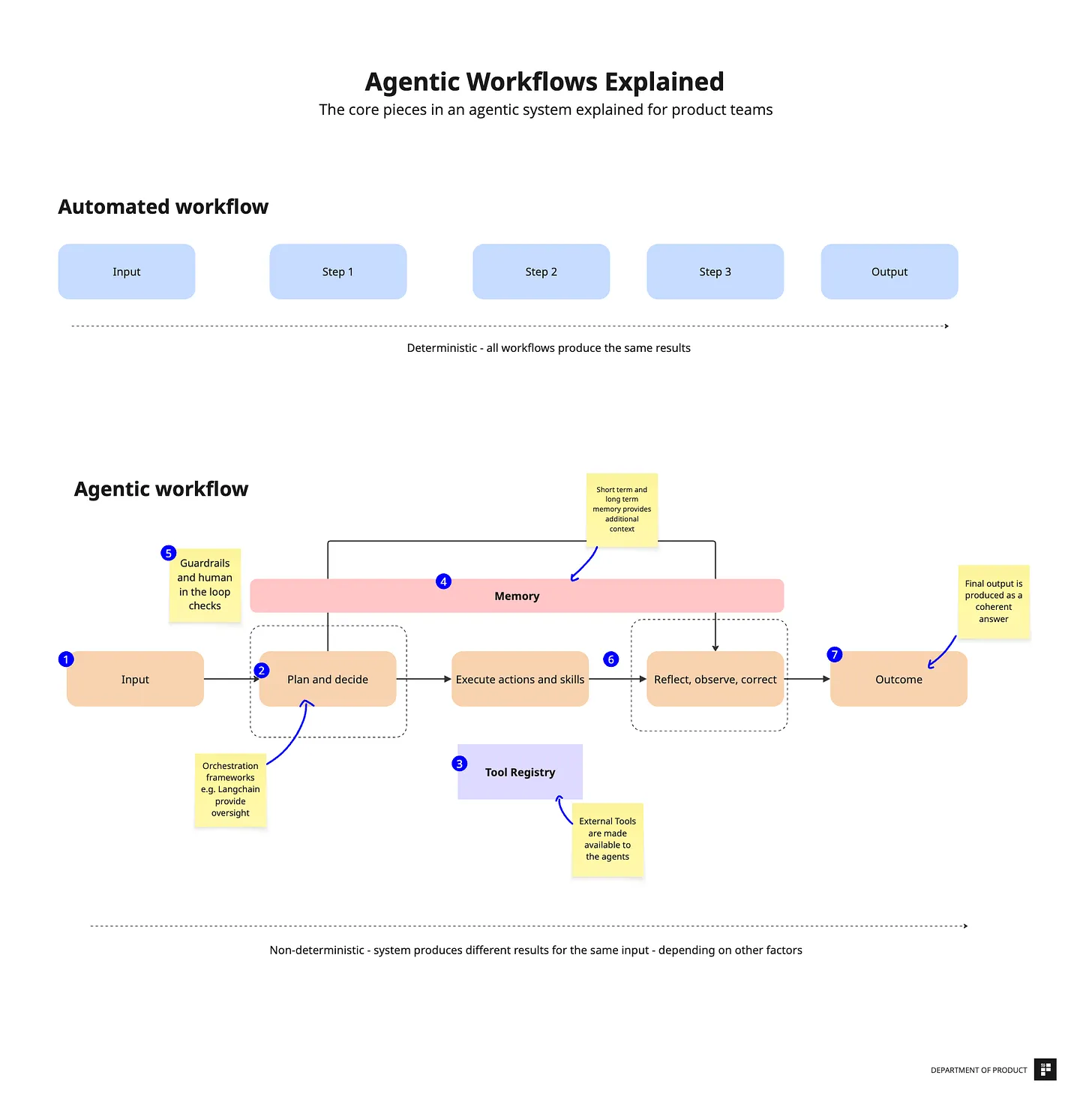
Read Also: How Agentic Workflows Differ from Traditional Automation
The bitter lesson for enterprise AI is that to scale, you should focus on your ability to leverage the leaps in model intelligence that happen elsewhere. Your differentiator is your ability to benefit from those leaps more than competitors. That means focusing primarily on three layers of the agentic AI stack for most companies today:
- Data layer: From conventional data platform operations that agents leverage, to newer needs: standardising knowledge bases, productising unstructured data, building/extending retrieval systems, and managing prompts & benchmarks
- Agentic AI: The “agentic” apps you deploy to create business impact & that end-users interact with
- Application layer: Apps & services inside your org, (e.g. Salesforce), that agents must integrate with to deliver value and fit in your workflows
These levels do not form a formal hierarchy, but rather represent an evolving picture of enterprise AI maturity. Agentic capabilities work across application and data layers by reasoning about data, calling tools, and acting within workflows. The firmer your foundation, the more effective your agentic systems will be.
Leverage your unique contextual data
Large language models are trained using the common knowledge of our world, which includes the public internet. That does not mean they will be aware of your policies, rates, or procedure exceptions. More than ever, garbage in equals rubbish out. More broadly, you require contextual intelligence that can locate the right data at the right time: injecting private data, rules, and benchmarks so that the system generates the correct response for your organization, not simply a plausible one.
That entails investing in pipelines for cleaning, tagging, and refreshing documents, records, and tacit knowledge. Furthermore, it entails combining the right data at the right time, with the proper instructions, and keeping “golden sets” of prompts (together with the full trace of how an answer was formed) paired with accurate replies to create business-aligned, task-level benchmarks.
Every hour invested on data quality, metadata, and retrievability will yield significantly more results than an extra hour spent training or fine-tuning a marginally more accurate model. In other words, the utility of a model in most use scenarios is only as good as the data it can access: Value = model intelligence × relevant data.
So what does contextual intelligence look like in practice? Mostly, it’s an extension of what you already know, supported by pre-existing data maturity & operations:
- Governed freshness & lineage: SLAs, access controls, and auditability baked in; no agent should be in charge of deciding who gets access to data
- On-boarding & applying your best practices to new data sources (e.g. procedures, call notes, tickets, manuals, code, logs); extend the principles of data products to unstructured data and centralise parsing, enrichment, data quality checks and other default pre-processing operations
- Extending data product thinking to information retrieval; productising unstructured products only goes so far. Clean, structured text is the beginning, but there’s still a need for actually bringing those documents to a person or agent at the right time. Task or question-level optimised retrieval is key, something we’ve started to frame and build as retrieval products; productising the outcome of retrieval systems to have the same type of guarantees & scalability potential as data products.
Agentic AI systems are impressive technical demonstrations in the absence of context. With contextual intelligence, people can make a significant difference, save time on everyday tasks, and allow transformative change throughout the company.
Architect for change
Agentic AI systems work in a rapidly changing environment. The question isn’t if your technology stack will evolve; it’s how thoughtfully you’ve planned your systems, as well as the surrounding teams and processes, to accommodate that change.
Two and a half years ago, just after the release of ChatGPT, teams delivered value by constructing heavy scaffolding around LLMs, including brittle prompt chains, bespoke retrieval logic, home-grown orchestration, and layers of post-processing to fill capability gaps. It worked—but after several years, most of that investment has shifted from facilitator to technical debt.
Since then, the centre of gravity has shifted upward. AI continues to “eat” software, consuming traditional business logic through new features: Models can now handle structured output and function calls more reliably; context windows have enlarged; and retrieval stacks have developed. What used to require custom code is now more commonly provided as a managed feature. As a result, code that was once critical has become an overhead to maintain.
There’s a trade-off to consider. In high-stakes domains, specific guardrails and standard operating procedures are still required to ensure reliability and determinism. However, overinvesting in hand-crafted “agentic workflows” for each business function binds you to today’s patterns and tomorrow’s maintenance burden.
To keep compounding, architect for forward-compatibility:
- Decouple business logic from model specifics. Express rules and policies in configuration and data rather than code that bakes in a model’s quirks
- Consider model-native capabilities once they clear your bar. Adopt function calling, JSON modes, and tool use when latency/accuracy meet benchmarks and unit economics make sense; don’t re-implement what the platform now does well
- Upgrade by evals, not vibes. Maintain golden sets and task-level benchmarks; when a new model or retriever clears them, adopt and move on.
Do this well, and new releases will become drop-in upgrades. When models, retrieval, or tool runtimes improve, your system benefits right away because the pipelines, policies, and UX are already designed to accommodate change. Accuracy, trust, and adoption improve in quarters rather than deteriorate with each ecosystem adjustment. An AI endeavor is never “done”; it must constantly adapt to new circumstances.
Continuous improvement
The majority of AI systems are provided with the assumption that launch is the end point. In reality, launch marks the beginning of a feedback loop. Without that loop, the same mistakes are repeated, adoption slows, and the system slips into obscurity. It increases accuracy, fosters trust, and promotes usage.
Agentic systems are used in actual workflows, not static sandboxes. That means that real-world usage quickly deviates from initial expectations: users modify drafts, skip suggestions, override outputs, escalate edge cases, tools fail, and regulations change. However, many agentic AI systems are still designed with a “deploy and forget” approach, as if the model and agentic workflow were the product. However, in practice, the model improves on its own; your system will not, unless you create the loop that causes it to happen.
That loop converts usage into evaluation, which in turn leads to decisions. What individuals accept, reject, or escalate becomes input for a set of task-level benchmarks—canonical situations with expected outcomes that reflect the system’s intended performance. These are employed as release gates, which determine if a change enhances or degrades production quality. Crucially, these benchmarks should not be owned solely by AI teams; data, domain specialists, and operations teams should all be involved.
When done well, this becomes a standard product capability: a weekly or bi-weekly cycle of analysis, patching, re-evaluation, and release. Importantly, fixes are not limited to the model; they also appear in retrieval, prompts, tools, data, and user experience. The same evaluation gates keep everything in line. And, as with mature engineering, the gates protect both correctness and regression.
This is systems engineering, not simply MLOps. It necessitates greater cross-functional collaboration, unambiguous ownership, and design for long-term maintainability. Without it, your system will plateau. It contains performance ingredients. So, don’t simply train the model; train the system. The winners view improvement as a built-in product feature, not a quarterly fire drill. That is what transforms an excellent demo into a dependable product.
Invest in people and process
We’ve seen the pattern: technical teams create attractive demos, but nothing scales because data is stored elsewhere, workflows don’t change, and no one owns the system after it’s deployed. Agentic AI cuts across silos. It requires data engineers to organize knowledge, application owners to wire procedures, and subject matter experts to define what “good” looks like. If any of these components are absent, adoption fails.
The remedy is cultural, not technological. Organize around outcomes. Create cross-functional teams that are responsible for all aspects of AI systems, including data, workflow, engineering, and product. The team that ships improves. Ownership must include both the build and the loop.
Sometimes it means reorganising how we deliver value across an entire process or function. The fix is not complicated but it is cultural. Create cross-functional squads for each AI initiative: one person who knows the data, one who owns the workflow, one who can ship software, one who speaks for the end users. Give them clear ownership of both launch and continuous improvement. Don’t bury AI inside IT or platform teams. Organise around real workflows and business outcomes.
The figure provides a canonical anatomy of a functioning agentic AI operating model: four core capabilities—data, retrieval, engagement, and improvement—each with a clear role , set of owners and contract between teams. When these teams stay siloed, systems fail to ship or stagnate after launch. When integrated through end-to-end squads, the system improves week by week.
Leadership has an important role here as well. Pilots plateau when CEOs view AI as an experiment rather than a capability. At the same time, we’ve seen AI experiments derailed due to incentives more than feasibility. When C-level targets call for the introduction of “20 use cases” by the end of the year, teams may prioritize checkboxes over impact. The organizations that move the fastest are those where leadership establishes priorities, prioritises KPIs that are linked to real operating indicators, removes impediments, and devotes resources to scaling what works.
The result is simple: systems with clear ownership, embedded in real workflows, and continuously improved by the people who actually use them. Without this, you don’t get enterprise AI. You get prototypes in a slide deck.
Empower users and institutionalise human-AI partnership
Even the best AI system will fail if no one utilizes it. Most initiatives fail at the adoption stage, not because the model is inadequate, but because of the interface. A blank chat box forces each user to reinvent the wheel. A strong user interface accomplishes the opposite: it crystallizes what the organization has already learned about what works, eliminating the need to start from scratch.
Think of Excel. Personal computing only went mainstream once interfaces like menus, templates, and formulas encoded best practice so that anyone could use it. Enterprise AI needs the same. Instead of “just prompt it,” provide structured flows that guide the task: a proposal generator with fields for client name, goals, and product, followed by “Generate Draft.” That interface doesn’t just reduce friction; it encodes institutional knowledge directly into the workflow.
Beyond interface, adoption depends on trust and fit. Users should see sources inline, be able to edit outputs, and know that edits feed back into the system. Over time, the assistant learns: it remembers the projects someone is working on, tailors drafts to their context, and improves with use. The more it feels like “my tool,” the faster adoption spreads.
Training and change management still matter. People need to know what the AI can do, what it can’t, and how to work with it. Sharing success stories and creating communities of practice accelerate the curve. And sometimes the right move isn’t inserting AI into today’s workflow but redesigning the workflow itself—offloading rote checks to the machine, reserving judgment and exceptions for humans, and giving both better dashboards in the process.
The eventual state will not be “AI replaces humans” nor should it be “humans wrestle with AI.” It’s a partnership. People maintain control; AI improves their speed, consistency, and concentration on what is important. Systems that achieve this become invisible—just part of how work is completed.
AI that behaves like a partner—predictable, auditable, and improving with use—gains trust. Adoption occurs when individuals cease viewing it as a distinct tool and instead consider it an integral part of how work is completed.
Build trust, transparency, and governance
Adoption follows trust. Users will not trust a system they cannot verify, leaders will not fund one they cannot manage, and customers will not accept one that appears to be a black box. Trust isn’t something you add after; it has to be built in from the beginning.
This requires transparency in the interface—showing sources, providing rationale, and making escalation evident. It entails linking autonomy to risk, securing data from start to finish, and arranging regular assessments for correctness, safety, and bias. It also involves auditability—logging prompts, sources, versions, and approvals so you can justify not only what the system said, but why.
Discipline is also necessary for building trust. AI initiatives should be treated as any other major initiative: establish KPIs, rigorously measure results, and report on impact. Saving time, reducing errors, and increasing customer satisfaction—when results are evident, confidence develops. With openness and oversight in place, AI transitions from “shiny demo” to “trusted partner.”
Experiment widely, scale deliberately
The future of AI is too variable to plan for certainty. You must learn by doing. That entails conducting several tiny, low-cost experiments—the majority of which fail. The goal is not to erect monuments; rather, it is to quickly identify areas where AI can make a significant impact.
The winners then get the privilege to scale. Before graduation, pass the following hard checks: data integration, access controls, evaluation coverage, UI fit, ownership, and observability. Gradually roll out—from shadow use to teams, then business units. Maintain a living registry of use cases, metrics, and failure modes to make each new deployment more cost-effective and smart.
Moreover, generative & agentic AI have made prototyping much more effective. No longer do we need experimentation cycles that last several quarters, or product requirement documentation that needs to be validated by each stakeholder before work can begin.
The time to market for a prototype that allows you to see if an idea holds merit has become infinitesimally smaller than before ChatGPT was a thing. Yet most companies are still experimenting as if it’s 2020.
Leverage generative & agentic AI to be creative; organise hackathons; inspire, and let everyone contribute to what success could look like. Illustrated below: One use-case discovery session can inspire many proof of concepts, or vice versa. What used to cost weeks or months of development time can now happen in a few days of intense collaboration and AI-assisted prototyping. The challenge has shifted, even more, into moving from pilot to production. And the scarce resource now, is simply the attention of engineering teams and stakeholders, overwhelmed by vendors and social media about the seemingly boundless potential of this new technology.
The discipline is in balance: promote innovation at the edges while scaling with rigor. Organizations that do this do not end up with dozens of incomplete proofs of concept. They end up with a portfolio of genuine solutions that add value over time.
The cacophony surrounding AI will continue to shift: new models, benchmarks, and promises of AGI are just around the corner. However, the headlines do not reflect the long-term impact. It resides at the slow, often unglamorous edge: your data pipelines, workflows, people, measurement capability, and weekly improvement discipline. If you can identify the metric, the user, and the owner, and that metric moves into production and remains there, you have genuine value.





Comments