
 By
Agentic workflows use AI agents to autonomously reason, adapt, and make decisions to meet goals, unlike traditional automation which relies on inflexible “if-then” rules for repetitive operations. Agentic systems manage complicated, multi-step processes and learn from the results, whereas classical automation is limited to fixed inputs and outputs.
Key differences between agentic workflows and traditional automation (like RPA) include:
- Decision-Making vs. Rules: Agentic systems use LLMs to evaluate, adapt, and choose actions, while traditional automation strictly follows pre-set scripts.
- Flexibility and Adaptability: Agentic AI can react to unexpected changes in real-time, whereas traditional systems fail or require manual intervention when processes deviate from the script.
- Goal-Oriented vs. Task-Oriented: Agents work toward a high-level goal (e.g., “resolve this customer complaint”) by determining the steps themselves. Traditional automation only executes specific, narrow tasks (e.g., “send a confirmation email”).
- Learning and Evolution: Agentic workflows improve over time by learning from feedback and past actions. Traditional automation remains static until manually updated.
- Integration and Autonomy: Agentic agents can connect disparate systems, tools, and data sources independently to solve complex problems.
While traditional automation is cost-effective for simple, predictable tasks, agentic workflows offer superior scalability and lower long-term maintenance costs for complex, dynamic operations.
What is Traditional Automation?
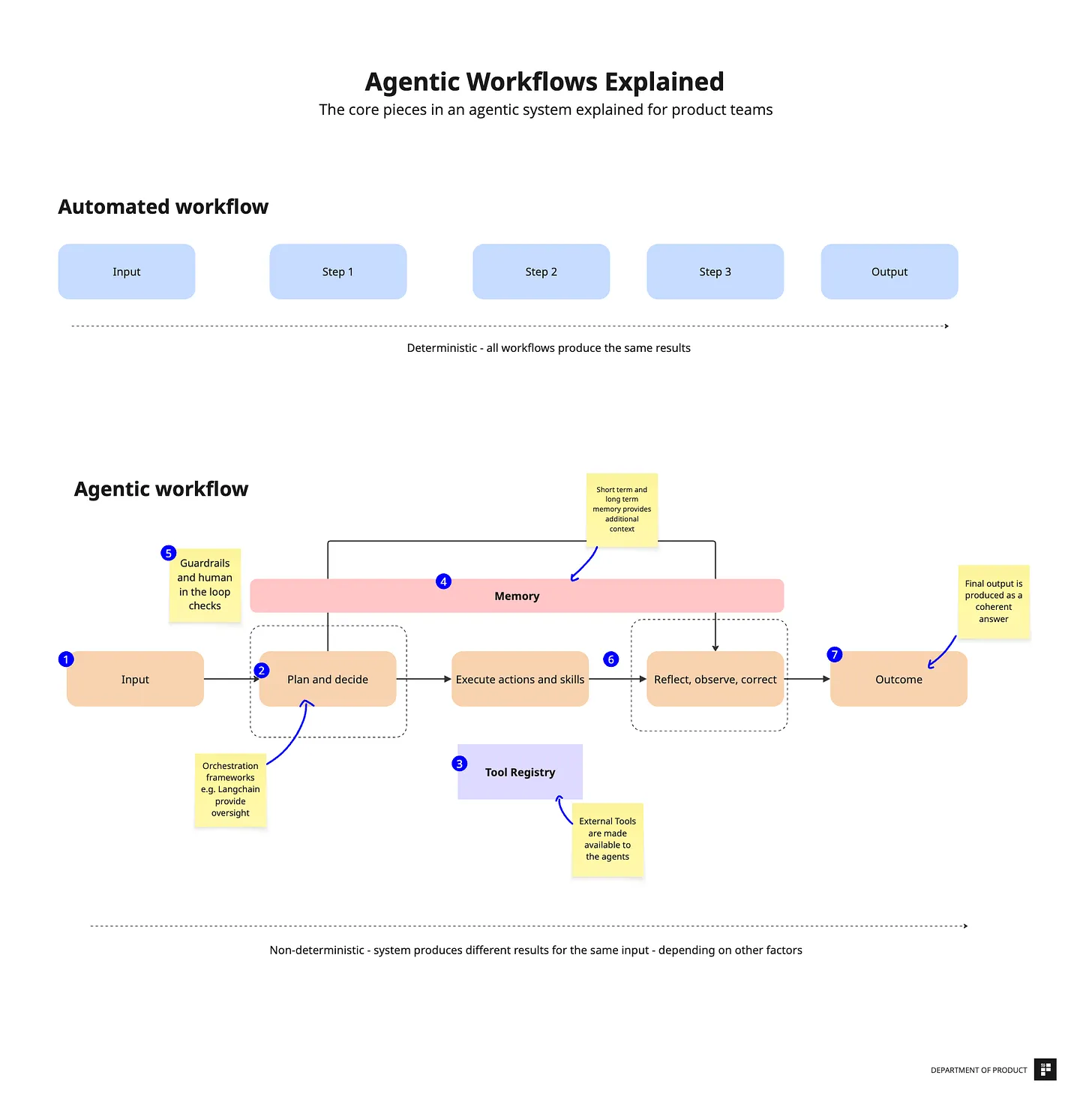
Traditional automation runs on rules. Whether it’s built with robotic process automation, workflow engines, or low-code platforms, the premise is the same: follow predefined instructions. These systems shine when the work is structured, consistent, and predictable.
The logic is designed upfront and doesn’t change unless someone rewrites it. Decisions are deterministic, it’s always yes or no, nothing in between. And when human inputs shift or processes stray from the script, maintenance becomes a headache.
No way, that’s not a flaw. In the right context, traditional automation still delivers enormous value. The trouble comes when we ask it to operate in environments it wasn’t built for, like places where data is messy, exceptions are constant, and goals change faster than workflows can be updated.
That’s the gap where agentic AI takes a very different path.
What is Agentic AI?
Agentic AI refers to systems that don’t just process information but act on it, autonomously, to reach specific outcomes. This goal-oriented behavior is often described as “human-like reasoning.”
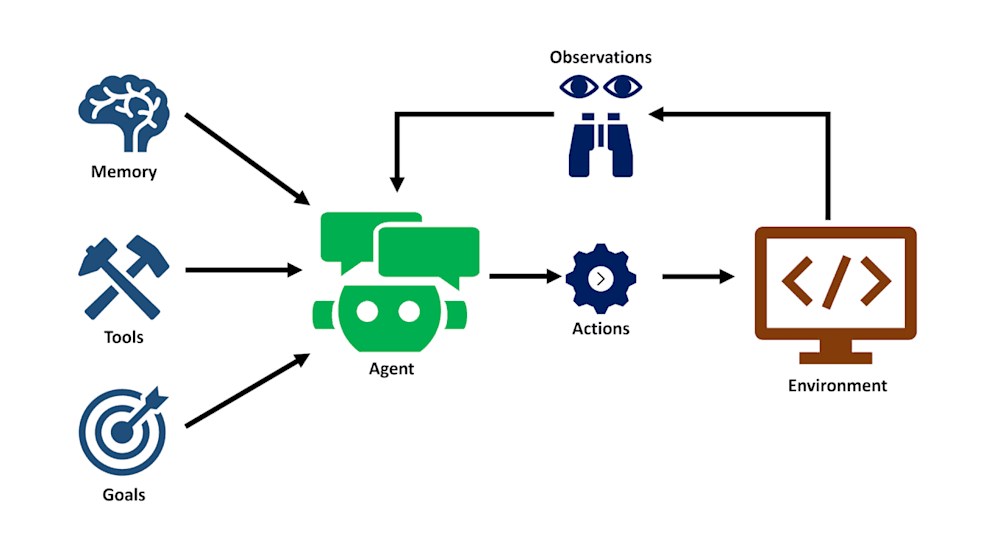
These next-generation models build on large language models (LLMs) and integrate external tools and data sources. That combination lets them solve complex tasks and problems, adapt as conditions change, and manage multi-step tasks without human intervention and constant supervision.
Let’s take supply chains, for example. An agentic AI system could proactively reroute logistics in response to weather conditions or an economic crisis.Considering that disruptions can drain up to 50% of an organization’s annual profits over a decade, this kind of adaptability has obvious value.
What Makes Agentic AI Different?
To move beyond simple automation, agentic AI needs a set of core capabilities:
- Intentional planning. The ability to set its own goals and design a strategy to achieve them.
- Foresight. Anticipating challenges and opportunities, and adjusting actions to prepare for multiple possible futures.
- Flexibility in action. Continuously course-correcting in real time as conditions change.
- Self-reflection. Learning from past actions to refine decisions and improve performance over time.
Together, these traits are what allow agentic AI to act autonomously rather than just follow instructions.
Why Agentic AI Need Orchestration?
Autonomy is powerful, but on its own, it’s messy. In an enterprise setting, unleashing agents without orchestration creates more noise than value. It’s not enough for agents to act, you need a framework that defines how they behave, in what order, under which conditions, and with what visibility.
Orchestration prevents agents from operating in silos and ensures they work together across departments, data systems, and use cases. It also creates the feedback loops that route decisions back to humans when judgment is required, turning a collection of agents into a coordinated mesh of intelligence.
Enterprises that skip this step often find their pilots stuck at a small scale. Orchestration isn’t a nice-to-have, as it’s the foundation that makes agentic AI sustainable.
What are the Benefits of Agentic AI vs. Traditional AI?
Agentic AI builds on the foundation of traditional AI but pushes it further. Where traditional models, often called narrow AI, depend on user input and fixed workflows, agentic systems can operate independently. They evaluate options, make decisions, and take action to achieve defined goals.
Read Also: What Is an Agentic Workflow? A Beginner’s Guide
Traditional AI systems are strong at narrow tasks but struggles to generalize beyond its training data. It doesn’t adapt easily to new situations.
Agentic AI, by contrast, is designed to do just that: it can recognize changes in its environment, adjust in real time, and reinforce its own learning with every cycle.
Another leap forward is collaboration. Multiple specialized agents can work together on complex tasks and challenges, each contributing expertise and sharing results. This makes them well-suited for problems that are too dynamic or multifaceted for single-purpose models.
Consider the difference between static voice assistants like Siri and the new wave of agentic AI systems.
Traditional models can answer questions or follow predefined instructions, but they can’t adapt or act beyond their scope without human intervention.
The takeaway is clear: agentic AI isn’t simply a more advanced assistant. It’s a new class of technology designed to collaborate, adapt, and take initiative, reshaping how businesses approach automation and decision-making.
Blending Traditional Automation With Agentic AI
Departments like finance, HR, and operations run on routines that need to be done fast, accurately, and without variation. This is where rule-based automation proves its worth, it handles repetitive tasks with precision.
But not every workflow fits neatly into that box. Some processes shift too often, depend on real-time data, or require judgment calls that rigid rules can’t cover. That’s where agentic AI comes in. Instead of following a fixed script, it learns from its environment and adjusts as conditions change.
The real skill lies in knowing which tool to use where. Agentic AI isn’t needed for every task, just as RBA can’t carry the weight of complex tasks and dynamic workflows. Together, though, they’re powerful: traditional automation provides structure, and artificial intelligence adds flexibility.
Combined, they help businesses build ecosystems that are not just efficient but adaptable enough to keep productivity high even as conditions shift.





Comments