
 By
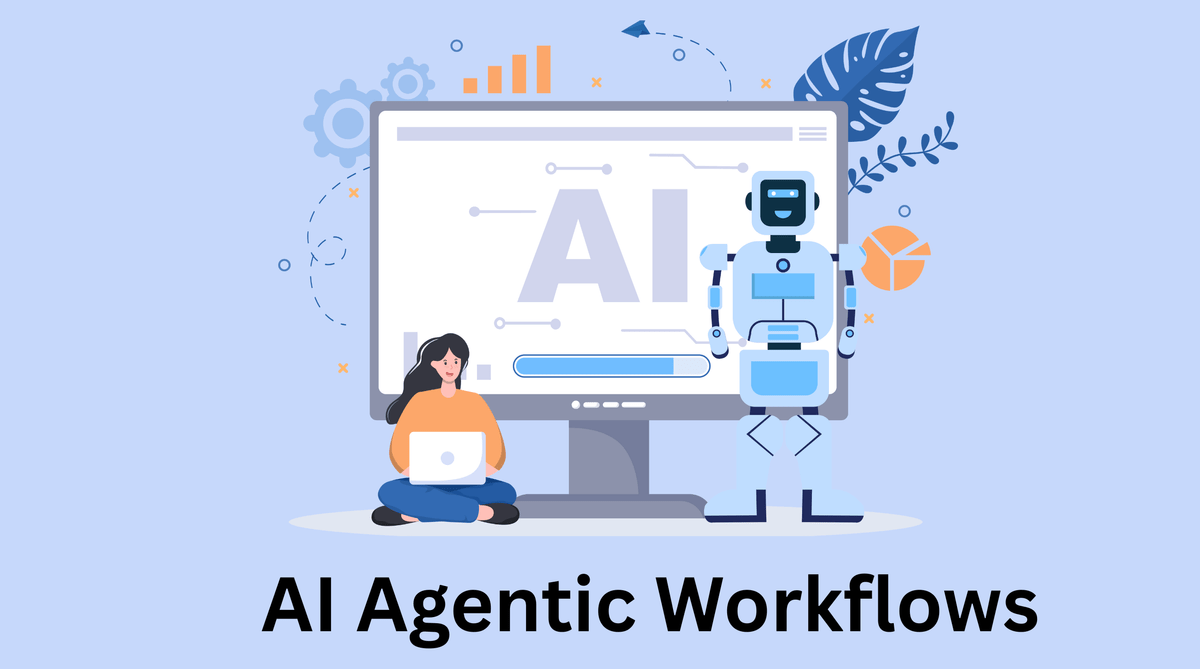
An agentic workflow is an advanced AI process in which autonomous agents plan, reason, and carry out multi-step tasks to reach a goal with minimum human intervention. Unlike typical, rigid automation, these agents may use tools, assess data, and respond to new information. Reasoning, planning, and self-reflection are essential components for improving accuracy.
What is an Agentic Workflow?
- Definition: A system where AI “agents” operate independently to solve complex problems, rather than just responding to single prompts.
- Key Characteristics: Autonomy, adaptability, reasoning, planning, tool usage, and iterative improvement.
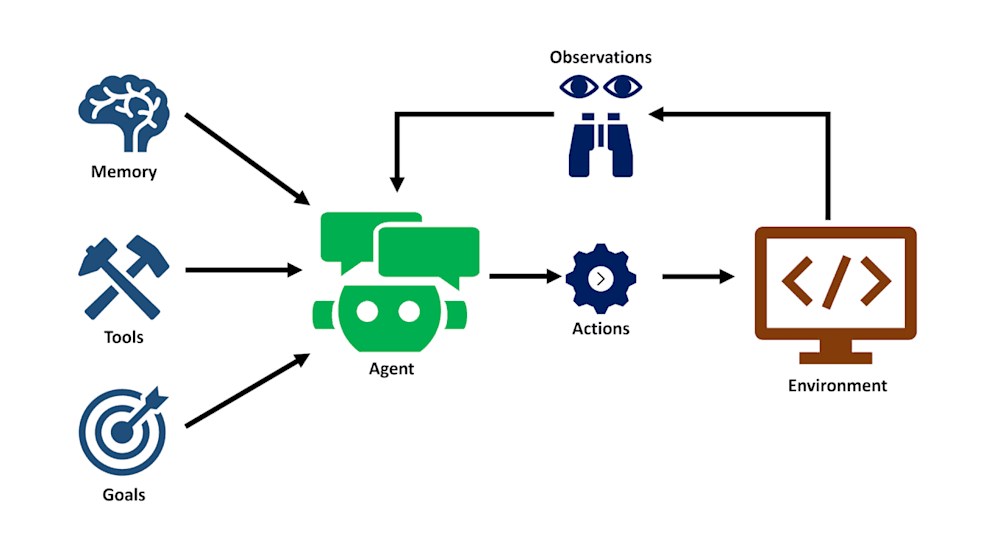
- Goal-Driven: The agent is given a goal (e.g., “research this topic”) and breaks it down into steps, such as searching, summarizing, and drafting.
Agentic Workflow vs. Traditional Automation
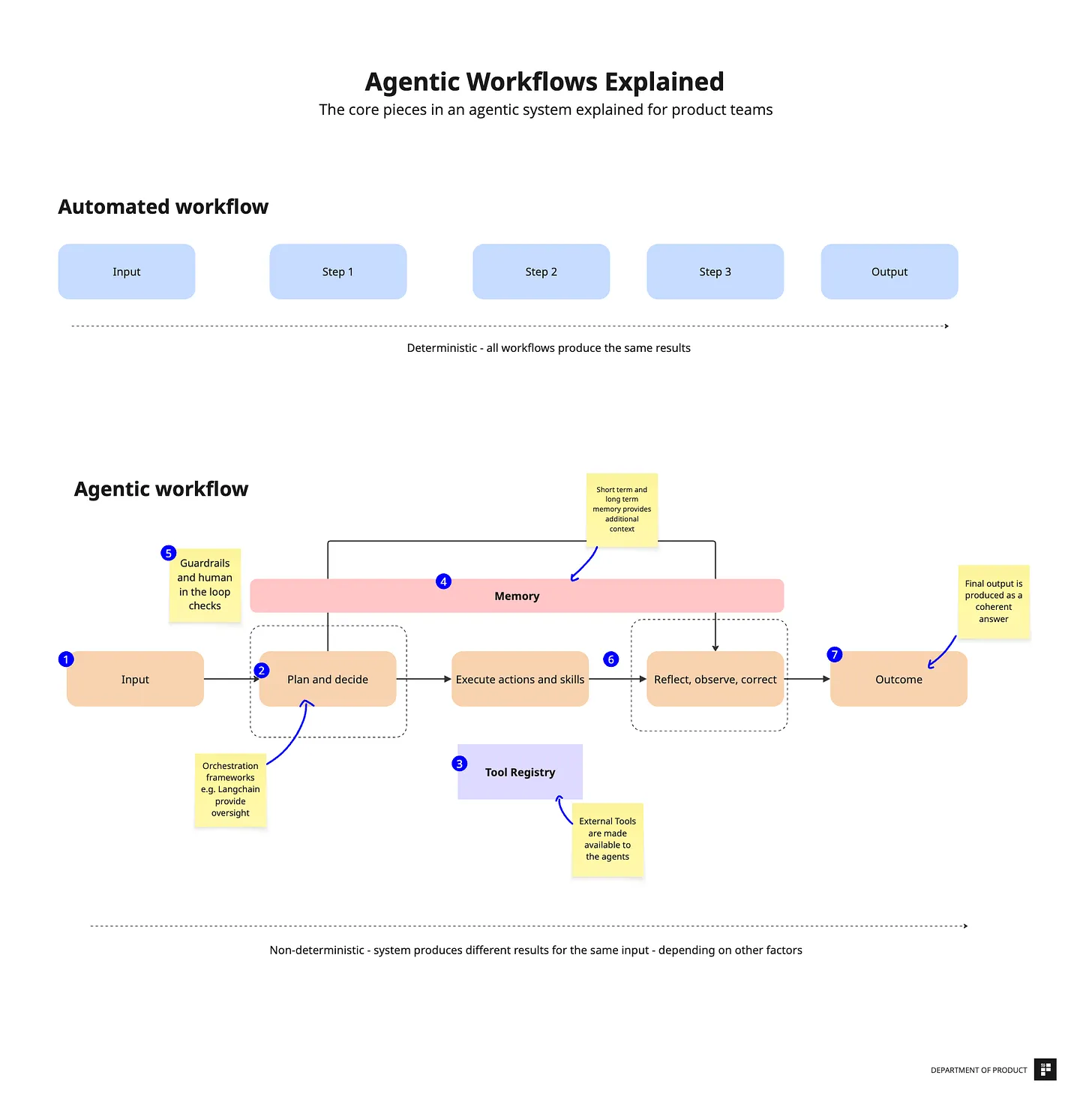
- Traditional RPA/Automation: Follows a strict, pre-programmed, linear path.
- Agentic Workflows: Dynamic, iterative, and capable of adapting to unexpected results or changing conditions.
Key Components & Capabilities
- Planning & Reasoning: Agents break down large objectives into smaller, actionable subtasks.
- Tool Usage: Agents can autonomously use external tools, such as web browsers, calculators, or software APIs (e.g., CRM or email).
- Self-Reflection & Memory: Agents analyze their own results to refine their approach, learning from mistakes to improve performance over time.
- Collaboration (Multi-Agent Systems): Multiple specialized agents can communicate to solve complex problems together.
Examples of Agentic Workflows
- Sales & Marketing: An agent receives a goal to re-engage leads, pulls CRM records, drafts personalized emails, and schedules follow-ups.
- Research & Content Creation: An agent searches the web, verifies sources, outlines a report, and writes the final document.
- HR Onboarding: An agent handles end-to-end onboarding by contacting new hires, collecting documents, and updating systems without human input.
Benefits
- Increased Efficiency & Productivity: Handles complex, multi-step processes without constant supervision.
- Scalability: Allows organizations to scale operations through intelligent automation rather than only hiring.
- Improved Accuracy: Iterative refinement reduces errors in complex tasks.
How to Get Started
Beginners can start by utilizing platforms that support AI agents, focusing on defining clear, goal-oriented instructions, and allowing agents to access tools for research or data manipulation.
What are Agentic Workflows?
Agentic workflows are AI-driven processes in which autonomous AI agents make decisions, perform actions, and coordinate tasks with little human participation. These workflows use basic components of intelligent agents including reasoning, planning, and tool use to efficiently complete complicated tasks. Traditional automation, such as robotic process automation (RPA), adheres to specified rules and design patterns.
This method can be suitable for repetitive jobs with a regular structure. Agentic processes are dynamic, providing greater flexibility by responding to real-time data and unforeseen conditions. AI Agentic workflows handle complicated problems in a multistep, iterative manner, allowing AI agents to break down business processes, adapt dynamically, and fine-tune their activities over time.
Organizations gain from increased operational efficiency, scalability, and informed decision-making when generative AI can manage complex workflows. As machine learning and natural language processing (NLP) advances, AI technology is becoming more prevalent in sectors looking to automate and improve processes while minimizing reliance on human oversight. The significance of growing AI models extends beyond software development to areas such as healthcare, finance, human resources, and many more.
Assume a corporation has an IT support chatbot that uses a rule-based automation system. When an employee reports an issue (for example, “My wifi isn’t working”), the chatbot uses static decision trees to generate predefined responses. If the issue is not resolved, the chatbot will simply escalate to human support. This strategy works well for simple, well-defined problems but struggles with complex, multistep troubleshooting that demands adaptation.
With an agentic workflow, the IT assistant addresses troubleshooting in a multistep, iterative manner. If an employee reports a wifi problem, the agent uses a dynamic step-by-step approach to breakdown the workflow:
- Understanding the problem: The AI agent gathers detailed information from the employee, asking clarifying questions like, “Are other devices connected to the network?” or “Did this start after a recent update?”
- Executing diagnostic steps: Based on the user’s responses, the AI selects and runs different problem-solving steps. It might ping the router, check network logs or suggest specific settings changes, retrieving and summarizing this information for the user.
- Adaptive tool use: If the AI detects a server-side issue, it can call an internal monitoring tool API to check for outages. If the issue is device-specific, it can retrieve driver update suggestions or run a script to reset network settings.
- Iterating based on results: If an action doesn’t resolve the problem, the AI adjusts its approach dynamically. It might cross-check related issues, reattempt diagnostics or suggest a different solution instead of just escalating immediately.
- Finalizing and learning: If the issue is fixed, the AI logs the solution for future cases, improving its troubleshooting efficiency over time. If unresolved, it escalates with a detailed report, saving IT staff time by summarizing attempted fixes.
Components of Agentic Workflows
The core components of agentic workflows consist of:
- AI agents – In artificial intelligence (AI), a workflow is not agentic if it does not consist of an AI agent. An AI agent refers to a system or program that is capable of autonomously performing tasks on behalf of a user or another system by designing its workflow and utilizing available tools.
- Large language models (LLMs) – At the core of AI agents are large language models. LLMs are crucial for processing and generating natural language. The adjustment of LLM parameters like temperature will also result in varying output quality.
- Tools – For an LLM to acquire information beyond the data used in training the model, we must provide tools. Examples of commonly used tools include external datasets, web searches and application programming interfaces (APIs). We can use tools to tailor an AI agent to specific use cases beyond routine tasks.
- Feedback mechanisms – Feedback mechanisms such as a human-in-the-loop (HITL) or even other agents can be valuable in facilitating the AI agent’s decision-making process and steering the agent output.
- Prompt engineering – Agentic workflow performance is heavily dependent on the quality of provided prompts. Prompt engineering helps generative AI models better comprehend and respond to a wide range of queries, from the simple to the highly technical. Common prompt engineering techniques include chain of thought (CoT), one-shot, zero-shot and self-reflection.
- Multiagent collaboration – Communication and distributed problem-solving within multiagent systems (MASs) are key for complex use cases. Each agent within a MAS can be designated a set of tools, algorithms and a domain of “expertise” so that agents are not all relearning the same information. Instead, agents are sharing their learned information with the rest of the MAS.
- Integrations – To streamline existing processes, agentic workflows need to be integrated with the existing infrastructure. This synergy is dependent on the requirements and goals of the agentic workflow. Data integration, the process of consolidating data into a central database for the agent to access, is often the first step. Other forms of integrations include agent frameworks such as LangChain, LangGraph, crewAI and IBM’s BeeAI. These agent orchestration frameworks can serve as providers for achieving greater scale and performance. The integration of context-specific tools is also key to achieving relevant outputs.
The Impact of Agentic Workflows
A personal narrative from Andrew Ng, an AI leader, emphasizes the versatility of agentic workflows. Andrew recounts his demonstration of AI agent development, during which one of the many AI tools, a web search API, failed. The AI system was able to swiftly address the dependence failure by relying on an existing Wikipedia search tool instead. The system performed the assignment and demonstrated adaptability to the changing environment. The reduced requirement for human oversight may allow us to focus our efforts less on banal, repetitive jobs and more on sophisticated work that requires human intelligence.
Read Also: Natural Language Processing in Global Enterprises
Andrew also argues why agentic workflows are useful for both task execution and training the future generation of LLMs. In typical, nonagenttic processes, using one LLM’s output to train another has not been shown to produce effective results. However, adopting an agentic approach that generates high-quality data yields beneficial training.
Agentic Workflow Patterns
In agentic workflows, patterns refer to the way AI agents approach and solve problems to reach a goal. Just like humans have different approaches to solving problems, some people plan everything out, while others learn by trial and error. AI agents also have distinct methods they can use depending on the situation.
These patterns are like building blocks that can be used alone or combined. A simple agent might use just one pattern, while more complex agents often combine multiple patterns to handle challenging tasks. The most advanced agents can even switch between different patterns as they work, choosing the best approach based on what they discover along the way.
These patterns show how AI agents can think strategically, gather information, and improve their work:
1. Planning Pattern
Planning pattern is like having an agent that thinks before it acts. Instead of jumping straight into a task, the agent breaks complex problems into smaller, logical steps and creates a roadmap to success. The agent analyzes what needs to be done, considers different approaches, and maps out the best sequence of actions. This systematic approach helps prevent mistakes and ensures nothing important gets missed along the way.
Planning works best for messy, unclear problems where there’s no obvious solution. Imagine asking an agent to improve your website’s performance. It might first analyze loading speeds, then identify bottlenecks, research best practices, prioritize fixes, and test each improvement. That makes them useful for problems that need creative thinking, not simple, repeated steps.
2. Tool Use Pattern
Tool use pattern turns agents into proactive researchers and decision-makers. Instead of relying solely on pre-trained knowledge, these agents connect to external tools, like search engines, databases, or code execution environments, to access real-time data. This enables them to gather insights and take action on the spot.
This pattern is especially useful when agents need real-time data or must interact with other systems. For example, when a user asks for financial advice, the agent might check current stock prices through a financial API, analyze the user’s investment portfolio, and generate personalized recommendations. This moves the agent beyond passive assistance, enabling it to reason, research, and respond dynamically in the real world.
3. Reflection Pattern
Reflection pattern gives agents the ability to be their own quality control. The agent reviews and critiques its own work, making improvements before delivering the final result.
Reflection is useful for tasks where first attempts often fail, like writing or coding. An agent might draft, review, revise, and repeat until the output meets quality standards. Over time, it learns from past mistakes and improves, becoming more reliable for complex work.
Pros and Cons of AI Agentic Workflows
Agentic workflows are a tremendous development in automation, but like with any powerful technology, they have both appealing advantages and substantial drawbacks. Understanding these trade-offs is critical for enterprises deciding whether to employ agentic systems and how to effectively use them in their operations.
Pros of Agentic Workflows
- 1. Operational Autonomy
Agents can handle unexpected situations and make decisions without stopping to ask for help. When a customer service agent encounters a problem it hasn’t seen before, the agents can try different approaches, use various tools, and find a solution on its own. This means workflows keep running smoothly even when things don’t go according to plan, unlike traditional systems that break down or stop working when they encounter something unexpected.
- 2. Process Optimization
Agentic workflows can think through problems and make plans, not just follow instructions. This means one agent can handle thousands of different customer requests at the same time, each requiring a unique approach. Instead of needing separate workflows for every possible scenario, you get one intelligent system that adapts to each situation while working at a massive scale.
- 3. Continuous Improvement
These systems get smarter over time by learning from their mistakes. When an agent fails at a task, it remembers what went wrong and tries a better approach next time. This means the system becomes more accurate and effective the longer it runs, without needing humans to constantly update and improve it.
Cons of Agentic Workflows
- 1. Unpredictable Behavior
Since agents make their own decisions, you can’t always predict what they’ll do. The same customer question might be handled three different ways by the same agent, depending on what information they find or which tools are available. This unpredictability can be problematic when you need consistent results or when operating in regulated industries with strict rules.
- 2. Higher Resource Requirements
Agentic workflows use much more computing power and money to operate. Instead of running one simple process, the agent might search databases, call multiple APIs, analyze results, and make several attempts before completing a task. This makes them slower and more expensive to run compared to basic automated systems.
- 3. Complex Testing and Monitoring
Traditional automation is easy to test, you give it a specific input and expect a predictable output every time. However, agentic workflows introduce variability: the agent might take different paths to solve the same problem depending on the context. This makes it harder to test every possible outcome or trace the exact reason something failed.
Lastly
Agentic workflows are a significant advancement in how AI can work autonomously to finish complex tasks. These agents go beyond simple automation by chaining tools, making decisions, and adjusting to real-time input, resulting in increased efficiency and scalability across sectors.
As technology advances, enterprises will need to carefully consider when and how to adopt agentic systems. Success depends on balancing automation and control, ensuring that agents work in accordance with company objectives, user demands, and ethical standards.




Comments