
 By

The 4 withdrawal rule means taking 4% of your starting retirement portfolio in year one, or $40,000 on $1 million, then increasing that dollar amount with inflation. It does not mean withdrawing 4% of whatever your investments are worth each year.
That distinction determines whether you're planning a reasonably steady paycheck or accepting income that moves with your investments. Neither approach is automatically better, but they solve different problems.
The useful question isn't how much you can withdraw. It's how much you can spend after tax, for how long, and what you'll change if markets disappoint. A cautious percentage can protect future spending, but unnecessary caution can also keep you from enjoying money your plan could reasonably support.
Table of Contents
- What the 4 Withdrawal Rule Pays in Year One
- How to Turn 4 Percent Into a Yearly Paycheck
- What Bengen's Original Test Assumed
- When 4 Percent Is the Wrong Starting Point
- Fixed Raises Versus Guardrails and Other Methods
- Three Households and the Checks They Could Write
- Taxes Other Income and a Longer Life
- Pick a Starting Rate You Can Actually Keep
What the 4 Withdrawal Rule Pays in Year One
A $1,000,000 portfolio at a 4% starting rate produces $40,000 before tax in year one. Other rates produce different first checks, but the figures below come from different planning methods and assumptions.
Starting withdrawal rates and year-one pay on $1,000,000
| Situation | Starting rate | Planning standard | Year-one dollars |
|---|---|---|---|
| 30-year historical Bengen test | 4% | Survived 50 years in 41 of 50 historical cases | $40,000 |
| 30-year Morningstar 2024 | 3.7% | 90% chance funds remain | $37,000 |
| 30-year Morningstar 2025 balanced mix | 3.9% | 90% chance of avoiding depletion | $39,000 |
| 20-year shorter retirement | About 5.5% | 90% success discussed for a shorter horizon | $55,000 |
| Flexible market-responsive spending | Up to 5.7% | Only if withdrawals can fall after poor markets | $57,000 |
For the historical Bengen result, 41 of 50 historical cases supported the 4% policy for 30 years, according to First Manhattan's discussion of the Bengen test. It is a historical result, not a guarantee that a future retirement will follow the same path.
Morningstar's 2024 State of Retirement Income estimated a 3.7% highest safe starting rate for a 30-year retirement, with a 90% probability of funds remaining. That equals $37,000 on $1,000,000, compared with $40,000 at 4%. For a 20-year retirement, the analysis discussed a starting rate of about 5.5% under its stated success objective.
Read the planning standard, not just the dollars
A historical test asks how a policy would have fared in past market conditions. A modeled probability estimates outcomes across scenarios built on particular assumptions. A flexible policy can support a larger initial withdrawal only if you can reduce spending after poor markets.
Those are different trade-offs, not competing promises. A higher first check may come with more risk or less predictable spending; a lower fixed rate may leave you underspending for decades if your portfolio and horizon could have supported more.
Scale the paycheck to your investments
Multiply your investable portfolio by the starting rate to estimate the first year's withdrawal. At the same rate, half the portfolio means half the withdrawal; a larger portfolio scales proportionally. These amounts are before tax.
Count assets available to fund retirement spending. Your home does not become spendable investment capital unless your plan converts some of its value into cash.
Before choosing a rate, consider:
- Your horizon: How long must the portfolio support withdrawals?
- Your spending flexibility: Can spending fall after poor markets?
- Your income gap: How much must investments provide after dependable income covers part of your budget?
Choose a planning standard that fits your horizon and the changes you could make. A first-year dollar figure is useful only when its assumptions match your spending needs.
How to Turn 4 Percent Into a Yearly Paycheck
The rule is a spending protocol, not a forecast of investment returns. You don't need your investments to produce the withdrawal entirely through interest and dividends, and you shouldn't assume the withdrawal percentage describes what the portfolio will earn.
Vanguard's retirement spending guidance describes the traditional method as taking 4% initially, then adjusting that dollar amount for inflation. It is similar to a pension's cost-of-living provision: the initial check establishes a spending level, and later adjustments aim to preserve its purchasing power.
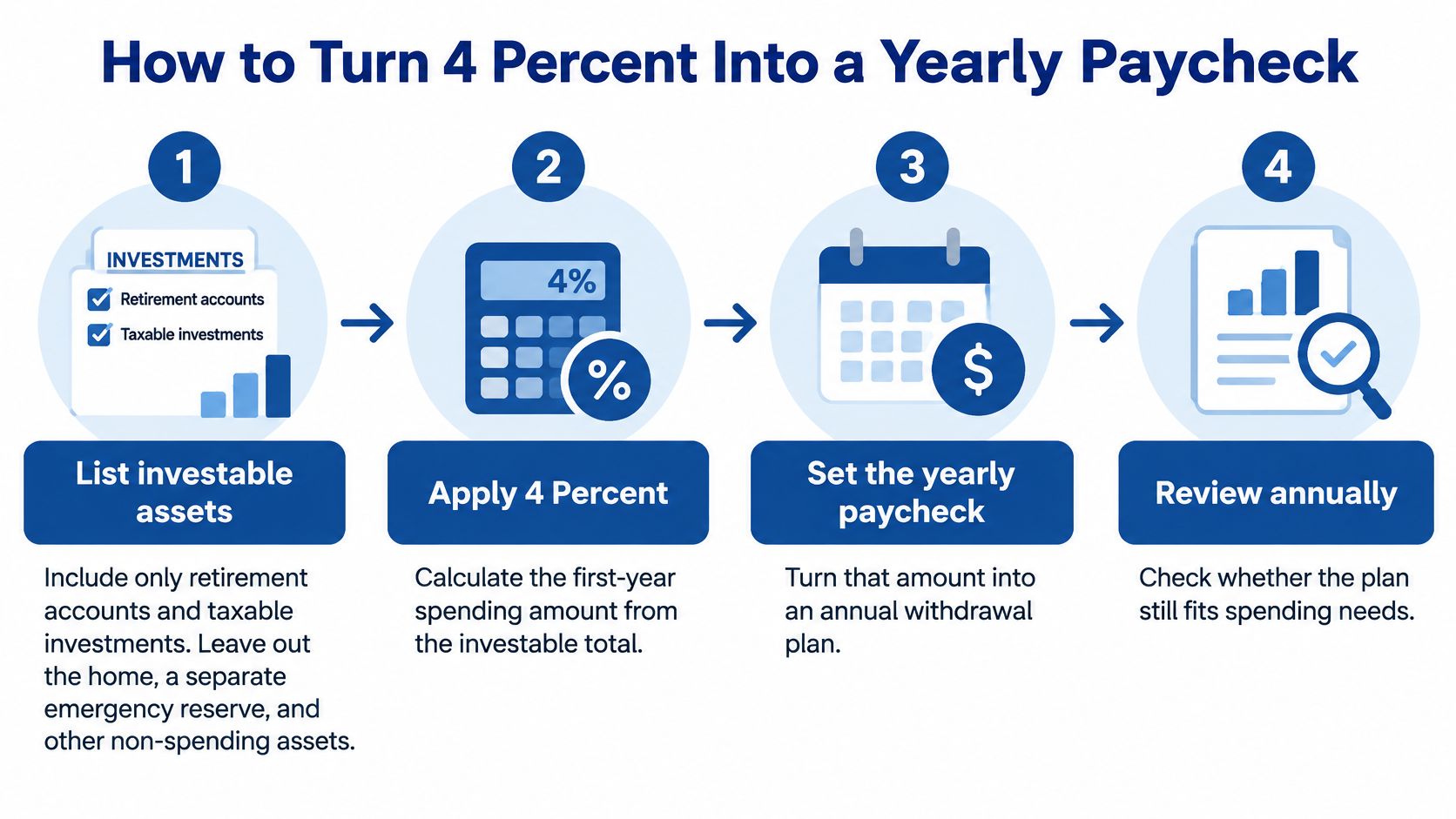
The process begins with a clean inventory of the assets that will fund your paycheck.
Build the withdrawal schedule
List investable assets. Include retirement accounts and taxable investments earmarked for spending. Leave out your home and a separately designated emergency reserve; don't count pension income as portfolio capital.
Apply your chosen starting rate. As a hypothetical example, applying the classic rate to an $800,000 portfolio produces a $32,000 first-year withdrawal. Write this as a dollar amount in your budget rather than leaving it as an abstract percentage.
Adjust the dollar amount for inflation. If inflation were 3% in that example, the following withdrawal would be $32,960. That's an illustrative calculation, not an inflation forecast, and the traditional schedule calls for the adjustment even after investment losses.
Don't reset the calculation to the new balance. Taking the same percentage of the current portfolio is a different method. It automatically lowers income after losses and raises it after gains, so it won't deliver the same purchasing-power target.
Arrange near-term cash. Hold a cash reserve sized to your upcoming spending needs and reliable income. If that cash is part of your retirement portfolio, count it once, not as an additional pool of wealth outside the calculation.
Write an adverse-market response. Decide in advance whether you'll freeze an inflation increase, postpone travel, or reduce other optional spending. A schedule without a response plan can become an unaffordable commitment.
Account access is a separate question from sustainable spending. For an account-specific starting point, Gold IRA Association's 401k withdrawal guidance for retirees can help you identify withdrawal issues to check before arranging transfers.
Why the cash reserve matters
Sequence-of-returns risk means poor returns early in retirement can do lasting damage when withdrawals continue. Selling investments after losses leaves fewer assets available to participate in a recovery.
Cash can reduce pressure to sell long-term holdings at an inconvenient moment, but it doesn't eliminate investment risk. Excessive cash also creates a trade-off because it leaves less invested for future growth.
Practical rule: Write down your starting annual paycheck, its inflation adjustment, and its review conditions. Don't substitute a fresh percentage calculation every January unless you deliberately choose variable income.
What Bengen's Original Test Assumed
The historical test had clear boundaries: U.S. investments, historical returns, a specified spending policy, and a stock-and-bond portfolio. It wasn't a universal finding about every country, investment mix, or retirement household.
William P. Bengen's 1994 retirement-income work tested U.S. market returns beginning in 1926, using U.S. large-cap stocks and intermediate-term U.S. government bonds, as described by First Manhattan's explanation of his research. In those reported results, the initial 4% withdrawal followed by inflation adjustments survived 50 years in 41 of 50 historical cases and lasted at least 35 years in every case.
A test of difficult starting dates
The important feature was exposure to unfavorable retirement starts. The historical periods included severe bear markets, high inflation, and major economic downturns.
A retiree doesn't know in advance whether retirement will begin before a difficult market period. Testing a spending policy through adverse starts therefore answers a more useful question than calculating a comfortable average return.
Bengen's planning conclusion supported the familiar retirement framework under the tested conditions. The percentage became influential because it held up under demanding historical circumstances, not because portfolios reliably earned an equivalent return each year.
Historical survival is evidence about a spending policy. It isn't an insurance contract covering your future.
What the original result doesn't establish
Several differences can weaken the connection between a historical test and your household:
- Investment mix: A concentrated stock portfolio or an almost entirely cash portfolio behaves differently from the tested blend.
- Costs and taxes: Investment expenses and taxes reduce what remains available for living costs or future growth.
- Household behavior: Unplanned purchases and withdrawals outside the budget change the spending policy.
- Future conditions: Historical experience can't establish every possible future combination of returns and inflation.
Bengen's later work also shouldn't be reduced to a more generous headline. CNBC reported in 2025 that his expanded analysis produced an average historical maximum safe withdrawal rate of approximately 7.1%.
An average of historical maxima isn't a rate you can identify and safely spend at the beginning of retirement. You would need advance knowledge of which market path you were about to experience. The cautious benchmark addresses that uncertainty rather than pretending it doesn't exist.
When 4 Percent Is the Wrong Starting Point
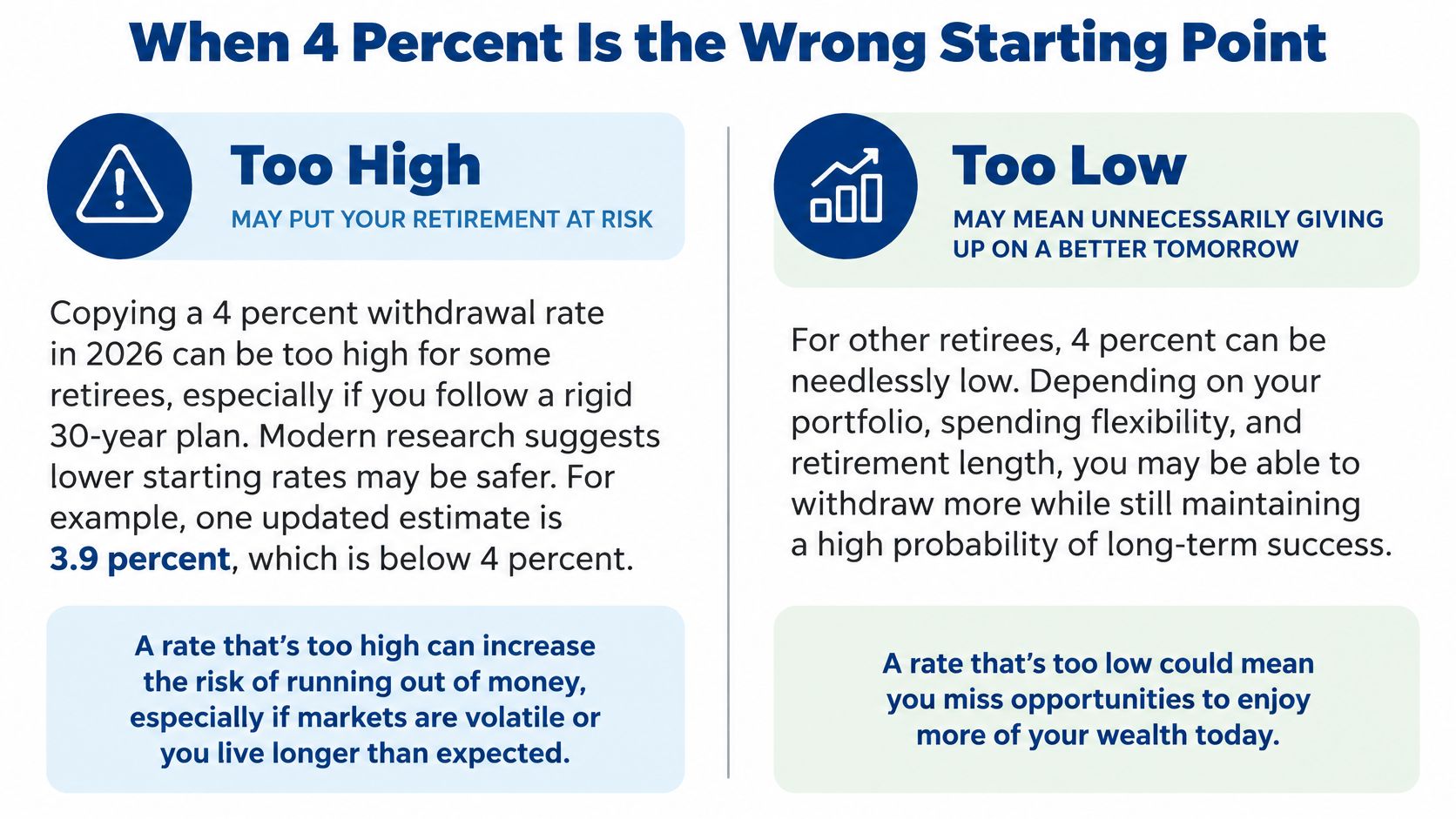
Copying a familiar percentage can be too aggressive for a household that needs an inflexible paycheck. It can also be unnecessarily restrictive for someone whose essential expenses are covered and whose portfolio spending is largely optional.
The dividing line is the plan underneath the number. Your horizon, investments, and ability to change spending determine whether the starting withdrawal is defensible.
These contrasting circumstances help explain why the same headline rate can lead to different decisions.
When a rigid paycheck asks too much
A household that depends on investments for rent, food, insurance, and medical care has limited room to respond to disappointing returns. Calling those costs discretionary won't make them easier to cut.
A longer retirement also requires the portfolio to support more withdrawals and more opportunities for unfavorable conditions. For couples, the relevant horizon should account for the longer-lived partner rather than ending at a convenient birthday.
Morningstar analysis reported by The News Tribune put the starting rate at 3.9% for a 30-year retirement, with a 90% success probability and roughly 30%–50% equities, falling to 3.5% over 35 years; flexible, market-responsive withdrawals could support starts as high as 5.7%. Those figures describe different spending commitments, not competing estimates of an identical paycheck.
When caution becomes permanent underspending
A lower initial withdrawal reduces pressure on a portfolio, all else equal. But a permanently lower spending policy can create a different problem: the retiree forgoes experiences, assistance to family, or improvements in daily life even when the plan could support them.
That doesn't mean spending more is automatically wise. It means minimizing withdrawals isn't the same as optimizing retirement.
Before lowering your paycheck indefinitely, distinguish between these situations:
- No genuine flexibility: Almost all spending is essential, so a conservative fixed plan or an income floor may be appropriate.
- Meaningful optional spending: Travel, gifts, and large purchases can be adjusted without jeopardizing basic living standards.
- Unclear spending priorities: The household says it can cut back but hasn't named anything it would stop buying.
The last situation is especially risky. Flexibility becomes useful only when you can describe a practical response and carry it out.
A defensible plan balances future security against present use of the money. It doesn't treat either maximum spending or minimum spending as the objective by itself.
Fixed Raises Versus Guardrails and Other Methods
Choose the method before choosing the paycheck. A starting withdrawal that works with variable spending may be unsuitable when the same household insists on automatic inflation increases regardless of investment performance.
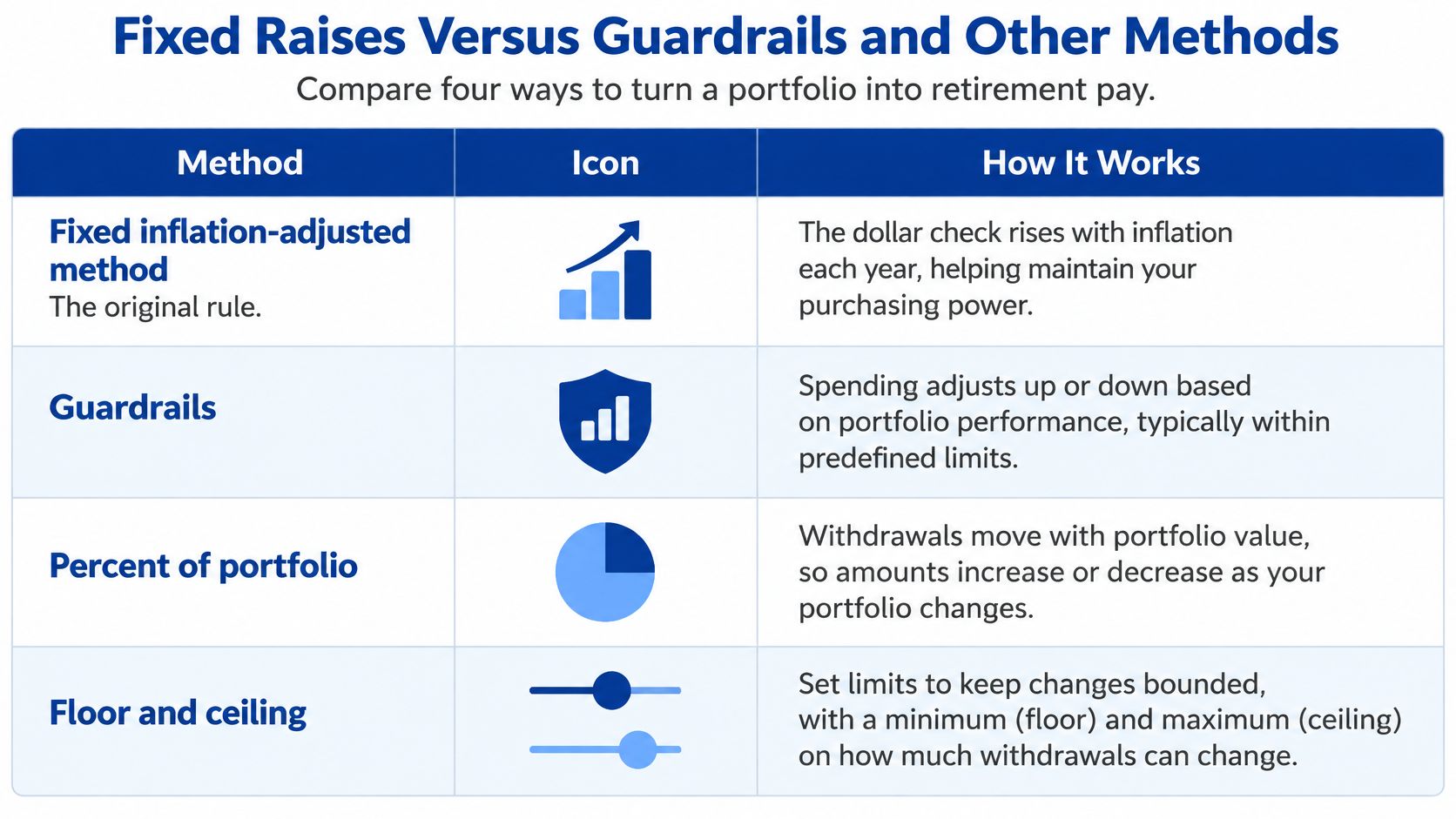
The comparison below separates the operating rules from the trade-offs.
Four retirement spending methods compared
| Method | How the check changes | Starting-rate context | Main trade-off |
|---|---|---|---|
| Fixed amount plus inflation | Rises with prices rather than market value | Historical benchmark or a forward-looking fixed-spending estimate | Continues demanding withdrawals after losses |
| Guardrails | Freeze inflation increases or reduce spending after deterioration, with restoration after recovery | Higher starts require genuine spending flexibility | Needs a written rule and expenses that can be cut |
| Percent of current balance | Resets to a selected share of the latest portfolio value | The selected percentage controls the withdrawal each year | Assets may remain while the paycheck becomes inadequate |
| Partial annuity plus portfolio | Contractual income supports a floor; investments fund flexible costs | Requires a household-specific income-floor assessment | Less liquidity and potentially less inheritance |
Morningstar's 2025 retirement-income analysis estimated 3.9% for inflation-adjusted spending over 30 years, with a 90% probability of avoiding depletion and approximately 20%–50% equities, versus flexible starts as high as 5.7%. It also reported 4.4% over 25 years and 3.2% over 40 years, illustrating how sharply the planning horizon changes the result.
Match the method to the household
Fixed inflation-adjusted spending fits someone who values predictable purchasing power and whose essential costs fit within a conservative starting budget. Its simplicity is useful, but the retiree still needs periodic reviews for costs, health changes, and unexpected withdrawals.
Guardrails fit someone with a dependable basic-income foundation and meaningful optional expenses. Write the decision before markets decline: which portfolio condition triggers a review, which expenses stop, and what improvement permits restoration?
Percentage-of-balance spending fits households able to tolerate substantial income changes. It avoids the same fixed-dollar pressure, but a portfolio that hasn't technically reached zero can still provide too little to live on.
A partial annuity plus investments may fit someone who prioritizes lifetime essential income over access to every dollar of capital. The contract terms matter, especially inflation treatment, survivor income, fees, and access to funds.
The visual also shows a floor-and-ceiling approach, which limits changes in an otherwise variable paycheck.
Make guardrails operational
A useful guardrail names actions rather than expressing optimism. For example, the household might suspend inflation increases after a material decline and postpone a major trip until an annual review supports restoring it.
Set a review date and record which investments will supply cash. Rebalancing can help maintain the intended asset mix, but it shouldn't become an excuse to increase risk merely to support an unrealistic spending target.
Choose the obligation first: If your household can't accept a smaller check, don't borrow the starting rate from a strategy that requires smaller checks during difficult periods.
No method is universally safest. Each assigns uncertainty differently between the investment portfolio, the spending budget, and any contractual income.
Three Households and the Checks They Could Write
Consider three hypothetical households. Their investment balances matter, but their retirement timing and dependable income matter just as much.
Each household needs a different conversation about what its portfolio must provide.

The conventional retiree, the early retiree, and the pension household
Household A is a single retiree with an investment portfolio intended to support a conventional retirement horizon. The classic policy offers a slightly larger initial check than a more conservative contemporary fixed-spending assumption, but the choice should depend on essential expenses and tolerance for adjustments.
Household B leaves work earlier with the same investment capital. The longer withdrawal period makes copying Household A's paycheck inappropriate without further analysis, even if both households have identical spending preferences.
Household C has a smaller portfolio but a pension that covers housing and food. Its investments fund additional costs, so this household may have more spending flexibility than either wealthier household.
Year-one checks for the three households
| Household | Starting rate | Portfolio base | Illustrative year-one withdrawal |
|---|---|---|---|
| A: single retiree at 65, classic rule | 4% | $1,000,000 | $40,000 |
| A: single retiree at 65, contemporary fixed estimate | 3.9% | $1,000,000 | $39,000 |
| B: early retiree, 40-year horizon | 3.2% | $1,000,000 | $32,000 |
| C: pension household, portfolio draw only | 4% | $600,000 | $24,000 |
| Observed-rate illustration: typical couple at 65 | 2.1% | $1,000,000 hypothetical base | $21,000 |
| Observed-rate illustration: typical single at 65 | 1.9% | $1,000,000 hypothetical base | $19,000 |
The household calculations are scenarios using the stated starting policies, not individual recommendations. The observed-rate rows apply reported behavior to an illustrative portfolio; they don't claim that the study participants held that balance.
A 2024 study in the CFP Board's Financial Planning Review, reported by Yahoo Finance, found that a typical 65-year-old couple withdrew 2.1% annually, while a single 65-year-old withdrew 1.9%.
A smaller withdrawal has more than one explanation
These observed rates don't prove that retirees should spend more. Some households preserve assets for uncertain medical costs, longevity, family support, or inheritance goals; others may hesitate to spend despite having adequate resources.
A couple must also plan for the surviving partner's circumstances. Household expenses won't necessarily fall in proportion to the loss of a partner, and dependable income may change.
For households coordinating benefits with investment withdrawals, understanding Social Security benefits in retirement helps frame the income gap before selecting portfolio spending.
Use the video alongside your own written budget rather than treating a general explanation as a personalized rate recommendation.
The practical question is which household you resemble. An early retirement, a pension-supported budget, and an investment-dependent single retiree shouldn't all receive the same answer just because the familiar percentage is easy to remember.
Taxes Other Income and a Longer Life
A portfolio withdrawal isn't automatically take-home pay. The amount transferred from an investment account may need to cover taxes before it can pay household bills.
Account type and withdrawal order affect that result. Tax-deferred withdrawals can create taxable income, Roth treatment depends on applicable qualification rules, and sales in taxable accounts can involve capital gains rather than making the entire withdrawal taxable.
Translate gross withdrawals into household cash
Build your spending budget from the cash left after estimated taxes, not from the headline portfolio transfer. Coordinate investment withdrawals with pensions and other taxable income rather than evaluating each account in isolation.
Use a tax projection to compare potential withdrawal sequences. Drawing exclusively from the easiest account can create future consequences that aren't visible in the current budget.
These are useful distinctions to carry into tax-efficient retirement savings planning, particularly when household income comes from several account types.
- Gross withdrawal: The amount removed from investments.
- Spendable cash: What remains after the associated tax obligations.
- Other income: Pension, government, or contractual payments that reduce the amount investments must supply.
- Investment costs: Expenses that also need room in the sustainability assessment.
Plan for life beyond the expected horizon
Longevity changes the result even when the starting balance looks substantial. A simulation reported by The Telegraph in Macon, using a $1 million portfolio, inflation-adjusted withdrawals, market-return assumptions, and modeled federal taxes, found failure rates rising from about 5% at age 85 to 38% at age 100.
Those are scenario-specific results, not your personal probability of failure. Their practical relevance is that surviving longer creates additional demands that a shorter planning exercise can miss.
The same modeled analysis found that combining a life annuity with an investment portfolio outperformed both all-portfolio and all-annuity strategies in its tested cases. That supports considering a blend, not assuming every household should buy an annuity.
Separate the income floor from optional spending
Pensions and government benefits belong in the household income plan, not inside the portfolio balance used for withdrawal arithmetic. They can reduce the investment draw by paying essential expenses directly.
A partial life annuity can serve a similar role, but compare liquidity, inflation protection, survivor benefits, fees, and inheritance preferences before committing capital. A contractual payment that looks attractive initially may fit poorly if its terms don't match the household's future needs.
Healthcare uncertainty and the needs of a surviving spouse deserve explicit budget lines. Choose a starting portfolio policy, estimate taxes, add dependable income, and only then decide what standard of living the combined cash flow can support.
Pick a Starting Rate You Can Actually Keep
A withdrawal rate becomes a spending policy only when you decide how it will respond to a long retirement, rising prices, and disappointing markets. Choose a starting paycheck your household can support, then write down what would prompt you to change it.
Begin with the budget. Separate expenses you must keep paying from purchases you could delay, and estimate how much of the gap pensions and government benefits will cover. Then account for taxes and costs: the amount withdrawn from a portfolio is not necessarily the amount available to spend.
Make the commitment explicit
For a conventional retirement horizon, the 4 percent rule can serve as a reference point, not a promise. A shorter horizon may allow more spending; a longer one may call for a smaller fixed paycheck, more flexibility, or additional lifetime income. A lower starting rate is not automatically safer if it leaves you underspending for decades.
Guardrails work only if you are willing to follow them. Decide in advance which optional expenses you would reduce or postpone if the plan deteriorates. Fees, concentrated investments, excessive cash, and late-life expenses can all change how far a starting rate goes.
For more context on retirement accounts, taxes, and coordinating income, read this guide to retirement planning strategies. This is financial education, not a personal recommendation.
Write down your policy before scheduling withdrawals:
- My starting paycheck: The annual amount my budget needs from the portfolio.
- My inflation policy: Whether and when I will adjust that amount as prices change.
- My market response: The specific spending I will reduce or postpone if the plan weakens.
Keep the policy with your budget and review it when your circumstances change. A rate you can follow, with a clear response to difficult years, is more useful than a precise percentage detached from your spending needs.
Mega Income Stream publishes explainers on personal finance, retirement accounts, taxes, and income planning; visit Mega Income Stream to browse guides that compare income approaches and connect your withdrawals with everyday spending.











Comments