
 By

Why business revenue has stalled often comes down to a mismatch between your marketing, the market, your business strategy, or your capacity to deliver. More marketing won’t fix a weak offer, changing customer demand, or a sales process that can’t keep up. First, find where the revenue pipeline is breaking before adding tools or spending more.
A flat revenue line can make you want to do more: publish more, spend more, or pursue every new opportunity. But activity helps only when it addresses the cause. If leads are steady but sales are slipping, the issue differs from a business that can’t attract qualified prospects or deliver more work.
This guide explains how to diagnose a slowdown by reviewing marketing performance, market changes, pricing and positioning, strategy, and operational constraints. You’ll learn which metrics to examine, how to spot friction in the customer journey, and how to test a focused change before scaling it. The goal is to replace guesswork with a clear next step.
Key Takeaways
- Trace revenue from lead generation through repeat purchases to identify where momentum breaks.
- Separate weak demand from pricing, positioning, or delivery constraints before changing your marketing.
- Use customer, product, and market opportunities to test focused growth moves before scaling them.
- Review cash flow, margins, and sales processes to spot structural bottlenecks behind a plateau.
- Turn the diagnosis into a short list of measurable actions, then monitor which changes improve revenue performance.
1. Should marketing be the first step when a business slows down?
Not automatically. Before increasing marketing activity, identify whether the constraint is lead volume, conversion, repeat business, pricing, or delivery capacity. Compare recent revenue across the same products, customer groups, and sales channels. This first diagnostic step helps you avoid spending more to amplify an offer or process that is already struggling.
How can businesses analyze revenue trends by product, customer segment, and sales channel? Split sales records into those three categories, then compare revenue, order frequency, and conversion trends across periods. This can show whether a particular product is weakening, a customer segment is buying less, or one channel is producing fewer completed sales.
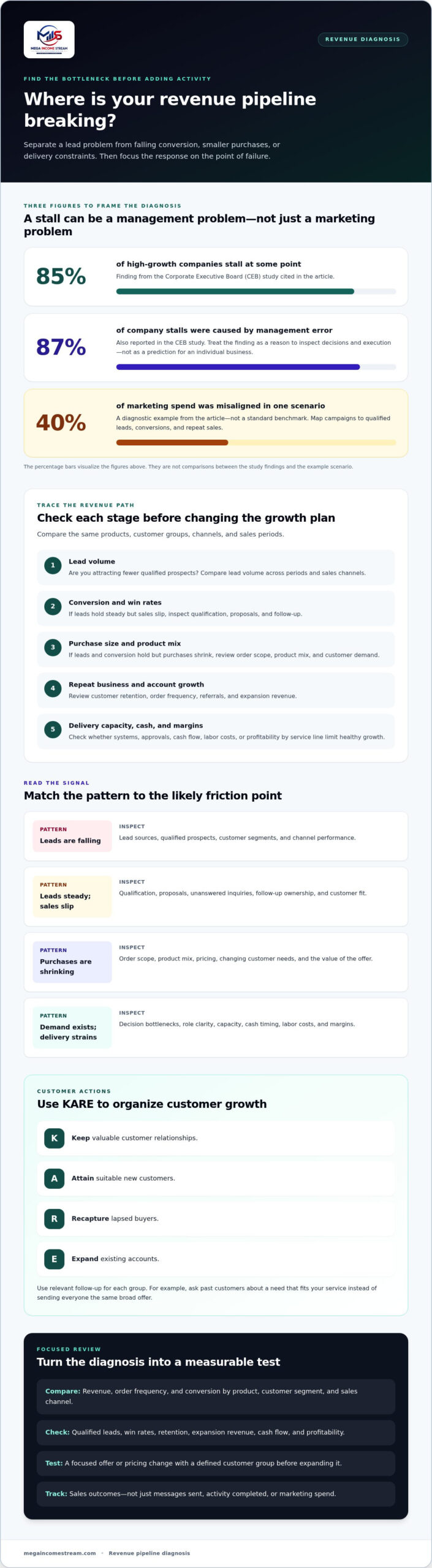
Start with existing customers. Early growth often comes from referrals, repeat business, and an owner’s personal network. Use the KARE model to organize customer actions: keep valuable relationships, attain suitable new customers, recapture lapsed buyers, and expand existing accounts. For example, a service business can follow up with past customers about a relevant need instead of sending everyone the same broad offer.
Follow-up can also reveal friction in the sales process. Review open proposals and unanswered inquiries, then assign an owner to each next step. Respond promptly to prospects and keep the business visible in its market with relevant updates or customer referrals. Track which conversations lead to sales, not just how many messages the team sends.
Customer needs change, so test whether your offer still fits before launching a large campaign. Ask recent buyers what problem they needed solved, what alternatives they considered, and how their requirements have changed. Compare their answers with your current product features and pricing. If the same new need comes up repeatedly, develop a small offer or pilot for a defined customer group before expanding it.
Segment customers by needs, buying behavior, and potential value. Measure win rates, market penetration, and expansion revenue before deciding a market is exhausted. A segment with fewer leads may still produce stronger repeat purchases or account growth. Prioritize high-value customers by matching service effort to their needs, rather than pursuing volume without checking profitability.
Differentiate your offer through customer value instead of defaulting to lower prices. Clarify the outcome, reliability, or time saved that makes it useful, then test how customers respond. You could also trial a tiered offer for a distinct buyer group. Keep the test manageable, define how you’ll measure success, and expand only when sales data supports the move.
Finally, audit marketing allocation against revenue goals. In one scenario, a founder found 40% of marketing spending was misaligned with those goals. Treat that as a diagnostic example, not a standard benchmark. Map each campaign to qualified leads, conversions, and repeat sales, then redirect effort toward activities that generate revenue. Marketing should lead only when the evidence points to a marketing gap.
2. Root Cause Analysis: What Causes Business Growth to Slow Down?
Diagnose the point of failure before changing the growth plan. A stall can reflect weaker demand, leadership gaps, thin margins, or systems that no longer support the business. The Corporate Executive Board (CEB) study found that 85% of high-growth companies stall at some point, and management error caused 87% of company stalls. Treat those findings as a prompt to inspect decisions and execution, not as a prediction for your business.
How can a business identify whether stalled revenue is caused by fewer leads, lower conversion, or smaller purchases? Compare lead volume, the share of leads that become customers, and average purchase size across the same sales periods. If leads hold steady but conversions fall, inspect qualification, proposals, and follow-up. If both hold steady but purchases shrink, review order scope, product mix, and customer demand.
Review sales and marketing metrics together. Track qualified leads, conversion rates, win rates, customer retention, and expansion revenue, then compare each with the prior period. Add revenue by offer and customer segment to see whether one channel is masking weakness elsewhere. A dashboard that reports activity without sales outcomes can make a team look busy while growth remains flat.
Next, assess whether leadership can execute the target without routing every decision through the owner. Check whether managers understand priorities, responsibilities, and decision limits. If routine approvals repeatedly wait for one person, that bottleneck can cap capacity. Recovery may depend on examining management choices, accountability, and execution rather than assuming the market alone caused the stall.
Cash and margins reveal whether growth is healthy. Review cash flow, labor costs, and profitability by service line, customer type, and pricing structure. Rising sales can still tighten cash when invoices arrive late or delivery costs outpace gross margin. Compare the timing of incoming payments with payroll, supplier obligations, and planned investment before adding growth financing. The U.S. Small Business Administration’s guidance on managing finances also emphasizes tracking cash flow and financial performance.
How long does it typically take for revenue-growth strategies to show results? Timing depends on the cause, the sales cycle, and the change being tested. Lead-generation adjustments may affect the pipeline before closed revenue, while pricing or product changes need enough customer decisions to reveal a pattern. Set review points around the sales cycle and track leading indicators alongside completed sales.
What financial benchmarks can businesses use to compare their revenue growth with industry peers? Compare trends with businesses of similar size, model, and market, while accounting for differences in margins, customer mix, and sales cycles. Peer growth alone can mislead, so use profitability and cash flow to judge whether expansion is sustainable.
Turn the diagnosis into a measurable plan. The four pillars of People, Strategy, Execution, and Cash help owners connect leadership readiness with operating priorities. Break an annual target into quarterly, monthly, and daily actions, assign each to a responsible person, and review results consistently. A growth framework or business coaching can help teams turn findings into clear priorities and correct mistakes before they reinforce a ceiling.
3. Strategy planning and adapting to market changes
Change your strategy only after identifying what shifted. Compare recent customer inquiries, lost deals, and repeat purchases with earlier patterns. Note whether buyers now ask for different outcomes, delay decisions, or choose another format. If demand is changing, align the offer with that shift. If demand remains steady, investigate pricing, reach, or sales execution before entering a new market.
Pricing and packaging should reflect distinct customer needs. Group buyers by the problem they want solved, the service level they need, and their buying behavior. Then compare how each segment responds to current packages. For example, a consulting business could test a focused entry offer alongside a broader engagement, with a clear outcome for both. Use customer feedback and completed sales to adjust scope or positioning, not a competitor’s lowest advertised price.
Lead generation needs more than one dependable route. Map how prospects discover the business, evaluate the offer, and make contact. Track qualified leads and conversions by channel, then compare lead quality with the time and resources each channel requires. A freelancer might test referrals, search content, and a professional network campaign separately. Invest in channels that bring suitable prospects, and reduce activity that creates attention without sales conversations.
Build a repeatable marketing system around a defined audience and message. Set a regular publishing or outreach schedule, assign an owner, and record the next step for each qualified lead. A simple pipeline can track source, need, status, follow-up, and outcome. Review it consistently to see whether progress comes from stronger messaging, faster follow-up, or a better-fit audience. Keep the process manageable during busy delivery periods.
A market pivot should respond to evidence, not anxiety. Before replacing an offer, compare customer demand, conversion, repeat sales, and delivery economics across the current segment. Test a new market or product with a limited pilot and a clear measure of success. For example, offer a revised package to a defined buyer group while keeping the existing offer available. Expand only when purchase behavior supports the change.
Turn the results into a focused plan. Choose one or two growth avenues that fit your capabilities and target customers. Define the action, owner, leading indicator, and review date for each. If the plan requires new skills or delivery capacity, address that constraint before increasing promotion. Balance efficiency with innovation: protect the activities that convert today while testing aligned offers that can develop future demand. This keeps progress visible without chasing every trend.
4. Operational systems and process constraints
Revenue can stall when your operating system can’t support demand. Marketing, sales, and customer success work together as a Revenue Operating System. Strong results from one function don’t ensure the whole system works. A campaign, for example, may generate inquiries while slow qualification leaves prospects waiting. Trace each customer handoff, from first contact through delivery and renewal, to find delays, duplicate tasks, or lost information.
Map the processes that connect a growth goal to daily work. For each workflow, record its trigger, owner, required information, next step, and completion point. A sales process might move from inquiry to qualification, proposal, decision, and onboarding. If proposals wait for owner approval, define approval boundaries and decision rights. This keeps routine deals moving while reserving attention for complex opportunities.
Document standard operating procedures for recurring work. A useful procedure states what starts the task, who handles it, what tools or information they need, and how completion is recorded. For example, a client onboarding SOP can explain how the team collects project details, assigns delivery work, and confirms the start. Use a checklist or shared workflow document, then revise it when staff encounter recurring exceptions.
Growth changes the workload. Processes that worked for a business at $1 million in revenue may collapse when it reaches $5 million. More customers can increase handoffs, approvals, support requests, and delivery coordination. A manufacturer identified about 20 key business processes that were not well documented. Map critical workflows before adding volume, so people can see where work stalls and which responsibilities lack a clear owner.
Automate repetitive steps only after clarifying the underlying process. For example, a workflow can route a completed intake form to the assigned team member and create a follow-up task. Automation won’t fix unclear ownership or inconsistent service definitions. Measure whether the change reduces manual handoffs, missed follow-ups, or rework. Keep human review for decisions that require context, judgment, or customer communication.
Compare performance across marketing, sales, and customer success instead of optimizing each team in isolation. A sales team may close quickly, but poor onboarding can lead to cancellations or extra support work. Track handoff delays, incomplete records, delivery rework, and recurring issues. Faster competitors may have simpler processes, not harder-working staff. Remove bottlenecks that weaken customer experience before adding more tools.
To break through an operational ceiling, link each process to a growth objective. Assign a workflow owner, document responsibilities, and review exceptions during regular operating reviews. Prioritize the constraint that most directly blocks revenue or delivery. Then test one improvement, such as removing an unnecessary approval or standardizing a handoff, and compare the workflow before and after. Scale the change only when it works reliably under real demand.
5. Common causes of stalled business revenue
Revenue often stalls when a growth assumption no longer matches how the business operates. A useful diagnosis separates demand, offer, customer mix, leadership, and execution. For example, a company may maintain sales volume while discounts and delivery costs reduce the value of each sale. The headline revenue figure alone can hide that decline.
A weakening value proposition is a common cause. Buyers may recognize the brand but see less reason to choose its offer. Compare recent lost deals with won deals, then note what customers valued, questioned, or chose instead. If buyers repeatedly ask for a feature or outcome the offer lacks, test a focused adjustment. If objections center on unclear benefits, refine the message before rebuilding the product.
An unprofitable customer or product mix can also block growth. A business may increase sales by accepting custom work that takes more labor than expected. Review contribution by offer and customer type, including delivery effort, revisions, support, and payment timing. If a segment produces sales but strains capacity, change the scope, terms, or service mix. Strengthen profitable work instead of treating every sale as equally valuable.
Customer concentration and weak retention create structural risk. If a small group of accounts drives a large share of sales, one delayed renewal can affect the entire pipeline. Map revenue by account and purchase pattern. Identify customers who have stopped buying, reduced orders, or shifted to a different need. A renewal review can reveal whether the cause is changing demand, poor onboarding, or inconsistent service.
Leadership and execution gaps can turn a sound plan into stalled results. When priorities change every week, teams can’t build consistent sales and delivery habits. Check whether each growth initiative has an accountable owner, a defined outcome, and a regular review. A new service launch, for example, requires coordination across marketing, sales, and delivery. Without clear handoffs, leads may arrive before the team can fulfill the offer.
Complexity can consume growth capacity. Adding products, sales channels, and customer types creates more decisions and handoffs. List the activities that directly support revenue, then compare their demands on staff and management time. If routine approvals crowd out customer work, simplify decision rights. If a new channel brings inquiries but little qualified demand, adjust or pause it based on conversion evidence.
External shifts can compound internal weaknesses. A competitor may repackage a similar offer, or customers may change how they evaluate solutions. Compare customer feedback, lost-deal reasons, and sales by segment before choosing a response. Don’t treat every missed target as a marketing problem. Identify the constraint with the clearest effect on profitable revenue, then test one corrective action and track the result.
Use this diagnosis to map a focused revenue recovery strategy around the cause, owner, and execution measure.
Mega Income Stream: Business Strategies
Mega Income Stream helps business owners turn a revenue diagnosis into practical growth priorities. Its Business Strategies and Making Money Insights support decisions about market opportunities, sustainable income streams, and where to focus execution. When the cause is clear but the next move isn’t, the Consulting Business offering provides a path to structured strategic guidance.
Bring the evidence you’ve reviewed: revenue patterns, customer segments, margins, lead flow, and operational bottlenecks. Use it to define the growth decision you need to make, such as refining an offer, prioritizing a market, or aligning execution with available capacity. The aim is a clear strategy grounded in your business conditions, not more activity without direction.
To explore how Mega Income Stream can support your next business strategy, visit megaincomestream.com.
Turn Your Diagnosis Into a Growth Decision
Understanding why business revenue has stalled matters when it informs your next decision. Turn your findings into a brief that names the constraint, states the evidence, and identifies the decision that needs attention. This gives your team a reference point when new opportunities compete for time and resources.
Make the next move part of your operating rhythm. Record the decision, who owns it, and which customer or business signal would prompt a review. When new evidence appears, update the plan rather than letting an old assumption guide execution. This keeps your strategy responsive without scattering effort across unrelated initiatives.
If you want help shaping that next decision, get in touch to discuss your business strategy. A clear direction gives you a practical foundation for the work ahead.
Frequently Asked Questions
Why Is My Business Revenue Not Growing?
First, confirm the figures cover comparable periods and recurring sales. A delayed invoice, a one-time contract, or a change in product mix can alter reported revenue without indicating a lasting shift in demand. To understand why business revenue has stalled, separate recurring income from unusual transactions and compare like-for-like periods. This gives you a cleaner baseline before deciding whether the business needs a strategic change.
Root Cause Analysis: What Causes Business Growth to Slow Down?
Growth can slow when a business adds complexity faster than its leadership and decision-making can manage. New offers, customer types, and sales routes create coordination demands. Trace a recent missed objective through the decisions that shaped it: who owned it, what trade-offs were made, and where accountability became unclear. This can reveal a management cause behind a result that first appeared market-driven.
Should marketing be the first step when a business slows down?
Not necessarily. Before increasing promotion, check whether you can identify which campaign influenced a sale. If attribution is unclear, compare a small, defined marketing test with a clear outcome, such as qualified inquiries or completed purchases. Keep the audience and offer consistent during the test. This helps distinguish useful activity from marketing that attracts attention but doesn’t contribute to a commercial objective.
What does it mean when a business is stuck?
A business is stuck when its current model limits the owner’s ability to reach the next objective. That objective may be building transferable value, reducing reliance on the owner, or preparing for a possible exit. Each goal leads to different priorities. Reducing owner dependency, for example, calls for decisions and relationships that others can manage, while transferable value requires documenting how the business creates and retains customer value.
What are the most common reasons a business’s revenue stalls?
Revenue may plateau when a business relies on one-time sales, discounts that weaken profitability, or offers requiring substantial customization. These patterns can hide weakness behind a steady top line. Review whether recent sales repeat naturally, require additional work after purchase, or depend on concessions to close. This helps clarify whether the revenue model needs attention rather than simply more sales activity.
How do market conditions, competition, and changing customer demand affect business revenue growth?
Competitors may attract price-sensitive buyers with simpler or lower-cost offers, while established customers still value a fuller service. A business can respond with tiered offerings or feature-gated options for different needs without replacing its core offer. Compare the value each segment seeks with the cost and effort of serving it. This keeps adaptation tied to customer fit and profitability, not price cuts alone.
What steps can a business take to restart revenue growth?
Choose a growth objective before selecting tactics. A business focused on transferable value may prioritize documented delivery and customer relationships that don’t depend on one person. A business considering a potential exit may need different priorities. Write down the intended outcome, identify the decisions it requires, and assign ownership. This makes growth work serve a clear direction instead of becoming a collection of disconnected projects.
How can businesses improve customer acquisition and conversion rates without overspending?
Reduce avoidable acquisition waste by matching each message to a specific buyer need. Use customers’ own language to clarify the offer and remove unnecessary steps between interest and purchase. A service page, for example, can state who the offer suits, what problem it addresses, and how to take the next step. Review which inquiries become suitable customers before expanding campaigns or adding channels.










Comments