
 By

DeFi applications let people trade, lend, borrow, and seek returns through smart contracts on public blockchains, rather than relying on banks or brokers to process every step. They hold tens of billions of dollars in crypto-assets, though that total can shift as asset prices, deposits, and incentives change.
If no clerk approves a transaction, who controls it, and who bears the cost when something goes wrong? Decentralization is a question of where control sits: in software, voting tokens, price feeds, or businesses that connect to the blockchain. Automation removes delays, but it also removes some safeguards. A mistaken transaction may be difficult or impossible to reverse.
Table of Contents
- What DeFi Is and How Large It Has Grown
- How DeFi Works Under the Hood
- Traditional Finance vs DeFi at a Glance
- Main DeFi Applications and Their Trade-Offs
- Risks That Can Turn DeFi Gains Into Losses
- Why DeFi Yield Is Not Always Income
- Checking a DeFi Protocol Before You Use It
What DeFi Is and How Large It Has Grown
What changes when a financial service runs on software instead of a staffed counter? DeFi uses public blockchains to record digital assets and smart contracts to carry out preset rules. The analogy to a vending machine helps, with one important difference: users can inspect the rules, but they may not be able to reverse a transaction when something goes wrong.
Three parts form the basic structure:
- Public blockchains are shared ledgers that record ownership of cryptocurrencies and other digital assets.
- Digital assets are the coins and tokens people move, including assets designed to track a currency.
- Smart contracts are programs that follow preset “if-then” conditions. A contract might lend when collateral and price conditions meet its rules, or refuse when they do not.
Together, these components let people exchange tokens, lend, borrow, and earn interest without a bank, broker, exchange, or card network approving each step, as DeFi market trackers describe the model. Ethereum's 2015 launch mattered because the chain could run programs like smart contracts, not only send payments. DeFi activity grew sharply in 2020.
What the size number actually measures
Total value locked (TVL) measures the dollar value of crypto-assets deposited into protocols for lending, liquidity, or rewards. Current DeFi dashboards report approximately $94.9 billion in TVL. That figure is not revenue or market capitalization, and it does not mean the assets will stay deposited. Prices, withdrawals, incentives, and assets moving between protocols can all change the total.
A chain-level figure shows how the measure can vary by ecosystem. QuickNode reported approximately $8.9 billion in Solana DeFi TVL during the first half of 2025, with 18% quarter-over-quarter growth, in its Solana ecosystem report.
Practical rule: Before relying on a scale figure, check its date, whether it measures TVL or transaction volume, and whether reward tokens are included.
DeFi is both a technical design and a market, not a single company. Open records and automated settlement can reduce friction, while code errors and transactions that cannot be undone shift more responsibility to users. Decentralization is therefore a question of who controls the rules and who bears the cost when they fail. For a guide to understanding key DeFi protocols, The Coin Course explains the category names.
How DeFi Works Under the Hood
A railway switch doesn't wait for a signalman on every train. A sensor sees the train, and the switch moves. A DeFi transaction is the same idea. Conditions fire the action. No loan officer sits in the loop.
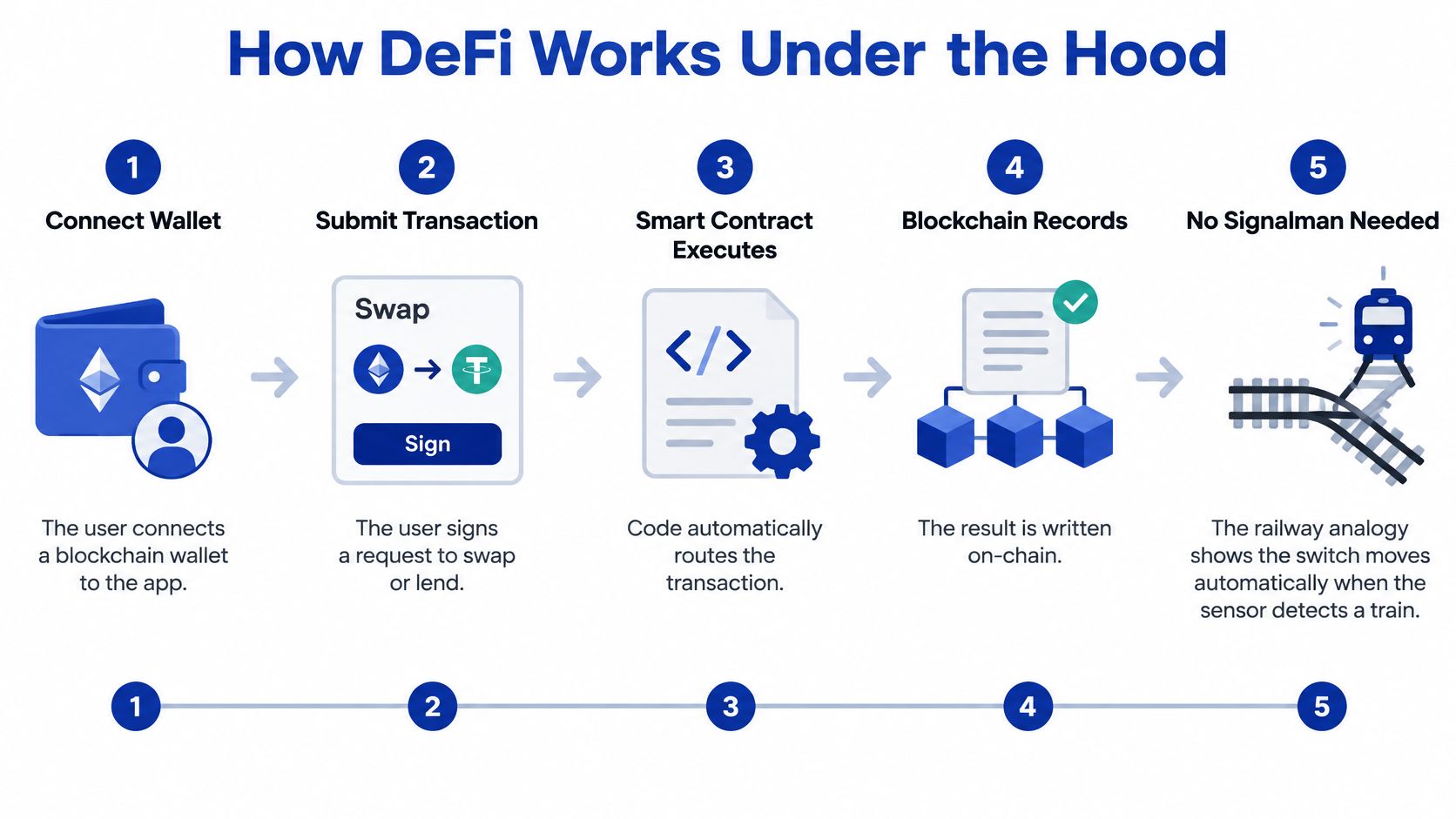
Walk one swap or loan in order, and name who does the work at each step.
- You connect a wallet. The wallet is your account key. It holds the permission to move assets, not a balance stored at a bank.
- You sign the request. Your private key approves a specific action, such as a swap or a deposit. That signature is the "yes" a clerk used to give.
- The smart contract checks its rules. The contract is the rulebook. It looks at collateral, fees, and any price the oracle just reported.
- Validators record the result. The blockchain's validators confirm the transaction and write the new ownership. Settlement is the shared record, not a bank ledger.
- Balances update. The protocol shows the new position. If the rules passed, the trade or loan is already done.
The Federal Reserve describes these services as finance on decentralized platforms that use blockchains to record and share data. The Bank for International Settlements treats smart contracts and decentralized exchanges as core pieces. Those contracts can automate lending, borrowing, trading, payments, investment, crowdfunding, and insurance.
What replaces the legal contract
Code, the governance process, price oracles, and collateral rules do the jobs firms and paper contracts used to do. An oracle is the price feed. Without it, the contract can't tell what your collateral is worth. Composability is the building-block habit. A receipt token from one deposit can be the input to a second protocol, the way one Lego brick snaps onto another.
Technical decentralization doesn't erase dependence. Concentrated developers, validators, stablecoin issuers, oracle operators, and governance-token holders can still steer outcomes. Before you deposit, check whether an independent audit covers the live code, who holds upgrade or emergency keys, how the oracle is built, and whether votes can change fees, collateral settings, or withdrawals. Fast settlement on a base chain is a different problem from moving small payments cheaply, which is why people compare on-chain apps with the Lightning Network.
The short version is easier to watch than to memorize. This walkthrough shows the same path from wallet to on-chain record.
Traditional Finance vs DeFi at a Glance
The jobs are familiar. The control structure isn't. This table puts the same function on two tracks so you can see where trust moves.
| Feature | Traditional Finance | DeFi |
|---|---|---|
| Who authorizes transactions | Banks, brokers, card networks | Smart contracts running on a blockchain |
| Account opening | Identity checks and account approval | A compatible wallet and internet access |
| Operating hours | Business hours for many services | Open every hour, every day |
| Settlement | Often 1-3 business days for bank transfers | Usually minutes, depending on network congestion |
| Reversibility | Disputes and chargebacks often possible | Generally irreversible once confirmed |
| Consumer protection | Deposit insurance and regulatory oversight in many countries | Usually none, and the rulebook differs by country |
| Decision-making | Company management and regulators | Protocol governance, often by token-holder votes |
Speed is the row people notice first. Recourse is the row that matters. In a bank transfer, a dispute desk can sometimes unwind a payment. On a confirmed blockchain transaction, there is usually no undo. Each row shows trust leaving an institution and landing on code, a vote, or you.
The line blurs in real life. Many people still buy crypto with a bank card, hold coins at a centralized exchange, or leave assets with a custodian. A protocol can have no bank in the transaction path and still depend on developers, validators, stablecoin issuers, or oracle providers.
DeFi trades reversals and deposit insurance for open access, automatic rules, and a market that doesn't close for the weekend.
Main DeFi Applications and Their Trade-Offs
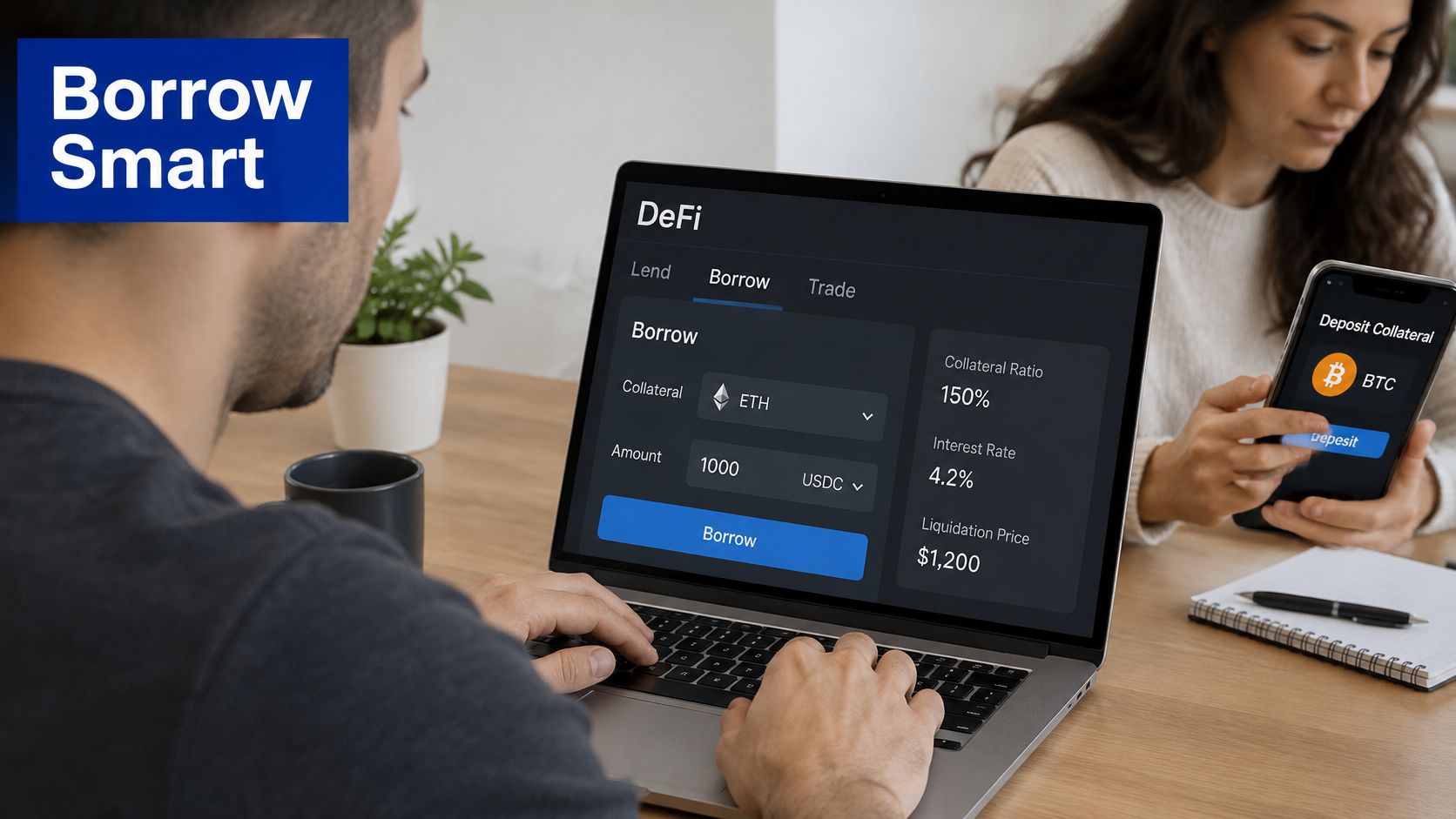
Say you put $1,000 of a dollar-pegged stablecoin into a lending pool so borrowers can use it. You earn interest while the pool is healthy. A second person locks volatile crypto as collateral and borrows stablecoins against it. Same pool, two jobs, two risks.
| Application | What It Does | Main Trade-Off |
|---|---|---|
| Decentralized exchanges | Swap tokens directly from shared liquidity pools | Convenience against price slippage on large trades |
| Lending and borrowing | Deposit assets to earn interest; borrow against overcollateralized collateral | Interest earned against liquidation risk |
| Stablecoins | Tokens pegged to a currency, used for payments and as collateral | Peg stability against issuer and collateral risk |
| Liquid staking | Stake assets to help secure a network and receive a transferable token | Staking reward against contract risk and reduced liquidity |
| Derivatives and perpetuals | Trade price exposure with leverage | Amplified gains against rapid losses |
A decentralized exchange, such as a Uniswap-style pool, doesn't match you with a named seller. It prices the swap from the pool's inventory. A small trade barely moves the price. A large one does, and you pay that gap as slippage.
Lending only works because the borrower posts more collateral than the loan. That cushion is why the lender can earn interest without a credit check. If the cushion shrinks, the position can be closed for you.
Stablecoins are the cash of this market. You use them to pay, to post collateral, and to park value between trades. The peg holds only while reserves or collateral do. If the issuer or the backing fails, every loan that treated the token as dollars is weaker at once.
Liquid staking lets you help secure a network and still hold a receipt you can move. The reward is real only while the staking contract and the receipt's market both behave. Derivatives and perpetual futures add exposure, so a small price move becomes a large gain or a fast loss.
When one deposit becomes three positions
Composability stacks these jobs. The receipt from the lending deposit can be posted as collateral somewhere else. One afternoon can include a swap, a loan, and a staked receipt. That chain is why copying someone else's buttons doesn't copy their result. A clear look at why mirrored trades deliver different results from copyfomo shows how timing, pool depth, and fees change the outcome even when the steps look identical.
Risks That Can Turn DeFi Gains Into Losses
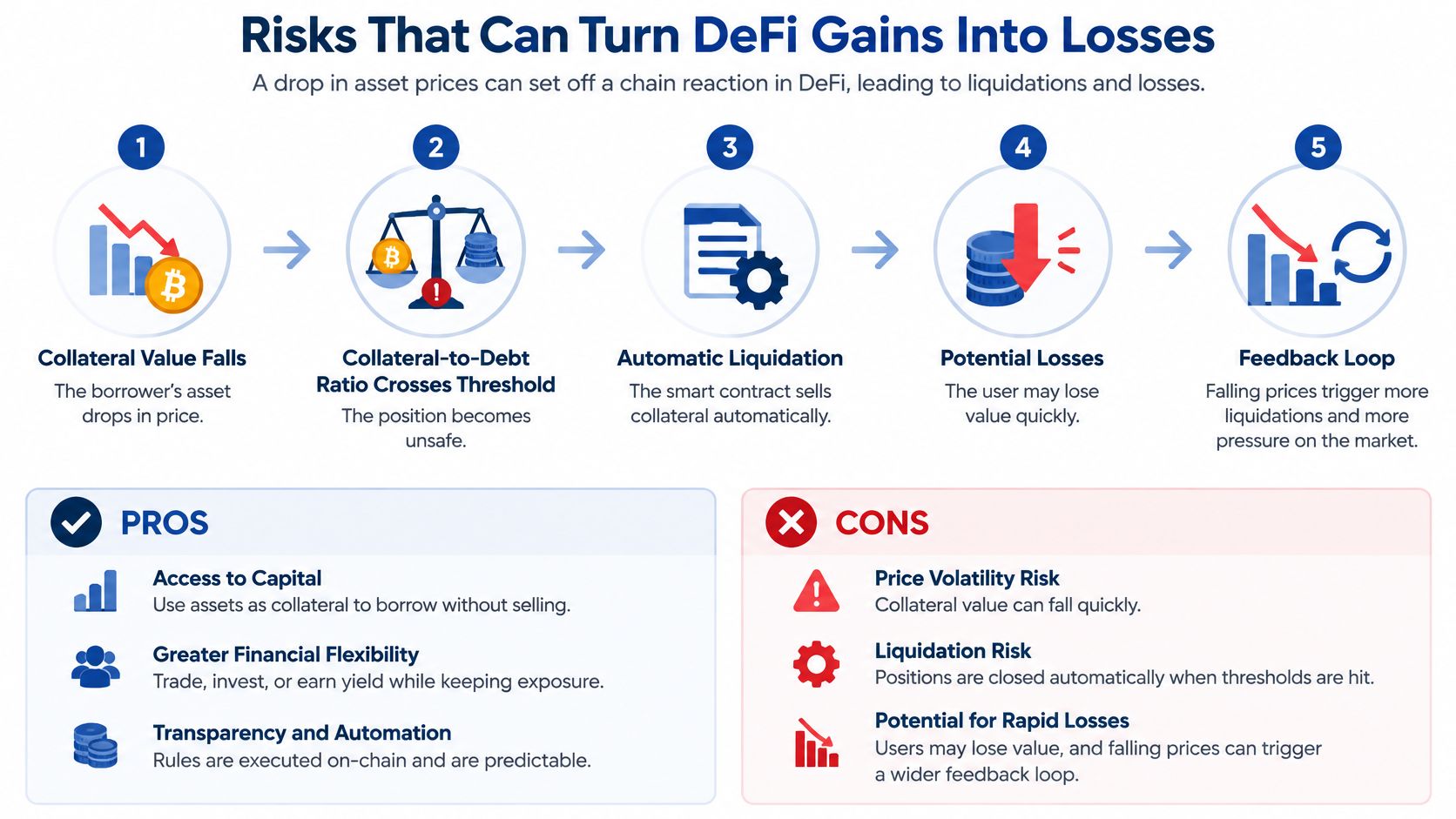
Automation doesn't only cut paperwork. It can speed up losses. Picture a borrower whose collateral price falls. The contract compares collateral with debt through an oracle. When the collateral-to-debt ratio drops through a programmed line, the contract sells the collateral. Those sales add supply, prices fall further, and more positions cross the same line. The Bank for International Settlements lists automatic collateral liquidation, risks from high borrowing, liquidity mismatches, and dependence on the underlying blockchain among DeFi's vulnerabilities.
| Risk | What Happens | Early Warning Sign |
|---|---|---|
| Liquidation cascade | Falling prices trigger forced sales that push prices lower | Collateral ratio approaching the liquidation threshold |
| Smart-contract bug | Flawed code can be exploited and may not be fixable after deployment | No independent audit, or audit reports are missing |
| Oracle failure | Wrong or delayed price data triggers bad liquidations or blocks exits | A single price source, or slow updates during volatility |
| Stablecoin depeg | A stablecoin trades below its peg, weakening collateral values | Heavy reliance on one stablecoin or unclear reserves |
| Governance failure | Votes or admin keys change fees, collateral rules or withdrawals | Concentrated voting power or unclear upgrade keys |
| Network congestion | Transactions stall or cost more exactly when users need to act | High fees and delayed confirmations during market swings |
Where the damage actually starts
A bug is sticky because many contracts can't be patched in place. If the live code is wrong, the exploit uses the rules you already agreed to. Congestion hits at the worst moment. The transaction you need in order to repay or add collateral is the one that stalls, and the fee jumps while you wait.
A bad oracle is a bad referee. A late or wrong price can liquidate a position that was still safe, or freeze an exit that should have been open. A stablecoin trading below its peg then marks down every loan that counted that token as full dollars.
High advertised yields often pay you for smart-contract, oracle, liquidity, governance, and counterparty risk. They aren't a salary. The same honesty applies when you ask whether cryptocurrencies are reliable in a business. Calculate the liquidation line and the buffer above it, test what the oracle does if it lags, and ask whether one stablecoin or one chain can take the whole position down.
Why DeFi Yield Is Not Always Income
A screen says 12% a year. Is that income? Only if you know who pays it, and in what asset.
Split the headline before you budget it.
- Borrower interest is paid by people who want the loan. It lasts while borrowing demand lasts.
- Trading fees come from people swapping through a pool you helped fund.
- Token incentives are extra coins paid to attract deposits. The program can end, and the coin can fall.
- Borrowing boosts the headline and the loss at the same time.
Say the entire 12% arrives as a reward token, and that token's price drops 30%. On a $100 deposit you receive $12 of tokens. At the new price those tokens are worth $8.40, about an 8.4% dollar return, before gas and tax. Any drop in the asset you deposited sits on top of that. The 12% was never cash in a savings account.
Impermanent loss in a liquidity pool, a depeg, a liquidation, a bad oracle, gas, and taxes can push the net result below zero. The BIS brief on stablecoin-related yields warns that these products can look like investments while lacking equivalent prudential oversight, deposit insurance, and transparency. It also flags run risk, links to banks, operational dependencies, and conflicts of interest.
Countries aren't writing one rule. Some prohibit yield products, some limit them for retail users, and some have no explicit ban. The same screen can be legal, restricted, or unavailable based on where you live.
Ask three questions before you call a rate income. Who pays it, what event stops it, and what happens to your principal in a stablecoin run?
Checking a DeFi Protocol Before You Use It
"Decentralized" is a stack of control points, not a badge. The Bank for International Settlements argues that DeFi can reproduce debt, liquidity mismatches, interconnectedness, and information gaps, and that the technology can amplify them. Work this list before you deposit.
- Who holds the code? Name the people or multisig that can upgrade contracts or hit an emergency pause.
- Does an audit match this version? An old report on retired code doesn't cover today's contract.
- How does the oracle fail? One feed, no fallback, is a single point of failure.
- Where is the liquidation line? Write down the threshold and how far today's ratio sits above it.
- What single asset or chain can sink it? If one stablecoin or one network fails, does your position fail with it?
- Can you exit? Thin liquidity means your withdrawal moves the price against you.
- Who pays the yield? If the answer is "new token emissions," treat the rate as temporary.
Who pays when it fails
Confirmed smart-contract transactions generally can't be reversed, and these protocols don't carry the consumer safeguards of a regulated bank. That leaves a gap among developers, governance-token holders, liquidity providers, users, front-end operators, and infrastructure providers. Removing the bank didn't remove the middle. It moved the middle into code, votes, servers, and market makers. Concentration in any layer creates a practical intermediary.
A wallet is part of that stack. Compare how you hold keys before you connect one, starting with a practical look at the best e-wallet for cryptocurrency. If you touch newer token markets, learn how to spot common Solana token scams from MemeAssist before a link in a chat becomes a signed approval.
Start with an amount you can afford to lose. Withdraw a small test amount before you add more. Keep a short note of each choice and why you made it. Mega Income Stream publishes a Disclaimer, and this article is general education, not personal financial advice.
Mega Income Stream explains earning methods, personal finance, and on-chain topics in plain language, including how decentralized finance fits beside other income ideas. If you want that mix of practical finance and digital earning, visit Mega Income Stream and read the guides that match the decision you're about to make.











Comments