
 By
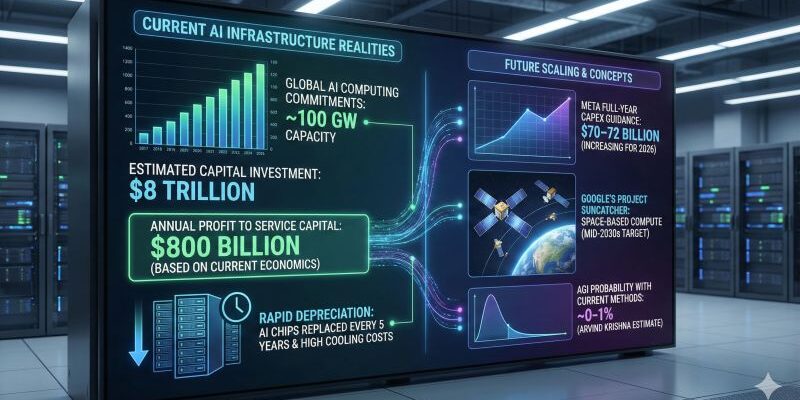
How much will the world spend on AI infrastructure, and when will that spending happen? Current estimates suggest the global AI and data-center buildout could require roughly $5 trillion to $7 trillion in cumulative investment by 2030, depending on what infrastructure is counted and how quickly artificial intelligence adoption grows.
McKinsey estimates that data centers could require $6.7 trillion worldwide by 2030 to meet growing demand for computing power. Of that total, approximately $5.2 trillion would be required specifically to meet AI-related demand.
Goldman Sachs separately estimates hyperscalers could spend approximately $5.3 trillion on AI and data centers through 2030.
Meanwhile, the International Energy Agency reports that global data-center investment had already reached approximately $500 billion annually in 2024, nearly doubling from 2022.
The important point is that the AI revolution is becoming much more than a software story. It is becoming one of the world’s largest infrastructure construction cycles:
AI → Chips → Servers → Data centers → Electricity → Cooling → Networks → Grid infrastructure
Global AI Infrastructure Timeline
| Period | Infrastructure Development | Key Figure |
|---|---|---|
| 2022–2024 | AI infrastructure accelerates | Data-center investment nearly doubles |
| 2024 | Data centers become major capital destination | ~$500B annual investment |
| 2025 | AI compute construction accelerates | ~$5.2T AI requirement estimated through 2030 |
| 2025–2030 | Massive data-center expansion | ~$6.7T total compute infrastructure requirement |
| 2026 | Hyperscaler spending accelerates | Big-tech capex expected to surge |
| 2030 | AI infrastructure reaches enormous scale | ~950 TWh data-center electricity use |
| 2030–2035 | Power becomes increasingly important | 1,200+ TWh possible in base projections |
Forecasts vary because organizations use different definitions, assumptions and scenarios.
Phase One: 2022–2024 — The AI Infrastructure Race Begins
The launch and rapid adoption of generative AI transformed demand for computing power. Training and operating sophisticated models requires:
- GPUs.
- Advanced semiconductors.
- High-speed networking.
- Memory.
- Servers.
- Data centers.
- Electricity.
- Cooling.
Money followed.
The IEA estimates global investment in data centers nearly doubled between 2022 and 2024, reaching approximately half a trillion dollars in 2024 alone.
This period effectively established the physical foundation of the generative-AI boom. But it was only the beginning.
Phase Two: 2025 — The $5.2 Trillion AI Requirement Emerges
By 2025, analysts were beginning to quantify the extraordinary scale of infrastructure that might be necessary. McKinsey estimated that companies across the compute-power value chain would need to invest approximately $5.2 trillion in AI-related data centers by 2030.
When traditional computing requirements are included, the estimate increases to approximately:
$6.7 trillion.
This includes much more than buildings. McKinsey’s calculations incorporate major categories such as:
AI accelerators + Networking + Storage + Data-center construction + Mechanical systems + Electrical systems + Power generation + Transmission
In other words, the multi-trillion-dollar AI infrastructure market isn’t simply about buying Nvidia-style accelerators.
It’s an entire industrial ecosystem.
Phase Three: 2025–2026 — Big Tech Capex Explodes
The next stage is already visible in corporate spending. The IEA reported that capital expenditure among five major technology companies exceeded $400 billion in 2025.
Even more strikingly, it expects that figure to increase by another 75% in 2026, driven largely by data-center investment. That would represent an extraordinary concentration of capital into computing infrastructure.
Read Also: Beyond the Hype: What Actually Counts as AI Infrastructure
Goldman Sachs expects private markets to play an increasingly important role in financing the expansion. Its research estimates hyperscalers could spend approximately:
$5.3 trillion on AI and data centers through 2030.
Goldman also reported that infrastructure funds held more than $1.7 trillion in assets and roughly $400 billion of dry powder as of September 2025. The AI boom is therefore pulling capital from:
Technology companies + Banks + Bonds + Private credit + Infrastructure funds + Institutional investors
This is becoming a global financing story as much as a technology story.
Phase Four: 2026–2030 — The $7 Trillion Buildout
By 2030, McKinsey estimates cumulative global data-center spending could approach $7 trillion. Another McKinsey analysis projects global data-center demand could rise from approximately 82 gigawatts in 2025 to about 220 GW by 2030.
That’s close to tripling capacity in only five years. And facilities themselves are becoming larger. Historically, a data center might require tens of megawatts.
The next generation can require:
Hundreds of megawatts → 1 gigawatt → Multiple gigawatts
This changes the economics of AI. A gigawatt-scale AI campus starts looking less like an office building and more like heavy industrial infrastructure.
Where Will the Trillions Go?
The investment isn’t going into one category.
| Infrastructure | Why It’s Needed |
|---|---|
| AI chips | Training and inference |
| Servers | Hosting compute |
| Memory/storage | Handling AI datasets |
| Networking | Connecting accelerators |
| Data-center buildings | Housing equipment |
| Cooling | Removing enormous heat loads |
| Power generation | Supplying electricity |
| Transformers | Connecting facilities |
| Transmission | Delivering power |
| Battery storage | Stabilizing electricity supply |
| Fiber | Moving information |
| Land | Building hyperscale campuses |
This is why AI infrastructure has become relevant to industries that historically had little connection with Silicon Valley. An electrical-equipment manufacturer can now be part of the AI supply chain.
So can a utility.
Phase Five: Electricity Becomes the Constraint
Compute requires electricity. And electricity is rapidly becoming one of AI’s most important bottlenecks. The IEA estimates global data-center electricity consumption will roughly double from 485 terawatt-hours in 2025 to approximately 950 TWh in 2030.
AI-focused data-center consumption is expected to grow even faster:
Approximately 3× by 2030.
The IEA says:
“AI is pushing data centre power density to the limits of today’s technologies.”
Between 2020 and 2025, the power density of AI servers increased approximately 11-fold. By 2027, the IEA expects another fourfold increase. That puts pressure on:
Transformers + Gas turbines + Batteries + Transmission + Nuclear + Renewable generation + Grid connections
AI infrastructure is consequently becoming energy infrastructure.
The $170 Billion Power Generation Requirement
Data centers cannot simply plug into an unlimited electrical grid. New generation needs to be constructed.
The IEA estimates another $4.2 trillion of global data-center investment between 2025 and 2030, accompanied by more than $170 billion required for new electricity-generation capacity.
Renewables are expected to provide a significant portion of additional electricity. But the mix is broader. The IEA expects additional data-center demand to be supplied by:
Renewables + Natural gas + Nuclear + Coal in some markets + Energy storage
Its 2025 outlook projected electricity generation serving data centers to rise from approximately 460 TWh in 2024 to more than 1,000 TWh by 2030.
The distinction between generation and consumption estimates reflects grid losses and methodological differences, but both point toward the same conclusion:
AI requires a massive expansion of energy infrastructure.
Phase Six: 2030–2035 — AI Becomes Permanent Infrastructure
2030 isn’t the finish line. It’s likely a milestone. The IEA’s base case sees global data-center electricity consumption continuing upward to around 1,200 TWh by 2035.
Its electricity-generation analysis estimates more than 1,300 TWh could be required to supply data centers by 2035. Under a faster AI-adoption scenario, generation requirements could approach:
2,000 TWh.
That is why today’s AI investment cycle may eventually resemble previous infrastructure transformations such as:
Railroads → Electricity → Telecommunications → Internet → Cloud computing → AI infrastructure
The technology starts as innovation. Eventually it becomes infrastructure society depends upon.
What Could Slow the Multi-Trillion-Dollar Buildout?
The biggest risk is assuming every announced data center will actually be built. The IEA identifies growing physical bottlenecks involving:
- Advanced chips
- Transformers
- Gas turbines
- Grid connections
- Planning approvals
- Electricity generation
- Supply chains
It says these bottlenecks are already reducing the probability of the most aggressive near-term expansion scenarios despite booming investment pipelines.
- There is also economic uncertainty.
- AI models may become dramatically more efficient.
- Enterprise adoption could develop more slowly than expected.
- Capital costs could rise.
- Some data centers could become obsolete.
- And the industry could eventually build more compute capacity than customers economically need.
Projected investment is not guaranteed spending.
Bottomline
The global AI infrastructure timeline is moving from billions to trillions. The progression looks approximately like this:
- 2022–2024: Data-center investment accelerates.
- 2024: Annual global investment reaches roughly $500 billion.
- 2025–2030: McKinsey estimates roughly $5.2 trillion could be required specifically for AI-related data-center demand.
- By 2030: Total compute-related data-center investment could approach $6.7 trillion, with higher-growth scenarios reaching about $7.9 trillion.
- 2030–2035: Electricity infrastructure becomes increasingly important as global data-center power requirements continue expanding.
The central lesson is simple:
Artificial intelligence may be digital, but scaling it is intensely physical.
- Every AI model ultimately needs chips.
- The chips need servers.
- Servers need data centers.
- Data centers need cooling.
- And everything needs electricity.
That’s why the multi-trillion-dollar AI opportunity stretches far beyond software companies.
The next stage of the AI revolution may be defined as much by power plants, transformers, cooling equipment, data centers and construction sites as by algorithms.
FAQ
How much AI infrastructure investment will be needed by 2030?
McKinsey estimates approximately $5.2 trillion for AI-related data-center infrastructure, increasing to roughly $6.7 trillion when broader computing demand is included.
How much electricity will data centers consume by 2030?
The IEA’s updated central projection estimates approximately 950 TWh in 2030, compared with 485 TWh in 2025. AI-focused data-center electricity consumption is expected to triple over that period.
What infrastructure will receive the investment?
Major beneficiaries of spending include semiconductors, servers, networking, data-center construction, cooling, electricity generation, transformers, transmission infrastructure, storage and fiber networks.
Could global AI infrastructure spending exceed $7 trillion?
Possibly. McKinsey’s central analysis estimates roughly $6.7 trillion of data-center investment through 2030, while its accelerated-demand scenario estimated requirements could reach approximately $7.9 trillion.
Source: iea.org/reports









Comments