
 By
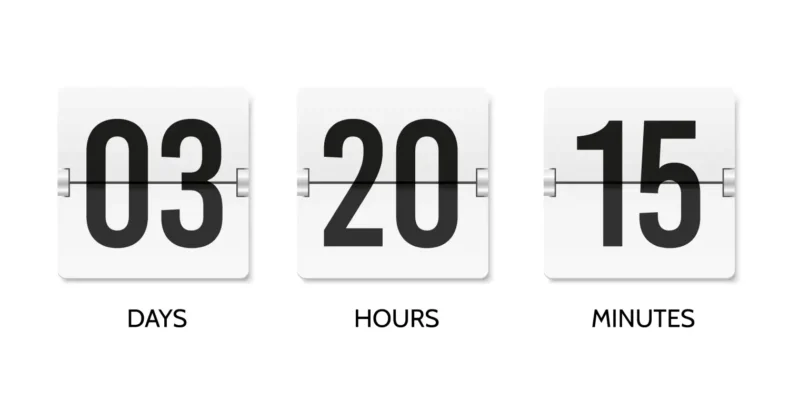
Countdown timers can encourage customers to act sooner, but they do not reliably increase sales in every situation. Their impact depends on the offer, the audience, the deadline, and whether shoppers believe the timer represents a genuine change.
A clock counting down to a real course enrolment deadline can provide useful information. A clock that restarts every time someone returns creates a different experience.
For business owners, the important question is whether the timer produces additional profitable purchases without increasing refunds, complaints, or distrust.
Here is what the research suggests, which urgency metrics matter, and how to test countdown timers properly.
Why Countdown Timers Influence Buying Decisions
A deadline changes the decision a customer faces. Without one, someone can think, “I will come back later.” With a genuine deadline, they must decide whether the offer is worth accepting before it changes.
That can help customers who already understand the product but keep postponing a decision.
However, the same pressure can make uncertain shoppers uncomfortable. Someone buying an unfamiliar course or expensive service may need more information rather than less time.
A timer therefore amplifies the buying situation already present. It cannot fix a confusing offer, an unsuitable product, or missing information.
What Research Says About Urgency
There is no dependable universal percentage showing how much a countdown timer increases sales. Research on scarcity also covers different mechanisms. A time limit, low-stock message, and limited-edition product are not interchangeable.
Scarcity effects vary by context
A 2022 meta-analysis published in the Journal of Retailing examined 416 effect sizes across 131 studies.
The researchers found that different scarcity messages worked differently across product types. Time-based scarcity had its strongest effect on purchase intentions for high-involvement products.
However, purchase intention is not the same as completed purchases, retained revenue, or profit. The study does not establish a universal timer conversion lift.
Timers can create an unpleasant experience
An experiment involving 202 participants, published in Behaviour & Information Technology, examined limited-time and limited-quantity cues.
Participants associated scarcity cues with lower perceived benevolence from sellers. The experience without scarcity cues performed better on user-experience measures, while limited-time cues generated frustration-related negative emotions.
Another exploratory study presented at CHI in 2023 found no quantitative evidence that deceptive countdown timers influenced product choice more strongly than discounts alone. Participants also reported negative reactions to the deceptive timers.
Its experimental setting and limitations mean the findings should not be treated as a forecast for every store. The practical lesson is to measure both purchasing behaviour and customer consequences.
Genuine Deadlines Versus Artificial Pressure
Before adding a timer, finish this sentence:
“When the countdown reaches zero, this specific thing changes.”
If you cannot answer clearly, the timer probably needs rethinking.
| Timer purpose | What should happen at expiry |
|---|---|
| Live workshop registration | Registration closes |
| Introductory price | The stated price changes |
| Shipping cutoff | The relevant delivery promise changes |
| Bonus availability | The specified bonus becomes unavailable |
| Genuine reservation | Reserved availability is released |
The wording should match the actual consequence. For example, if only a bonus expires, say:
“Book by Friday to receive the additional planning session.”
A broad “Your last chance!” message can imply that the entire product disappears, even when it remains available.
The Urgency Metrics That Matter
Timer performance should be measured across the whole customer journey.
| Metric | Calculation or definition | Why it matters |
|---|---|---|
| Purchase conversion rate | Purchasers ÷ eligible visitors | Measures completed buying |
| Revenue per visitor | Net revenue ÷ eligible visitors | Combines conversion and spending |
| Checkout completion | Completed orders ÷ checkout starters | Reveals checkout friction |
| Time to purchase | Time between defined exposure and purchase | Shows whether decisions happen sooner |
| Refund rate | Refunded transactions ÷ paid transactions | Flags possible regret or mismatch |
| Contribution per visitor | Revenue minus defined variable costs, divided by visitors | Measures commercial value |
| Repeat purchase or renewal | Subsequent customer behaviour | Helps assess longer-term effects |
Clicks on a purchase button are useful diagnostic information. They are not evidence of a successful sale. Use a consistent visitor definition and avoid counting one customer as several independent people because they returned repeatedly.
How to Calculate Conversion Lift Correctly
Suppose a sales page converts 3% of visitors without a timer and 3.6% with one. The absolute increase is:
3.6% − 3.0% = 0.6 percentage points
The relative increase is:
(3.6% − 3.0%) ÷ 3.0% × 100 = 20%
Both descriptions are correct.
However, “20% more conversions” can sound much larger than the underlying change. With 1,000 visitors, it represents six additional purchases.
Always report:
- The number of visitors.
- The number of purchases.
- The absolute difference.
- The relative difference.
- Statistical uncertainty.
- The measurement period.
A small apparent improvement may simply reflect ordinary variation.
A Worked Example: More Orders, But How Much More Revenue?
Imagine a hypothetical digital guide priced at $50. A test assigns 10,000 eligible visitors to each version.
| Result | Deadline text only | Deadline text plus timer |
|---|---|---|
| Visitors | 10,000 | 10,000 |
| Purchase conversion | 3.0% | 3.6% |
| Purchases | 300 | 360 |
| Initial sales | $15,000 | $18,000 |
| Fully refunded purchases | 15 | 36 |
| Refund rate | 5% | 10% |
| Revenue after refunds | $14,250 | $16,200 |
The timer version produces $3,000 more initial sales, but only $1,950 more revenue after refunds. If additional fulfilment, support, payment, and timer-related expenses total $1,000, the remaining improvement is $950 before other costs and tax.
Read Also: Are Black Friday deals worth it?
The example shows why gross sales can overstate the benefit. It also raises a question worth investigating: why did the refund rate increase?
Check Whether the Timer Creates New Sales or Earlier Sales
Urgency can bring forward purchases that would have happened later. Suppose one version sells 100 additional courses during a weekend promotion. Over the following month, that same group purchases 90 fewer courses than the comparison group.
The initial advantage has mostly disappeared. This is sometimes called purchase acceleration.
To assess it:
- Compare equivalent customer groups.
- Measure purchases during the offer.
- Continue observing after expiry.
- Include refunds and later purchases.
- Examine the total contribution over a suitable period.
Choose the period around your buying cycle. A low-priced download and a substantial training programme may require different observation windows.
How to Run a Useful Countdown Timer Test
A clean test separates the timer from other changes.
Step 1: Use a genuine deadline
Define the offer, expiry time, time zone, and exact consequence.
Step 2: Keep the underlying offer consistent
To test the display itself, both groups should receive the same price, product, and deadline. One group can see clear deadline text. The other sees the same information with a timer.
Step 3: Randomly assign eligible visitors
Keep returning visitors in their original group where possible. Ensure both groups encounter comparable traffic throughout the promotion.
Step 4: Set the main outcome beforehand
Contribution per visitor is useful when delivery costs vary. Revenue per visitor can also work when combined with cost and refund checks.
Step 5: Plan the analysis
Set the sample-size requirement, analysis date, and stopping rules before examining results. A short promotion may end before enough data accumulates. Report that limitation rather than declaring a winner from a handful of orders.
Step 6: Check the complete outcome
Review refunds, complaints, support workload, and subsequent customer behaviour.
Make the Timer Easy to Understand
A helpful timer tells people what is happening without dominating the page.
Use:
- A descriptive label.
- A clear deadline and time zone.
- Readable text.
- Enough surrounding information to evaluate the offer.
- Consistent timing across the page, email, and checkout.
Avoid covering refund information, product details, or navigation. Display a readable deadline alongside the moving clock. Customers should still understand the offer if the timer fails to load.
Test expiry behaviour, caching, and checkout pricing before launching the promotion.
Real-World Lessons From Developed Markets
Regulators have focused on timers that misrepresent availability.
| Market | Relevant example or guidance |
|---|---|
| United States | The FTC identifies countdowns for offers that are not genuinely time-limited as a deceptive design concern |
| United Kingdom | Emma Sleep admitted misleading countdown and other urgency practices in a court-confirmed settlement in May 2026 |
| Canada | Competition Bureau guidance warns against timers that expire or reset while the sale price remains |
| Australia | The ACCC announced penalties paid by James Lane and Vuly in September 2026 over allegedly misleading sale-duration claims |
These examples concern misleading representations, rather than establishing that every countdown is unlawful.
Canada’s Competition Bureau gives a straightforward instruction: “Be truthful about the duration of the sale.”
That principle is also good customer communication.
Can Personalised Countdown Timers Work?
A personalised deadline can have a genuine purpose—for example, a clearly explained offer available for a stated period after registration. However, the stated conditions need to be real and consistently enforced. Reloading the page should not quietly create another deadline.
Consider whether the customer can understand:
- When their eligibility begins.
- When it ends.
- What changes afterwards.
- Whether the offer is personal.
- Any relevant exceptions.
A timer plugin’s technical capability does not establish that its marketing claims are accurate. For many businesses, a fixed campaign deadline is simpler to explain and administer.
When a Timer Is Unlikely to Help
Consider improving the page first when:
- Customers do not understand the product.
- Pricing or recurring charges are unclear.
- Important compatibility information is missing.
- Checkout is unreliable.
- Buyers need individual advice.
- The offer has no meaningful deadline.
A useful comparison table, representative preview, or clear answer to a common question may resolve the hesitation more effectively.
Test the actual obstacle rather than assuming every delay reflects a lack of urgency.
Final Thoughts
Countdown timers can help communicate real deadlines and encourage timely decisions. Their value depends on the additional contribution they create and the experience customers receive afterwards.
Measure completed purchases, refunds, costs, and later behaviour. Explain what expires and follow through when the clock reaches zero.
A credible deadline can support a good offer. Trust determines whether customers return after the promotion ends.
FAQ
1. How much can a countdown timer increase conversions?
There is no reliable universal percentage. Results depend on the audience, offer, deadline, design, and measurement method. Test against a comparable version of your page.
2. Are countdown timers legal?
Genuine, accurately described deadlines can be legitimate, while misleading timers can breach consumer-protection requirements. The applicable rules depend on the market and circumstances.
3. Should my timer restart when someone returns?
It should not restart in a way that contradicts the deadline you promised. Preserve genuine expiry conditions and explain any personalised offer clearly.
4. What is the best metric for judging a timer?
Contribution per eligible visitor provides a strong financial measure when calculated consistently. Review it alongside conversion, refunds, complaints, and longer-term customer behaviour.
Source: ScienceDirect










Comments