
 By
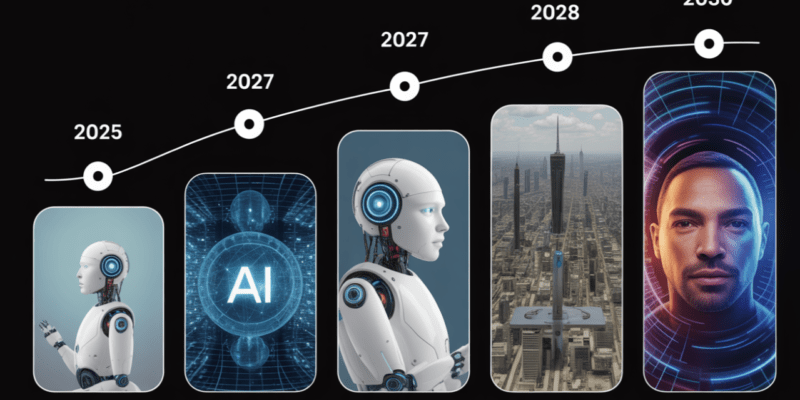
Predictions for the AI Market in 2030
By 2030, the global artificial intelligence market is projected to skyrocket past $1.2 trillion, driven by a massive surge in autonomous agentic workflows, data center capital expenditures exceeding $3 trillion, and widespread economic integration that could boost global GDP by roughly 16%.
- Valuation: Market analysis expects the AI sector to scale from roughly $224 billion in 2024 to over $1.23 trillion by 2030 at a compound annual growth rate (CAGR) near 32.9%.
- Data Centers: Worldwide capital expenditure on data centers will surpass $3 trillion by 2030, heavily anchored by high-end accelerators and specialized AI cloud providers.
- Hardware & Optics: The AI data center optical interconnect market alone is projected to hit $144 billion, driven heavily by silicon photonics and co-packaged optics.
- Autonomous Workflows: By 2030, AI shifts from passive tools to active partners capable of handling end-to-end business workstreams, negotiations, and supply chain management with human oversight as the default.
- Token Consumption: Enterprise and consumer utilization of agentic AI is forecasted by financial analysts to trigger a massive 24-fold increase in global token consumption.
- Labor Market Disruption: Up to 70% of companies are expected to adopt core AI technologies, creating intense productivity gains while heavily disrupting entry-level intellectual and administrative job roles.
By 2030, AI stops being a set of tools and becomes the interface for life, the engine of the economy, and the wiring of society. We move from clicking and tapping to talking and delegating, from simple automation to autonomous value creation, and from patchwork systems to infrastructure that runs on data and energy at nationwide scale.
Yes, raw capability jumps matter. However, the big story is deep integration. The thread running through all of this is simple. Humans stop doing everything by hand and start directing autonomous systems with clear goals. If you want the most useful AI predictions for 2030, start there.
Prediction 1: The End of the Standalone App
Look, we all know the drill today. You bounce between a dozen apps to finish one job. By 2030, that goes away for most daily tasks. Goal based agents will take your intent as input, then stitch together services behind the scenes.
Instead of opening five apps to plan a trip, you’ll say, book me a two day New York visit on a $900 budget, direct flights, hotel within 0.5 miles of the venue, and a 7 am gym slot both days. The agent hits your calendar, loyalty programs, payment methods, and company policy. It returns one clean plan with receipts. That is what next-gen AI applications look like at scale.
This is the final abstraction layer above apps. You keep your favorite services, but the agent composes them faster than you can click. In addition, vendors will compete to be the easiest to orchestrate with fast APIs, clear pricing, and reliable data rights. If you track AI predictions for 2030, watch the usage share that flows to agent friendly platforms.
Prediction 2: Every Professional Has a Chief of Staff
Today’s “copilots” still feel like autocomplete with benefits. By 2030, every pro has a personal chief of staff that handles the grind. You set targets and taste. The agent drafts, schedules, books, follows up, and learns your style.
Picture Monday at 9 am. The agent has already summarized your weekend emails, flagged 6 that truly matter, booked 3 meetings, prepped 2 agendas, and drafted a 1 page brief with the latest numbers. It also wrote 4 follow ups, each in your voice, and queued 2 posts with analytics baked in. You review, tweak, and hit go. Therefore, you spend your time on choices, not chores.
The payoff is huge. AI software revenue is on track to pass 100 billion dollars by the end of 2025, growing near 34.9% CAGR. As adoption spreads, productivity lifts compound. If you want useful AI predictions for 2030, factor in how many hours get freed per worker. Even a 10% boost across 500 million knowledge workers is a tidal wave.
Prediction 3: Hyper Personalization Becomes Ambient
Your media, education, and shopping will feel hand tuned. Not just recommended, but generated or remixed in real time for your context. Watch a video lesson and the agent pauses to insert a 30 second explainer using your own notes. Open a recipe and the agent swaps ingredients to match your macros and your pantry at 7 pm on a Thursday.
Commerce follows the same playbook. Prices, bundles, and content adapt to your goals. In addition, consent gets cleaner. You grant the agent rights to use your history inside guardrails. It tracks what you allow and why. With the right privacy settings, you still get convenience without handing out your entire life. That’s the practical side of AI predictions for 2030 that folks often skip.
Prediction 4: The Automation of Scientific Discovery
Here’s where it gets wild. By 2030, models will form hypotheses, design experiments, run sims, and propose next steps across materials, drug discovery, and biology. You describe the target. The system builds a ranked plan, with budget and time estimates, then updates as data rolls in.
Think about a lab that can test 10 thousand compounds per week with AI driven candidates. If the hit rate rises from 0.1% to 0.5%, that is a 5x jump in useful leads. In addition, AI can write lab code from plain language, point out protocol gaps, and translate proof sketches into formal math. This is the industrialization of the scientific method, and it shows up across R&D orgs with hundreds of millions in annual spend.
Read Also: The Silent Partner: How Artificial Intelligence Drives Instagram Growth
Put numbers on it. If AI contributes 15.7 trillion dollars to the global economy by 2030, even a 5% slice tied to faster discovery is 785 billion dollars. That is why so many AI predictions for 2030 center on labs, chemistry, and bio. Time to market drops, and so does cost per candidate.
Prediction 5: The Physical World Gets a Digital Nervous System
Sensors, robots, and models mesh into live control systems. That means logistics that route themselves, factories that schedule around parts and energy prices, and farms that adjust irrigation by square meter. You get fewer stoppages and tighter yield.
Picture a warehouse in 2029. Vision models track 100% of inbound units. The system staggers unloading to match staffing, then runs picker routes to cut feet walked by 22%. Forklifts move in sync with charging cycles. In addition, drones count inventory nightly. The agent predicts delays 48 hours out and reroutes 12% of orders preemptively. None of this needs a dashboard open all day. It just runs.
The tech steps are clear. Better spatial reasoning, better grasping, and better sim to real transfer. However, the switch flips when companies link those models to scheduling, markets, and maintenance. That is when AI predictions for 2030 touch the real world in a way you can measure in dollars, miles, and minutes. The whole setup functions like a digital nervous system.
Prediction 6: The Synthetic Artisan Emerges
Mass production once meant sameness. By 2030, we get mass customization at scale. AI will draft one off products that meet tight specs, then push them through flexible lines. You will see it in mechanical parts, apparel, furniture, and even home layouts.
A brand could sell 50 thousand bikes, each with a fit tuned to the rider. CAD files change per order. Tool paths update on the fly. Quality control learns the customer’s priority, whether it is weight, comfort, or cost. In addition, creators will ship unique digital goods for fans at scale with custom art, custom audio, and interactive stories. The line between studio and workshop blurs.
The money trail fits the bigger numbers. Generative AI sits near 37.89 billion dollars in 2025 and could pass 1 trillion dollars by 2034, a 44.2% CAGR. When you map that to factories and studios, the case for AI predictions for 2030 that favor bespoke at scale gets pretty strong.
Prediction 7: Healthcare Shifts from Reactive to Predictive
Instead of waiting for symptoms, care moves upstream. Wearables and ambient sensors collect continuous signals. Models flag risks early, then route you to care before things go sideways. Your primary care team gets a daily digest with 3 real actions, not a flood of noise.
Imagine a 55 year old with a heart risk profile. The system picks up micro changes in recovery and sleep, correlates with diet and meds, and suggests a 30 day plan. It books a virtual check in, orders labs, and adjusts goals. In addition, it closes the loop by tracking adherence and outcomes. You feel guided, not nagged.
The numbers back the shift. If early detection trims hospitalizations by even 8% across tens of millions of patients, the savings run into tens of billions. That is why so many AI predictions for 2030 call out prevention first, treatment second.
Prediction 8: The Prove It’s Human Economy
Synthetic media will be everywhere. That is not a scare line. It is just the math of cheap generation. Therefore, we will adopt digital watermarking, cryptographic signatures, and new etiquette that puts provenance up front.
You will see green check marks next to live video that is verified at capture. You will see content passports that log edits. In addition, payments and perks will favor verified accounts in high risk spaces. This is not about killing creativity. It is about making trust cheap again. Any responsible list of AI predictions for 2030 needs to include this authentication layer.
Prediction 9: AI Governance Becomes a Geopolitical Battleground
Countries will not agree on one set of rules. Some will favor open ecosystems with broad data flows. Others will lock down data and models within borders. That split will create digital blocs with different standards for safety, privacy, and export.
Watch three things. First, data sovereignty laws that decide where data can sit. Second, licensing for frontier models tied to compute and evaluations. Third, cross border rules for safety tools. In addition, trade deals will start to include compute access and energy guarantees. If you stack up AI predictions for 2030 by region, you will see at least two or three distinct playbooks.
Prediction 10: Energy Becomes the Ultimate AI Bottleneck
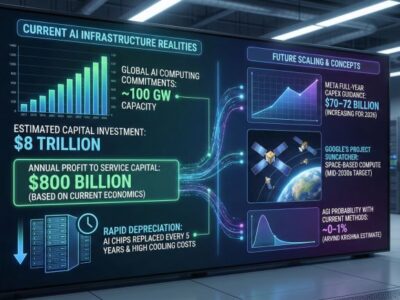
Training and running large models is hungry work. By 2030, the main limit is not algorithms or datasets. It is power. We are talking gigawatts for data centers the way small cities draw power. That means siting near cheap electricity and building new capacity fast.
Here are some hard numbers. If model training scale keeps climbing, single projects could pull 100 to 500 megawatts. Fleet wide needs land in the multi gigawatt range. In addition, the grid must handle spikes and provide steady supply. Nuclear, wind, solar, hydro, storage, and demand response all matter. Data centers will publish PUE under 1.2 and track hourly carbon intensity. If you care about grounded AI predictions for 2030, you have to care about terawatt hours.
This is solvable with money and planning. Capital will flow because the returns pencil out. If AI lab revenue keeps rising through 2030, hundred billion dollar buildouts are not only possible, they are rational. However, time to permit and interconnect can slow everything, so policy speed matters.
Finally
By 2030, AI is the interface we talk to, the engine that creates value, and the wiring that keeps the modern world running. The dollars, the adoption curves, and the energy builds all point the same way. Agents move from assist to act, science speeds up, factories think, and society updates how we prove, govern, and power everything.
FAQ
How far will AI be in 2030?
The global Artificial Intelligence (AI) market is projected to grow aggressively, expanding from its current multi-hundred-billion-dollar valuation to a market size between $827 billion and $1.8 trillion by 2030. This represents an explosive compound annual growth rate (CAGR) of 25% to 36%. Additionally, economists project that AI investments and adoption will drive a massive global economic impact, contributing up to $15.7 trillion to the global GDP by the end of the decade.
Where will AI be in 5 years prediction?
In five years (by 2031), AI is projected to shift from a reactive chat tool into autonomous agentic systems that run multi-step workflows, manage continuous enterprise operations, and integrate invisibly into everyday software. Industry projections estimate a multi-trillion dollar global economic impact, alongside widespread humanoid robot deployment and major workforce transformations.
What is the future of AI in the next 10 years?
Over the next 10 years, artificial intelligence will shift from separate chat tools into invisible background infrastructure. AI will drive major breakthroughs in personalized medicine, autonomous daily workflows, and scientific research, while raising vital questions about workforce shifts, synthetic media trust, and global regulation.
Which jobs will AI take over by 2030?
By 2030, AI will not completely eliminate most entire professions, but it will heavily automate routine, rule-based, and digital tasks. The roles facing the highest risk of displacement are concentrated in administrative support, basic data processing, telemarketing, and entry-level content creation.
Source: zigron.com










Comments