
 By

The most repeated advice on this topic is that passive income and residual income are two names for money you earn without working. That shortcut is popular because it sells a simple picture. It also steers people into the wrong tax bucket, the wrong capital test, and the wrong estimate of how much work is left.
A rent deposit, a dividend, a book royalty, and a recurring sales commission can all arrive on a schedule. They don't answer the same question. One idea is about how involved you still are. The other is about what remains after a cost, either your bills or the return your capital should have earned. Treat them as synonyms and you'll misread both the cash and the obligation attached to it.
Table of Contents
- Why Passive and Residual Income Get Mixed Up
- Defining Passive Income by Level of Participation
- Defining Residual Income Across Finance and Accounting
- Comparing Cash Flow, Accounting, and Tax Meanings
- Judging Income Streams by Workload, Capital, and Risk
- Matching Each Income Type to Your Situation
- Your Next Step for Choosing an Income Model
Why Passive and Residual Income Get Mixed Up
Writers swap the phrases because both sit outside a paycheck. Blog lists, sales decks, and social posts then treat every recurring deposit as automatic, lightly taxed, and built to last. Readers budget around that story. Tax rules and corporate-finance usage don't follow it.
Passive income, in its stricter sense, is about participation. Did you materially run the activity, or did you mostly commit capital or rights and step back? Residual income answers a leftover question. In household budgeting it means cash after expenses and debt payments. In corporate finance it means accounting profit after a charge for the capital tied up in the business.
Those jobs aren't interchangeable. A rental can send monthly cash and still fail a capital test if the equity could have earned more elsewhere. A sales residual can keep paying after the first close and still need service every month. A dividend can feel hands-off and still belong in a tax category that everyday writing never mentions.
Where the labels collide
Three sources cause most of the mix-ups:
- Portfolio cash: Interest and dividends arrive without a shift, so lists file them under passive. The tax label is often different.
- Rent and royalties: Recurring checks look like leftover money and like effort-free money at the same time. Repairs, promotion, and how the rights were created can pull them back toward active work.
- Subscriptions and commissions: Automated billing creates a residual payment. The operator may still be running a business.
Planning rule: Name the lens before you name the income. Cash-flow language, accounting language, and tax language can assign three different jobs to one deposit.
Keep those lenses apart when you compare options. The useful test is hours, capital, risk, and how fast the revenue decays, not whether the transfer posts by itself.
Defining Passive Income by Level of Participation
Two owners of the same duplex can file under different rules. One interviews tenants, schedules repairs, and pays contractors; the other signed a management contract and reads a monthly statement. The IRS passive-activity test measures the first owner's hours, not the second's mailbox.
In U.S. tax law, the Internal Revenue Service defines passive activity income as income from activities in which the taxpayer does not materially participate. Profits from a passive business count, and so do gains from selling an interest in a passive activity or the property behind it. Whether the deposit arrives without a daily task is irrelevant to the classification.
The same rules fence off portfolio income. Ordinary interest, dividends, annuities, and royalties outside the ordinary course of a business fall outside the passive-activity category. Wages, commissions, and self-employment income from a business you materially participate in are excluded too. Everyday writing still files dividends, rent, and automated online revenue under "passive," while the tax code asks a narrower question: did you materially participate in the activity that produced it?
The test is also local. Tax codes that draw a participation line set their own thresholds, and many categorize income strictly by source. An identical rent check can carry a different label across a border.
Who already holds non-labor income
Federal Reserve household survey data shows receipt of interest, dividend, and rental income climbing steeply with age, while younger adults rely mostly on wages. Retirement income concentrates at the upper end of the age range for the same reason: it takes years of contributions before a stream pays back.
Age separates who already holds non-labor cash from who is still building it.
That skew changes what the word means for each reader. A 25-year-old comparing income models usually has time and little capital; a 60-year-old often holds the reverse. One label covers both situations and hides the binding constraint.
Online sellers stretch the term further. Staking, lending, and yield products get marketed as effort-free while price swings, platform risk, and lockups sit underneath the quoted rate. Read a clear walk-through of how crypto passive income works before treating that rate as spendable cash. The same caution applies to websites, courses, and affiliate setups; anyone weighing those options can start with a practical map of what tends to work for passive income online that doesn't pretend the work disappears.
Defining Residual Income Across Finance and Accounting
Residual income is mainly an accounting and valuation measure. It isn't a synonym for money that earns itself. You calculate it by subtracting a capital charge, the required return on invested capital, from accounting profit:
Residual income = net income − (required rate of return × invested capital).
A business can show a positive accounting profit and still produce negative residual income. Earnings failed to pay investors for the capital they tied up.
A worked example
Take a business that earns $120,000 after tax on $1,000,000 of equity, with a 10% required return. The capital charge is $1,000,000 × 10%, or $100,000. Residual income is $120,000 − $100,000, or $20,000. Drop after-tax earnings to $80,000 and the accounting profit is still positive, while residual income turns negative by $20,000. The cash exists. It doesn't cover the opportunity cost of the equity.
The economic concept traces to Alfred Marshall's 1890 work, and General Motors used residual-income analysis to judge business segments as early as the 1920s. After World War II the idea gained ground in management accounting. In the 1990s, related approaches were widely recast as economic value added or economic profit. The question stayed the same. Did this use of capital beat the return investors require?
Why the household meaning diverges
Personal-finance writing uses the same words for something else: money left after rent, food, debt payments, and other bills. That leftover can come from a job. It doesn't require a capital charge, and it doesn't say whether an asset earned its keep. Corporate residual income can be negative while your household still has cash left over, because the two calculations subtract different things.
One test asks whether profit survives the opportunity cost of capital. The other asks whether revenue continues with limited material participation.
A stream can pass the second test and fail the first. Rent, royalties, or investment distributions may continue with little day-to-day work and still earn less than investors require. In that case the passive-looking cash flow has negative residual income.
Comparing Cash Flow, Accounting, and Tax Meanings
Stop looking for one universal definition of passive income vs residual income. Each phrase changes meaning when you change the lens. Planning errors start when a cash-flow habit gets treated as a tax conclusion, or when an accounting profit gets treated as money you can spend.
Three lenses, three questions
| Lens | Passive Income | Residual Income |
|---|---|---|
| Cash flow | Money that continues with limited daily effort, such as rent, a royalty, or a dividend | In household use, money left after expenses and debt payments, from a job or from other sources |
| Accounting | Not a standard profit metric. The label doesn't say whether capital earned its required return | Profit after a capital charge. Positive net income can still mean negative residual income |
| U.S. tax | Passive activity is generally a rental or a business without material participation. Interest and dividends are usually portfolio income | Not a separate tax category. The cash is taxed according to its real source |
In U.S. terminology, dividends and interest are usually portfolio income, not passive-activity income. Household "residual income" is commonly what's left after expenses and debt. Mainstream financial references state that both categories are generally taxable, and that residual income isn't its own tax category. Articles that imply either stream is lightly taxed or tax-free are arguing with that treatment.
Where a single source splits
Royalties, rental cash flow, and subscription revenue can look passive in the cash-flow column and still carry active-business duties. You might owe self-employment tax, report ordinary income, or meet filing rules tied to how the activity is organized. A creator who launches a course, then keeps updating it and answering buyers, hasn't stepped out of the business just because checkout is automated. A landlord who screens tenants, coordinates repairs, and sets rents may be participating far more than a passive-activity story assumes. The cash-flow label doesn't settle that.
The check has to be local. Country, legal structure, source of income, and level of participation all move the result. A royalty that is portfolio-like in one system can be business income in another. A rental held in a company isn't taxed like the same rental held personally. Nothing in the phrase "residual" creates a shelter.
Overlap exists, and it is narrow. A stream can be recurring, lightly touched week to week, and still leave a surplus after a capital charge. Divergence is the normal case. Recurring doesn't mean passive for tax. Leftover household cash doesn't mean the asset beat its hurdle rate. Before you model taxes or value a small business, write down which definition you are using. If you can't, you don't have a plan yet. You have a label.
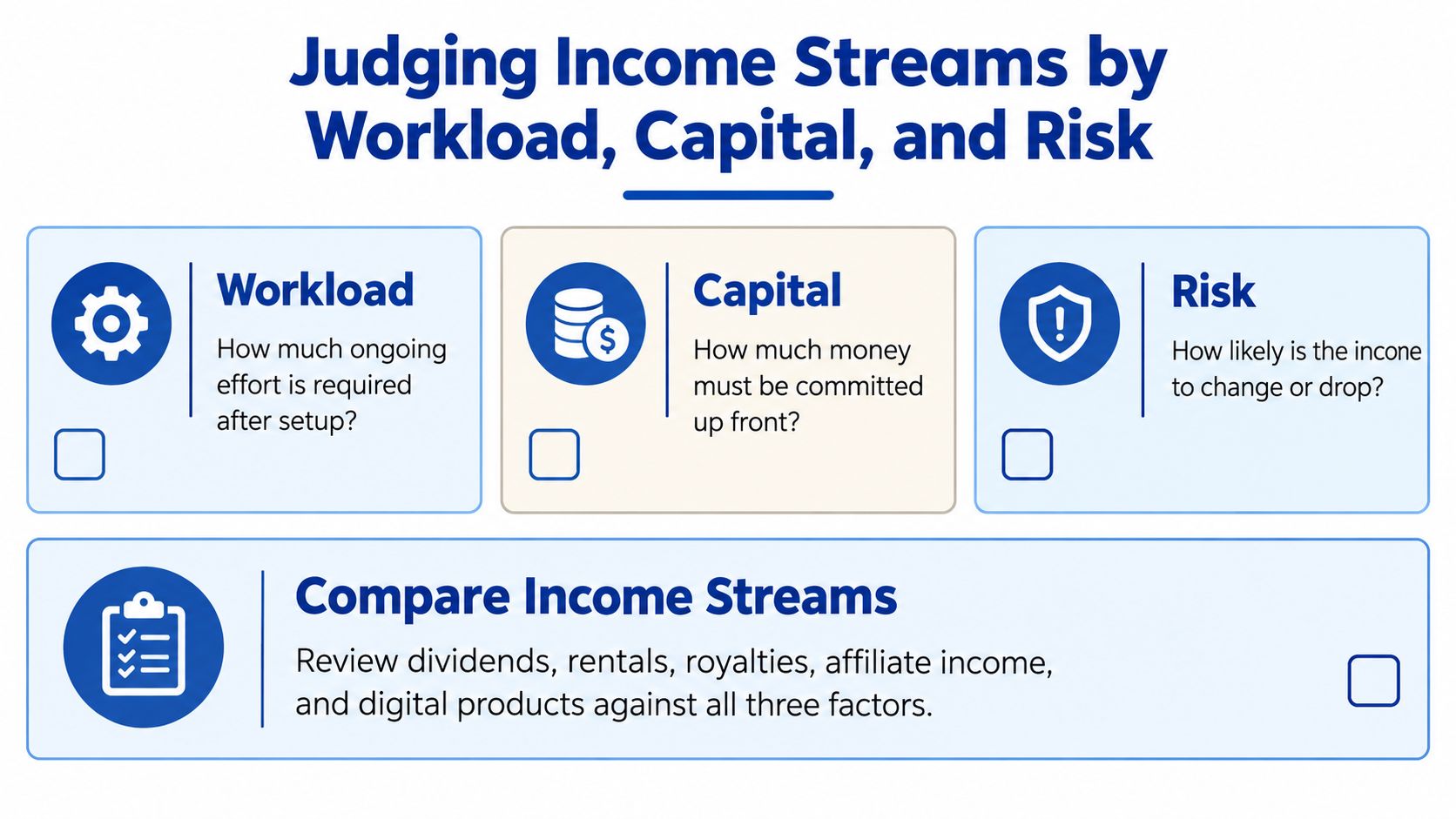
Judging Income Streams by Workload, Capital, and Risk
Popular lists stop at the deposit. Dividends, rentals, royalties, affiliate income, and digital products get called passive, with no count of the maintenance hiding behind the automation. Community discussions keep making the same point. Supposedly passive models need support, customer service, updates, marketing, or outsourced labor. Subscription website revenue is the recurring example. Billing runs on its own, and the seller still provides the service.
A score you can actually use
Score any idea on seven items, not on whether money arrives by itself:
- Hours per month: Count support, updates, marketing, and the time you spend managing people you hired.
- Upfront capital: Cash, equipment, inventory, or unpaid months before the first dollar.
- Operating costs: Hosting, ads, repairs, payment fees, insurance, and contractors.
- Concentration risk: One tenant, one sponsor, one product, or one client that can erase the stream.
- Platform dependence: A marketplace, app store, or ad network that can change the rules.
- Cancellation or vacancy risk: Churn, empty units, and refunds.
- Revenue half-life: How fast receipts fade if you stop feeding the system.
Break-even and stress
Build a plain break-even before you quit a job or borrow. Estimate the capital or the labor required to replace employment income after operating costs, not before them. Then stress the model four ways: lost customers, lower investment yields, a tax change, and a platform or algorithm change. If the surplus disappears under one of those hits, the stream wasn't durable. It was a good month.
Rent shows the split cleanly. Cash flow can recur while repairs, vacancies, and management eat the residual. Some owners hire help. Others keep the work. A practical side-by-side is to compare property management and self-managing in Fresno and then ask what remains after fees. Property type changes that math too, which is why it helps to separate which rental property types tend to be more profitable before you treat "rental" as one strategy.
What remains after costs and maintenance is the only figure that belongs in a plan.
Dividends skip the tenant calls and still carry price risk, yield cuts, and the capital charge from the accounting lens. Affiliate and digital-product income often fail on half-life. Stop the marketing and the receipts thin out. Residual commission or subscription pay can be recurring and still operational. The label doesn't excuse you from the score.
Matching Each Income Type to Your Situation

Labels get useful only when you pin them to a real setup. Five common ones show how participation, capital, and upkeep refuse to travel together.
Long-held dividends. Cash-flow language calls this passive because you aren't operating a firm day to day. The accounting lens still asks whether the portfolio's return beats the return you require on that capital. In U.S. terms, as covered earlier, this is usually portfolio income rather than passive-activity income. A patient buyer comparing yields, payout consistency, and concentration can use a guide to dividend investing for long-term wealth as a checklist, not as a promise of effort-free profit.
Rental cash flow. The deposit is recurring. Participation is the swing factor. A hands-off owner with a manager looks closer to the passive-activity idea than an owner who leases, repairs, and prices every unit. Residual income here is what's left after mortgage, tax, insurance, repairs, and a fair charge on equity. Vacancy can erase that leftover even when last year's cash looked strong.
Royalties from a book or course. The sale can continue after the launch, which is the residual-payment sense. If you keep rewriting, advertising, and supporting buyers, participation never really ended. Tax treatment follows how you created and sold the work, not the word royalty on the statement.
A subscription website. Automated billing is residual cash flow. Continuing service is the business. Churn, refunds, and content updates belong in the monthly hours, not in a footnote.
Recurring commissions. Merchant or affiliate residuals pay on accounts you already won, for as long as those accounts stay active. You invested selling skill more than a large capital stake. Retention work doesn't vanish. You stopped reselling the same account every month. You didn't stop being responsible for it.
Picking a frame on purpose
Someone comparing monetization platforms, or a freelancer weighing a product against more client work, should match the frame to the decision. Cash-flow framing answers whether receipts recur. The capital-charge framing answers whether profit survives the money you locked up. Tax framing answers how the jurisdiction is likely to treat that source given your structure and your participation.
Mega Income Stream publishes comparisons such as Patreon versus Substack and business consultants versus business coaches, plus guides on dividend stocks, digital products, and online business models. Those pieces sit next to other operator write-ups. Use them to see how a model behaves, then run your own hours, capital, and tax check. A stream that looks passive on a landing page can still demand real operating attention once customers, platforms, and upkeep show up.
Your Next Step for Choosing an Income Model
Pick one income idea you are considering. Don't rank five dreams at once. Score that one idea with the seven-part test: monthly hours after setup, upfront capital, operating costs, concentration, platform dependence, cancellation or vacancy, and revenue half-life.
Then build a simple break-even. Estimate how much capital or labor, after costs, would replace your current employment income. Write the assumption in a sentence you can revisit. If you can't state the assumption, you can't test it.
Stress the same model four times. Remove a slice of customers. Cut the yield. Apply a plausible tax change for your situation. Assume the platform alters its rules or its cut. Keep the idea only if something remains under at least two of those hits. If every version depends on last year's best case, you don't have durability. You have a forecast.
Before you commit money or months, confirm the tax treatment for your jurisdiction and your legal structure. Ask which income bucket applies, whether participation changes it, and what filings or self-employment rules follow. A fee for that answer is cheaper than a year of the wrong setup.
Put the result on one page: hours, capital, the main risk, break-even, and the tax question you still need answered. That page is the plan. The label isn't.
Mega Income Stream publishes practical guides on income models, business operations, dividend investing, digital products, and side-by-side platform comparisons so you can test an idea before you fund it. If you're sorting passive income vs residual income for a real project, use those explainers to pressure-check hours, capital, and tax questions instead of relying on a label. Visit Mega Income Stream and start with the model you're closest to choosing.
Generated with Outrank app











Comments