
 By

A market opportunity analysis tests whether a target market can support a profitable business by assessing customer groups, channels, market size and growth, competition, and unmet needs. A large or fast-growing market alone does not prove an opportunity is worth pursuing. The business also needs a practical way to reach customers and deliver value.
A useful assessment connects demand with the realities of competing, acquiring customers, and earning revenue. It helps you distinguish promising signals from assumptions before committing time and resources.
This guide explains how to define customer segments, compare channels, estimate market size and growth, and evaluate profitability. You’ll also learn how to identify unmet needs, assess competitive threats, and compare the findings with your business’s capabilities to make a clearer go, refine, or pass decision.
Key Takeaways
- Map customer segments by their needs and behaviors, then identify the channels that can reach them effectively.
- Compare market size and growth with the practical potential to earn profit, not demand alone.
- Use competitor research and SWOT analysis to spot market threats, gaps, and advantages your business can act on.
- Assess new products, markets, and partnerships against customer needs and your ability to deliver value.
- Turn your findings into a clear next step, then revisit the analysis as market conditions change.
What is a market opportunity analysis?
A market opportunity analysis evaluates customer needs, market size and growth, profitability, competition, and a business’s ability to compete. Key components include competitor research, competitive market analysis, and a SWOT review. Common risks include relying on incomplete or outdated evidence and overlooking changes in customer behavior or market conditions.
-
Research Direct and Indirect Competitors
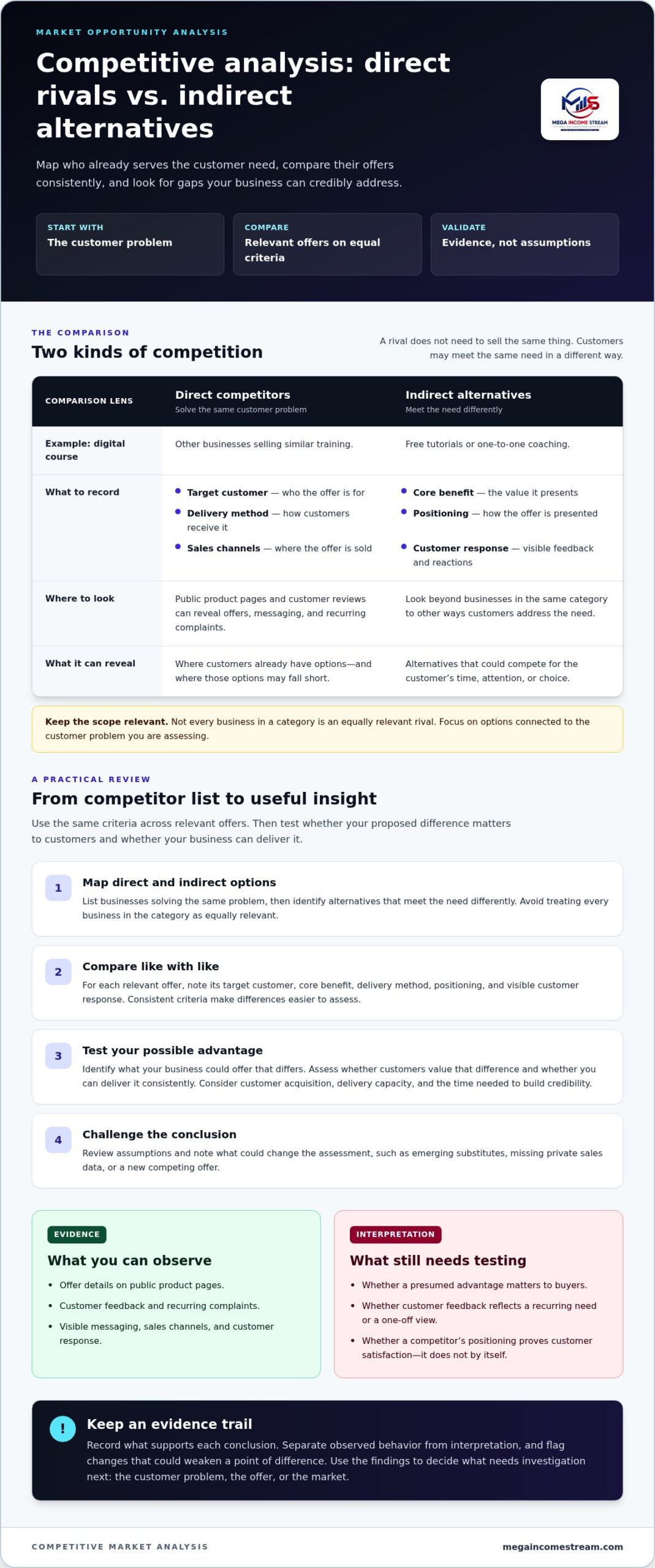
List direct competitors that solve the same customer problem, then identify indirect alternatives that meet the need differently. For a digital course, direct competitors might sell similar training, while free tutorials or one-to-one coaching could be indirect alternatives. Compare their audiences, offers, messaging, sales channels, and customer feedback. Use public product pages and reviews to spot recurring complaints and unmet needs. Avoid treating every business in the category as an equally relevant rival.
-
Conduct Competitive Market Analysis
Compare competitors using the same criteria to reveal meaningful differences. For each relevant offer, record its target customer, core benefit, delivery method, positioning, and visible customer response. A freelance design business, for example, could compare packaged design services with custom agency work and do-it-yourself templates. This competitive market analysis shows where customers already have options and where those options fall short. Treat competitor claims as positioning, not evidence of customer satisfaction.
-
Assess Competitive Advantage and Hurdles
Identify the specific advantage your business could offer, then assess what it would take to sustain. An automation consultant, for example, might stand out by tailoring a workflow to a client’s existing process rather than offering a generic setup. Use SWOT analysis to organize internal strengths and weaknesses alongside external opportunities and threats. Then assess hurdles such as customer acquisition, delivery capacity, and the time needed to build credibility. An advantage matters only if customers value it and the business can deliver it consistently.
-
Review Risks and Limitations
Challenge the assumptions behind each conclusion before treating an opportunity as actionable. Competitor research may miss private sales data, emerging substitutes, or customers who have not yet expressed a need. A positive SWOT result also depends on accurate inputs: a presumed strength may not matter to buyers. Record the evidence behind each claim, distinguish observed behavior from interpretation, and flag changes that could alter the assessment. For example, a new competing offer may weaken a previously clear point of difference.
Use the findings to decide what to investigate next: test the customer problem, refine the offer, or reassess the market. A clear evidence trail helps distinguish a genuine competitive advantage from an appealing but untested assumption.
Customer groups, messaging and marketing channels
Define who needs the offering, what they value, and how to reach them. Useful research combines customer conversations, business records, and channel data to compare stated preferences with actual behavior.
For market opportunity research, use interviews, surveys, support records, sales conversations, and channel analytics. Actionable market segments are distinct and reachable.
-
Segment Customers and Select Target Groups
Group potential customers by shared needs, behavior, or circumstances, then select a target segment with a clear problem. For example, a workflow automation business could distinguish local agencies seeking lead-management systems from freelancers looking for personal productivity tools. Compare each group’s unmet needs, buying process, and access through relevant channels. Avoid grouping customers with different motivations simply because they share a broad demographic.
Keep segments practical. A useful segment helps you shape a distinct offering and identify where to reach its members. For a global audience, assess whether language, payment preferences, or local economic conditions affect how customers evaluate the same solution.
-
Collect Customer Research and Feedback
Gather direct feedback through interviews, surveys, sales conversations, and customer support records. Ask people to describe the task they struggle with, the workaround they use, and what makes existing options difficult. Compare their answers with observed behavior, such as which service pages generate inquiries or where prospective buyers leave a signup flow.
Use a simple evidence log to record the customer type, recurring problem, exact feedback, and source. Separate repeated observations from one-off opinions. For example, several agency owners describing manual lead follow-up may point to a shared workflow problem, while a single feature request may reflect one customer’s preference.
-
Identify Unmet and Underserved Needs
Look for recurring customer friction, not just ideas people say they would like. Review complaints, abandoned steps, and common workarounds to find gaps in the current customer experience. A local business that tracks inquiries across spreadsheets may need a more consistent process, even if it has not asked for a specific automation product.
Describe each gap as a customer problem before proposing a solution. Check who experiences it, what they do now, and whether the issue affects buying or use. This keeps feature ideas tied to a real need rather than an assumption about demand.
-
Match Messaging to Channels
Write a distinct message for each target segment, linking its problem to the outcome your offering supports. A freelancer may respond to messaging about reducing repetitive admin, while an agency may prioritize consistent lead handling. Test whether the same promise works across email, search, social platforms, or direct outreach.
Choose channels based on where each group looks for solutions and how its members prefer to evaluate them. Compare inquiries and meaningful engagement by channel instead of treating reach alone as evidence of fit. Refine the message when prospects misunderstand the offer or ask the same clarifying question.
-
Map the Buying and Use Experience
Trace the customer’s path from first discovering the offering through purchase, setup, and continued use. For an online service, review the landing page, inquiry form, onboarding instructions, and first-use workflow. Note where customers need extra explanation, repeat information, or switch tools to complete a task.
Use feedback from each stage to improve the experience for the selected segment. If agency prospects understand the value but struggle to picture setup, clarify the workflow in the message or demonstration. A smoother path can make the offer easier to assess and use.
Market growth, size, and profitability
Assess market demand alongside your ability to earn revenue and retain profit. Compare the market’s scale and direction with the customers, channels, and operating model your business can realistically serve.
- Measure market size. Define the market by product, audience, and geography before estimating demand. Market size can be measured by sales volume in units or by value in total revenue. Use the unit measure when comparing how much customers buy; use revenue when comparing the economic value of purchases. For U.S. market estimates, the Census Bureau’s Economic Census is a relevant official data reference. Keep the market boundary consistent so your estimate doesn’t combine unlike products or customer groups.
- Separate total potential from reachable demand. Market potential represents the total sales a company could achieve if it captured 100% of a market. Treat that as an upper boundary, not a sales forecast. Then narrow the estimate to the customers your channels can reach and your business can serve. For example, an online training business should distinguish all possible learners from the segment it can actually attract with its current platform and offering.
- Check the growth signal. Compare changes in customer demand, sales volume, and revenue over time. A customer-market growth rate of 30-50% annually is identified as an attractiveness factor, but fast expansion alone doesn’t establish profitability. Investigate what drives the increase, whether demand is recurring, and whether competition can respond. A growing audience may still be difficult to monetize if customers have limited need or few paths to purchase.
- Compare locations consistently. If expansion depends on geography, group locations by population and growth rate before comparing them. The U.S. Environmental Protection Agency describes using those factors to compare areas of similar size and growth. Apply the same market definition to each area. For example, compare demand for the same service across locations rather than mixing population growth in one area with revenue growth in another.
- Estimate profitability. Compare the revenue each sale or customer could generate with the resources needed to acquire, serve, and support them. Include channel costs, production time, customer support, and repeat-purchase potential. A subscription platform may show attractive recurring revenue, but high support needs can reduce profit. Test assumptions separately so a strong sales estimate does not obscure a costly operating model.
- Choose an entry or expansion strategy. Existing businesses can grow by serving more customers in a current segment, encouraging repeat purchases, or adapting an offer for a related audience. New entrants should compare market growth and competitive pressure with their ability to reach buyers. Choose a strategy that links a defined customer group to a viable channel and a deliverable offer, then track revenue and operating effort as the business expands.
Identifying products, markets, partnerships, and unmet needs to assess
Compare possible offers, customer segments, markets, and partnerships against observed demand and your ability to deliver. Use industry trends to test where an idea might perform, rather than treating novelty as proof of opportunity.
-
Identify Products, Markets, and Partnerships
Build a shortlist of products, markets, and potential partners linked to a specific customer problem. For example, a workflow consultant could assess a packaged automation offer, a new industry segment, or a partnership with an agency already serving that segment. Compare each option’s customer fit, channel access, delivery requirements, and alignment with your business capabilities. Do not choose a partnership solely because it offers access to a large audience.
- Assess market trends. For each shortlisted option, record the trend or market condition that could support demand. Consider how customer needs, buying habits, and competing solutions may shape performance over the next 2-5 years. A shift toward remote operations, for example, could make automated client onboarding more valuable to distributed service businesses. Treat the trend as a reason to investigate, not as evidence that customers will buy.
- Connect product development to market conditions. Define the customer need before shaping the product. If small agencies struggle to organize incoming leads, test whether a streamlined tracking workflow solves the problem better than a broad software bundle. Market opportunity analysis can guide product development by aligning the offer with customer needs and market conditions. Tie proposed features to a specific use case.
-
Identify Unmet Needs and Product Opportunities
Look for repeated customer workarounds, service gaps, and requests that existing solutions handle poorly. A business that copies lead details between forms and spreadsheets may need a simpler connected process, not another dashboard. Describe the unmet need in the customer’s terms, then compare possible solutions. Do not label a feature request a market opportunity until it connects to a clear need and a reachable audience.
- Compare expansion paths. Assess whether the evidence supports a new product, an additional product line, entry into a new market, or service to a new segment. For instance, an existing training business might adapt a course for a related audience before building a separate product. Compare the development effort, customer access, and capabilities each path requires. Choose the path that solves a defined problem with a workable delivery model.
- Evaluate potential partners. Identify each partner’s contribution, such as access to a customer segment, specialist knowledge, or a complementary service. Then map shared responsibilities, customer handoffs, and the value each side provides. A consultant partnering with a web agency could combine automation expertise with the agency’s client relationships. Assess whether the arrangement improves the customer experience and supports execution instead of assuming the partnership itself creates demand.
Market opportunity analysis
Conduct the analysis by defining a decision, gathering customer and market evidence, estimating revenue and profit potential, and testing your capabilities against competition. Then compare the options, record key assumptions, and choose whether to pursue, refine, or reject each opportunity.
- Define the decision and scope. State what the business needs to decide, such as launching a product, entering a market, or targeting another customer segment. Specify the offer, audience, and geography you will assess. For example, evaluate an automated appointment workflow for independent clinics rather than broadly studying “health technology.” A focused scope keeps the research relevant to the decision.
- Build an evidence base. Combine customer feedback, competitor observations, market data, and internal business information. Separate direct evidence, such as customer descriptions of a recurring task, from assumptions about likely demand. The U.S. Environmental Protection Agency describes estimating niche-market revenues for companies commercializing specific applications or technologies, then placing those estimates within broader market segments.
- Map drivers and external conditions. Identify industry trends and factors that could change demand, costs, or access to customers. Use PESTLE to examine political, economic, social, technological, legal, and environmental influences; rate each factor’s impact on a 1-5 scale. For example, assess whether a technology shift could make an existing service easier to deliver, while noting other conditions that could constrain adoption.
- Model opportunity scenarios. Estimate market size through unit sales or total revenue, then distinguish total market potential from the portion your business can reach. Create conservative, expected, and stronger-demand scenarios using transparent assumptions about customer access, purchase behavior, and delivery capacity. Compare expected revenue with acquisition, fulfillment, and support requirements. A large audience does not prove that a business can capture profitable sales.
- Connect evidence to business capabilities. Compare each opportunity with your expertise, channels, operating resources, and ability to deliver value. For example, an online training business with a relevant course platform may be better placed to serve a new learner segment than to build an unrelated product. Record capability gaps alongside strengths, and identify whether a gap affects the opportunity’s feasibility.
- Make a decision and refresh it. Summarize the evidence, assumptions, competitive position, and customer value for each option. Choose to pursue, refine, or reject it, and assign a concrete next action, such as testing a product concept with a target segment. Market conditions and competitor behavior can shift, so repeat the assessment every 6-12 months to keep decisions aligned with current conditions.
Mega Income Stream: Business Strategies
Mega Income Stream helps turn market findings into practical business decisions through Business Strategies and Making Money Insights. Use this support when customer evidence points to an opportunity but you need to clarify the offer, audience, or route to revenue.
Its Consulting Business helps entrepreneurs and business leaders assess growth options and develop sustainable income streams. Bring your market research, customer insights, and key assumptions into the discussion. This gives you a focused starting point for deciding what to develop, refine, or pursue.
Visit Mega Income Stream to explore the next step for your business.
Turn Your Opportunity Into a Clear Next Move
Use your assessment to move from evaluation to disciplined execution. Choose one opportunity and write a short decision brief covering the customer problem, proposed offer, supporting evidence, and capability gaps that could slow delivery. A market opportunity analysis is useful when it informs a concrete test, not just a report. Focus the test on a decision, such as adjusting the offer, changing its message, or preparing a fuller launch.
Assign responsibility for the test and define what evidence will guide the next action. Compare the results with your original assumptions, not the outcome you hoped for. If customer responses reveal a different problem, refine the offer before expanding. If the evidence supports your direction, use the market opportunity analysis to shape a measured execution plan.
For support turning business opportunities into practical next steps, contact Mega Income Stream to discuss your opportunities. Keep testing, learn from the market, and build with purpose.
Frequently Asked Questions
What does a market opportunity assessment involve?
A market opportunity analysis is a structured way to judge whether a business idea merits resources. It connects evidence about customer demand with the ability to reach buyers, deliver the offer, and earn revenue. A useful output is a decision brief, not just a market description. For example, document the customer problem, supporting evidence, main assumptions, and the next test that could challenge those assumptions.
What methods are used to estimate market size, TAM, SAM, and SOM?
Use a top-down estimate to narrow a broad market using relevant customer or product categories, then cross-check it with a bottom-up estimate based on reachable buyers and expected purchases. TAM describes total demand, SAM limits that demand to the business’s offer and serviceable market, and SOM estimates the portion it could realistically capture. A market opportunity analysis can compare both estimates and reveal gaps in their assumptions.
How do you assess market growth, trends, and demand in the United States?
For the United States, compare sales or usage patterns over time with customer interviews, search behavior, and changes in competing offers. Distinguish a temporary spike from a trend affecting recurring customer needs. For example, a business assessing demand for workflow software could compare inquiries with the tasks buyers still handle manually. Track what changed, who is affected, and whether the shift supports a viable offer.
How do you analyze competitors and market share?
Identify direct rivals and indirect substitutes, then compare their offers, customer focus, distribution, and public positioning. Estimate market share by dividing a competitor’s sales by total sales for the same defined market and period; unit share can compare quantities sold instead. Treat the result as an estimate when market boundaries or competitor sales are unclear. Note where customers choose alternatives and what those options fail to solve.
How do you identify and evaluate target customer segments?
Group potential customers by a shared need, behavior, or buying situation, then test whether each group is distinct enough to need its own offer or message. For example, freelancers and small agencies may both need workflow automation, but their tasks and purchase decisions can differ. Compare each segment’s problem frequency, current workaround, access channels, and feedback. Prioritize the group whose need aligns with what the business can deliver.
How do you estimate pricing, revenue potential, and profitability?
Estimate revenue by linking a proposed price to the customers likely to buy and their expected purchase pattern. Test pricing through customer conversations, offer comparisons, or a limited pilot, and record objections alongside buying signals. Then subtract delivery, customer acquisition, and ongoing support costs to assess profit potential. Use a market opportunity analysis to determine whether each sale can cover its operating demands and contribute to sustainable profitability.











Comments