
 By
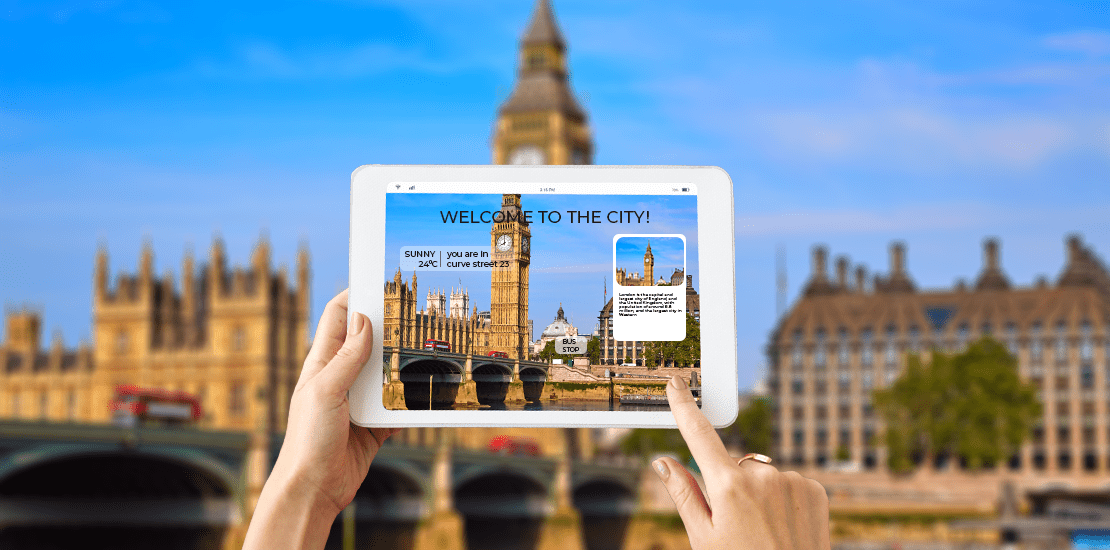
Augmented Reality (AR) improves the tourism experience by superimposing digital information and graphics on a user’s real-world surroundings, making it more interactive, instructive, and personalized. Benefits include easier navigation with contextual directions, more immersive historical experiences by virtually recreating old ruins, and interesting interactive exhibitions in museums. AR also overcomes language barriers, generates immersive marketing content, and enables “virtual” tours to aid in pre-trip planning, changing travel into a more dynamic and memorable adventure.
Augmented reality (AR) has the potential to completely revolutionize how people find and explore new locations. Travelers can obtain greater insights into foreign cultures by combining physical experience with digital elements, while also creating memories.
In today’s environment, an increasing number of travelers are turning to technology to make their trips more exciting and convenient. That is why the hotel and travel industries have looked for methods to use innovative technologies to empower travelers.
New technology provides new experiences for travelers, and augmented reality (AR) is one example. The new visitor wants to visit a destination and have a completely immersive, interactive, and unforgettable experience.
With a population of around 82 million, Gen Z makes up the majority of the U.S. consumer population and generation ready to travel that travel companies need to be targeting. Gen Z is tech-addicted and highly connected, making them a powerful target demographic for businesses to reach.
What Is Augmented Reality AR?
First, let us clarify what augmented reality is.
Simply simply, augmented reality (AR) technology incorporates a digital layer into the physical world.
Users can scan an object, a specific place, or an image with a smartphone or other AR-enabled device to see information that is not visible to the human eye. An immersive experience can be created by combining visual and audio elements such as images, text, animations, 3D models, films, sound effects, and more.
Tourists, for example, can point their smartphone at a historical site and see its history or virtual models superimposed on the real environment, giving them new insights on old landmarks.
Tourists can use augmented reality to relive the history of a historical place or to navigate interactive paths across a metropolis. Some apps, for example, allow users to explore the current ruins of a castle and see how it looked in the Middle Ages. This combination of virtual and real worlds creates both informative and entertaining experiences.
Unlike other technologies, such as virtual reality (VR), augmented reality (AR) improves the physical world without removing the user from reality. This makes it an excellent tool for tourism, as it enhances experiences without isolating visitors from their surroundings.
AR has multiple applications in tourism, from promotion to customer retention:
Destination Promotion Before Travel
Before choosing a destination, tourists can explore it virtually through AR. From strolling along a paradise beach to virtually touring a museum, these experiences generate excitement and increase bookings. One example is Marriott Hotels’ campaign that used AR to showcase their facilities and room views.
Enhanced Experiences During Travel
During a trip, AR can serve as an interactive guide. Tourists visiting historical places can utilize applications that show 3D reconstructions of how these destinations appeared at their zenith. Smart glasses provide additional context in museums by displaying animated artwork or interactive explanations.
Cities such as Amsterdam have incorporated AR into cultural tours, allowing visitors to scan QR codes to discover historical or artistic information. This not only improves the experience, but it also encourages sustainable tourism by eliminating the need for physical guides and printed materials.
Post-Visit Customer Retention
AR provides post-travel applications that let tourists to revisit their experiences. Destinations can provide virtual keepsakes, such as animated AR postcards or digital tours, for people to share on social media. This encourages positive word-of-mouth and keeps destinations in passengers’ memories.
Benefits of AR for Tourism Industry Professionals
Tourism sector experts can benefit greatly from employing augmented reality because it can be a helpful tool for enhancing client satisfaction, average order value, and bottom line.
1. Enhanced Visitor Engagement
Businesses in the travel sector can utilize augmented reality to improve their existing selling points and show clients a preview of the experience or destination they are promoting.
According to Three Kit, “AR product experiences are 200% more engaging as they deliver double the levels of engagement compared to their non-AR equivalent.”
Businesses may better connect and encourage visitors to act by providing them with a tailored, immersive experience. For example, a museum may make visits more enjoyable by giving a tour that highlights intriguing facts or information about the exhibit as visitors go through the institution.
2. Increased Revenue Opportunities
A one-of-a-kind encounter may entice customers to book the trip or experience with you rather than the competitors. Travelers already want to visit a specific site, but they want to have a unique experience that augmented reality may provide.
Snapchat discovered that when AR is included in the travel planning process, Snapchatters expect to spend more than they normally would. This is because AR allows consumers to be more confident in making travel decisions and, eventually, arranging longer vacations by including travel excursions or other add-ons on the agenda.”
3. Better Customer Insights and Data Collection
Augmented reality can assist acquire useful information about how customers interact with their surroundings and what services or experiences they like. Knowing where customers spend the most time and what they want can help adapt their experiences and make them more memorable.
Read Also: The Role of Technology in Enhancing the Travel Experience
Understanding the importance of technology in tourism can provide greater customer insights and data to inform the use of augmented reality. It can also help businesses spot patterns, make faster choices, and enhance the customer experience.
4. Improved Destination Marketing
Destination marketing has greatly improved over the years. Immersive experiences are one of the most effective ways to attract passengers during the trip planning phase.
Hotels, for example, can use smartphones to provide an immersive experience and transport guests to their locations. Travelers might imagine themselves in their hotel room, dining at a restaurant, or relaxing by the pool.
How Can AR Improve Customer Satisfaction in Travel and Tourism?
AR technology can improve the travel experience at all stages of the journey, including before, during, and after the visitors return home.
1. Before: Experience Previews
Forward-thinking travel agencies and tour operators use AR apps and brochures to show hyper-realistic 3D previews of hotel rooms to potential clients. Visualization helps clear up any hesitation about hotel design and amenities, which speeds up the decision-making process.
2. During: Navigation & Immersion
Augmented reality plays an even bigger role during the trip. Top tourist destinations like Paris, New York City, Tokyo, Dubai, and London have developed AR navigation apps that enable first-time visitors to move through the city with ease and explore it without a tour guide.
Apps like Google Maps (Live View) display not only traffic routes, but also landmarks, cultural hotspots, and restaurant ratings. They use the phone camera, GPS, and motion sensors to overlay digital directions like arrows on the sidewalk, floating street names, and pins over cafes and museums.
Other apps utilize AR to translate road signs, restaurant menus, and other writings in real time. They are of immense help to tourists who don’t speak the language of the country they are visiting.
But AR travel apps go beyond practical solutions that help make trips smoother and more convenient. Some of them serve to deepen the experience and allow full cultural immersion. At historical landmarks and museums, these apps provide a cultural context through visual storytelling.
Augmented reality can digitally recreate historical sites or events—tourists need only point their phones at a monument or a ruin to see how it used to look throughout history. As they move through a location or museum, the AR can show characters and animations that tell a story.
Many good examples of AI for cultural travel come from all over the world:
- TimeLooper (London, New York, Istanbul, etc) shows AR/VR experiences at iconic sites.
- Streetmuseum (Museum of London) overlays historical photographs onto London streets.
- Göteborg AR Guide (Sweden) offers an AR guide and characters that tell stories about the city.
- Ancient Augmented Reality (EU and US) creates AR reconstructions of ancient architecture.
Navigation and cultural immersion apps put on display the true potential of AR in travel: facilitation of independence. According to a recent survey by Skyscanner, 43% of respondents indicated they traveled solo over the last year. Their main motive is not having to wait for others.
AR technology empowers these travelers to book trips to lesser-known and faraway destinations with greater confidence and to explore them through self-guided, interactive tours. Real-time translation and navigation remove stress from their trips and save them both money and time.
Besides convenience, augmented reality offers personalization. It enables tech-savvy travelers to skip cookie-cutter guided tours and set off on a journey that truly reflects their interests. AR gives them the freedom they need to roam around and experience the city at their own pace.
3. After: Lifetime Memories
Post-trip AR is still unexplored and underused, even though its application could have many benefits for repeat bookings and brand loyalty. For example, agencies and booking platforms could start offering AR travel recaps and journey maps that travelers could keep and share online.
How Can AR Increase Travel and Tourism Revenue?
Increased customer happiness leads to more revenue. In the travel industry, satisfied travelers are more inclined to return to a destination or book with the same agency or operator. If AR can make their trips more enjoyable, convenient, and memorable, that’s great news for your bottom line.
Here are some of the ways that AR might generate new revenue streams:
1. Cross-Selling & Upselling with Immersive Previews
Augmented reality can be utilized to deliver immersive previews of excursions, attractions, and other improvements offered by travel companies and tour operators. Sunning pictures allow passengers to sample the experience, demonstrate its genuine value, and persuade them to book out of “fear of missing out”.
One such effort by Thomas Cook has become famous in the business. It offered a variety of “taster” experiences, such as a helicopter tour of Manhattan or the Egyptian pyramids, resulting in a 190% rise in excursion bookings in 2015, when augmented reality was still a novelty.
2. Enhancing On-Site Spending (Shopping & Dining)
AR is a powerful cross-selling and upselling strategy that can boost ancillary and secondary expenditure in travel locations while enhancing profits for local companies. Shopping and dining are ideal areas for adopting AR technology in famous tourist destinations.
Augmented menus are a prime illustration of this. They boost restaurant spending by displaying 3D meals in 360 degrees, allowing customers to see what their orders will look like, portion sizes, and so on. KabaQ at The Mirage in Las Vegas has gained popularity thanks to its AR menus.
3. Reducing Operational Costs with Self-Service AR
Modern travelers like to travel independently. Equipping them with augmented reality capabilities for self-guided tours, navigation, and translation dramatically decreases the requirement for on-site staff and traveler support while maintaining their comfort and quality of experience.
AR removes the need for additional guides in museums and other historically and culturally significant sites. These tools help hotels and resorts reduce front-desk expenses. The more guests utilize AR, the less support they require, resulting in greater overhead savings for enterprises.
Despite these revolutionary examples, augmented reality was not a popular investment possibility among travel organizations prior to COVID. In 2019, only 17% of travel brands intended to commit funds for this technology. The AR market has risen subsequently, indicating a significant shift in interest.
We anticipate that as personalized and immersive travel experiences become the new industry norm, an increasing number of enterprises will embrace the AR trend. There are several compelling reasons for this: AR promotes booking frequency, traveler pleasure, and income.
Bottomline
Finally, augmented reality is transforming the way we experience tourism. AR enhances education and creates new experiences, adding interest to historical and cultural exploration.
Destinations, travel agencies, and tour operators can use AR technology to provide a more personalized experience for tourists, improving client experiences while responding to their ever-changing requirements and preferences.
As augmented reality technology advances, we should expect new methods for tourists to interact with their environment. It’s safe to assume that travel is becoming more immersive and gratifying.











Comments