
 By

Do image affiliate links or text affiliate links generate more clicks and sales? Text affiliate links generally have the advantage in articles, tutorials and product reviews because they appear naturally within the information readers are already looking for. Image links can be more effective when shoppers need to see a product before making a decision, particularly in fashion, beauty, furniture and other visually driven categories.
However, there is no universally verified 2026 statistic proving that text links always outperform image links. Performance depends on placement, audience intent, design, product type and traffic source.
The strongest approach for many affiliate marketers is to combine both formats: use useful images to show the product, then place descriptive text links where readers are ready to take action.
1. Image vs. text affiliate links: The numbers
One published comparison from affiliate software provider Post Affiliate Pro gives the following indicative ranges:
| Performance metric | Text links | Banner image links | Product image links |
|---|---|---|---|
| Click-through rate (CTR) | 2–4% | 0.5–1.5% | 1–3% |
| Post-click conversion rate | 3–6% | 1–3% | 2–5% |
| Best placement | Reviews, tutorials | Promotional sections | Product galleries |
| Main strength | Context and relevance | Visual attention | Product demonstration |
| Main weakness | Less visually prominent | Banner blindness | Depends on image quality |
Source: Post Affiliate Pro’s promotional-material comparison. These are vendor-published indicative ranges, not independently verified 2026 industry averages.
At first glance, text links look like the clear winner. But the comparison needs context. A text link inside a detailed product review reaches someone who may already be interested in buying. A banner shown to every visitor reaches a much broader audience.
That difference in buyer intent can influence performance as much as the link format itself.
Calculated using midpoints of Post Affiliate Pro’s indicative CTR ranges. Not actual campaign results.
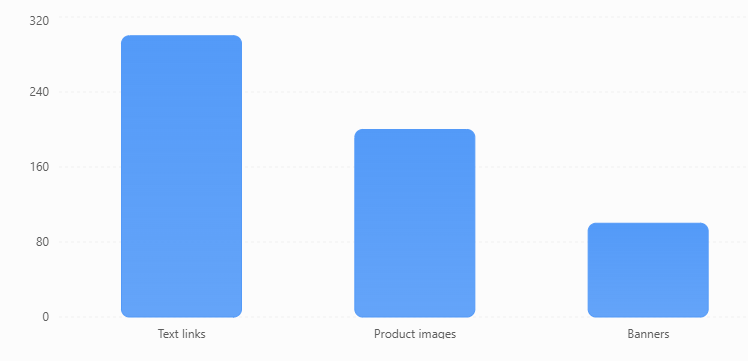
The chart shows why marketers often prioritize contextual links. Still, your own results may differ substantially.
2. What exactly is a text affiliate link?
A text affiliate link is a clickable word or phrase that directs readers to a merchant’s website using a tracked affiliate URL. For example, imagine writing an article about affordable laptops.
Instead of interrupting the reader with a large advertisement, you might write:
For students who need a lightweight computer, compare the latest budget laptops before choosing a model. The linked phrase leads to a relevant product page.
Text links work because they fit naturally into the conversation. Readers don’t feel as though they’ve suddenly left the article and entered an advertising section.
Affiliate platform impact.com recommends descriptive anchor text rather than displaying long, unattractive URLs. Its guidance emphasizes keeping links relevant to the surrounding content. That makes text links especially useful for SEO-driven affiliate blogs.
3. What is an image affiliate link?
An image affiliate link uses a clickable photograph, graphic or banner to send visitors to an advertiser. It could be a photograph of a pair of running shoes, a product comparison card or a promotional banner advertising a discount.

Product photography
Helps readers inspect the product before clicking.

Promotional banner
Draws attention to an offer, but may be ignored as advertising.
Images can communicate information much faster than paragraphs. If someone is shopping for a sofa, handbag or wristwatch, seeing the product can be an important part of the decision. But images aren’t automatically more persuasive.
A generic banner shouting “BUY NOW” may receive less attention than a helpful product photograph placed beside a genuine recommendation.
Read Also: 9 Affiliate Marketing Myths Holding You Back From Earning
4. Why text links often outperform traditional banners
One reason is a well-documented behavior called banner blindness. Researchers at Nielsen Norman Group found that internet users frequently ignore content that looks like advertising, even when it appears within the main body of a webpage.
Their research explains:
“Users have learned to ignore content that resembles ads.”
This doesn’t mean people hate every advertisement. It means they’ve become skilled at filtering out things that don’t appear relevant to their immediate goal.
Imagine reading a review of five budget smartphones. You’re likely to notice a sentence explaining which phone has the best battery life. But a flashing banner promoting an unrelated subscription may barely register.
The practical lesson is simple: relevance beats decoration. An image should contribute something useful rather than merely occupy space.
5. Latest affiliate marketing statistics: What changed in 2025–2027?
The most recent large-scale affiliate research provides an important warning: more clicks don’t always mean more purchases. In its 2025 Industry Benchmark Report, published in 2026, impact.com analyzed 2,368 North American retail brands and compared performance with 2024.
2%
Increase in affiliate clicks
6%
Decline in conversion rate
5%
Decline in transactions
4%
Increase in average order value
Year-over-year changes across impact.com’s 2025 retail affiliate dataset. These are overall affiliate performance trends, not separate text-link or image-link results.
Shoppers were researching products, comparing prices and waiting for better offers before purchasing. The report found that content-review partners generated 18% of affiliate clicks but 9% of transactions. This doesn’t mean product reviews are ineffective. Many reviews influence purchases that happen later through other channels.
For publishers, the message is clear: measure what your links contribute to the customer journey, not just how often someone clicks.
6. How image and text links affect affiliate earnings
Let’s compare three hypothetical campaigns, each receiving 20,000 link impressions. Using the indicative midpoint rates from the earlier table:
| Metric | Text link | Banner | Product image |
|---|---|---|---|
| Impressions | 20,000 | 20,000 | 20,000 |
| CTR | 3% | 1% | 2% |
| Clicks | 600 | 200 | 400 |
| Post-click conversion | 4.5% | 2% | 3.5% |
| Expected sales | 27 | 4 | 14 |
| Commission per sale | $15 | $15 | $15 |
| Estimated commission | $405 | $60 | $210 |
Illustrative calculations using vendor-published rate midpoints. These are not observed results or a forecast for your campaign.
The text link earns the most in this scenario. But imagine promoting designer furniture. A beautifully photographed product might attract shoppers who would never click a generic text recommendation.
Your audience determines what works.
There’s also an important measurement detail: Awin’s documentation explains that its hosted banners can track impressions and clicks, while standard text links track clicks but not impressions. You may need your own analytics to calculate comparable CTRs.
7. Where should you place image and text affiliate links?
Placement can be just as important as format.
| Website content | Recommended approach |
|---|---|
| Product review | Text links alongside product images |
| Buying guide | Descriptive links within recommendations |
| Fashion article | Clickable product photographs |
| Email newsletter | Primarily text links with selective images |
| Product comparison | Images, prices and clear text buttons |
| Tutorial | Contextual text links |
| Homepage promotion | Relevant image banner, tested against alternatives |
For example, a blog post titled Best Running Shoes for Beginners might show photographs of five recommended shoes. Under each photograph, include a short explanation and a descriptive link such as Check current price and sizes.
The photograph helps readers recognize the product. The text link explains what happens next. That combination can be more helpful than either element alone.
8. Seven ways to improve image and text affiliate link performance
Whether you run a review blog, comparison website or email newsletter, these improvements are worth testing:
-
Use descriptive anchor text. Replace vague phrases like “click here” with wording that identifies the product or action.
-
Choose genuine product photographs. Avoid unrelated stock images and misleading promotional graphics.
-
Place links near useful information. A recommendation is more persuasive after you’ve explained why the product matters.
-
Make images mobile-friendly. Compress files and use responsive layouts so images don’t slow down the page.
-
Avoid excessive banners. Too many advertisements can make a website difficult to navigate.
-
Disclose affiliate relationships. Explain clearly when you may earn a commission from a purchase.
-
Track links separately. Use different tracking IDs for text, product images and banners.
Awin’s creative guidance specifically recommends high-quality, relevant images and proper alternative text for accessibility.
It’s also worth testing the same product with different creative treatments. For example, compare a lifestyle photograph with a plain product image, while keeping the offer and audience consistent.
9. How to run a fair affiliate link A/B test
Suppose your review page receives 10,000 visitors monthly. You want to know whether a clickable product image or a descriptive text link produces more approved commissions.
Create two versions of the page and randomly divide eligible visitors between them. Keep the product, price, offer and surrounding content as similar as possible. Change the link presentation rather than redesigning the entire page.
Track:
-
Link impressions and clicks.
-
Click-through rate.
-
Post-click conversion rate.
-
Approved commissions.
-
Earnings per 1,000 page views.
Run the test long enough to gather meaningful results, accounting for the advertiser’s conversion window and delayed commission approvals. If text links generate more clicks but image links lead to higher-value purchases, you may discover that the best option depends on your revenue goal.
And if both formats work well together, there’s no reason to force an unnecessary winner.
Final Thoughts
So, which performs better: image or text affiliate links?
Text links are often a stronger starting choice for articles, tutorials and product reviews. Product images are particularly useful when visual appearance influences the buying decision, while generic promotional banners can struggle with banner blindness.
The published indicative benchmarks favor contextual text links, but they aren’t proof that every text link will outperform every image. Recent affiliate data also shows why clicks alone aren’t enough. In 2025, affiliate clicks increased even as overall conversion rates declined.
The smartest approach is to make your content genuinely useful, combine visuals with relevant recommendations and measure actual approved commissions. A good affiliate link doesn’t simply attract attention. It helps someone make a more informed buying decision.
FAQ
1. Do text affiliate links convert better than image links?
They often perform well in articles and product reviews because they fit naturally into useful content. However, there is no universal conversion advantage. Product images may perform better in visually driven categories.
2. What is a good click-through rate for affiliate text links?
Post Affiliate Pro publishes an indicative CTR range of 2%–4% for text links, compared with 0.5%–1.5% for banner advertisements. These should be treated as rough benchmarks rather than guaranteed results.
3. Can I use image and text affiliate links together?
Yes. Combining product photographs with descriptive links or buttons can help customers understand what they’re buying and where to go next. Make sure affiliate links are properly disclosed.
4. How do I know which affiliate link format earns more money?
Use separate tracking identifiers and compare approved commissions, earnings per click and revenue per 1,000 page views. Test similar audiences and offers so the comparison is fair.
Source: glass.digital










Comments