
 By
Three weeks, fourteen proposals, two opened, zero replies, and a bid-credit balance already at zero. That is how many beginners meet their first freelance marketplace, and it is why so many quit in month one.
The same skill set on a different site can sometimes produce a first client far sooner, because fees, competition, profile requirements, and the way work arrives differ sharply between them.
Online freelancing is now an established labour-market channel rather than a side experiment. The International Labour Organization's 2021 World Employment and Social Outlook counted at least 142 digital labour platforms worldwide in 2010 and more than 777 in 2020, a five-fold rise in a decade, drawing on surveys of roughly 12,000 workers across 100 countries.
More platforms means more places to look, and more ways to waste a month.
This guide judges each of the best freelance websites for beginners on one question: how does someone with no reviews land a first paid job, and what does it cost to get there? Fees are stated as each platform publishes them. Where payment is held back until a client signs off, that's flagged. The examples below are hypothetical, so use them to shape a quote rather than as promises of what a platform will pay.
Three things to check before you sign up anywhere:
- Fees at your likely billing level: A 20% cut on a $300 project hurts less than a 10% cut you never earn because you can't win a bid.
- How work arrives: Bidding, browsing a catalog, and being found through a profile are different daily jobs. Pick the one you'll do.
- When you get paid: Escrow, milestone release, and "client approves first" are not the same thing, and the third one can stall for weeks.
Start with one platform. Two at once means two half-built profiles and no usable data.
Table of Contents
- 1. Upwork
- 2. Fiverr
- 3. Freelancer.com
- 4. PeoplePerHour
- 5. Guru
- 6. Contra
- 7. Workana
- 8. LinkedIn Services
- 9. 99designs
- 10. Taskrabbit
- How the Top Freelance Platforms Compare on Cost, Work Type, and Beginner Fit
- Frequently Asked Questions
- Choosing Your First Platform and Testing It Within 30 Days
1. Upwork
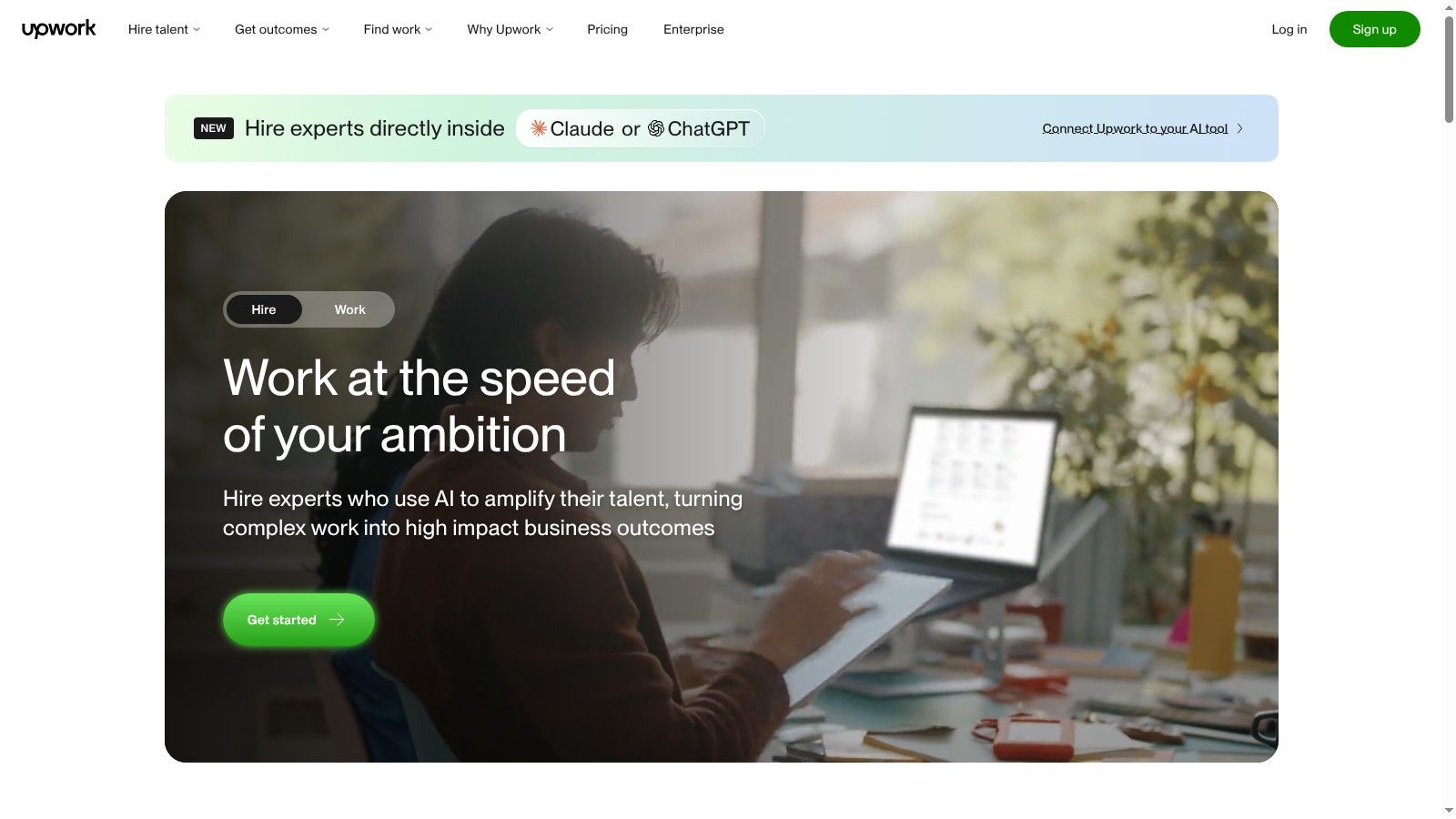
Upwork is the default answer for a reason. Clients post a job, you send a proposal, and contracts run hourly or fixed-price, with project catalog listings for selling a packaged service without pitching each order.
Buyer density is what makes the friction worth tolerating. Mordor Intelligence estimates the global freelance-platform market at $7.64 billion in 2025, projected to reach $18.97 billion by 2031 at a 16.32% compound annual growth rate, with small and medium-sized businesses accounting for 65.02% of demand. That buyer type is exactly who posts on Upwork.
The choice between proposals and a catalog listing matters. Proposals let you pursue a specific brief today, but every application takes time and may cost Connects. A catalog listing makes sense once you can define a service tightly enough for someone to buy without a long conversation. A new editor, for instance, could pitch three suitable editing jobs this week and separately prepare a clearly scoped article-editing package. Neither route excuses a vague sample portfolio.
What a first job actually costs
Basic membership is free. Proposals are not. Each application spends Connects, the free monthly allowance covers only a handful of bids, and extra Connects come out of your pocket before you have earned anything. On top of that, Upwork's freelancer service fee applies to contract earnings. Check the fee shown for each opportunity before calculating your take-home pay; do not assume that winning a second job with the same client automatically changes the rate.
The structure still rewards repeat business in a practical sense: a client who already trusts you may be easier to retain than a new client is to win. A modest ongoing engagement can save hours of applications even when the headline project rate is unchanged. Price a retainer with that time saving in mind, and read how Upwork's fee changes affect your take-home rate before quoting a monthly figure.
Consider a $120 fixed-price edit that will take three hours, including messages and one revision. If the fee displayed on that contract were 10%, the $108 remaining would work out to $36 per hour before taxes and proposal costs. If the same job stretches to six hours, the effective rate falls to $18. Write down the hours you expect, then compare them with the hours you actually spend.
Where it bites
Entry-level categories are crowded. A generic "WordPress help" post can collect dozens of proposals within an hour, several from freelancers with hundreds of reviews. A new profile has no social proof, so the first contract often comes through a referral, an existing contact, or a niche narrow enough that the sample fits the brief unusually well.
Practical rule: In your first month, prioritize recent postings with a clear scope and a sample you can match. Age is a filter, not a guarantee that the client will reply.
Two personalized proposals a day beat ten templates. Quote a fixed scope with a clear deliverable; an open-ended hourly estimate is the one you regret when the job takes three times longer than planned. A useful opening sentence identifies the problem: "I can tighten the introduction and return tracked edits on your 1,000-word draft by Friday." Your experience belongs in the next sentence, with a matching sample.
For a first job, imagine a client posts a 1,000-word article that needs a clearer introduction and a copyedit by Friday. A beginner editor could propose a fixed-price package: revise the introduction, correct grammar and consistency throughout, deliver tracked changes, and include one round of revisions. Attach a relevant before-and-after sample, even if it is clearly labeled practice work. Open the proposal by naming the client's deadline and the specific edits you would make, rather than repeating your résumé.
Before spending Connects, estimate the time for the edit, messages, and revision round. Subtract Upwork's displayed service fee from your proposed price and check whether the remaining amount meets your minimum hourly rate. If the client responds, confirm that the 1,000-word article is the entire scope, ask for the source file, and agree on what the revision round covers. For fixed-price work, make sure the milestone is funded before you begin and submit the finished file through the contract. If the client asks you to edit two more articles, quote those as separate milestones instead of treating them as part of the first job.
2. Fiverr
On Fiverr you don't write proposals. Clients search a catalog of Gigs, choose a package, and order. That flips the beginner problem: instead of pitching yourself in a written message before any of your work is seen, you build one repeatable offer and let the listing sell it.
For skills that are awkward to pitch in writing, such as subtitle cleanup, podcast editing, Notion setup, or logo vectorizing, the catalog model is a genuine advantage. Creating a seller account and listing services is free. Sellers receive 80% of each completed order's purchase amount.
Think of a Gig as a small product, not a general availability notice. "I will edit your podcast" leaves the buyer guessing about length, file format, background noise, and revisions. "I will clean up one 15-minute interview clip and deliver an edited audio file" gives them something they can actually compare with other listings. Show a short before-and-after sample if you have permission to use the recording; otherwise make a clearly labeled practice sample.
The margin math
That 80% is your starting point, not your profit. A $100 order leaves $80 before tax, and revisions are unpaid time inside that figure. Set your delivery window so a single revision request doesn't wipe out the margin. Price each package assuming some buyers will ask for extra work beyond what they paid for, because they will.
Build packages around one measurable limit. A basic subtitle Gig might cover up to five minutes of clear English speech, one caption file, and one correction round. A longer recording, translation, or burned-in captions would be a different package or an extra. Without those boundaries, a buyer can reasonably think a 45-minute recording is covered by the same price as a short clip.
AI is rearranging the catalog
Commoditized gigs are the exposed end of the market. A 2025 study of online freelancing recorded a 21% decrease in postings for automation-prone writing and coding work relative to manual-intensive work within eight months of ChatGPT's introduction.
Sell the judgment around the tool, not the tool's output. Verification, editing, quality control, and workflow setup still sell. Generic article writing at rock-bottom rates does not. A beginner who can check citations, correct factual inconsistencies, and format a draft to a client's style guide has a more defensible offer than one who promises "AI blog posts" with no review process.
The buyer pool is shrinking
Fiverr's 2025 annual filing reports 3.1 million annual active buyers, down from 3.6 million in 2024. Fewer buyers chasing more sellers makes ranking and response time matter more than listing volume.
One Gig with a fixed deliverable, a two-day turnaround, and three sample images gives buyers more to judge than ten vague listings. Start with depth rather than listing volume.
For a first Gig, imagine you offer to clean up the audio and remove filler words from a podcast clip of up to 15 minutes. Make the basic package one edited audio file delivered within three days, with one revision for missed cuts or audio issues. Ask the buyer to provide the source recording and any notes on words or pauses they want kept. A transcript, additional clips, or faster delivery can be separate extras rather than work silently added to the basic order.
When the first order arrives, check the recording's length and quality before starting. If the buyer submits a 45-minute episode, ask them to select a 15-minute segment or pay for the larger scope. Deliver the edited file through the order page and explain what you changed. If they request a revision, check it against the agreed package before doing more work.
At a $50 package price, Fiverr's 80% seller share leaves you $40 before tax. If editing, messages, delivery, and the included revision take four hours, that is $10 per hour before other costs. Track the time on your first few orders; if the return is too low, narrow the package or raise its price before creating more Gigs. If buyers repeatedly ask the same pre-order question, add the answer to the listing so the next buyer can decide without waiting for a message.
3. Freelancer.com
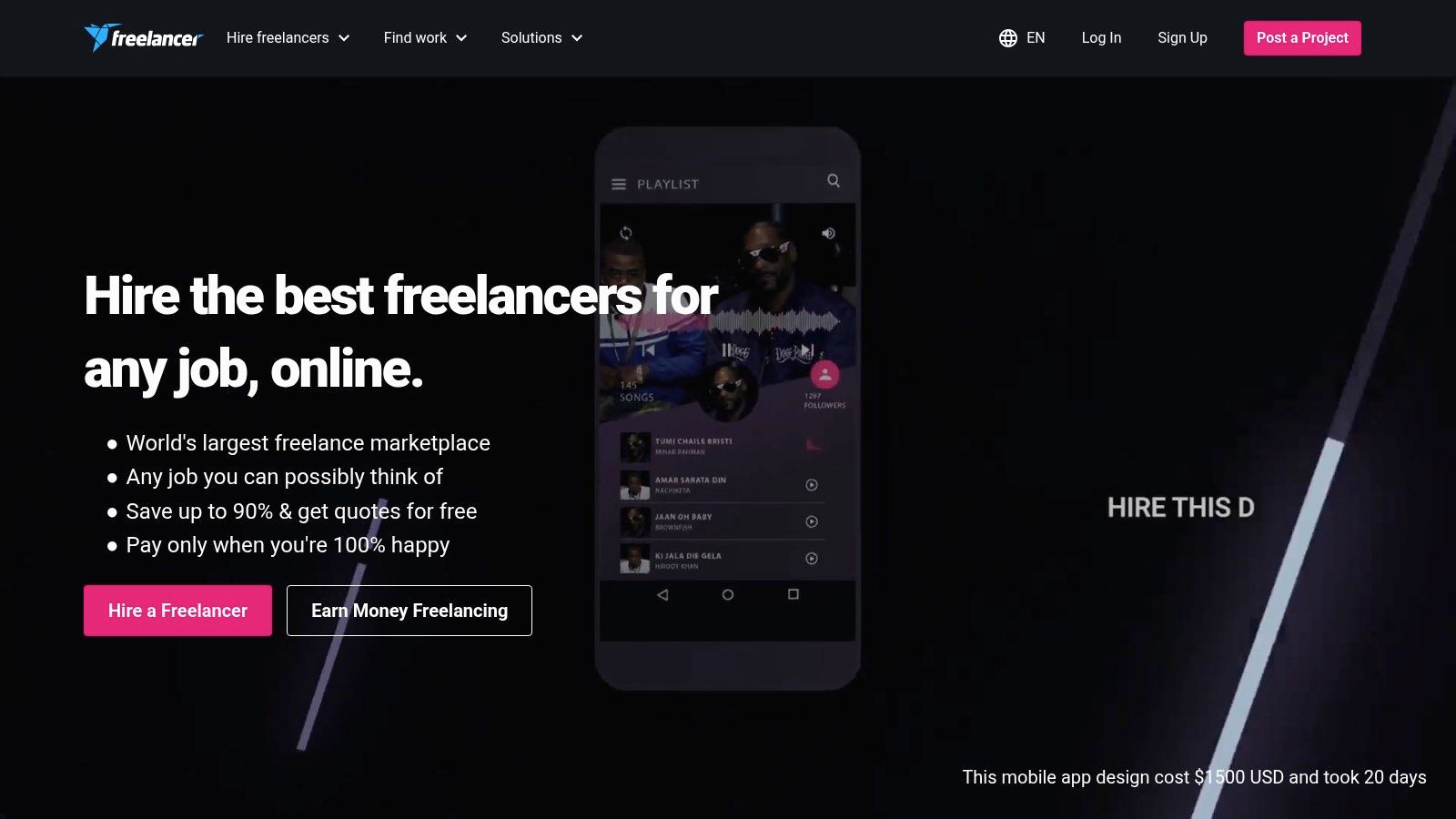
Freelancer.com is the highest-volume, lowest-patience marketplace of the big three. Work comes to you as posted projects you bid on, plus design and naming contests where the client picks a winner from submitted concepts. Both routes stay open on the free membership, so a beginner with zero reviews can pitch real budgets from day one instead of waiting for a search algorithm to rank them.
The fees are blunt. The Freelancer.com commission takes a percentage of each project's value and adds a minimum charge on small fixed-price jobs, which pushes the effective cut well above the headline rate on cheap work. The smallest projects are exactly where beginners concentrate, so run the fee math before you bid rather than after you win.
For example, on a hypothetical $30 fixed-price project, a $5 minimum project fee would take a larger share than a 10% fee. That leaves $25 before tax, payment costs, and the time spent bidding. The lesson is not to avoid every small project; it is to choose one with a tightly bounded deliverable, such as formatting a supplied spreadsheet, rather than a vague request to "fix our data."
Contests are a portfolio play
Contest entries pay nothing unless yours is selected. Treat them as a way to build portfolio pieces and watch how buyers react to your style, with a hard cap on attempts set before you start. Five losing concepts is a week of unpaid work if you never decided how much time you were willing to spend.
Choose briefs that let you reuse the skill even if you lose. A designer practicing restaurant packaging could enter one relevant packaging contest, cap the initial concept at two hours, and record what the brief taught them. That is a different decision from spending three days on speculative revisions in the hope of a prize. Check the contest terms before showing or reusing an unselected entry elsewhere.
Scale, with a caveat
Dataintelo's market analysis reports more than 70 million registered users on Freelancer.com in 2025 and puts Upwork, Fiverr and Freelancer.com together at roughly 41.3% of global freelance-platform revenue, with Upwork's 2025 gross services volume around $4.1 billion.
Registered users are not active buyers, and they're not beginners getting hired either. Measure your own funnel instead:
- Profile views to inquiries: If nobody opens your profile, the headline and skills tags may need work.
- Inquiries to proposals or orders: If people ask questions but never request a quote, the offer may be unclear.
- Proposals or orders to paid work: Compare your price, scope, and proof with the briefs you are actually pursuing.
- Effective hourly rate after fees: This decides whether the work is worth repeating.
Milestone payments arrive before you've thought about tax, so read how freelancers keep up with quarterly taxes before your first payout lands.
For a first project, imagine a client needs a five-page website for a local business. Instead of bidding "I can build your site," send a short plan: set up five pages using the client's supplied copy and images, make the layout work on mobile, test the contact form, and hand over the finished site by an agreed date. Attach a relevant sample, even if it is clearly labeled practice work. Ask which website platform the client uses and whether they already have hosting, before you settle on a price.
Break the work into milestones the client can check, such as page setup, content entry, and final testing. Confirm that the first milestone is funded before starting, and submit each deliverable through the project rather than relying on a message saying it looks good. If the client has no copy or wants a booking system added, quote that separately. On a small fixed-price project, calculate the platform's minimum fee before bidding; it may leave less in your pocket than the headline percentage suggests.
If you try a contest instead, choose one portfolio goal, such as a packaging concept you could show as a sample, and set a time limit before opening the brief. Assume the entry will not win when deciding how many hours to spend. Read the contest's terms before reusing an unselected concept, and do not submit work you cannot afford to produce for free.
4. PeoplePerHour
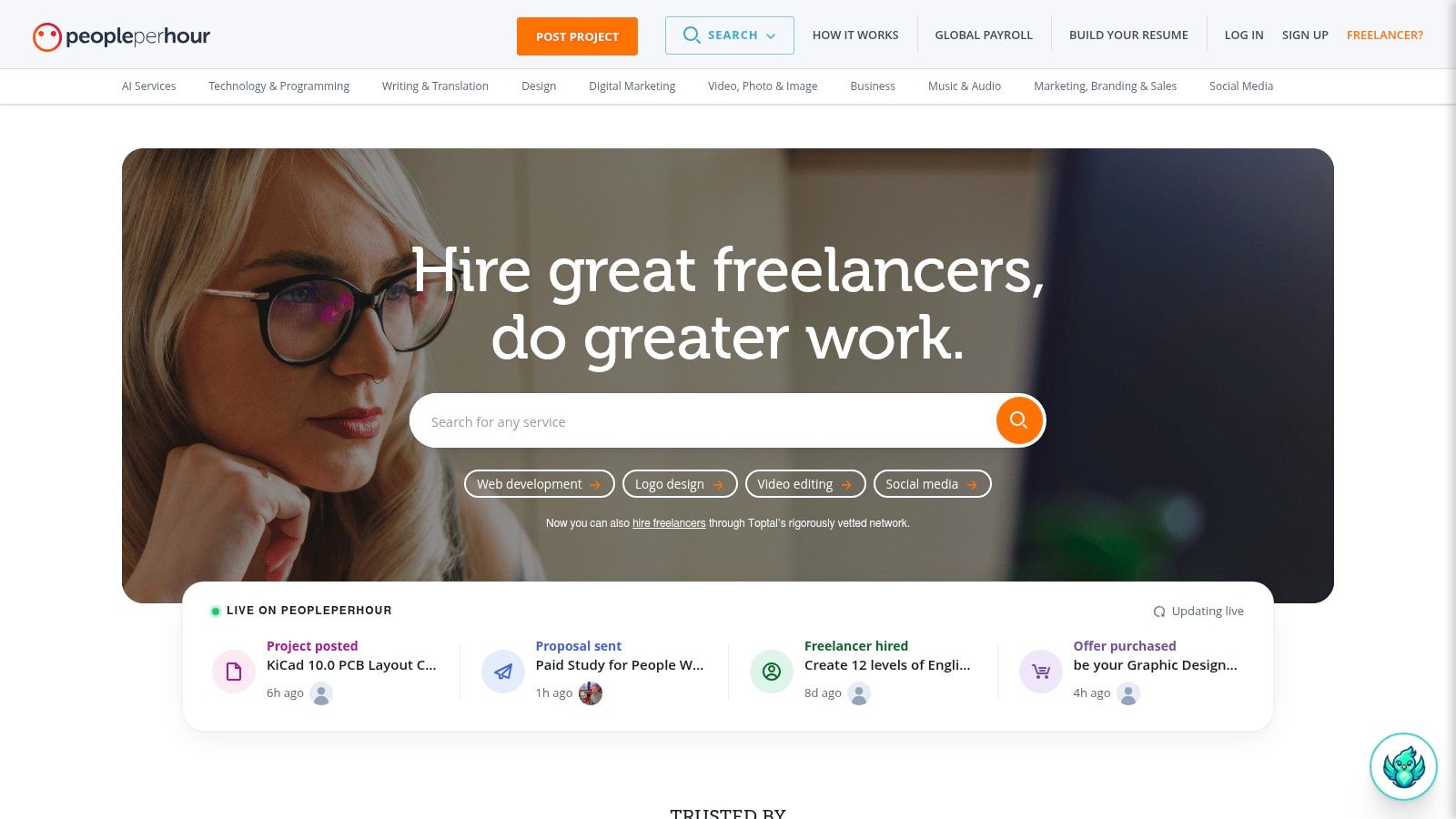
PeoplePerHour combines proposals on client projects with fixed-price "Offers" you publish yourself. I'd send a beginner here first if their target clients are in the UK or Europe, because the buyer base skews that way and the competition is thinner than on the American giants.
Freelancers get 15 free proposal credits per month, which is enough to apply selectively rather than blast. The message and project coordination tools sit inside the platform, so client conversations don't scatter across email and chat apps.
Use the two routes for different kinds of work. A posted bookkeeping project with an itemized brief deserves a tailored proposal. A repeatable task, such as categorizing a set number of transactions or formatting a monthly report, is easier to explain as an Offer with a fixed scope. If the work cannot be described without a long discovery call, do not squeeze it into a cheap package just to get listed.
The fee falls as you bill
Commission starts at 20% on lifetime billings below $350 with a buyer and steps down as that same client keeps paying. That structure rewards depth. One client who returns every month is worth more here than five one-off projects at the same headline rate.
At the starting rate, a hypothetical $100 Offer leaves $80 before tax and other costs. If the job takes two hours, that is $40 per hour before those costs; if vague requirements stretch it to five hours, the same Offer falls to $16 per hour. A transaction cap, required input format, and defined correction round protect that estimate more effectively than an optimistic turnaround time.
Approval isn't automatic
New freelancers apply and pass moderation, so applications can be declined. Sign up the week you start researching, not the week you need the money, and have your portfolio ready before you submit.
Rule of thumb: If you're outside the UK, convert the 20% starting commission into local currency before you set a price. It changes what "competitive" means.
A profile sample should look like the output the buyer will receive. For a bookkeeping Offer, that might mean a practice spreadsheet with fictional transactions and a separate tab for unclear items. Label it as a sample and remove any real client's financial information before uploading it. For a design Offer, show a finished export as well as a sentence explaining what files the buyer receives.
For a first job, suppose a small business needs its previous month's expenses organized before handing the records to its accountant. A beginner bookkeeper could publish a fixed-price Offer to categorize up to 75 transactions from one bank statement, flag unclear items in a separate list, and deliver a spreadsheet within five working days. State that the client supplies the statement in an agreed format and that the Offer excludes tax filing and reconciliation of other accounts. That turns "sort my books" into a job both sides can evaluate.
If the business posts the job as a project instead, use one of your proposal credits to reference its stated transaction count and explain how you would handle missing receipts. Before accepting, confirm the number of accounts, the delivery date, and whether a short round of corrections is included. Check your take-home pay after PeoplePerHour's starting commission against the time for categorization, messages, and corrections. If the client has 300 transactions rather than 75, quote a larger scope instead of absorbing the difference.
Use proposal credits on briefs that name a budget, deliverable, and deadline you can meet. Link to a relevant sample on your profile, even if it is a clearly labeled practice spreadsheet. If moderation has not approved your account yet, prepare the Offer and sample rather than assuming you can start bidding immediately.
5. Guru
Guru is quieter than Upwork, and that's the point. You send quotes to employers posting jobs, and agreements can run hourly, fixed-price, task-based, or recurring. That last option matters if you want maintenance retainers instead of a permanent scramble for one-off projects.
The free Basic plan is a fair place to start. Guru lists a 9% job fee on the free plan, with lower fees available on some paid plans, which puts it below most general marketplaces at entry level.
The agreement type should follow the work. Use a fixed-price task when the outcome is easy to check, such as updating three pages. An hourly arrangement can make more sense for troubleshooting an unknown technical issue, provided you agree on reporting and a spending limit. A recurring agreement is easier to sell once a client has seen one month of reliable work, not when you have no shared history.
Do the arithmetic on an upgrade
The free plan caps how many bids you can send, and paid plans add a recurring cost whether or not you win anything. Upgrade only after you've proven the free plan converts. Paying a monthly fee to send more losing bids is the most common way beginners turn a side income into a subscription expense.
Suppose an upgrade would save you $10 in fees across your expected monthly billings but cost $20 for the month. More bids would have to produce at least another $10 in net value just to break even. Before paying, log how many free-plan quotes earned replies and whether you actually ran out of bids on suitable jobs. If the bottleneck is your sample or pitch, a subscription will not fix it.
Who it suits
Guru rewards freelancers who can hold a relationship. If your work involves ongoing maintenance, monthly reporting, or a long build, the flexible agreement types and comparatively low job fee give you room to price a retainer that survives the cut.
Rule of thumb: Judge a membership upgrade on your reply rate, not on how many jobs are visible. A bigger board you can't convert is just more rejection.
Build the profile around outcomes: what you deliver, how long it takes, and what the client owns at the end. Vague skill lists get skipped. "Monthly website checks with a written issue log" tells a buyer more than "WordPress, HTML, CSS, communication." Show an example log using a practice site if you do not have permission to display client work.
For a first job, imagine a small business needs its website maintained. Quote an initial task: update three existing pages using copy the client supplies, test the contact form, and send a change log by an agreed date. Confirm access before accepting, allow one round of corrections, and exclude new page copy or a redesign from the price. Once the client approves that task, you can propose a monthly agreement for updates and checks rather than asking them to commit to a retainer before seeing your work.
Before starting, agree on how the employer will fund and approve the task and what triggers payment. If you later move to a recurring agreement, specify how many updates are included each month and how extra work is quoted. Track replies and completed contracts on the free plan for a month before deciding whether more bids would actually help.
6. Contra
Contra makes most sense when you already have a lead to close. Contra is a portfolio platform before it is a job board: you build a public profile, list services, send proposals, and run contracts, invoices, and payments in one place. Core features and profile creation are free, and the built-in paperwork saves a beginner from stitching together three separate tools in the first month.
The profile is the pitch. A résumé says where you worked; a Contra page shows what the work looked like. For someone with three real samples and no reviews, that is a stronger opening than a blank marketplace profile.
One useful case study can be short. Show the starting material if you are allowed, the finished deliverable, what you changed, and the constraint you worked within. A presentation designer might show three slides from a self-initiated redesign and explain that they simplified the hierarchy for a specific audience. Do not claim a client outcome you cannot document.
Commission-free isn't fee-free
Contra markets itself as commission-free, but the pricing page lists payment-related platform fees on the Free plan, and the paid Pro tier adds a recurring subscription cost. Read the payment terms before you invoice a client, because "no commission" and "no fees" are different claims. I would not pay for Pro until a few proposals have already converted through the free profile.
An empty Contra page converts badly. Two projects with a short paragraph of context each, the problem, the decision, and the result, will do more than a grid of images with no explanation. If an invoice is for $300, calculate any applicable payment-related fee using the checkout terms before promising yourself the whole $300. Also decide whether your quoted price includes one revision or reserves time for several rounds.
Where the leads come from
Opportunities depend on finding projects in your specialty, so the platform rewards people who already know what they sell. If you are still testing three service ideas, pick one before you build the profile, or the page will read like a directory of everything you have ever touched.
Build it once, properly. Then send proposals that point at the specific project on your page that matches the client's problem. Your first ten prospects might come from past coworkers, professional communities, or people who have already asked for help. In that situation, Contra is the place to show the work and formalize a project, not a substitute for the initial introduction.
For a first job, imagine a former colleague needs a 10-slide pitch deck polished before a meeting. Build a Contra profile with a short presentation-design case study: show two or three sample slides, explain how you organized the information, and label any self-initiated work clearly. Send the colleague that specific project page rather than a general résumé.
In your proposal, offer to redesign up to 10 slides using copy and brand assets the client supplies, deliver an editable file by the agreed date, and include one revision round for layout and visual consistency. Ask to see the existing deck before quoting. Writing new copy, sourcing images, or adding slides changes the scope and should have a separate price. Agree on the deliverable, payment schedule, and approval point in the contract before you begin.
Before invoicing, check the payment-related fees that apply to your Contra account. Divide your expected take-home amount by the time for design, messages, and revisions to see whether the quote works. A polished profile can help close a lead from your network, but it does not replace finding that lead.
7. Workana
Workana carries programming, design, writing, marketing, administration, finance, and management projects, with a strong Latin American base and multilingual listings. Registration is free, commission starts at 20% for a new client relationship and falls as that client pays more, and the platform describes an escrow-style payment protection process.
The language of a listing is only part of the fit. Translation and marketing projects depend on the reader's location, terminology, and buying habits. A freelancer who knows the difference between Spanish-language markets can ask where the copy will run before quoting, instead of treating "translate to Spanish" as a complete brief. That one question can prevent a revision round caused by the wrong tone or vocabulary.
The hourly reality check
The ILO's 2025 report on digital labour platforms put average hourly income at $2.84 on Workana, alongside $3.57 on Upwork and $3.75 on SoyFreelancer, all below comparable non-platform work. That isn't a reason to avoid the platform. It's a reason to price and target deliberately instead of accepting the median posting.
The same report found 44.2% of freelance workers surveyed lacked access to social-security services, only 20.1% had compensation or injury insurance, and 19.8% had unemployment insurance. Fairwork-related reporting cited there found only 4 of 16 assessed platforms could demonstrate that workers consistently earned at least the local minimum wage after costs, while 31% of surveyed workers reported non-payment and 38% late payment.
Build the net-earnings worksheet before the profile. Commission, currency conversion, proposal time, revisions, tax, and unpaid applications all come out of the headline figure.
Local knowledge is an edge here. If you write Portuguese or Spanish and understand the buyer's market, you're competing against a smaller pool than on the English-language giants. But a language advantage only pays if the quote accounts for research, clarification, and review. A $100 project with an $80 take-home amount is a very different proposition when it takes four hours instead of ten.
For a first job, consider a client who needs five product descriptions translated from English into Spanish. Before proposing, ask for the total word count, intended market, and any brand terminology. Quote for five finished descriptions, one revision round, and a delivery date, rather than an open-ended promise to translate the catalog. If the project pays $100 and the 20% starting commission applies, you would receive $80 before any other costs. Estimate the time for translation, messages, and revisions to decide whether that amount meets your minimum hourly rate. Agree on the deliverables and payment milestone through Workana before starting.
If the client sends five descriptions with 300 words each after you priced five descriptions of 50 words each, pause and re-quote before translating. Keep a copy of the agreed word count and acceptance criteria in the project conversation. Once you have one satisfied client, a second batch with the same terminology may be quicker to deliver, which is where an ongoing relationship begins to improve the economics.
8. LinkedIn Services
LinkedIn Services isn't a marketplace. It's a service page attached to your professional profile. You describe what you offer, either show a starting price or invite inquiries about pricing, and receive project requests from people browsing your profile.
Basic service pages are free to create, and clients can contact you without being a first-degree connection, which is the part most freelancers miss. Your network isn't the market; the search results are.
Still, a warm introduction gives a beginner something a marketplace profile cannot: an existing reason to trust them. A former manager may not know you have started offering presentation design, editing, or bookkeeping. State the service plainly on your page, then tell relevant contacts what kind of small project you can take on. Keep the message specific rather than asking everyone if they "know anyone who needs freelance help."
No escrow, no commission, no safety net
Payment and project terms are arranged outside LinkedIn. That's the trade. You keep the full fee, and you also carry the risk of a client who disappears after the third revision. For a first project, take a deposit, agree the scope in writing, and never start work on a verbal promise.
A simple agreement can fit in an email: the deliverable, materials the client supplies, number of revisions, delivery date, price, deposit, and date the balance is due. If you are refreshing five slides, "one revision round" can mean one consolidated list of edits, not unlimited messages over three weeks. Save the written approval and invoice record rather than relying on your memory of a call.
What makes the page convert
Recommendations and work history do the heavy lifting. A profile with three specific recommendations gives buyers more evidence than one with a polished summary and nothing else, because buyers are looking for signs that someone else trusted you with real work.
Enhanced features require a LinkedIn subscription, but you don't need them to test the channel. Publish the service page, post twice a week about the problem you solve, and see whether inquiries arrive before you pay for anything. One post might show a before-and-after slide with permission; another could explain three mistakes that make a sales deck hard to read. Both demonstrate your service better than a generic "available for work" announcement.
For someone with an existing professional network, this can be a fast route to a first client without a marketplace fee. It is not automatically the safest route, because you handle payment protection yourself.
For a first project, suppose a former colleague asks you to refresh a five-slide sales presentation. Reply with a short written scope: five slides using content they supply, one round of revisions, a delivery date, and a fixed price. Share a relevant sample, request a deposit before starting, and confirm when the balance is due. If they later ask for new copy or ten more slides, quote that separately instead of letting a small first job grow without pay.
9. 99designs
99designs is design-only, which cuts out most of the noise you meet on general marketplaces. Work arrives two ways: one-to-one client projects, and contests where a client picks a winner from submitted concepts. Signing up is free. The platform charges a fee on one-to-one projects that can vary by designer level, so check the current rate on 99designs before you price your first project.
Contests are the fastest portfolio builder and the worst income plan. You're competing for a prize, and you aren't paid unless your entry is selected. Decide how many unpaid concepts you're willing to fund per month before you start, because the platform is built to keep you submitting.
A designer who spends six hours on each of five contests has invested 30 unpaid hours before counting revisions. Compare that with the time it would take to make two thoughtful, self-initiated samples and a focused portfolio. Contest work makes sense only when the learning opportunity and chance of a prize justify the time risk for you.
The curation cuts both ways
99designs curates its design community, so approval isn't guaranteed and the standard of competition is high. That protects the buyer experience and makes every win worth more. It also means a beginner with a thin portfolio should build samples elsewhere first, then apply.
Make the samples look like assignments, not isolated decorations. A packaging concept should include the product, the target customer, the label hierarchy, and realistic print constraints. A logo concept should show how the mark works in small sizes and in one color. Label both as self-initiated if no client commissioned them. This lets a reviewer or potential buyer judge your decisions, not just the polished final image.
Getting the first one-to-one project
A contest win gives you real client work to reference when you pitch one-to-one projects, but you do not need to treat contests as your only route. If you have permission to show strong past work and can clearly describe your process, use that proof when discussing a direct project. In either case, the platform fee is easier to plan around when you're selling a defined scope at a set price rather than gambling hours on a brief.
If you're weighing design platforms more broadly, this roundup of the best websites for graphic designers to make money covers the alternatives and what each one suits.
Specialise inside the design category. Logo work, packaging, and web design attract different buyers with different budgets, and a profile that names one of them beats a generalist page. Show two relevant pieces for the kind of project you want next rather than leading with the most impressive unrelated image.
For a first job, imagine a small coffee shop needs a logo. If you enter a contest, read the brief and set a time limit before sketching: one strong concept you can afford to make without payment is safer than a week of unpaid variations. If the client instead invites you to a one-to-one project, agree on the number of initial concepts, revision rounds, final file formats, and deadline before quoting. For example, you might offer two concepts, one selected direction with two revision rounds, and final files for print and web. Confirm whether the client also expects packaging or social-media templates, and price those separately. Check the project fee before setting your quote, then compare your take-home amount with the hours you expect to spend.
10. Taskrabbit
Taskrabbit is the one option on this list that pays for hands rather than screens. Clients book help with furniture assembly, moving, mounting, and minor home repairs across more than 50 task categories, and you set your own rates and service area.
Taskers keep 100% of what they charge, plus tips, which is a different economics from every marketplace above. There's no commission eating the margin. The cost sits at the door instead: applicable cities charge a one-time, non-refundable $25 registration fee, and approval isn't guaranteed.
Pick a category you can perform safely with tools you already own. "Beginner-friendly" does not mean you should accept electrical work, heavy lifting, or wall mounting you are not equipped to do. A straightforward assembly task can be a better first booking than a higher-priced job with unfamiliar materials and a tight deadline. Before accepting, confirm access, parking, the product model, and whether another person is needed.
The real costs are tools and travel
A task that pays $80 can cost $20 in fuel and two hours of driving. Price the trip, not just the job, and cluster your service area so you're not crossing a city for a single booking. Many tasks require tools you may not own yet, and identity checks plus a smartphone are mandatory before you can accept work.
Suppose an $80 booking takes an hour on-site, 30 minutes traveling in total, and $10 in transport costs. That leaves $70 for 90 minutes, or about $46.67 per hour before taxes and any other expenses. If travel becomes two hours instead, the same task takes three hours overall and the rate falls to about $23.33. Your service radius can matter as much as your listed rate.
Some categories don't demand extensive prior experience, which is why this works as a genuine beginner entry point. It's also entirely location-dependent. If Taskrabbit doesn't operate where you live, skip it and don't waste an afternoon on the application.
For a first job, imagine a client needs a flat-pack bookshelf assembled. Before accepting, check the product instructions, ask whether the box is already in the room, and confirm that you have the required tools. If you expect one hour of assembly plus 30 minutes of round-trip travel, judge the booking against 90 minutes of your time, not just the hour spent at the client's home. Clarify who provides any missing hardware and whether disposal of packaging is included. After the task, note your actual travel and work time so you can adjust your service area or rate for the next booking.
It's a bridge, not a career ceiling
The people who do well here treat it as repeat business. A client who books you for one bookshelf may have a second one, and a direct request for another task saves you the effort of winning a fresh booking. Collect those relationships early while keeping booking and payment arrangements consistent with the platform's rules.
Keep a short record of each job: task type, hours on-site, travel time, supplies, and any surprise that delayed you. After ten bookings, you may find that small assemblies close to home pay better per hour than larger moving jobs across town. That is useful evidence for choosing categories and setting your availability, even if Taskrabbit is only a bridge to other work.
How the Top Freelance Platforms Compare on Cost, Work Type, and Beginner Fit
| Item | Entry Cost | Fee on Earnings | Work Model | Best For |
|---|---|---|---|---|
| Upwork | Free Basic membership; proposals use Connects | 0% to 15%; check the fee shown for each contract | Proposals, hourly or fixed-price contracts, and project listings | Beginners seeking work across many categories |
| Fiverr | Free to join and list services | Sellers keep 80% of each order | Clients browse and order packaged service listings | Freelancers with a clear, repeatable service |
| Freelancer.com | Free membership available | Fixed-price: 10% or $5, whichever is greater; hourly: 10% | Bidding on projects and entering contests | Beginners seeking varied projects or contests |
| PeoplePerHour | Free application; 15 proposal credits monthly | Starts at 20% on billings below $350 per buyer, then decreases | Project proposals and fixed-price Offers | Freelancers targeting UK or European clients |
| Guru | Free Basic plan with limited bids | 9% on the free plan | Quotes for hourly, fixed-price, task-based, or recurring work | Freelancers seeking flexible or ongoing client work |
| Contra | Free core features; optional Pro plan | Commission-free model; payment-related fees may apply | Portfolio-led project discovery, proposals, contracts, and payments | Freelancers with samples who want portfolio-based work |
| Workana | Free registration | Starts at 20% per new client relationship, then decreases | Hourly and fixed-price projects | Freelancers seeking international or Latin American opportunities |
| LinkedIn Services | Free basic Service Page | Clients and providers arrange payment outside LinkedIn | Profile-based service discovery and project requests | Beginners building direct client relationships |
| 99designs | Free to sign up | 15% for entry-level designers on one-to-one projects | Design contests and one-to-one client projects | Designers building a visual portfolio |
| Taskrabbit | One-time $25 registration fee in applicable cities | Taskers keep 100% of their charges, plus tips | Local, hands-on tasks booked through the platform | Beginners seeking local practical work |
Frequently Asked Questions
Which freelance website is best if I have no experience?
Choose based on what you can show a client, not just whether a site lets you join for free. Fiverr suits a small, repeatable service you can demonstrate with a sample. Upwork and Guru suit people who can respond to a specific brief with a clear plan. LinkedIn Services may be a better starting point if former colleagues or contacts can vouch for your work. For local, hands-on work, check whether Taskrabbit operates in your area.
You do not need a paid client project to make a useful sample. A beginner editor could mark up a practice article; a designer could label a concept as self-initiated work. Do not present either as a commissioned project.
Can I get freelance work without reviews?
Yes, but make the first job easy to evaluate. Offer a narrow deliverable, show a relevant sample, state what is included, and give a realistic deadline. A proposal to edit one 1,000-word article with tracked changes and one revision gives a buyer more confidence than a general promise to help with writing. If you already know a potential client, a direct introduction may be more effective than competing on a crowded listing.
Which sites let beginners start without paying upfront?
Several platforms in this comparison offer free basic access, including Fiverr, Guru, Contra, Workana, and LinkedIn Services. Free entry does not mean free work: a platform may charge a fee on earnings, limit applications, or add payment-related costs. Upwork proposals use Connects, while Taskrabbit may charge a registration fee in applicable cities. Check the current terms before you apply or quote a price.
Is Fiverr or Upwork better for a first client?
Choose Fiverr if you can package a service with a defined scope, price, and delivery time, then make a listing buyers can find. Choose Upwork if you prefer finding client briefs and writing tailored proposals. On Fiverr, the challenge is getting a new Gig noticed; on Upwork, it is earning replies while managing proposal costs. Test one clear offer on one platform before trying both.
How do I avoid losing money on my first freelance job?
Estimate the hours for the deliverable, messages, revisions, and administration before quoting. Subtract the platform fee and any payment or currency-conversion costs, then divide what remains by your total hours. For fixed-price work, agree on the deliverable, revision limit, deadline, and payment milestone in writing. If that calculation leaves too little, reduce the scope or raise the price before accepting.
Choosing Your First Platform and Testing It Within 30 Days
Pick one platform that matches your skill, the clients you can realistically reach, and the fees you can absorb while you're unproven. Then treat the next 30 days as a test with a fixed end date, not a commitment you have to defend.
Build the profile with two or three samples that show finished work rather than process shots. Set a rate you can defend in one sentence. If you don't know what that rate is, Mega Income Stream's freelance rate guide lists Upwork marketplace benchmarks by role, including virtual assistants at $20 to $35 per hour and writers at $30 to $40 per hour, which gives you a starting band instead of a guess.
Track applications, replies, and net earnings in a plain spreadsheet. Net means after commission, after payment conversion, after revisions you didn't charge for, and after the hours you spent writing proposals. Effective hourly rate is the only figure that tells you whether a platform is working.
The earnings picture, before you blame yourself
The International Labour Organization's survey of about 12,000 workers in 100 countries found average hourly earnings of about $7.60 on freelance platforms, against $3.40 an hour for online web-based platform workers overall, and half of online web-based workers earned less than $2.10 per hour. In G20 countries, freelance-platform earnings averaged $10.30 an hour with a median around $7.80, compared with $3.60 average and $2.50 median on microtask sites.
That spread explains a lot of beginner disappointment. A weak first month usually reflects the category and the country, not the person. It also tells you why professional marketplaces and microtask sites shouldn't be compared on sign-up volume alone.
Record four numbers every week:
- Applications sent: If you send only a few, you may not have enough data to judge your pitch.
- Reply rate: Few replies to well-matched proposals can signal a positioning or sample problem.
- Paid work: Replies that never convert point at pricing, scope, or proof.
- Effective hourly: Divide net earnings by every hour worked, including learning and admin.
When to switch, and when to stay
If replies arrive but nobody pays, rewrite the offer and raise the proof before you move. If nobody replies at all, your headline, your samples, or your category may need work. Switch platforms only when the funnel suggests the buyers you need aren't there, because hopping between sites every fortnight resets your reviews to zero each time.
If you bill in one currency and live in another, Mega Income Stream's USD vs. Local Currency Freelance Earnings Estimator shows what a quoted rate is worth after conversion. A rate that looks thin in dollars may be strong in your local market, and the reverse is just as true.
Once you have three paid projects and two reviews, test a higher price with the next new client rather than changing the terms on a current contract. Most beginners stay underpriced for a year because they never test a higher number on a fresh buyer. Thirty days of honest measurement beats six months of guessing.
Mega Income Stream publishes practical guidance for people earning online, including freelance platform comparisons, rate benchmarks by role, tax notes for self-employed work, and tools like the USD vs. Local Currency Freelance Earnings Estimator. If you're narrowing down where to start or working out what to charge once you're there, visit Mega Income Stream and use the freelance sections alongside this comparison.











Comments