
 By

Seven out of eight large corporations failed to achieve profitable growth, even though more than 90% had detailed strategic plans with ambitious targets. A Harvard Business School summary of Bain research looked at 1,854 of those companies and found the plans were not the missing piece. The wiring was. Budgets, pay, job roles, and daily choices never picked up the strategy the leadership team had already written.
A strategy execution framework is the management system that closes that gap. It turns a short list of business goals into funded work, named owners, decision rights, measures, and a review rhythm people can run on a Tuesday. It isn't another slide deck, and it isn't a software license. If two people can't point to the same owner, the same budget line, and the same number that would prove the work mattered, you don't have a framework yet. You have a hope.
Table of Contents
- Why Good Strategies Still Fail to Deliver
- What a Strategy Execution Framework Contains
- How to Connect Goals to Weekly Work
- Measuring Benefits and Avoiding Common Myths
- Decision Rights and Approval Speed
- Running Execution in a Small Team or AI Initiative
- Confirm Your Execution Framework Before Next Quarter
Why Good Strategies Still Fail to Deliver
Think of a ship with a careful chart and nobody assigned to the wheel. The destination is printed. The crew is busy. The vessel still drifts, because charts don't steer. Delivery breaks in the same place, where a written goal meets money, operating routines, incentives, and the actual job someone holds.
That Bain review, summarized by Harvard Business School, mapped the breaks as structural, not motivational. About 60% of organizations did not link strategic priorities to their budgets, so an initiative could be approved with no funding behind it. Two-thirds of human-resources and information-technology functions built plans that were not linked to the broader corporate strategy. Compensation was not connected to strategy for 70% of middle managers and more than 90% of frontline employees. Most sharply, 95% of employees did not understand their organization's strategy, so Tuesday's choices drifted off the chart.
Four gaps you can check this week
| Execution gap | Organizations affected | What it looks like day to day |
|---|---|---|
| Strategic priorities not linked to budgets | About 60% of organizations | Initiatives approved without funding or resources |
| HR and IT plans not linked to corporate strategy | Two-thirds of those functions | Teams work toward goals the company never set |
| Pay not connected to strategy | 70% of middle managers; over 90% of frontline employees | Incentives reward the old behaviour |
| Employees unable to state the strategy | 95% of employees | Daily decisions drift away from intent |
Use the table as a self-check, not a history lesson. If two or more gaps match your company, another strategy document will not fix delivery. You need a system that translates goals into measurable priorities, names an owner, allocates resources, ties performance management to those priorities, and tells each person how their work shows up in the result.
Practical rule: If a priority has no budget line and no named owner, it isn't a priority. It's a wish with a deadline.
The rest of this guide defines the parts of that system, shows how to connect them to weekly work, separates a finished project from a real benefit, and treats approval speed as a result you can manage. Frameworks fail when leaders collect components and never run them as one operating rhythm.
What a Strategy Execution Framework Contains
A strategy execution framework is a management system that connects a small number of business goals to funded initiatives, named owners, decision rights, measures, and a review rhythm. The logic matters more than the binder it lives in. A spreadsheet, a planning app, or a whiteboard can hold it. If any component is missing, the rest can't carry the load.
A railway timetable is a useful picture. Goals are the destinations and the arrival times. Initiatives are the trains. Owners are the signallers who clear a path and stop a conflict. Measures are the arrival boards. The review meeting is the control room that notices a delay and changes the next movement before the whole line backs up. A pretty timetable with no signaller still produces late trains.
The five elements, with a worked online business
| Element | Question it answers | Example for a growing online business | Accountable role |
|---|---|---|---|
| Business goal | Where must the business be, and by when? | Reach a stated annual revenue by 31 December, with monthly churn held under a stated rate | CEO or general manager |
| Initiative | What will we change to get there? | Launch annual plans and a 30-day onboarding email series | Initiative lead |
| Accountability | Who decides and who delivers? | One named owner per initiative; RACI for cross-team work | Executive sponsor |
| Measurement | How will we know it is working? | Leading: trial-to-paid rate; lagging: net revenue retention | Metric owner |
| Resourcing and cadence | Is it funded, and when do we review? | Budget line per initiative; monthly operating review | Finance partner and operations lead |
Each row answers a different question, so don't collapse them into one "owner and a KPI" cell.
Business goal. Pick a place and a date. "Grow the business" isn't a destination. A revenue figure, a churn ceiling, and a calendar date are. The CEO or general manager owns the trade-off when two goals fight for the same people.
Initiative. Name the change, not the department. Launching annual plans and a 30-day onboarding series is a change a customer can feel. "Improve marketing" is a mood.
Accountability. One person is accountable for each initiative. A RACI (responsible, accountable, consulted, informed) covers the cross-team work so marketing, product, and finance aren't all "kind of" in charge. The executive sponsor removes blockers. They don't rewrite the work every Friday.
Measurement. Pair a leading indicator the team can move this month with a lagging indicator that proves the money or the customer result. Trial-to-paid rate moves before net revenue retention does. If you only watch the lagging number, you'll notice failure after the quarter is gone.
Resourcing and cadence. An initiative without a budget line is theatre. A monthly operating review is the control room. Finance and operations own the calendar, the actuals, and the decision to move money.
A five-question self-test
Can every live initiative name its goal, its owner, its budget line, its metric, and its review date? If any answer is no, the gap sits in the framework, not in the team's effort. Fix the blank cell before you add another initiative. Tools don't create decision rights. People and a written rule do.
How to Connect Goals to Weekly Work
The cascade is how a company goal becomes a sentence a frontline person can say on Monday. In a survey of 1,075 Harvard Business Review Advisory Council members, the largest execution challenge was making strategy meaningful to frontline employees. Many respondents couldn't state their organization's strategy. People who had helped formulate it were more likely to support it. That finding is the reason step 5 exists, and the reason you don't write measures in a closed room.
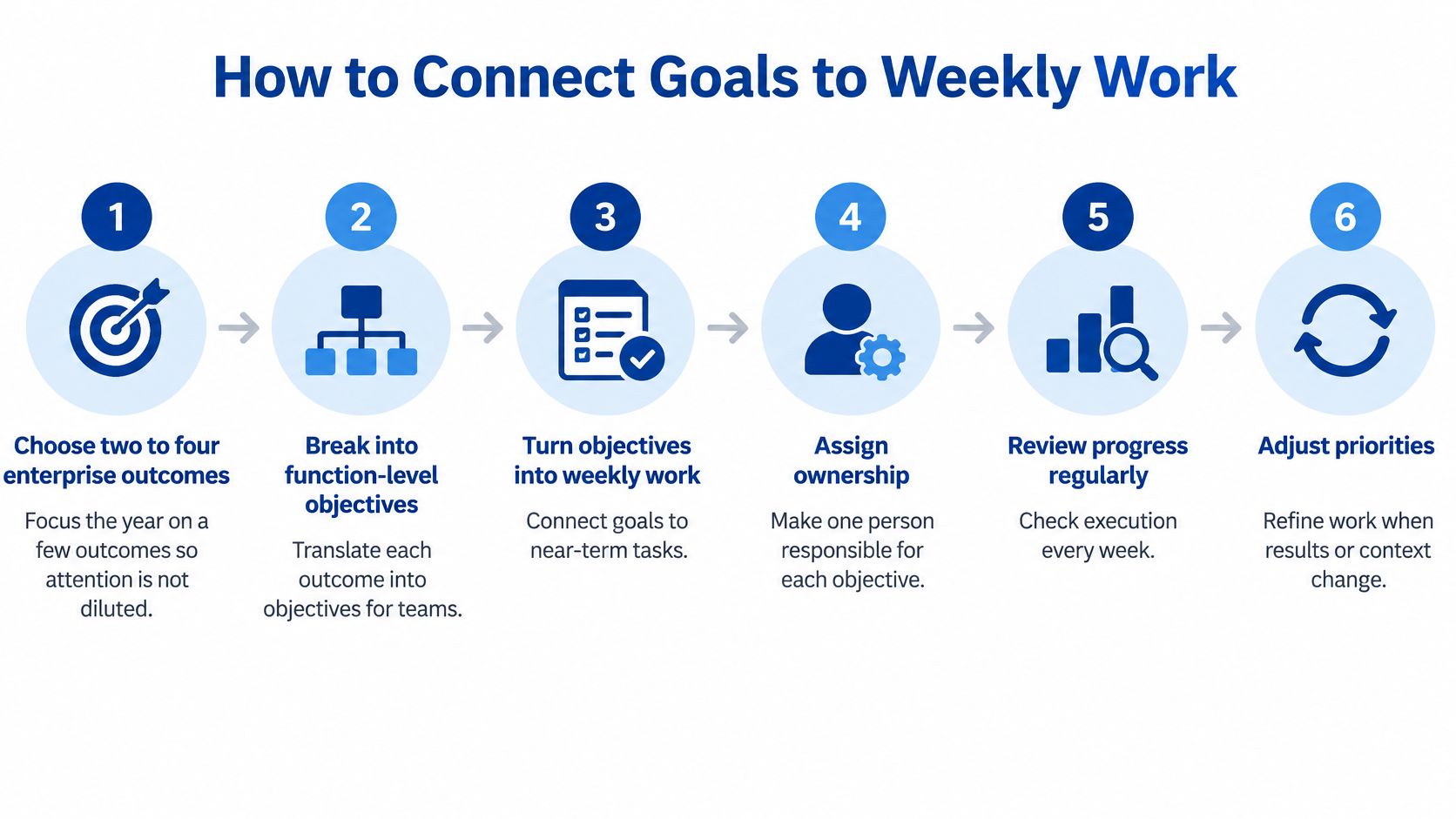
Six steps from the year to the week
- Choose two to four enterprise outcomes for the year. More than that splits attention until nothing is protected when a loud request arrives.
- Break each outcome into function-level objectives and attach two or three leading indicators. Qualified pipeline, cycle time, defect rate, adoption, or experiment velocity are controllable drivers. A lagging number such as revenue checks the result later.
- Assign decision rights with a RACI or an equivalent model. One person is accountable for each objective, so a stuck choice has a name rather than a committee.
- Link each team commitment to a funded initiative. Write the budget line and the delivery date on the same row as the commitment. Unfunded work doesn't enter the cascade.
- Translate commitments into weekly work the front line can state in one sentence. This is the translation layer. "I will clear the 12 oldest onboarding tickets by Friday so trial-to-paid can move" is a sentence. "Support the growth strategy" isn't.
- Run a monthly operating review. Compare actuals with thresholds, name the root cause, and trigger a correction you defined in advance, including moving budget. A review that only reports numbers hasn't decided anything.
Teams that already work in short cycles can park this cascade on top of an agile project management rhythm. The sprint board shows tasks. The cascade shows why those tasks exist and which outcome they are allowed to serve.
Involve the people who will hit the number when you set the number. Buy-in follows authorship more reliably than it follows a town hall.
Where steps 2 and 6 usually slip
The common slip on indicators is measuring activity instead of a driver the team controls. Emails sent, meetings held, and tickets closed can all rise while the outcome stays flat. Pick the driver that would have to move if the outcome were real.
The common slip in the monthly review is a status recital. Actuals, a threshold, a root cause, and a pre-agreed action belong on the page before anyone speaks. If the only output is "we'll watch it," you held a presentation, not an operating review.
Measuring Benefits and Avoiding Common Myths
A bridge works the same way a project does. The last bolt tightened is the output. The traffic that crosses it every morning is the benefit. Say a small subscription business ships an analytics platform in March, and customer-acquisition cost hasn't moved by June. The output landed on schedule. The benefit never arrived. A team that scores execution by launch dates will call that a win and repeat the mistake on the next initiative.
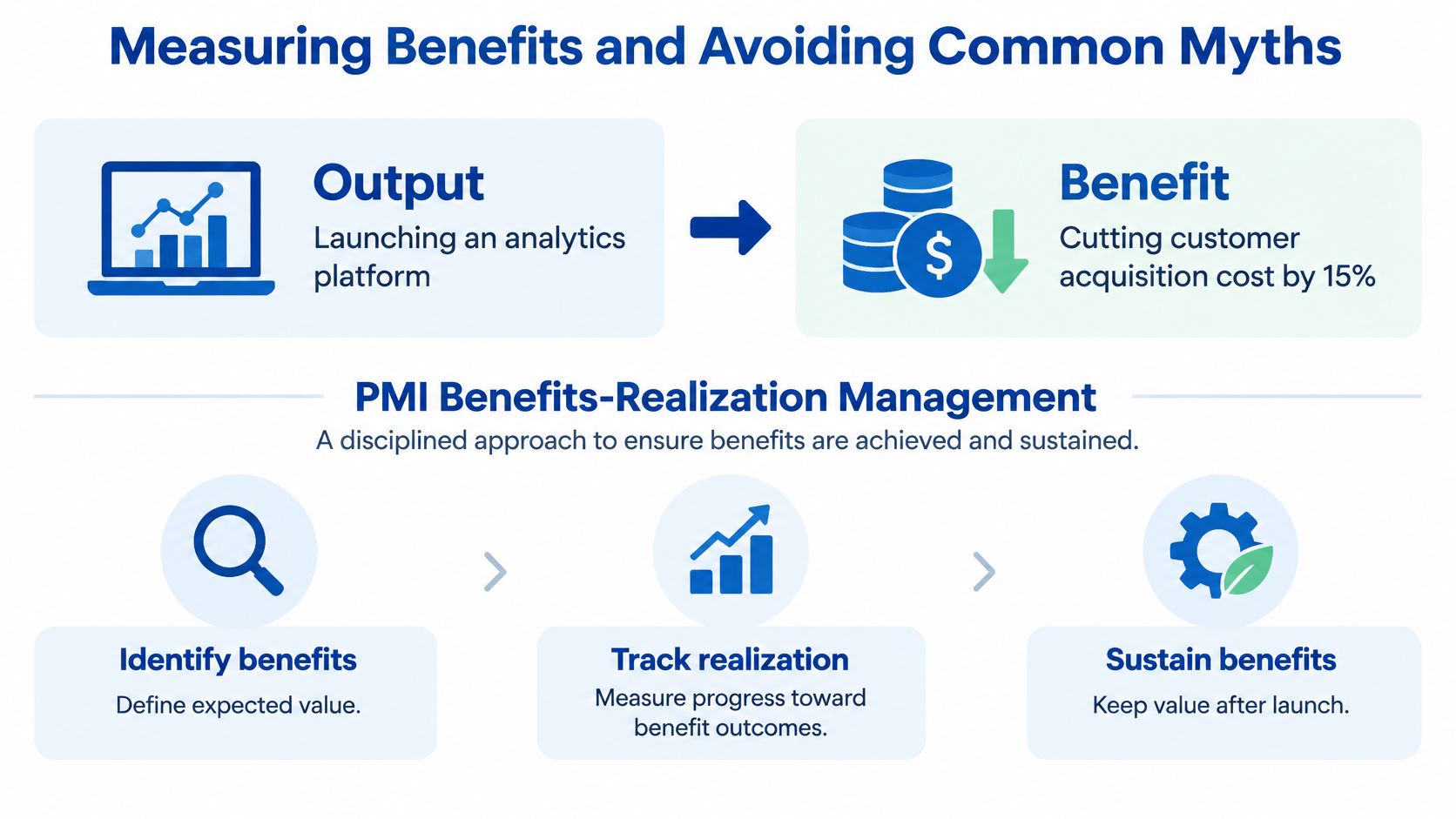
PMI's Pulse of the Profession research found that only 17% of organizations had high benefits-realization maturity, meaning most firms still can't prove execution created business value. PMI defines benefits-realization management as a lifecycle with three control points. Identify the expected benefits before execution starts. Deliver and measure them while the work is underway. Sustain them after responsibility transfers to the operating business, so value doesn't decay the week the project team disbands.
What belongs in the benefits register
Keep one register, not a pile of status slides. Each row needs the strategic objective, the baseline, the target, the metric formula, the realization date, the accountable executive, the contributing initiatives, the dependencies, and the review cadence. The baseline and target pair does the heavy lifting: they let you say "retention moved from this number to that number" instead of "the platform launched." The accountable executive matters for a different reason. Someone must hold the authority to act when a benefit stalls, because a number without a decider attached is decoration. Review those benefit indicators in the operating review and at portfolio level. Schedule, budget, and scope still matter. They answer whether the work shipped, not whether the business is better.
Before you rebuild the register, watch how leaders separate activity from value.
The Balanced Scorecard, introduced by Robert S. Kaplan and David P. Norton in a 1992 Harvard Business Review article, pushed measurement past short-term financials into customer, internal-process, and learning-and-growth perspectives. A review of research from 1992 through 2023, published in Review of Managerial Science, reports that use reached about 53% of surveyed companies in the late 2000s, based on Bain research, then fell to 29% in the late 2010s among more than 1,000 global-company managers. Those figures show real reach, and they also show that adoption fades when sponsorship fades. A scorecard survives on executive attention, not on its own logic. None of this proves the framework automatically improves performance. The same logic explains why the Balanced Scorecard matters for legal firms that need more than a billable-hours dashboard.
Myths that waste a quarter
- A launched project is a success. The launch is an output. The benefit is the movement from baseline to target after the operating team owns it.
- The framework is a software purchase. A tool can store the register. It can't create decision rights, a budget line, or a person who will act when a threshold breaks.
- More KPIs mean tighter control. Two or three predictive measures do the work. A wall of charts lets everyone pick a number that flatters their team.
- Execution belongs to middle managers alone. Leaders own the goals and the trade-offs. Managers own delivery inside those choices.
- The strategy must be perfect before anyone starts. A narrow pilot shows what the plan missed. Waiting for a perfect map is another way to skip the wheel.
Decision Rights and Approval Speed
Approvals slow execution more often than teams admit, and adding another approval layer is a common way to feel in control while the work waits. In a 2025 global benchmark of 800 business professionals, Planview found complex governance and approval processes were the most frequently reported execution barrier, cited by 39% of respondents. Lack of alignment between strategy and execution followed at 33%, and slow or ineffective decision-making at 32%. More control, in the form of more gates, can lower execution quality. Rules written to protect consistency often delay the moment you move money or stop a failing test.
Sort decisions by how hard they are to undo
Give each class a decider and a time limit. The limits below are examples. Rewrite the thresholds to match your budget and your risk, then keep them written even if three people run the whole company. A founder who decides marketing, product, finance, and technology in one head still needs the map, because "I'll get to it" has no clock.
| Decision type | Reversibility | Who decides | Time limit (example) |
|---|---|---|---|
| Campaign or channel test within approved budget | Reversible | Initiative lead | 2 business days |
| Reallocating budget between approved initiatives | Reversible in the next cycle | Executive sponsor | 5 business days |
| Hiring or contract commitments beyond one quarter | Hard to reverse | CEO or finance committee | 10 business days |
| Discontinuing a product line or market | Irreversible | Leadership team | Scheduled at the next strategic review |
Reversible tests stay with the initiative lead. A channel test inside an approved budget shouldn't wait for a monthly meeting. Budget moves between approved initiatives sit with the executive sponsor, on a five-day clock, so a winning test can take money from a flat one inside the cycle. Hiring and multi-quarter contracts are hard to unwind, so they go to the CEO or a finance committee, with a ten-day limit so "we're still discussing" doesn't become the default. Killing a product line or a market is irreversible for practical purposes. Put it on the strategic review, not in a side chat.
Stakeholders and their impact on the business belong on that map too. Anyone who can block a hire, a contract, or a budget move needs a named seat, or they become an unlisted approval gate.
Track decision latency, the number of days from request to decision, next to your outcome KPIs. If latency on reversible tests runs past the limit you wrote down, the framework is slowing the strategy it was built to deliver. Centralize the hard-to-reverse calls. Delegate the reversible ones. Measure the wait.
Running Execution in a Small Team or AI Initiative
Say a three-person online course business wants AI to draft customer-support replies. The founder buys a tool in week one, points it at the inbox, and expects faster service by Friday. The draft tone is off, refund answers invent a policy the business doesn't have, and the support lead stops trusting the queue. The attempt stalls because the team started with software instead of an outcome.

They reset. The goal narrows to cutting first-reply time. For two weeks they change nothing and record an illustrative baseline of about 26 hours. That number is the starting line, not a promise. One person, the support lead, owns the outcome. Each morning they review drafts against a short style note. Refunds and billing disputes stay manual, because a wrong answer there costs cash and trust. The pilot covers roughly one fifth of tickets. They audit a sample for accuracy and tone. They scale only when quality holds. If the sample slips, they stop the pilot rather than "fix it in production."
Why the tool-first start fails so often
A 2025 KPMG AI survey reported that 91% of executives had formal AI strategies, while only 23% considered their organizations' execution capability adequate. The constraints they cited were organizational, not a missing model. Fragmented accountability, competing priorities, inadequate data infrastructure, unrealistic timelines, workforce anxiety, middle-management resistance, and thin training all showed up. A formal strategy with weak execution is the same ship-and-chart problem, now with a chatbot on the bridge.
For a freelancer, a creator, or a small firm, the order is the framework.
- Name a narrow outcome first. Shorter first reply, or more qualified leads. Not "adopt AI."
- Record a baseline before you change the workflow. Two quiet weeks beat a guess.
- Redesign the human step, then add the tool. Someone still owns quality.
- Pilot the smallest slice and audit risk. Scale is a decision, not a default.
When manual work is the better strategy
Keep the work human when an error is expensive for the customer, when the content includes private data you shouldn't paste into a tool, or when trust is the product. A wrong billing promise, a leaked student record, or a cold reply in a moment of frustration can cost more than the hours you hoped to save. Pausing a new AI initiative until the workflow, the owner, and the quality check exist isn't caution for its own sake. It's execution.
Confirm Your Execution Framework Before Next Quarter
Run four questions before the next quarter starts. A no on any of them outranks a new idea.
- Does every active initiative have a funded budget line? If the money isn't named, the work will lose to whatever already has a code.
- Does each one have a single named owner? Shared ownership becomes no ownership the week someone is on leave.
- Does each measure have a baseline and a target? A direction without a starting number can't show movement.
- Is the review date in the calendar? A cadence that lives in a document isn't a cadence.
Take a three-person course business and its onboarding initiative. It has a $2,400 budget line, one owner, a baseline of 31% trial-to-paid, a target of 38%, and a review on the first Monday of the quarter. Those are example answers, not benchmarks. Your numbers will differ. The shape should not. If any answer is no, fix that item first and hold new initiatives until the gap closes. If all four are yes, move to the weekly cascade and check that every team commitment still links to a funded initiative.
Write the four answers in the next leadership meeting, with names and dates, so the next review has a starting point you can see.
Repeat the four questions at each quarterly close. Budgets, owners, and review dates decay as priorities shift, even when nobody intends to drop them. The framework holds only if someone re-asks the questions before the new quarter fills the calendar.
Mega Income Stream publishes practical guides on strategy implementation, business operations, and the tools small teams use to turn plans into revenue. If you're building a strategy execution framework you can run, start with the goal, the owner, the measure, and the review date, then read how we break targets into work you can schedule. Visit Mega Income Stream for the next guide.










Comments