
 By

The freelance skills in demand this year include content writing and SEO, marketing, independent work, photography, videography, and video production. The right fit depends on what you can deliver consistently and how clearly your work supports a client’s goals.
Choosing a skill is only the first step. A broad service can help you get started, while a focused specialty can make your offer easier to explain and position. Neither demand nor specialization guarantees higher earnings, so consider the work involved and the value you can demonstrate.
This guide covers skills across writing, marketing, and visual production, then explores practical foundations for an independent freelance workflow. You’ll learn what each area requires, how to present your work in a portfolio, and how to choose a direction that matches your strengths and commercial goals. Use the overview to narrow your options, identify skill gaps, and turn your strongest capability into a clear service offer.
Key Takeaways
- Writing and SEO: Build capability around keyword research, on-page optimization, and performance analysis.
- Digital marketing: Connect digital marketing and social media work to clear business goals, then focus your offer on the outcomes you can deliver.
- Portfolio: Create a focused portfolio and start with defined freelance tasks before narrowing into a specialty.
- Photography and videography: Strengthen your work through deliberate equipment choices, lighting, composition, and framing.
- Video editing and production: Develop skills that help turn raw footage into clear, polished content for a client’s intended audience.
1. Content writing and SEO
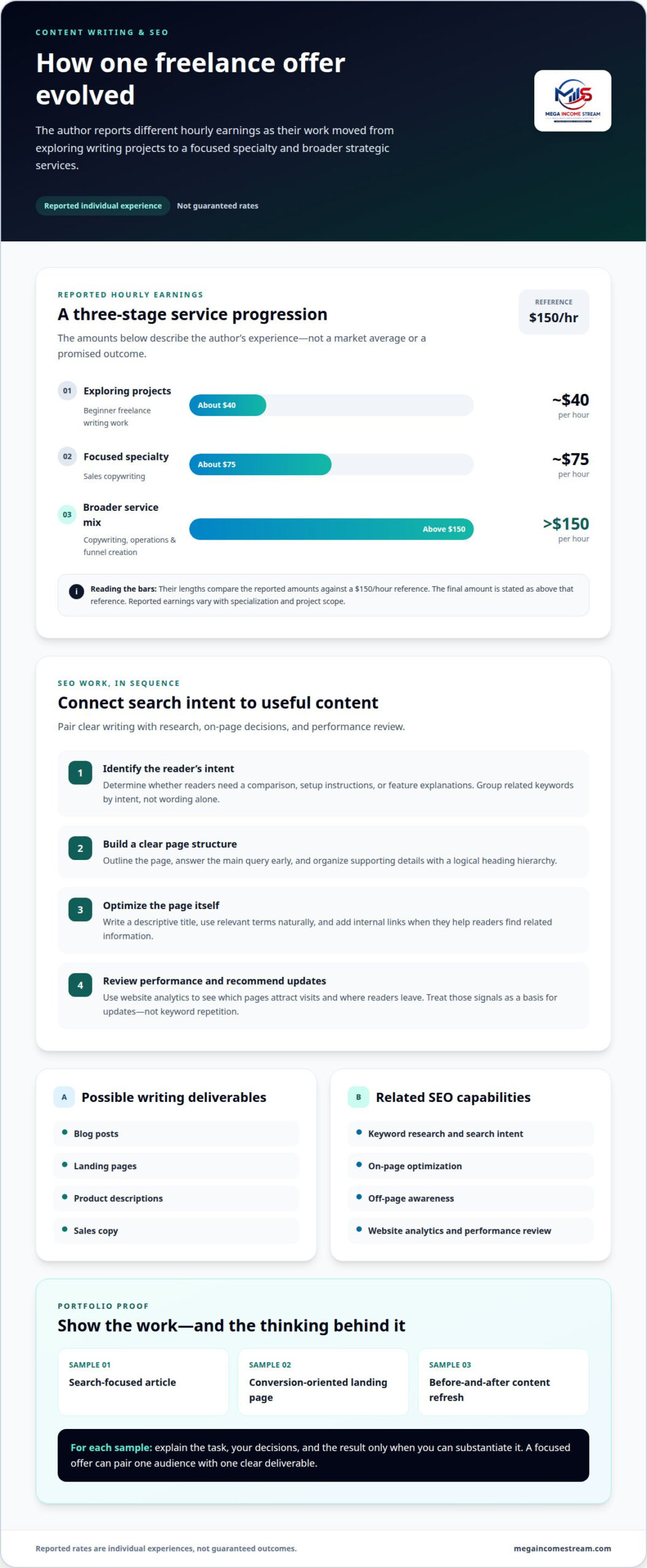
Content writing and SEO pair clear messaging with measurable search work. A freelancer might create blog posts, landing pages, product descriptions, or sales copy. SEO adds keyword research, on-page optimization, off-page awareness, and website analytics. Together, these skills connect content decisions with search visibility and reader actions. A writer who can explain that connection offers clients more than polished sentences.
Start by identifying the search intent behind a topic. For a page about project management software, determine whether readers want comparisons, setup instructions, or feature explanations. Group related keywords by intent, not just wording. Build a clear outline, answer the main query early, and use headings to organize supporting details. This structure makes a draft easier to scan and gives each section a clear purpose.
On-page SEO focuses on the page itself. Write a descriptive title, use a logical heading hierarchy, and place relevant terms where they fit naturally. Add internal links when they help readers find a related page. For example, a guide to email marketing could link to an explanation of segmentation. After publication, review website analytics to see which pages attract visits and where readers leave. Use those signals to recommend updates, not to repeat keywords.
Off-page SEO calls for a different approach. Writers may support link-building campaigns with useful research, expert commentary, or content that other sites can reference. Accuracy and a clear audience remain essential. A practical portfolio might include a search-focused article, a conversion-oriented landing page, and a before-and-after content refresh. Explain the task, your decisions, and the result only when you can substantiate it.
Reported earnings vary with specialization and project scope. The author describes earning about $40 per hour while exploring different writing projects as a beginner freelancer. After specializing in sales copywriting, the author describes earning about $75 per hour. Combining copywriting with operations work and funnel creation brought reported earnings above $150 per hour. These are individual experiences, not guaranteed rates. They illustrate how a focused offer can include more strategic work.
Web development, software, and cybersecurity assignments each require distinct technical capabilities. Clients seeking web development value familiarity with version control systems such as Git or Bitbucket. Mobile app projects also call for app design fundamentals, UX guidelines, deployment, testing, and version control. Cybersecurity work can involve secure coding, access controls, and vulnerability assessment, while software roles depend on the specific product and task.
Sharpen your offer by choosing one audience and one deliverable. For example, write SEO product pages for an online retailer, then document your research and editing process. Pair each sample with a concise explanation of its purpose. This gives prospective clients concrete evidence of your writing, SEO judgment, and ability to work toward a business objective.
2. Digital marketing and social media management
Digital marketing freelancers turn business goals into campaigns, content, and measurable actions. A client may want more qualified leads, product trials, or event registrations. The freelancer translates that goal into a channel plan, audience, message, and tracking method. Social media management also involves publishing, community responses, and performance reviews. For anyone weighing freelance skills in demand this year, this field connects creative decisions with business objectives.
Begin each project by defining the conversion action. For a neighborhood bakery, that might mean promoting a seasonal menu and directing local customers to order. For a software company, it could mean generating demo requests through LinkedIn. Each example calls for a different audience and creative approach. A clear goal also keeps a campaign focused on business outcomes rather than activity for its own sake.
Choose channels based on the audience and offer. Instagram can support visual product stories, while LinkedIn can suit business-focused campaigns. TikTok may work well for short demonstrations or creator-style explanations. These platforms are not interchangeable. Match the format to the message, then adapt the creative for each channel instead of copying the same post everywhere.
Organize campaign work into clear stages. First, gather the offer details, target audience, and approved brand materials. Next, draft content themes and a publishing calendar. Prepare posts, review them with the client, and schedule approved assets. Track the agreed action, such as clicks to a landing page or completed lead forms. This workflow creates a clear record of decisions and next steps.
Paid campaign management adds budget pacing and testing. A freelancer can compare two ad messages aimed at the same audience, changing one element at a time. For example, one version might lead with a product benefit, while another emphasizes a use case. Assess results against the campaign goal, not vanity metrics alone. Reach and likes offer context, but they do not necessarily show leads or sales.
Social media managers also support community operations. They can organize incoming comments, identify recurring customer questions, and route service issues to the business. A monthly report might group posts by format and summarize which themes prompted meaningful interactions. Keep the analysis tied to the original objective. If the campaign aimed to generate registrations, report on registrations and the steps that supported them.
To package this skill, create a sample campaign brief for a fictional meal-prep brand. Include the objective, audience, channel rationale, sample posts, and reporting fields. Freelancers exploring freelance skills in demand this year can use this exercise to show strategic thinking, not just screenshots. A defined scope, such as campaign planning, publishing support, or performance analysis, helps clients understand what the work includes.
3. Freelancing basics and independent work
Start with a defined service, not a broad freelancer label. Website testing, surveys, and research can help beginners learn client workflows. One author describes earning about $15 per hour while doing these general tasks. Treat that as an individual example, then build toward work that uses a specific skill.
A portfolio gives prospects evidence they can assess. Select your strongest samples and label each with its purpose, audience, and contribution. A research sample might show how you organized findings into a concise brief. A website test could document the issue, reproduction steps, and suggested improvement. Aim to earn your first five-star reviews through reliable delivery and clear communication.
Demand for AI and machine-learning freelancers depends on each client’s technical problem and the expertise required. These projects may call for specialized skills, while writing, marketing, and creative work address different business needs. Compare opportunities by the requested deliverable and the capabilities needed to complete it.
The timeline to specialization depends on available work time. One author reports reaching that stage in about three months while freelancing for 20-30 hours per week. People balancing employment, children, and other responsibilities may take about six months. Use either timeline as a planning example, then set milestones around practice, completed projects, and client feedback.
The highest hourly earnings described in this article came from combining copywriting with operations work and funnel creation. This example suggests specialized execution can become more valuable when paired with related commercial skills. It does not establish a universal top-paying skill or rate: client needs, project scope, and the work delivered shape each engagement.
There is no single typical U.S. freelance rate for every skill. Rates vary by specialization, project scope, client value, and time spent on delivery. Employee wage data and freelance rates also describe different work arrangements, so compare them carefully rather than treating them as equivalent.
For U.S. occupation-level wage and outlook context, use the Bureau of Labor Statistics Occupational Outlook Handbook. The O*NET OnLine occupation profiles can help identify skills and tasks associated with different roles. Compare those resources with current freelance listings to understand requested deliverables and posted budgets.
Track each project with a simple workflow: record the requested outcome, agree on deliverables, log time, and save client feedback. Review your results after several assignments. If research tasks repeatedly lead to stronger work, package that capability as a focused service and add a relevant portfolio sample.
Keep the portfolio focused on your best work so prospective clients can assess it. The author’s beginner framework makes 5 first five-star reviews a goal for general freelance tasks. The author says specialization took about 3 months while freelancing for 20-30 hours per week; balancing freelancing with jobs, children, and other responsibilities may make it about 6 months.
4. Photography and videography
Photography and videography turn visual judgment into client-ready assets. A product photographer might create clean images for an online catalog. A videographer could capture an interview for a company’s recruiting page. Both roles involve equipment choices, lighting control, composition, and framing. Clients value reliable execution as much as creative ideas.
Start by defining the shoot’s purpose and final format. A restaurant menu needs clear food details and consistent color. A real estate listing needs room coverage that accurately shows the layout. An interview needs steady framing and intelligible speech. These goals guide camera settings, lenses, lighting, and shot lists. Confirm the deliverables before packing your equipment.
Handling equipment is practical as well as technical. Match the camera and lens to the scene, then check batteries, storage, and support gear. A tripod helps keep interview framing steady. A wider lens can capture more of a small room, while a closer view can emphasize product details. Learn to use each tool before a paid shoot so setup does not consume the session.
Lighting changes how a subject appears. For a product photo, position the light to reveal texture without distracting reflections. For a portrait, adjust its direction to shape facial features. Window light can work for a simple interview, but changing daylight may affect continuity. Test the scene, review the image, then adjust exposure and light placement.
Composition and framing direct the viewer’s attention. Keep a product’s key feature visible and remove distracting objects from the background. For a speaker, leave enough space around the face and frame at a consistent eye level. Videographers also plan coverage: a wide shot establishes the location, while close-ups capture useful details. A shot list helps prevent missing essential footage.
Build a focused portfolio around recognizable assignments. Include a product set, a portrait, an event sequence, and a short interview sample. Show varied lighting conditions and framing choices. Add a concise project note explaining the goal and your role. Do not present edited work as an unaltered capture. Clear context helps clients judge whether your approach suits their project.
- Before the shoot: Confirm location, schedule, deliverables, and access.
- During setup: Test equipment, lighting, framing, and sound.
- After capture: Organize files, select strong takes, and prepare agreed formats.
Photography and videography can also come together in one assignment. A small clothing brand, for example, may need catalog stills and short product clips. Plan the shot sequence so both formats use the same setup efficiently. Record selected settings and lighting positions. That makes retakes more consistent and gives the client a coherent visual package.
5. Video editing and production
Video editors turn raw footage into a clear, finished story. A product demo may need tight pacing, readable captions, and clean audio. A founder interview may need pauses removed and key points emphasized. Production work can also involve planning, recording, and coordinating assets. Clients value editors who shape footage around a specific viewing goal.
Which creative freelance skills, such as video editing and graphic design, are in demand? Video editing, motion graphics, and graphic design can support campaigns, tutorials, product launches, and social content. Their commercial value depends on matching the format to the audience and intended action. A freelancer can strengthen an offer by pairing editing with a related deliverable, such as branded title cards.
Start each edit by confirming the deliverable and source files. Ask about the intended platform, audience, tone, and call to action. Then organize footage by scene or topic. For a tutorial, arrange clips in instructional order. For a customer story, build around the customer’s problem, experience, and outcome. This structure prevents attractive shots from displacing the message.
Editing decisions should improve clarity. Remove repeated phrases, tighten pauses, and keep useful context. Balance dialogue against music so speech remains easy to understand. Use captions to support viewers watching without sound. For a software walkthrough, zooming in on an interface can make a small control easier to follow. Avoid effects that compete with the information.
Production planning improves the footage available for editing. Create a shot list based on the script or brief. Record a clean opening, supporting details, and a closing action. For a cooking demonstration, capture ingredient preparation, the key technique, and the finished dish. Keep camera framing and lighting consistent across related shots. Capture clean audio, since distracting noise can limit usability.
Build a portfolio that demonstrates different editing challenges. Include a short tutorial, a product demonstration, and an interview excerpt. Explain your role, the source material, and your editing choices. Show how captions, pacing, or graphics clarify the message. A before-and-after sample can demonstrate judgment, but get permission before sharing client footage or confidential material.
Set project boundaries before editing begins. Specify deliverable formats, revision expectations, asset handoff, and who supplies the script. Organize source files by project and label final exports clearly. For example, keep approved captions separate from draft text. This workflow reduces confusion and supports consistent delivery. It also helps clients understand which production tasks the project includes.
To shape editing into a freelance offer, connect each deliverable to a business use. A product clip supports a launch; a tutorial can explain setup. Build a focused video production workflow around the work clients need.
Mega Income Stream
Mega Income Stream helps freelancers turn a marketable skill into a clearer business direction. If you have identified a strength in writing, marketing, or visual production, the next step is to package that work and connect it to a viable income stream. Its business strategies, Making Money Insights, and consulting support help with this planning, focusing on practical commercial choices.
Turn to Mega Income Stream when you need to assess an offer, identify potential revenue opportunities, or plan how independent work fits into broader business goals. The aim is to move from a list of skills to a structured approach, without treating demand as a guarantee of results.
For help planning your next freelance business step, contact Mega Income Stream.
Turn a Freelance Skill Into a Business Direction
A skill becomes a stronger business asset when you connect it to a clear audience, a specific problem, and a repeatable offer. Choosing among freelance skills in demand this year is only the starting point. Next, decide how your work can fit into a sustainable independent business, then refine your direction as you learn from client projects.
Mega Income Stream can help you think through this commercial path. Its Business Strategies, Making Money Insights, and Consulting Business offerings support planning for business growth and revenue opportunities. Use this support when you are ready to assess how your freelance work could develop into a more structured income stream.
Contact Mega Income Stream today to discuss your next business step. Define a target client and a repeatable freelance deliverable.
Frequently Asked Questions
What freelance skills are most in demand in the U.S. in 2026?
U.S. freelance opportunities include content writing and SEO, digital marketing, social media management, web development, app development, photography, videography, and video editing. Demand depends on the project and the client’s needs. For example, an online retailer may need search-focused product content, while a startup may seek an app developer who can handle testing and deployment. Match your service to a clear deliverable.
Which freelance skills are growing fastest this year?
No growth ranking applies across every industry or freelance marketplace. Skills tied to clear business needs can attract attention, such as editing product videos, improving search content, or building software features. To assess a niche, compare current project listings over time. Note recurring requirements, requested deliverables, and the experience clients expect. This evidence can help distinguish a passing trend from a useful service opportunity.
Which digital marketing skills are most in demand for freelancers this year?
Freelancers can build digital marketing offers around campaign planning, social media content, paid advertising, audience research, and performance reporting. For example, a local service business may need a campaign that drives appointment requests, while an online store may prioritize product discovery and repeat visits. Connecting a channel and message to a conversion goal makes a marketing proposal more concrete than a list of posting tasks.
What skills should new freelancers learn to get hired in 2026?
New freelancers should develop one marketable skill alongside client communication and project scoping. For example, a beginner offering video editing can practice organizing footage, improving dialogue clarity, and exporting files for a stated use. Pair that skill with a concise portfolio sample and a clear description of the deliverable. Reviewing client feedback after each project helps you decide what to strengthen next, without trying to master every field at once.










Comments