
 By

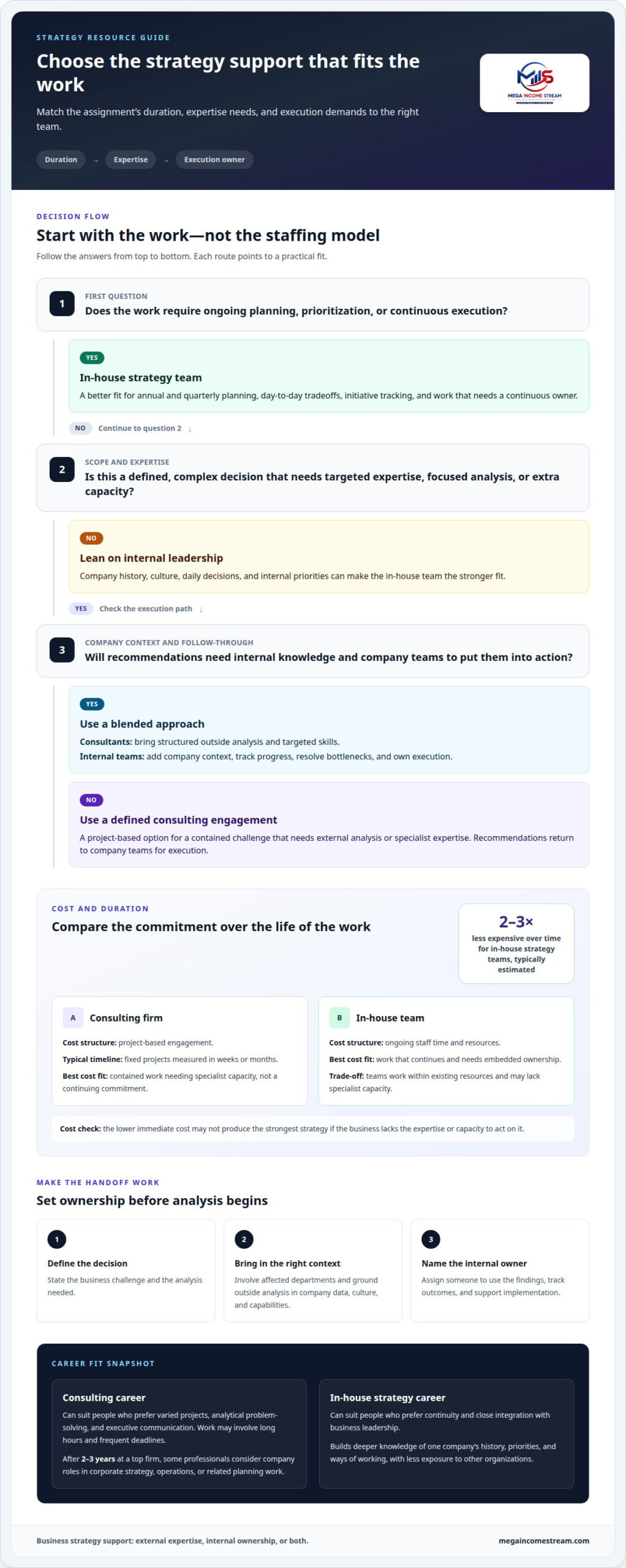
Choosing a business consultant or an in-house strategy team depends on the work’s duration, expertise needs, and execution demands. Consultants offer an outside perspective and targeted skills for defined projects; internal teams provide continuity and stay close to daily decisions. A blended approach can combine fresh analysis with company knowledge and follow-through.
Cost is a reasonable concern: an external engagement is project-based, while an internal team requires an ongoing commitment of staff time and resources. But the lowest immediate cost may not deliver the strongest strategy if the business lacks the expertise or capacity to act on it.
This guide compares the two options by cost, objectivity, expertise, and ownership, then explains how they can work together. You’ll see when a short consulting engagement makes sense, when internal leadership is better suited to the task, and how to connect strategic recommendations to execution.
Key Takeaways
- Match the resource to the work: Use external expertise for defined, complex decisions and internal teams for continuity and execution.
- Weigh career fit: Consider exposure to varied industries against the intensity and deadlines of consulting work.
- Account for internal costs: Include staff time and resources needed to sustain strategic work and retain company knowledge.
- Test outside perspectives: Ground recommendations in company data, culture, and capabilities.
- Assign clear ownership: Let consultants focus on analysis while internal teams track outcomes and support implementation.
What Is a Business Consulting Firm?
A consulting firm provides external advice on management, operations, marketing, or strategy. An in-house team is better suited to ongoing planning, internal process improvements, and decisions shaped by company history and culture.
Collaboration with company departments
Consultants work with departments to examine a defined business challenge, analyze relevant data, and develop practical recommendations. For example, a marketing project may need input from sales, finance, and operations to understand customer acquisition and delivery constraints. Department leaders contribute company knowledge, while consultants bring a structured outside analysis. After recommendations are delivered, company teams typically own execution. Internal strategy colleagues can track progress and help resolve bottlenecks.
Industry and company specialization
A consulting firm may bring experience across industries and business models, which can help when a company is considering market entry, restructuring, or a merger. In specialized sectors, partnering with sector-focused advisors such as Yellow Rose Consultants illustrates how targeted consultancy can deliver business development and operational support tailored to specific industry demands. Its analysis may examine the company’s structure, products, services, and target audience before recommending a strategic path. But industry patterns alone won’t capture the company’s culture or distinctive strengths. Internal leaders add that context, helping turn outside benchmarks into choices that fit the business rather than copy another company’s playbook.
Career fit and transitions
Consulting can suit professionals who enjoy varied projects, analytical problem-solving, and executive communication under pressure. The work may expose them to multiple industries, business models, and leadership teams in a short period, but it can involve long hours and frequent deadlines. After 2-3 years at a top firm, some professionals consider roles inside companies. Skills in structured analysis and presenting recommendations can transfer to corporate strategy, operations, or other roles connected to business planning.
An in-house strategy role may suit professionals who prefer continuity and close integration with business leadership. Internal team members support annual and quarterly planning, track strategic initiatives, and help address execution barriers. Their work builds a deeper understanding of one company’s history, ways of working, and priorities. The trade-off is less exposure to different organizations than a consulting career may offer.
In-house versus consultant comparison
The right fit depends on the assignment, the expertise required, and who will carry the work forward. Use this comparison to identify the key difference before choosing an approach.
| Option | Typical focus | Best-fit work | Execution role |
|---|---|---|---|
| Consulting firm | External analysis and specialized advice | Defined, complex projects | Recommendations return to company teams |
| In-house strategy team | Ongoing planning and internal alignment | Annual planning and continuous initiatives | Supports tracking and implementation |
Choose consultants for a defined challenge; rely on internal teams when continuity and follow-through matter most.
For either approach, define the decision, required analysis, and accountable owner before work begins. A market-entry project, for instance, needs clear input from affected departments and a named internal lead to put recommendations into action.
Choosing between external consultants and internal teams
Choosing a business consultant or in-house strategy support depends on the work’s scope and who will own execution. Evaluate a consulting firm by how well it fits your business goals, the analysis it proposes, and its plan for turning recommendations into action.
One-time sessions versus full-time hires
A one-time strategy session or short engagement can help a small business resolve a specific decision without an ongoing commitment. Most small businesses don’t need a consultant retainer. A full-time hire makes more sense when planning, prioritization, and execution need continuous ownership. Consulting projects usually have fixed timelines measured in weeks or months, while an employee remains embedded in daily operations.
Internal strategy teams are typically estimated to be 2-3 times less expensive over time than consulting firms. That comparison matters most when the work continues, not when a specialist is needed for a contained project. Compare the work’s duration, required expertise, and implementation load before choosing a staffing model.
Factors for selecting an approach
Start with the decision at hand. For an urgent, high-stakes choice, external advice can add focused analysis and specialist capacity. For annual planning, ongoing customer experience work, or day-to-day tradeoffs, internal teams bring company context and continuity. Consultants can add capacity when a project exceeds current staffing, while an internal team must work within existing resources.
Next, identify the main barrier. If leaders lack analysis, define the evidence and expertise needed. If the analysis exists but teams aren’t acting, outside support may help address change management and organizational alignment. Assign an internal owner either way, so recommendations have a clear path to implementation.
Evaluating strategy consulting firms
Assess a firm against the specific business challenge, not its general reputation. Define the decision, expected analysis, departments involved, and internal person responsible for putting findings into action. For market expansion, clarify how the work will address local market dynamics and how company leaders will use the findings.
Review whether the proposed approach aligns with your business strategy and goals. The Board of Governors of the Federal Reserve System uses strategic fit and alignment with business goals when evaluating a potential third party in banking. Apply those criteria by connecting the proposed work to your objectives, then agree on deliverables and ownership.
Choosing a path based on career goals
A business consultant or in-house strategy team can provide different paths into roles in corporate planning, operations, or leadership support. Consulting builds experience across varied business problems; internal strategy develops deeper familiarity with one organization’s priorities. Compare the skills each path builds with those needed for your target role, then identify which experience would strengthen your next career move.
For practical business strategy guidance, focus on the decision, available resources, and who will carry the plan forward.
What Is an In-House Strategy Team?
An in-house strategy team consists of employees who develop and execute plans aligned with organizational goals. Its cost model trades project-based external spending for ongoing staffing and internal knowledge.
In the United States, salary and total employment costs depend on role scope, seniority, location, and the organization’s staffing structure. Building a team involves defining its mandate, identifying capability gaps, assigning decision rights, and hiring or developing people to do the work.
Internal costs and intellectual property
An internal team builds knowledge through repeated work with company data, leaders, and operating processes. That continuity helps employees retain analytical methods and strategic context within the organization, rather than relying on an outside engagement to transfer recommendations. Internal costs include staff time and the tools or resources needed for analysis. The team can also track outcomes and update plans as business conditions change.
In-house costs and talent challenges
Internal strategy teams are typically estimated to be 2-3 times less expensive over time than consulting firms. That comparison matters for sustained work, but it doesn’t remove hiring and capability challenges. A company must find people who can analyze evidence, communicate with leadership, and coordinate implementation. Existing employees may contribute, but assigning strategy work also draws time from their current responsibilities.
External consulting costs are usually tied to a defined project, its scope and timeline, and the expertise required. Consultants can add specialist knowledge or capacity for a complex initiative. The trade-off is that the organization must translate recommendations into sustained action after the engagement ends. Compare the total internal staffing commitment with the project work and expertise required, rather than judging either option by its headline cost alone.
Upfront and ongoing expenses
Initial internal expenses can include recruiting, onboarding, and giving the team access to company data and planning processes. Ongoing expenses include salaries, development, management time, and resources for analysis. The team’s operating model also affects cost: a small group focused on prioritization differs from a broader function serving multiple departments.
Before hiring for a new team, define its remit. Specify the decisions it supports, the data it needs, and the leaders who will act on its work. Then compare the required skills with those already available among staff. This helps an organization decide whether to hire, develop current employees, or use external expertise to fill a capability gap. Review the structure as priorities shift, so ongoing staffing stays connected to strategic work.
Consultant objectivity and external benchmarks
External consultants can challenge internal assumptions, while employees contribute company context. Strong analysis combines both perspectives and tests recommendations against evidence, strategic priorities, and implementation constraints.
External perspective and objectivity
A consultant works outside the organization’s reporting lines, which can make it easier to question established assumptions. That distance doesn’t guarantee objectivity. Analysis still depends on the data, scope, and questions set for the engagement. If leaders assume falling sales are due to pricing, for example, an external team can test that view against customer segments, sales patterns, and competitor positioning.
Use benchmarks as comparison points, not automatic targets. A competitor’s growth model may rely on different channels, capabilities, or customer economics. Use the Small Business Administration’s market research and competitive analysis guidance as a prompt to examine relevant market conditions. Ask advisers which comparisons fit your company, what evidence supports them, and where key differences remain.
Hybrid internal and external strategy teams
A hybrid team combines external analytical capacity with internal knowledge and access to decision-makers. Set roles at kickoff: consultants frame the problem, test data, and present options; internal leaders provide operating context and decide which tradeoffs the business can accept. For a market expansion, outside analysis of local demand can complement internal expertise in product delivery and customer support.
Keep ownership visible throughout strategic planning. Assign an internal lead to coordinate departments, document assumptions, and track decisions. Ask external advisers to explain their methods so employees can use the analysis after the engagement. This division helps leadership challenge recommendations without losing company-specific details that shape execution.
Internal versus external expertise
Internal specialists understand the organization’s history, processes, and data limitations. External consultants may bring expertise from other industries or business models, especially when a team faces an unfamiliar problem. A company considering a new market, for instance, can combine product-team knowledge with outside research into market dynamics.
Use a structured review to test whether the combined expertise supports success:
- Define the decision: State the choice leadership must make and the evidence it needs.
- Separate assumptions: Distinguish internal beliefs, external benchmarks, and available data.
- Test the fit: Compare recommendations with company strengths, customer needs, and operating capacity.
- Set ownership: Name the decision-maker and the team responsible for follow-through.
For banking organizations, the Board of Governors of the Federal Reserve System’s third-party guidance includes strategic fit and alignment with business goals as evaluation considerations. Apply the principle by tying external recommendations to company objectives, then setting review points that keep analysis connected to decisions.
Combining consulting firms with in-house teams
A hybrid model gives consultants a focused role and internal strategy teams responsibility for continuity. For a market expansion, external advisers can assess opportunities while company leaders connect those insights to product, staffing, and customer decisions. The value depends on clear ownership, not simply having both groups in the room.
Start by defining one business decision and the outcome it needs to support. Then assign the consultant a defined scope, such as analyzing a new customer segment, and name an internal lead to own decisions and execution. This structure avoids duplicated work: consultants investigate the agreed question, while employees provide context and keep the project connected to operating priorities.
Set collaboration rules at kickoff. Give both groups access to relevant data, agree on how to record assumptions, and identify which leader will resolve disagreements. For example, if external market insights conflict with a sales team’s experience, compare the underlying evidence before changing the plan. A documented decision log keeps the analysis, rationale, and next action visible to everyone involved.
Build the engagement around defined handoffs, not just a final presentation. Consultants can deliver analysis, options, and risks; internal owners can turn those findings into work across departments. Before the project closes, have the internal lead review the recommendations, outstanding questions, and implementation dependencies. This transfer helps preserve useful methods and prevents a strategy from becoming a slide deck without an operational owner.
Track execution with measures tied to the original decision. For a new market initiative, an internal team might monitor customer response, delivery capacity, and changes in the assumptions behind the opportunity. Leadership can review those indicators in regular planning meetings, resolve tradeoffs, and adjust the work. Consulting projects typically have fixed timelines measured in weeks or months, so employees who remain involved after the engagement should own ongoing tracking.
Use this sequence to keep a blended team accountable:
- Frame the decision: State the business question and the evidence needed to answer it.
- Split responsibilities: Assign analysis to consultants and implementation ownership to internal leaders.
- Set review points: Schedule leadership decisions around key findings and dependencies.
- Transfer the method: Record assumptions, data sources, and analysis steps for future use.
- Track outcomes: Let internal strategy teams monitor progress and address execution barriers.
This model works best when a company needs external expertise for a defined challenge but also has internal capacity to act. If the organization lacks an accountable owner or implementation resources, adding consultants alone won’t close that gap. Strengthen the decision process with practical strategy guidance that connects analysis to execution.
Mega Income Stream
Mega Income Stream helps entrepreneurs and business leaders turn strategic questions into practical plans for growth and revenue optimization. If you’re weighing internal capacity against outside expertise, its Business Strategies, Making Money Insights, and Consulting Business offerings can help clarify priorities, assess opportunities, and shape a path aligned with your organization’s goals.
Consider this support when you need to connect analysis with a clear next step, whether you’re refining an existing strategy or exploring sustainable income streams. The focus is on actionable direction, not choosing consultants or in-house staff by default.
Contact Mega Income Stream to discuss your strategic priorities.
Turn the Strategy Choice Into a Clear Next Step
Make the next move a short decision brief, not another open-ended discussion. State the business outcome you want, the capability gap to close, and the person who will own implementation. Then choose whether a business consultant or an in-house strategy team best fits the need. Set a review point so the approach can change if the work shifts from analysis to ongoing execution.
Mega Income Stream offers Business Strategies, Making Money Insights, and Consulting Business to help entrepreneurs and business leaders shape practical growth plans. If you want support turning your strategic priorities into a workable direction, contact Mega Income Stream.
Choose the approach that fits the work, assign ownership, and move forward with clarity.
Frequently Asked Questions
In-House Consulting – What Is It Really?
In-house consulting is an internal group that provides analysis and advice to departments within its organization. Unlike an external consulting firm, it works with company data and leaders over time, then supports changes from within the business. For example, an internal team might help operations diagnose recurring delays, compare process options, and coordinate a pilot with the employees who run that workflow.
How should organizations treat these two roles in practice?
Treat external consultants as specialists for defined assignments and internal teams as stewards of company decisions. For example, a consultant can assess a proposed product launch, while an internal lead brings sales, product, and support teams together to test readiness. Set one decision owner, document assumptions, and agree on how recommendations will move into action before analysis begins. This keeps responsibilities clear as the work progresses.
What are the main risks of relying exclusively on one model?
Relying only on internal staff can limit access to outside perspectives or specialist skills when an organization faces an unfamiliar challenge. Relying only on consultants can weaken continuity if employees don’t adopt recommendations or retain the knowledge to maintain them. A practical safeguard is to pair external analysis with an internal owner who records decisions, shares methods, and coordinates implementation across affected teams.
When does hiring a management consultant make more sense?
A management consultant may be useful when a decision is urgent, complex, and outside the organization’s current expertise. Examples include entering an unfamiliar market, restructuring departments, or assessing a merger. A focused engagement can add analytical capacity without creating a permanent role. Define the business question and expected output first, then assign an internal leader to evaluate recommendations and coordinate next steps.
Who are the Big Internal Consulting Players?
“Big Internal Consulting Players” usually refers to internal consulting or strategy groups within large organizations, not a standard list of firms. Their names and structures vary by company. They may be called corporate strategy, transformation, or internal advisory teams. To understand a particular group, identify its mandate, the leaders it serves, the decisions it supports, and whether it helps implement recommendations.
What does a business consultant do compared with an in-house strategy team?
Whether a business consultant or in-house strategy team leads depends on the assignment and the continuity required. A consultant may assess a defined question, such as whether a new revenue model fits the market. Internal strategists can then coordinate input from finance, product, and sales. Clarify who evaluates the evidence, makes the decision, and handles follow-up so recommendations don’t stall between analysis and action.
What are the pros and cons of hiring a business consultant versus building an in-house strategy team?
Choosing a business consultant or in-house strategy team depends on how long the need will last and who can implement the work. A consultant offers targeted outside expertise for a defined challenge, while an internal team builds company knowledge and continuity. The trade-off is project-based support versus ongoing staffing and capacity. Compare the work required, skills available internally, and responsibility for follow-through before deciding.
How much do business consultants cost in the United States?
Consultant costs in the United States depend on project scope, duration, required expertise, and resources involved. A short advisory session differs from a complex organizational review, so one figure cannot describe every engagement. Compare proposals by deliverables, team involvement, and timeline. Also account for the internal time needed to provide information, coordinate departments, evaluate recommendations, and put resulting decisions into practice.










Comments