
 By
You are spending too much to acquire a buyer when the cost exceeds the customer contribution you can reasonably recover within a period your business can afford. That means looking beyond advertising revenue to include refunds, delivery costs, repeat purchases, and cash flow.
A $40 acquisition cost could be excellent for a profitable consulting service and disastrous for a $20 download. The number only becomes useful when you connect it to what customers leave behind after the sale.
Here is how to calculate customer acquisition cost, interpret current benchmarks, and decide when to improve a campaign, increase spending, or pause it.
What Is Customer Acquisition Cost?
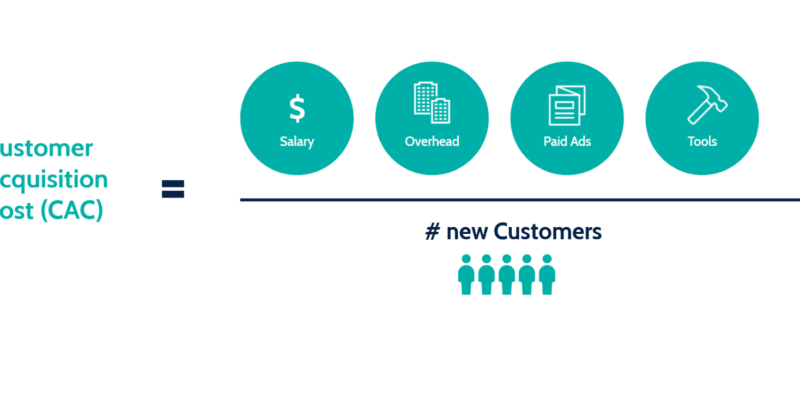
Customer acquisition cost measures the sales and marketing spending required to gain a new paying customer.
The basic formula is:
CAC = Acquisition-related sales and marketing costs ÷ New paying customers acquired
Suppose your business spends $6,000 acquiring customers and gains 200 first-time buyers:
$6,000 ÷ 200 = $30 CAC
Count each new customer once, regardless of how many orders they place.
A returning customer making another purchase should not enter the denominator as a newly acquired buyer. Shopify’s current guidance makes this distinction and recommends including relevant creative, commission, and referral costs.
The calculation is simple. Choosing the right costs and customer group requires more care.
CAC Is Different From Cost Per Lead
A lead has expressed interest. A customer has paid. That difference can dramatically change the economics.
| Metric | What you are paying for |
|---|---|
| Cost per click | A visit or click |
| Cost per lead | An enquiry, registration, or other defined lead |
| Cost per purchase | A purchase event, potentially including returning buyers |
| Customer acquisition cost | A new paying customer |
| Return on ad spend | Attributed revenue relative to advertising expenditure |
Imagine paying $20 for each lead.
If 10% become new customers, the advertising cost per buyer is:
$20 ÷ 10% = $200
If only 5% buy, it becomes:
$20 ÷ 5% = $400
Neither figure includes additional sales staff, creative, or acquisition software costs. Cheap enquiries can become expensive customers when few of them purchase.
What Current Advertising Benchmarks Tell Us
WordStream and LocaliQ’s 2026 search advertising report analysed 13,474 US campaigns running between April 2025 and March 2026. The report presents its figures as averages, while its methodology specifies that they are medians.
Selected cost-per-lead benchmarks were:
| Category | Reported cost per lead |
|---|---|
| All industries | $66.69 |
| Arts and entertainment | $26.84 |
| Business services | $93.69 |
| Education and instruction | $77.48 |
| Attorneys and legal services | $131.63 |
These are search-advertising lead costs from the provider’s sample—not universal CAC targets. They exclude the further expense of turning leads into paying customers.
Use benchmarks to investigate unusual performance. Your own margins and customer behaviour determine what you can afford.
How to Know If You’re Spending Too Much to Get a Buyer
Step 1: Include the Costs You Actually Incur
Advertising platforms show what you spent with them. Your business usually spends more.
A practical acquisition-cost calculation can include:
- Advertising.
- Creative production.
- Agency or freelancer fees.
- Acquisition-related staff time.
- Sales commissions.
- Relevant software.
- Referral rewards.
- Promotional samples and events.
Allocate shared expenses reasonably and consistently. For example:
| Monthly acquisition expense | Amount |
|---|---|
| Advertising | $4,000 |
| Creative production | $1,000 |
| Allocated software costs | $500 |
| Sales and marketing labour | $1,500 |
| Total | $7,000 |
With 200 new customers:
Fully loaded CAC = $7,000 ÷ 200 = $35
Advertising alone would suggest $20 per buyer. The fuller calculation reveals $35. Include owner time where it materially contributes to acquisition. A business can look efficient simply because its founder’s work has been treated as free.
Step 2: Match Spending With the Buying Cycle
Monthly reporting works well for some businesses, but customer decisions do not always fit calendar boundaries. A person might discover your course in January and enrol in March. A business software prospect may spend several months evaluating options.
Read Also: Analyzing Customer Lifetime Value (CLV) for Digital Product Stores
Dividing this month’s spending by this month’s customers can become misleading during rapid growth or a long sales cycle.
Use:
- Consistent reporting periods.
- Rolling averages.
- Customer groups based on acquisition timing.
- Campaign tracking linked to actual purchases.
- Enough time for delayed conversions.
Also report refunds and fully reversed purchases. Keep your standard CAC definition consistent, while separately monitoring whether acquired customers remain commercially valuable.
Step 3: Calculate What a First Purchase Contributes
Revenue is the starting point, not the amount available for marketing. Consider a hypothetical $80 purchase:
| Item | Amount |
|---|---|
| Selling price after discounts, excluding collected taxes | $80 |
| Expected refund allowance | −$4 |
| Payment and platform fees | −$3 |
| Product or delivery costs | −$18 |
| Variable support and fulfilment | −$5 |
| Contribution before acquisition | $50 |
At a $35 CAC, that first purchase leaves:
$50 − $35 = $15
That $15 must still help cover fixed overhead and profit.
If your business needs $20 per new customer for those purposes, your acquisition target becomes:
$50 − $20 = $30 maximum target CAC
A campaign delivering buyers at $35 therefore misses the target, even though the first sale covers acquisition spending.
Step 4: Distinguish Break-Even CAC From Your Target
Break-even CAC uses the available customer contribution and leaves nothing additional for the costs outside that calculation. A target CAC should leave room for the business you want to operate.
| CAC level in the previous example | Interpretation |
|---|---|
| $20 | Leaves $30 after acquisition |
| $30 | Leaves the desired $20 |
| $35 | Leaves $15; below the stated target |
| $50 | Uses all first-order contribution |
| $60 | Creates a $10 first-order shortfall |
Your target should reflect uncertainty too. Expected refunds, delivery expenses, and acquisition costs can change. A narrow margin between CAC and break-even provides little protection when performance weakens.
Step 5: Use Customer Lifetime Value Carefully
Repeat purchases can justify spending more than the first order contributes. However, the repeat purchases need evidence. Suppose a customer contributes:
- $35 from the first order.
- Another $25 over the next six months.
- A further $15 during the following six months.
The measured 12-month contribution is $75. At a $25 CAC, the contribution-to-CAC ratio is:
$75 ÷ $25 = 3:1
ChartMogul describes approximately 3:1 as a common subscription-business guideline. It is a reference point, rather than a universal pass mark. Its guidance also warns that simple lifetime-value models can overstate value when cancellation patterns change over the customer relationship.
Use margin-adjusted customer value consistently. Comparing lifetime revenue with CAC can make weak economics appear attractive.
Step 6: Check How Long Payback Takes
A customer may eventually become profitable while creating a cash shortage today. CAC payback occurs when cumulative customer contribution covers acquisition spending.
For a simplified subscription example:
- CAC: $120.
- Monthly contribution: $20.
- No cancellation or contribution change.
Payback takes approximately:
$120 ÷ $20 = six months
If customers cancel before then, the business may never recover the cost. Real analysis should track contribution across the whole acquired group, including cancellations.
Your acceptable payback period depends on available cash, collection timing, and other obligations.
Shopify quotes Ridge CEO Sean Frank explaining the company’s approach: “We’ve always needed each customer’s first purchase to cover the cost of acquiring them.” He connects that approach with infrequent wallet purchases.
A subscription business may make a different choice, but it still needs a realistic funding plan.
Why Strong ROAS Can Hide a Loss
Suppose advertising costs $3,000 and generates $9,000 in attributed revenue.
ROAS = $9,000 ÷ $3,000 = 3:1
That sounds encouraging. But if customer contribution before advertising is only 25%:
$9,000 × 25% = $2,250
After the $3,000 advertising expense, the result is a $750 shortfall, before fixed overhead. ROAS measures revenue against ad spend. It does not automatically establish profitability.
Also check whether attributed orders came from new or returning buyers. Strong repeat-customer sales do not necessarily prove efficient acquisition.
Step 7: Compare Channels Without Double-Counting Buyers
Calculate both:
- Blended CAC: Total relevant acquisition spending divided by all new customers.
- Channel CAC: Allocated channel costs divided by new customers attributed under a stated method.
A customer may encounter a creator post, search advertisement, and email before buying. Several platforms can claim the same purchase. Reconcile reports against customer records.
When practical, use controlled holdouts or geographic tests to assess whether advertising creates additional customers. Attribution helps organise credit; incrementality asks what happened because of the spending.
Use the same currency and observation period when comparing markets.
| Hypothetical business | Main affordability question |
|---|---|
| US digital guide store | Does first-order contribution cover acquisition? |
| UK consulting service | How many enquiries become profitable clients? |
| Canadian subscription app | Do customers remain beyond payback? |
| Australian retailer | Do shipping and returns erase the margin? |
Step 8: Reduce CAC by Fixing the Actual Problem
Start with the weakest part of the journey.
- Improve traffic quality
Review search terms, placements, locations, and audience fit. Low-cost clicks are unhelpful when visitors cannot use the offer.
- Make the offer easier to evaluate
Explain the price, contents, limitations, and suitability. Show representative examples.
- Remove purchasing friction
Check mobile usability, payment failures, delivery information, and broken forms.
- Follow up appropriately
Respond promptly to enquiries and send relevant information to people who have agreed to receive it.
- Improve contribution
A useful bundle or better pricing may improve affordability, but measure conversion and refunds alongside order value.
At the same acquisition spend, increasing new buyers from 100 to 125 reduces CAC by 20%. It does not guarantee a 20% profit improvement, because those customers may have different costs and value.
A Simple Weekly CAC Review
| Question | Action |
|---|---|
| Are all relevant costs included? | Reconcile expenses |
| Are buyers genuinely new? | Deduplicate customer records |
| Has the buying cycle matured? | Allow for delayed purchases |
| Is CAC below the target? | Compare with contribution |
| Is payback affordable? | Review cash requirements |
| Does added spending still work? | Measure additional buyers and costs |
Increase budgets gradually. The next group of buyers may cost more than the customers already acquired.
Final Thoughts
CAC tells you what it costs to win a customer. Contribution and payback tell you whether that cost makes sense. Include the work behind acquisition, count buyers accurately, and use repeat-purchase assumptions supported by evidence.
Spend more when additional customers leave enough value to support the business—and you can afford the time required to recover the investment.
FAQ
1. What is a good customer acquisition cost?
A good CAC leaves enough customer contribution to cover remaining expenses and profit within an affordable period. There is no universal dollar amount.
2. Is CAC the same as advertising cost per purchase?
No. CAC usually includes broader acquisition expenses and focuses on new customers. Advertising cost per purchase may include returning buyers.
3. Can CAC exceed the first order’s value?
It can, but the business then depends on future contribution and sufficient cash. Verify retention and repeat purchases before relying on that approach.
4. Should I stop a campaign when CAC rises?
Investigate first. Check reporting delays, customer quality, margins, and the cost of additional buyers. Pause or adjust spending when mature results no longer support your target.
Source: Shopify, ChartMogul









Comments