
 By

Customer testimonials can improve checkout success by answering the doubts that stop shoppers from paying. A believable review can explain whether a jacket fits properly, a delivery arrives on time, or customer support actually helps.
You have probably done this yourself: added something to your basket, paused, and looked for someone else’s experience before entering your card details. That small pause is where social proof earns its keep.
The numbers show why businesses take reviews seriously. However, they also need careful reading. A rise in product purchases is not automatically a rise in checkout completion, and an impressive case study is not a guaranteed result for every store.
Why Testimonials Matter at the Buying Moment
Social proof means using other people’s experiences to judge a decision. Online, that includes written testimonials, star ratings, customer photographs, videos, and verified purchase labels.
Testimonials are usually selected customer endorsements. Review systems collect a broader range of feedback. Most of the research below measures reviews, so it should not be treated as proof that any handpicked quote will perform equally well.
According to Baymard’s abandonment compilation, the average documented shopping cart abandonment rate is 70.22%, calculated across 50 studies. This is a broad benchmark drawing on studies from different years, rather than a measurement of one year’s shoppers.
Reviews cannot rescue every abandoned basket. They can, however, help address uncertainty about product quality and the seller’s reliability before someone reaches the payment screen.
The Statistics Behind Customer Confidence
| Research finding | What it means | Keep in mind |
|---|---|---|
| Five reviews were associated with 270% greater purchase likelihood than no reviews | A small initial review collection can matter | A study result, not a universal target |
| Conversion increased 190% for lower-priced products and 380% for higher-priced products | Reviews can be especially useful when more money is at stake | Relative increases, not percentage-point gains |
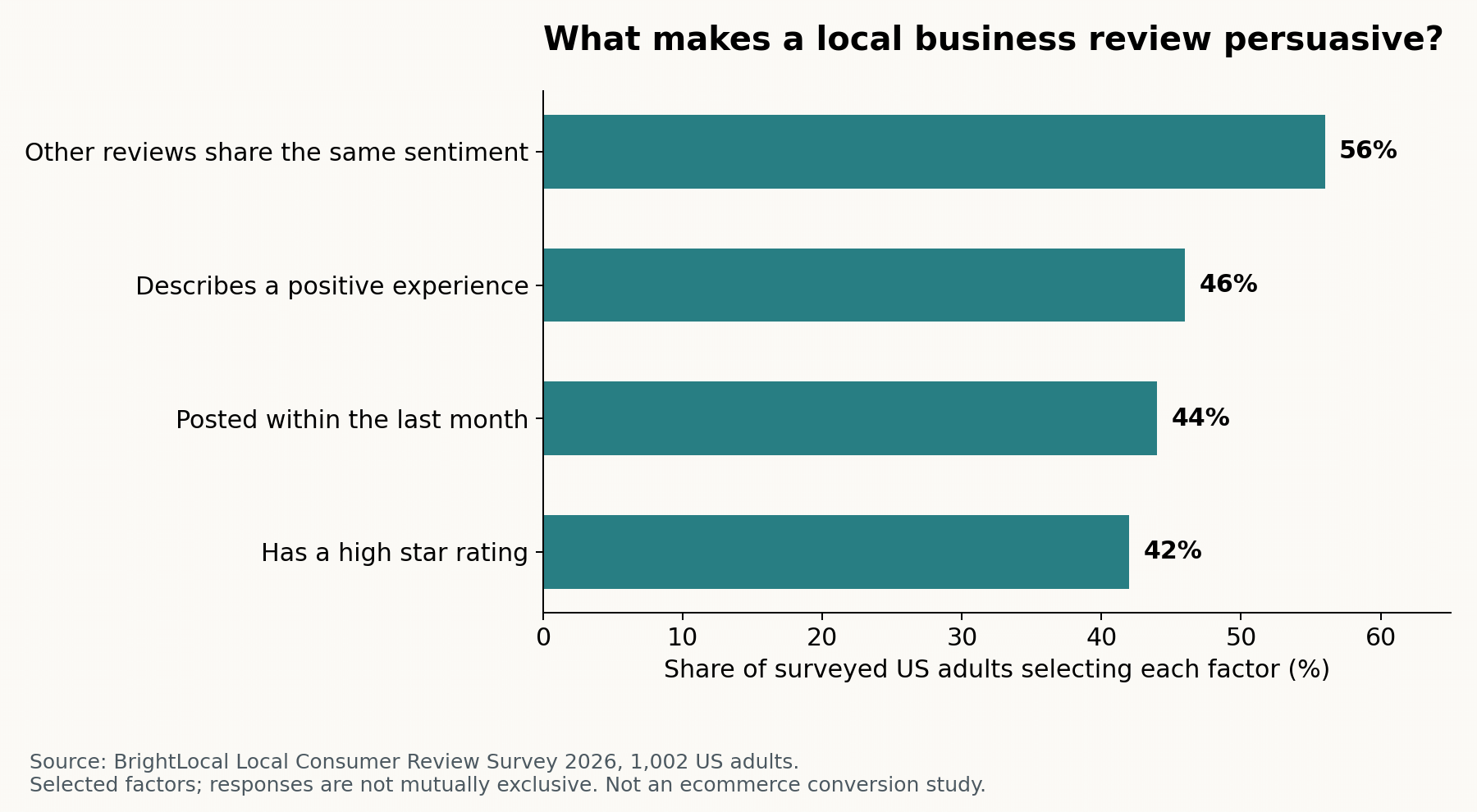
| 68% of surveyed consumers required at least four stars | Reputation influences which businesses get considered | US local-business survey, not an ecommerce experiment |
The first two findings come from Medill Spiegel Research Center’s research published in 2017. The third comes from BrightLocal’s 2026 survey of 1,002 US adults. These sources cover different buying situations and should be read separately.
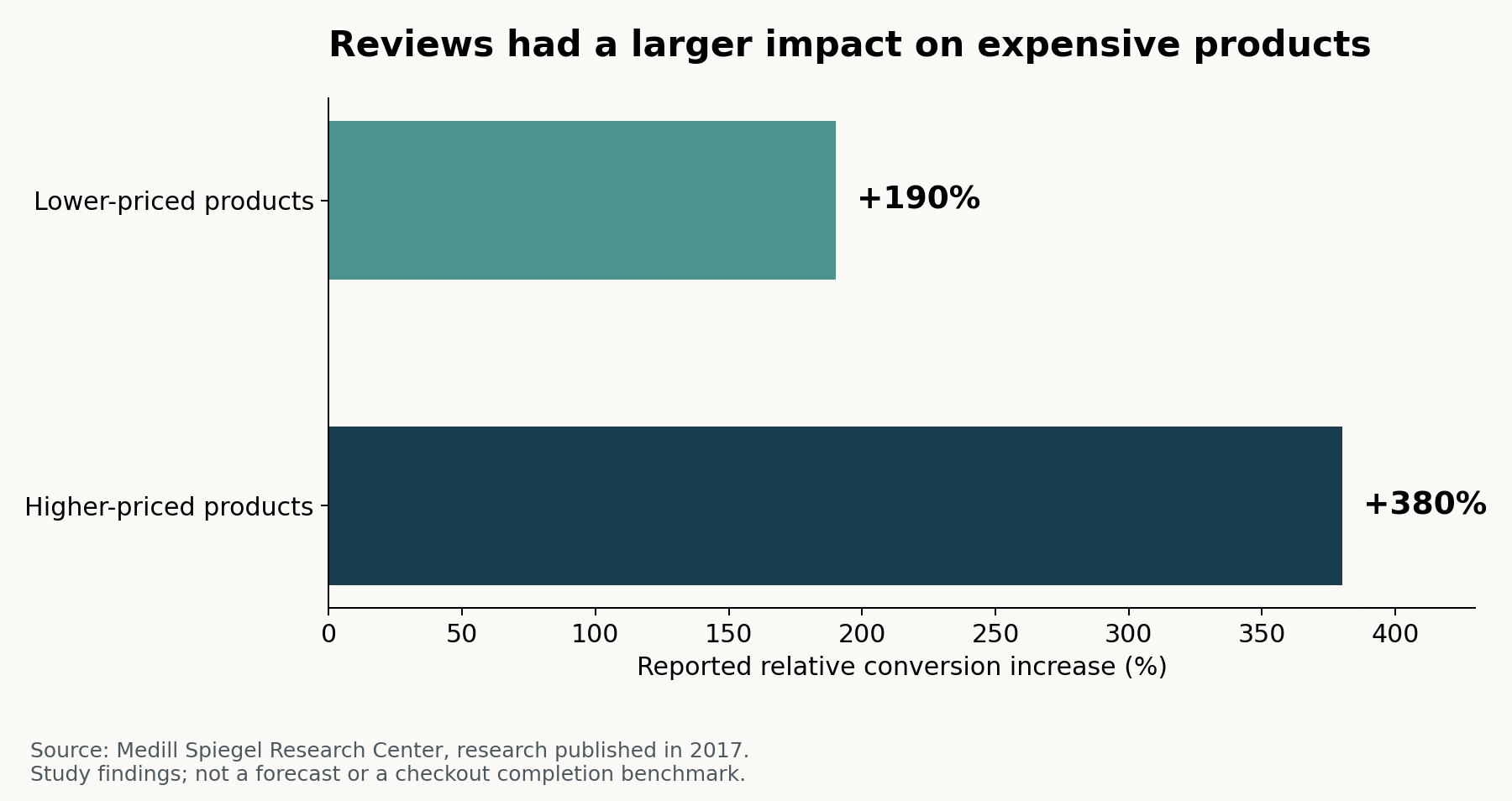
A 190% relative improvement would turn a hypothetical 1% conversion rate into 2.9%, not 191%. Understanding that distinction keeps a useful statistic from becoming a misleading sales promise.
Real Examples
Australia: Hairhouse makes reviews easier to use
Australian beauty retailer Hairhouse introduced ratings, reviews, and review highlights. Bazaarvoice’s case study reports a 35% conversion increase and a 15% increase in average order value on pages with ratings and reviews compared with pages without them.
The retailer also requested feedback after purchases and displayed review excerpts on relevant category pages. As Hairhouse executive Ash Mehta explained:
“They like to make informed decisions based on their own research.” Bazaarvoice
The practical lesson is straightforward: make useful feedback easy to find and scan. This vendor-published comparison does not establish that a testimonial added to checkout alone caused the increase.
United Kingdom: Lancôme takes feedback to the retailer
In another Bazaarvoice case study, Lancôme syndicated more than 3,000 reviews to UK retailer Debenhams and reported a 30% increase in conversions on the retail site.
This historical example highlights placement. Customers buying from a retailer need reassurance there, rather than having to visit the manufacturer’s website. The sensible takeaway is to bring relevant evidence to the place where the decision happens.
United States: Burt’s Bees prepares for launch
For a cosmetics launch, Burt’s Bees used product sampling to collect early feedback. Its published case study reports that 94% of sample recipients reviewed products within two weeks, generating more than 300 reviews.
Read Also: Analyzing Customer Lifetime Value (CLV) for Digital Product Stores
That figure measures review participation, not checkout improvement. Still, the example offers a useful lesson for new products: collect real experiences before expecting unfamiliar shoppers to take a chance. Clearly identify feedback collected through sampling.
Canada: Walmart distributes existing customer feedback
Walmart Canada’s case study reports that review syndication from brand partners accounted for 80% of its review volume at the time described.
That is a content-sourcing statistic, not an 80% sales increase. It illustrates how retailers can make existing feedback available where people shop, with clear sourcing and accurate product matching.
What Makes a Testimonial Persuasive?
A vague compliment tells you little. Specific feedback helps you picture what owning the product will actually feel like.
BrightLocal’s 2026 research found that 56% valued reviews supported by similar opinions, while 44% valued feedback posted within the previous month. These are reported preferences about local businesses, but they offer useful questions for merchants reviewing their own content.
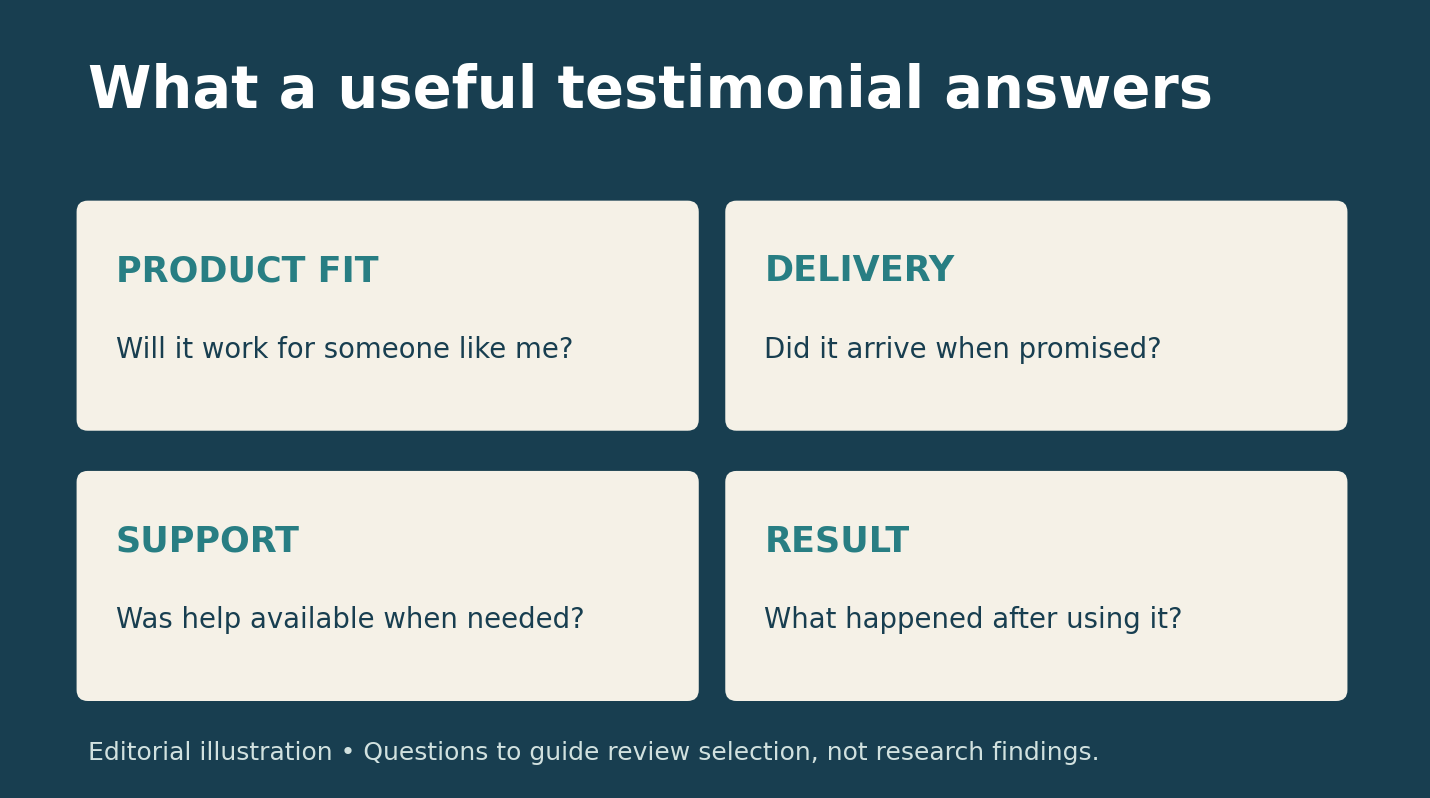
When selecting testimonials, look for:
- Specificity: What problem did the product solve?
- Relevance: Does the reviewer describe a similar need?
- Context: Which product, size, or service did they use?
- Credibility: Can readers understand where the feedback came from?
- Freshness: Does the experience still reflect what you sell?
Where Should Customer Testimonials Appear?
Start by matching the evidence to the hesitation. Someone choosing a size needs different reassurance from someone wondering whether an unfamiliar store will deliver.
| Location | Helpful social proof | Question it answers |
|---|---|---|
| Product page | Reviews, fit details, customer photographs | Will this suit me? |
| Basket | Brief feedback about delivery or service | Can I trust this seller? |
| Checkout | One concise, relevant testimonial | Am I comfortable paying? |
| Follow-up email | Product-specific customer experience | What uncertainty remains? |
Treat checkout placement as something to test. Keep the payment button prominent, avoid distracting carousels, and make the experience comfortable on mobile. A long review feed can create another task when the customer is trying to finish.
How to Measure Checkout Success Properly
Track checkout completion as completed purchases divided by checkout starts. Site conversion uses a different denominator, such as sessions or visitors. Keep those definitions consistent.
- Record a baseline. Measure checkout starts, purchases, device type, and order value.
- Change one element. Test a relevant testimonial against the existing checkout.
- Randomly assign visitors. Keep pricing, promotions, and delivery terms consistent.
- Choose the sample size beforehand. Avoid stopping as soon as results look encouraging.
- Check the wider outcome. Monitor refunds, loading speed, and revenue alongside completion.
For illustration, suppose each version receives 1,000 checkout starts. The original produces 400 purchases; the testimonial version produces 440. Completion rises from 40% to 44%: four percentage points, or 10% relatively. These invented numbers explain the calculation; they do not establish statistical significance.
Collect Feedback Customers can Actually Use
Ask after customers have had enough time to experience the product. A delivery review may be possible quickly; feedback about a mattress or skincare routine needs longer. Let the product guide the timing instead of sending every request on the same schedule.
Keep the request friendly and brief. Ask what they bought, what they hoped it would do, and how it worked out. Leave room for disappointment as well as praise. Those details are often more useful than a request to rate the business.
When turning feedback into a testimonial, preserve its meaning and ask permission where appropriate. Do not remove a qualification that changes the impression. A customer saying a coat is warm but runs small has given you valuable buying guidance, not an inconvenient sentence to edit away.
Finally, route repeated concerns back to the team. If several buyers mention confusing sizing, improve the size guide. Social proof becomes more useful when the business responds to what customers are saying.
Final Thoughts
Customer testimonials help when they answer a real question at the right moment. The strongest approach combines relevant experiences, visible sourcing, sensible placement, and measurement.
Start with products that attract uncertainty. Ask customers for honest feedback, make it easy to browse, and test whether a short excerpt helps people finish paying. Listen to recurring complaints too: improving the experience gives future customers something better to recommend.
FAQ
1. Do testimonials always increase checkout conversion?
No. Results depend on credibility, relevance, placement, and the existing buying experience. Test them against completed purchases rather than assuming that more visible praise means more sales.
2. How many reviews should a product have?
There is no universal minimum. The historical research shows that early reviews can be valuable, but customer expectations vary. Build coverage across products rather than concentrating all feedback on one bestseller.
3. Are customer photographs better than written testimonials?
Neither format always wins. Photographs can show fit, colour, or scale; written feedback can explain delivery and service. Choose the format that answers the customer’s question and test its effect.
4. Can testimonials replace a clear returns policy?
No. Feedback describes someone else’s experience; a returns policy explains the customer’s options. Keep delivery charges, payment information, and return terms easy to find alongside any social proof.











Comments