
 By
Buying the highest-yielding stocks is a poor starting point for a dependable income portfolio. A large payout means little if the company can't afford it, the share price keeps falling, or taxes leave you with less cash than you expected.
Learning how to build a dividend portfolio starts with a different question: Which combination of investments can support spending now while keeping future income resilient? A lower starting yield can be the better choice when the business has room to raise its dividend, maintain its balance sheet, and keep investing in growth.
Table of Contents
- A Portfolio Built for Income Reliability
- Set Goals Then Build the Portfolio
- Screen Stocks for Durable Dividends
- Spread Risk Across Sectors and Assets
- Place Holdings for Tax and Currency
- Turn Holdings Into Spendable Income
- Write the Plan and Run the Quarterly Check
A Portfolio Built for Income Reliability
Say you want dividend income to cover a meaningful part of your monthly bills. A stock offering an unusually large yield looks like a shortcut because you appear to need less capital. But that calculation assumes the payment survives.
Dividend yield is the annual dividend divided by the current share price. When the price falls, the displayed yield rises even if the business hasn't increased its payment. Buying that yield without investigating the decline can leave you exposed to both a dividend cut and a capital loss.
The scale of dividend payments doesn't remove that risk. According to Janus Henderson, global dividends reached a record $606.1 billion in the second quarter of 2024, increasing 5.8% on a headline basis. That's evidence of substantial distributions, not a promise that every company or market will provide dependable income.
Give each holding a separate job
A useful portfolio separates rising income, extra current income, spending reserves, and defensive assets. Don't ask dividend stocks to perform all those jobs.
The following is a hypothetical allocation worksheet, not a universal recommendation or a set of market statistics. Its ranges are alternatives to tailor, not percentages to add together at their maximums.
Roles and target ranges for a dividend portfolio
| Role | Target share | Job | Yield stance |
|---|---|---|---|
| Dividend-growth stocks | Illustrative range of 40–60% | Rising income plus price appreciation | An illustrative sustainable 2–4% can be preferable to the maximum |
| Higher-yield stocks | Illustrative range of 0–15% | Extra current cash as a capped satellite | Treat yields far above peers as a warning |
| Bonds | Illustrative range of 20–40% | Stability equities don't provide | Prefer credit quality and suitable maturity over maximum yield |
| Cash equivalents | Illustrative range of 5–10% | Accessible spending reserves | Access matters more than yield |
| Broad dividend ETF | Inside the equity allocation | Many issuers in a single holding | Use it instead of unresearched individual names |
Bonds aren't all equally defensive. A short government bond and a long corporate bond respond differently to interest rates and credit stress. Match their maturity and credit quality to the spending they're intended to support.
Choose the mix before the ticker
Dividend-growth holdings can provide increasing distributions and price appreciation. Higher-yield holdings may add useful cash today, but they shouldn't determine the entire portfolio.
A broad dividend exchange-traded fund, or ETF, can provide the equity core when you don't want to read individual companies' filings. Check its methodology, sector weights, expenses, and distribution history rather than buying it because dividend appears in its name.
Starting rule: Choose what each part of the portfolio must accomplish before comparing its yield.
Circle a workable allocation on your worksheet. Then make sure the chosen weights form a complete portfolio, with the ETF counted inside equities rather than added as an extra asset category.
Set Goals Then Build the Portfolio
A dividend portfolio can pay less today and still produce more dependable income later. The difference comes from setting a clear goal, funding it consistently, and choosing holdings for their roles rather than their headline yields.
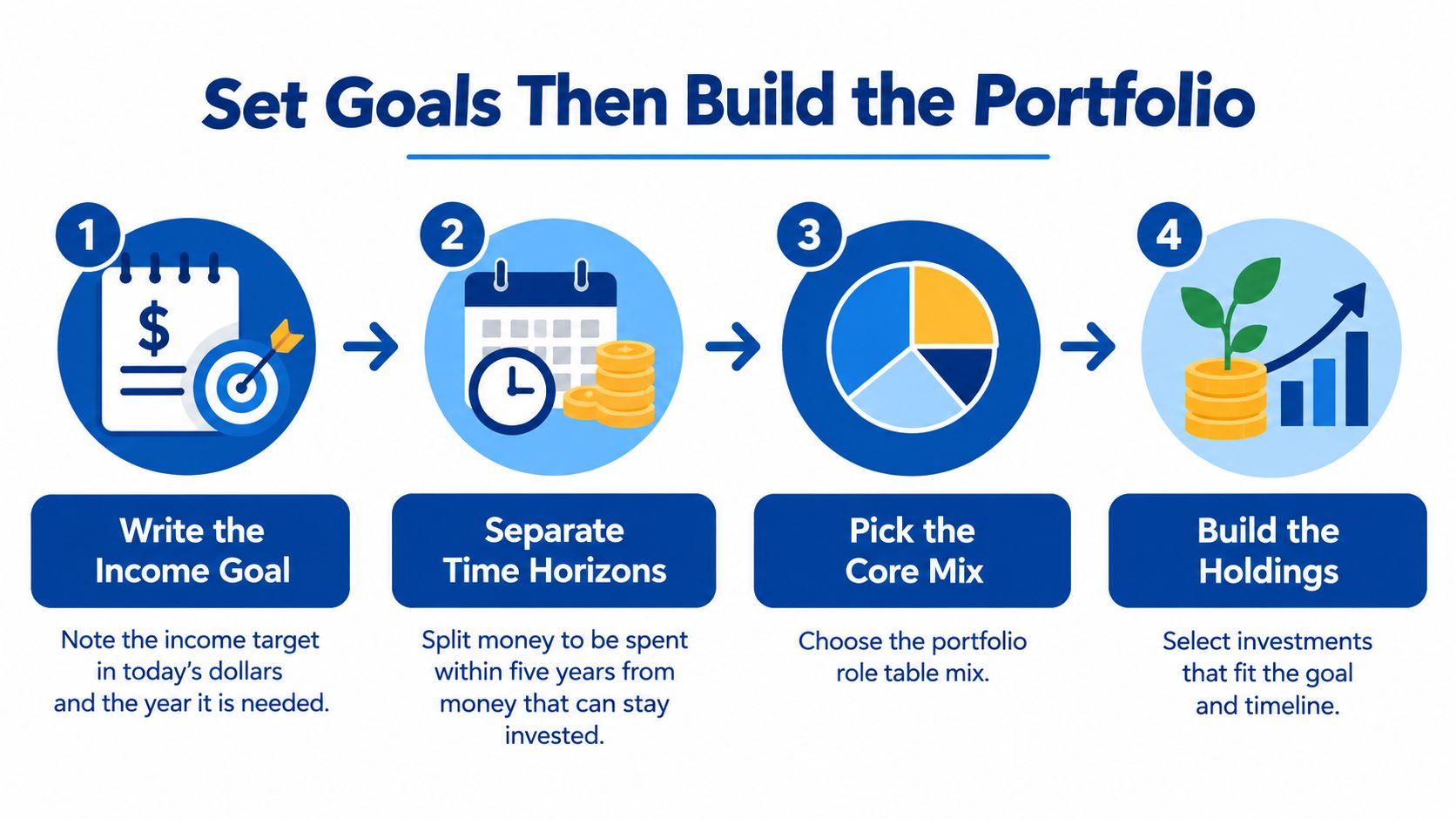
Use this visual to organize the decisions before opening a trading screen.
Establish the goal and funding habit
Write down the income goal in today's purchasing power and when you'll need it. A target without a date makes it difficult to judge how much growth or ready cash you need. Separate essential expenses from optional spending.
Set aside near-term spending separately from long-term investments. Accessible cash can cover unexpected bills, while suitable bonds can support planned expenses without requiring an equity sale during a downturn.
Choose an account and automate contributions. A taxable brokerage account, IRA, workplace retirement plan, or eligible solo retirement plan may suit different needs. Compare access and tax treatment before deciding. Regular contributions create a repeatable funding habit instead of relying on a lucky entry price.
Set an income objective without making yield the only target. A portfolio focused on future income growth may pay less at first. Record whether you need distributions now or are building purchasing power for later.
Mega Income Stream advises entrepreneurs to automate contributions, diversify, and open a tax-advantaged retirement account. These habits help turn a goal into a consistent process.
Build and test the holdings
Begin with dividend-paying companies or a diversified dividend ETF. Use a screen to find candidates, then check company filings to assess whether their distributions are supported by the business.
Compare surviving candidates by sustainable yield, growth prospects, and price. A high yield can provide more cash today, but an overstretched payout or inflated purchase price can weaken future results.
Test how the business might fare under pressure. Consider weaker sales, narrower margins, higher interest costs, and lower free cash flow. Ask whether the company could maintain its dividend without borrowing to pay it.
Set limits for each company and sector. A holding that passes your quality checks can still become too large a part of the portfolio.
Reinvest distributions during the accumulation stage, unless you need the cash or want to direct it to an underweight holding. Automatic reinvestment is convenient, but it should not lead to excessive concentration.
Review your allocations and the reasons you own each holding. Track the business conditions that would make you reconsider, rather than reacting to every price change.
Judge the result by total return
Dividend income is only part of an investment's result. The S&P High Yield Dividend Aristocrats practitioner's guide discusses the role dividends can play in long-run total returns. Price changes matter too, so a yield-only comparison leaves out part of the picture.
Measure total return by accounting for both price changes and distributions, including reinvested payments where applicable. Compare the result with a suitable broad-market benchmark after fees, taxes, and withholding.
Before buying, write a short investment policy covering your goal, contribution method, allocation, selection rules, and review triggers. It should give you clear decisions to follow when markets are uncomfortable, not just when prices are rising.
Screen Stocks for Durable Dividends
A long dividend-increase record can be a useful starting point, but it cannot prove a payout is safe. A company may keep raising its dividend even as the business has less cash available to support it.
The S&P 500 Dividend Aristocrats index requirements and performance include at least 25 consecutive years of dividend increases. From May 2, 2005, the index achieved 8.1% annualized dividend growth. Rising payouts can help preserve purchasing power over time, but they do not guarantee future increases or share-price gains.
Read the cash flow before the yield
Start with the annual report, recent earnings release, cash-flow statement, and debt notes. Check whether management explains capital spending, borrowing needs, and its distribution policy consistently.
Free cash flow is operating cash flow after capital expenditures. It helps show whether a company can fund its dividend while maintaining the business, though the measure works differently across industries.
Dividend quality screens
| Screen | Pass | Caution | Fail |
|---|---|---|---|
| Increase history | Long increase record supported by business performance | Shorter but clean record | Recent cut or freeze requiring a separate recovery thesis |
| Payout coverage | Recurring cash flow comfortably exceeds dividends | Thin coverage or reliance on unusually favorable conditions | Dividend larger than recurring cash flow |
| Debt and interest | Manageable debt and comfortable interest coverage | Approaching maturities without a clear funding plan | Rising debt used to fund the payout |
| Yield versus peers | Consistent with comparable quality businesses | Elevated yield with an identifiable explanation | Extreme yield after a price decline and deteriorating fundamentals |
| Valuation | Price fits reasonable growth assumptions | Expensive but supported by plausible results | Price requires uninterrupted growth and no setbacks |
Consider a hypothetical utility with an attractive yield, a dividend consuming nearly all earnings, and rising debt. Steady customer demand may not be enough: investment needs and refinancing costs can leave less cash for shareholders.
A consumer business with a smaller payout, recurring cash flow comfortably above its dividend, and room for gradual increases may offer more reliable future income. Its lower starting yield still means less cash today. Whether later increases make up the difference depends on growth, cuts, reinvestment, taxes, and the price paid.
Check what could weaken the payout
Earnings coverage and cash coverage answer different questions. Customers who pay slowly or heavy capital spending can strain cash even when accounting earnings look healthy. An unusual expense can also reduce reported profit without creating an equivalent recurring cash burden.
Interest coverage shows whether operating earnings can meet interest expense. Read the debt maturity schedule as well: manageable interest costs today do not guarantee affordable refinancing later.
- Payout room: Leave space for maintenance spending, working capital, debt service, and business investment.
- Business durability: Identify why customers keep buying and what could weaken that advantage.
- Valuation discipline: Compare today's price with conservative earnings and cash-flow expectations, not the most optimistic forecast.
- Industry context: Financial firms and property businesses need sector-appropriate measures, not mechanical comparisons with manufacturers.
The determinants of corporate and individual payouts help explain why companies distribute cash instead of retaining it.
For an investor focused on spending income, a recent freeze may fail the income-growth screen without proving the company is permanently uninvestable. The decision depends on whether the goal is dependable income or a recovery investment.
Write a pass, caution, or fail decision for each candidate. State what supports the payout, what threatens it, and what evidence would change your conclusion.
Spread Risk Across Sectors and Assets
Owning many dividend stocks doesn't necessarily mean owning different risks. A portfolio filled with lenders, property companies, and utilities can remain heavily exposed to borrowing costs even when it contains many tickers.
The U.S. Securities and Exchange Commission's asset-allocation guide recommends diversification both across asset categories and within them. The practical distinction is between company-specific trouble, such as bankruptcy, and concentration risk, where several holdings suffer from the same economic pressure.
Use a portfolio view that includes the assets supporting the rest of your household finances.

Control exposure rather than ticker count
Write a maximum company weight and sector weight into your policy. Choose limits that reflect how much income disruption you can tolerate, and treat them as purchase constraints rather than targets every holding must reach.
A hypothetical cap sheet could use the following rules without treating them as universal allocation standards.
| Exposure | Rule to write down | Action when breached |
|---|---|---|
| Individual company | Maximum share of total assets and income | Pause purchases and assess whether trimming is necessary |
| Sector | Maximum share of equities | Redirect contributions and inspect overlapping funds |
| Country and currency | Deliberate home and foreign allocations | Rebalance accidental geographic concentration |
| Higher-yield holdings | Restricted satellite allocation | Don't enlarge it simply to replace lost income |
| Employer or owned business | Include household economic exposure | Avoid duplicating that industry risk in investments |
Inspect ETF holdings as well as direct shares. A company owned through several funds remains the same underlying business, and a fund holding doesn't make sector exposure disappear.
Income concentration deserves its own check. A modestly sized high-yield holding can supply a disproportionately large share of distributions, leaving your budget vulnerable even when its capital weight looks acceptable.
Include assets outside the brokerage account
Our diversification guidance includes stocks, ETFs, bonds, real estate, and an owned business. These are potential cash-flow sources to evaluate together, not a requirement to purchase every category.
If your business income depends on construction, additional property and construction-related shares may increase the same underlying exposure. Likewise, owning a rental property doesn't make it liquid enough to replace emergency cash.
For a broader assessment, consider the trade-offs discussed in alternative investments for portfolio diversification. Illiquidity, valuation uncertainty, and ongoing operating costs matter alongside potential income.
This video offers another format for considering diversification decisions.
Rebalance with a reason
Price changes alter weights even when companies leave dividends unchanged. Use scheduled reviews and predetermined allocation boundaries rather than selling because a holding has appreciated.
Direct new contributions toward underweight assets before creating unnecessary taxable sales. When a position remains beyond your chosen boundary, consider trimming with taxes and transaction costs in mind.
Diversification can reduce dependence on a company or industry. It can't prevent a broad market decline or guarantee dividend payments.
Your cap sheet should fit on a line: company exposure, sector exposure, foreign exposure, higher-yield allowance, and the action triggered by a breach.
Place Holdings for Tax and Currency
The best account for a holding isn't necessarily the account where you already have spare cash. Compare the income you can use, the taxes you may owe, and the restrictions on accessing it.
A foreign dividend can face withholding before it reaches you. Local income tax, fund expenses, and currency movements can further change the result, so a higher advertised yield doesn't necessarily mean more spendable cash.
Compare account homes
Morningstar's dividend-portfolio guidance notes that foreign-dividend tax credits may help investors in taxable U.S. accounts but generally don't provide the same benefit inside retirement accounts. The available benefit still requires attention to the investor's circumstances, applicable tax rules, and the investment structure.
Where dividend and income holdings belong
| Holding | Better home | Why | Watch-out |
|---|---|---|---|
| U.S. qualified dividends | Taxable or retirement, after comparing tax treatment | Dividend taxation and withdrawal rules differ | Future retirement withdrawals can affect the outcome |
| Foreign dividends | Often taxable when a credit applies | A foreign tax credit may offset eligible foreign tax | The same benefit generally isn't available inside retirement accounts |
| Bonds or high ordinary-income holdings | Often tax-advantaged, subject to individual circumstances | Sheltering current taxable income may help | Shelter doesn't remove interest-rate or credit risk |
| Broad international ETF | Taxable account or an appropriate locally domiciled fund | Easier administration than numerous direct foreign holdings | Fees, withholding, and currency exposure remain |
| Near-term spending cash | An accessible account, with suitable cash instruments | Spending shouldn't depend on selling equities | Access and principal stability come before yield |
Account placement is not a reason to ignore liquidity. Money needed for spending must remain accessible under the account's withdrawal rules.
For eligible self-employed investors, our guidance describes traditional and Roth choices within a Solo 401(k), along with broad investment flexibility. Choose the tax treatment and investment menu deliberately rather than assuming every retirement account works identically.
Compare foreign investment routes
Direct foreign shares suit investors prepared to track withholding, exchange rates, company disclosures, and tax records. A diversified international ETF can simplify administration, although the fund's domicile and underlying investments still affect taxation.
A locally domiciled fund may make reporting easier, but check its share class and distribution policy. The currency printed beside a fund's price doesn't by itself describe the currencies affecting its underlying businesses.
- Start with the gross distribution: Identify what the company or fund pays before deductions.
- Subtract actual costs: Account for withholding, applicable local taxes, and fund expenses without counting expenses twice.
- Translate into spending currency: Use a cautious currency scenario rather than assuming favorable exchange-rate movements.
Our guide to tax-saving investments can help frame the account comparison. Assign each current holding a preferred account home and write the reason beside it before making transfers or realizing taxable gains.
Turn Holdings Into Spendable Income
A portfolio can generate adequate annual income and still leave you short when a bill arrives. Companies and funds determine their distribution schedules; your household needs its own payment process.
For the broader task of coordinating investment distributions and withdrawals, Wealth Collective's resource on building retirement cash flow with Wealth Collective offers a useful starting point. Treat cash-flow planning as a separate job from selecting dividend stocks.
Create the payment process
Convert the spending goal into an annual after-tax requirement, because a monthly budget and an annual yield aren't directly comparable. Include irregular expenses such as insurance, repairs, and travel rather than treating them as surprises.
Estimate spendable distributions holding by holding, using actual withholding, anticipated local taxes, and investment costs. Don't subtract a withholding rate directly from a yield: withholding applies to the payment, while an annual fund expense is generally expressed relative to assets.
Check whether the required income leaves a margin for disappointment, rather than assuming every declared payment continues. If the plan only works with uninterrupted payouts, lower the spending commitment, add capital, or extend the accumulation period.
Choose where distributions land, directing them to reinvestment during accumulation or to a spending account when withdrawals begin. You can also collect distributions centrally and reinvest them into underweight holdings instead of automatically buying the same securities.
Pay yourself from the spending reserve, then replenish it through distributions, maturing bonds, and planned sales where appropriate. This separates the household payment schedule from the portfolio's uneven cash receipts.
Avoid creating income by weakening the plan
A dividend ETF can remain the equity core without requiring an additional collection of individual stocks. Add direct holdings only when they improve the portfolio and you can maintain their financial reviews.
Don't force the portfolio to produce every spending dollar as dividends. A planned sale from an appreciated holding can be more sensible than buying a financially weaker company solely for its payout.
Cash-flow safeguard: A distribution is useful only when you can spend it without undermining the capital and reserves supporting future withdrawals.
During a prolonged decline, spending reserves won't last indefinitely. Review discretionary withdrawals, available bond maturities, and the remaining asset mix rather than following an inflexible instruction never to sell equities.
The objective is a sustainable withdrawal process. It isn't to keep the dividend total looking attractive at any cost.
Write the Plan and Run the Quarterly Check
A written policy protects you from changing your investment strategy every time prices change. It also makes decisions easier to review: you can compare what you intended with what you own.
The policy doesn't need elaborate forecasting software. A document and a spreadsheet are enough if they contain the decisions you'll use.
Record decisions you can act on
- Purpose and timing: Write the spending goal, when withdrawals should begin, and which expenses the portfolio is expected to support.
- Asset roles: Record the chosen equity, bond, and cash allocations, including where a dividend ETF fits.
- Exposure boundaries: State company, sector, geographic, currency, and higher-yield limits, together with the action each breach triggers.
- Account placement: Identify the intended home for domestic dividends, foreign dividends, bonds, and accessible cash.
- Distribution instructions: Specify whether payments are reinvested, redirected, or transferred for spending.
- Funding: Record the automatic contribution and the account receiving it.
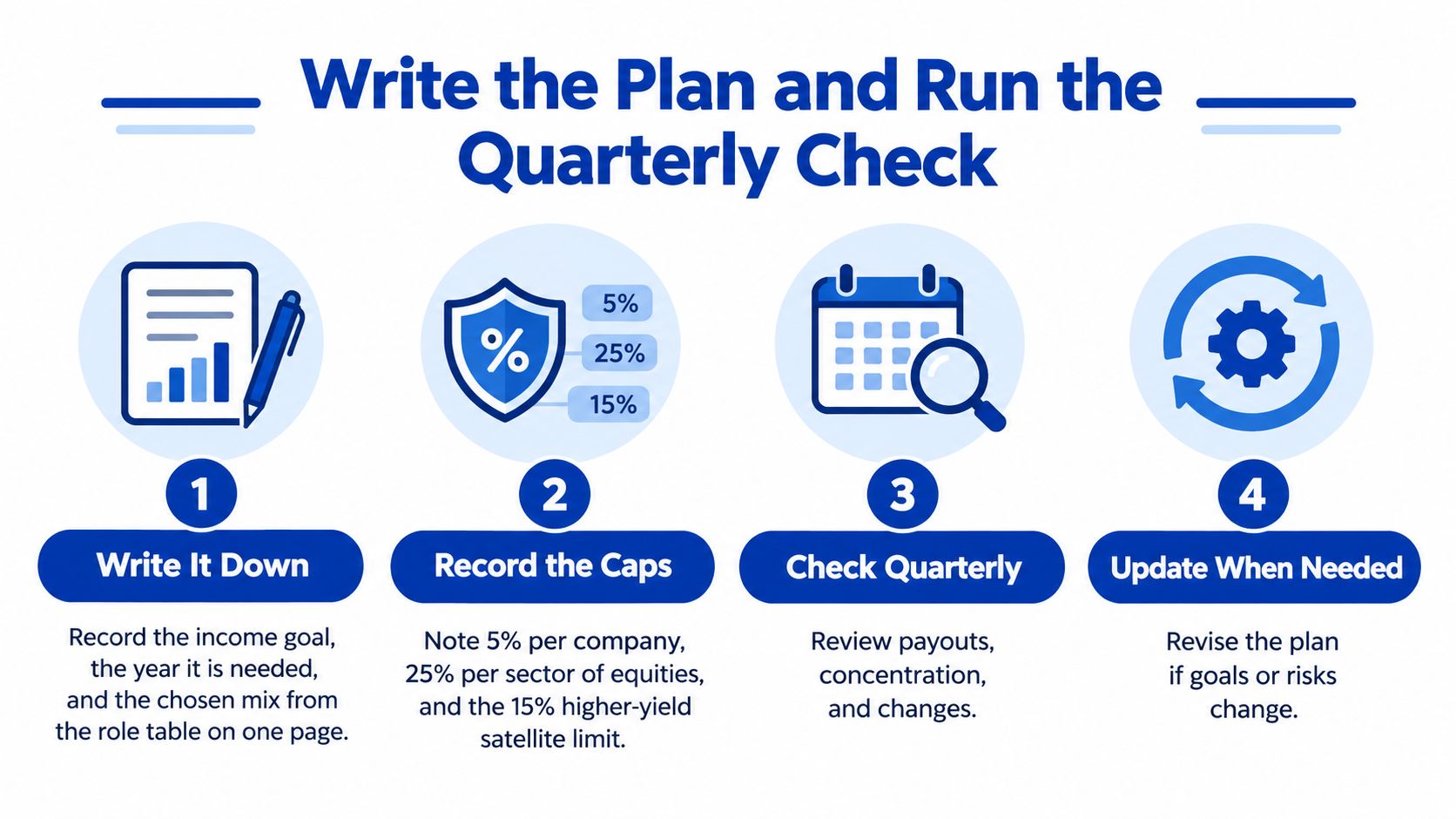
Use this visual as a reminder of the operating routine.
Review changes rather than headlines
At the quarterly check, confirm whether any company reduced or suspended its dividend. Investigate whether cash coverage, debt, or the competitive position has weakened, even when the payment remains unchanged.
Then inspect concentration, account cash balances, and contribution settings. Record decisions and reasons so an unchanged holding reflects a deliberate choice rather than neglect.
Keep a short exception list for anything requiring investigation. A pending refinancing, deteriorating coverage, or unexplained yield increase deserves a follow-up date and a clear decision condition.
Avoid replacing a reduced payment with whatever offers the highest current yield. That can turn an isolated setback into a portfolio-wide decline in quality.
Use support where the decisions are unclear
A fee-only financial planner can help match assets to retirement goals when the spending requirement, account structure, or suitable allocation remains uncertain. Our guidance recognizes that a planner can help determine appropriate assets; the value is in resolving those decisions, not in finding a yield shortcut.
You don't need a fully populated stock portfolio to begin. A researched diversified core, appropriate defensive assets, and automatic funding can establish the process while individual companies wait for proper analysis.
The task is complete when your policy exists and your first automatic contribution is scheduled. Future changes should follow from that policy or a genuine change in your circumstances, not from the most eye-catching payout on a screening page.
Mega Income Stream offers practical editorial guides on investing, retirement, taxes, and income generation for individuals and business owners. Visit Mega Income Stream to explore related guidance as you turn your dividend strategy into a written plan and a regular funding habit.










Comments