
 By

The worldwide average hourly rate charged by freelancers is $21, but earning in USD as an international freelancer depends on your skill, experience, client demand, and billable work. That figure is a benchmark, not a take-home estimate: payment fees and currency conversion can reduce what reaches your local account.
It makes sense to focus on the headline rate. A US-dollar contract can look more valuable than a local one, but the amount you keep also depends on how you receive the money and when you convert it. A 3–5% difference in exchange rates or transfer fees can affect yearly income.
This guide explains how to assess earning in USD as an international freelancer: compare hourly and project rates, understand how payment methods affect your net income, and prepare the right records. It also covers financial risks such as exchange-rate movements and local inflation.
Use the figures as reference points, then calculate your floor rate: the minimum you need to cover business costs, unpaid work, and personal expenses. This gives you a clearer basis for choosing clients, setting terms, and building a more reliable freelance income.
Key Takeaways
- Rate benchmark: Use the worldwide average freelance rate of $21 per hour as a reference, then account for your skills, experience, demand, and billable work.
- Net payment: Estimate what reaches your local account after transfer costs and currency conversion; even a 3–5% difference can affect yearly income.
- Payment route: Compare transfer methods by processing, charges, and conversion impact before setting payment terms.
- Income potential: For India-based freelancers, experience and client market can shift monthly earnings; compare local and international work by take-home amount.
- Financial buffer: Plan for taxes, business expenses, local inflation, and exchange-rate changes before treating gross payments as personal income.
1. Do freelancers need special documentation to receive payments from foreign clients?
There is no single documentation package for every international payment. Requirements depend on your country, payment route, and client. Keep signed agreements, invoices, payment confirmations, and currency-conversion records together. They help you reconcile what you billed, what arrived, and what you received in local currency.
For each client, start with a written agreement that identifies the work, rate, currency, milestones, and payment schedule. An hourly design contract, for example, should explain how to record billable time and approve extra work. Then issue an invoice with your business details, invoice number, amount due, and payment instructions. Store the final invoice and transfer receipt in the same client folder.
Internationally demanded freelance skills include programming and IT, web and graphic design, and specialized writing. These fields attract global work, although strong competition can affect rates. Some companies pay freelance writers more than $100 per hour for legal writing, copywriting, and technical writing. Build authority with a focused digital portfolio: show the problem, your process, and a measurable result for each project.
To attract clients, share useful examples where buyers already assess freelancers. A Fiverr profile can highlight a specific service, such as landing-page design, rather than a broad claim like “digital expert.” Add relevant case studies to your professional profile and share practical insights on social media. Direct interested prospects to one clear portfolio page and a defined service offer.
Keep payment records separate from marketing records. Maintain a ledger linking each invoice to its client, platform, currency, payment date, and net amount received. If one client pays through Fiverr and another by direct transfer, record each transaction separately before calculating monthly totals. This makes reconciliation easier and shows which sources generate reliable work.
For Indian freelancers doing comparable work, international clients may pay around 2 to 4 times domestic rates. Treat that as a market comparison, not an automatic rate multiplier. Compare scope, client expectations, experience, and unpaid admin time before quoting. Use an hourly rate when the work changes often; use a fixed project fee when deliverables are clearly defined.
Strong client relationships can create a repeatable referral pipeline. After delivery, send a concise handoff with the completed files, agreed results, and any next-step recommendations. Ask satisfied clients for a testimonial or introduction, then record the referral source beside the next inquiry. This connects service quality to future leads and helps you prioritize relationships that produce sustainable work.
2. Forced currency conversion and hidden exchange-rate spreads
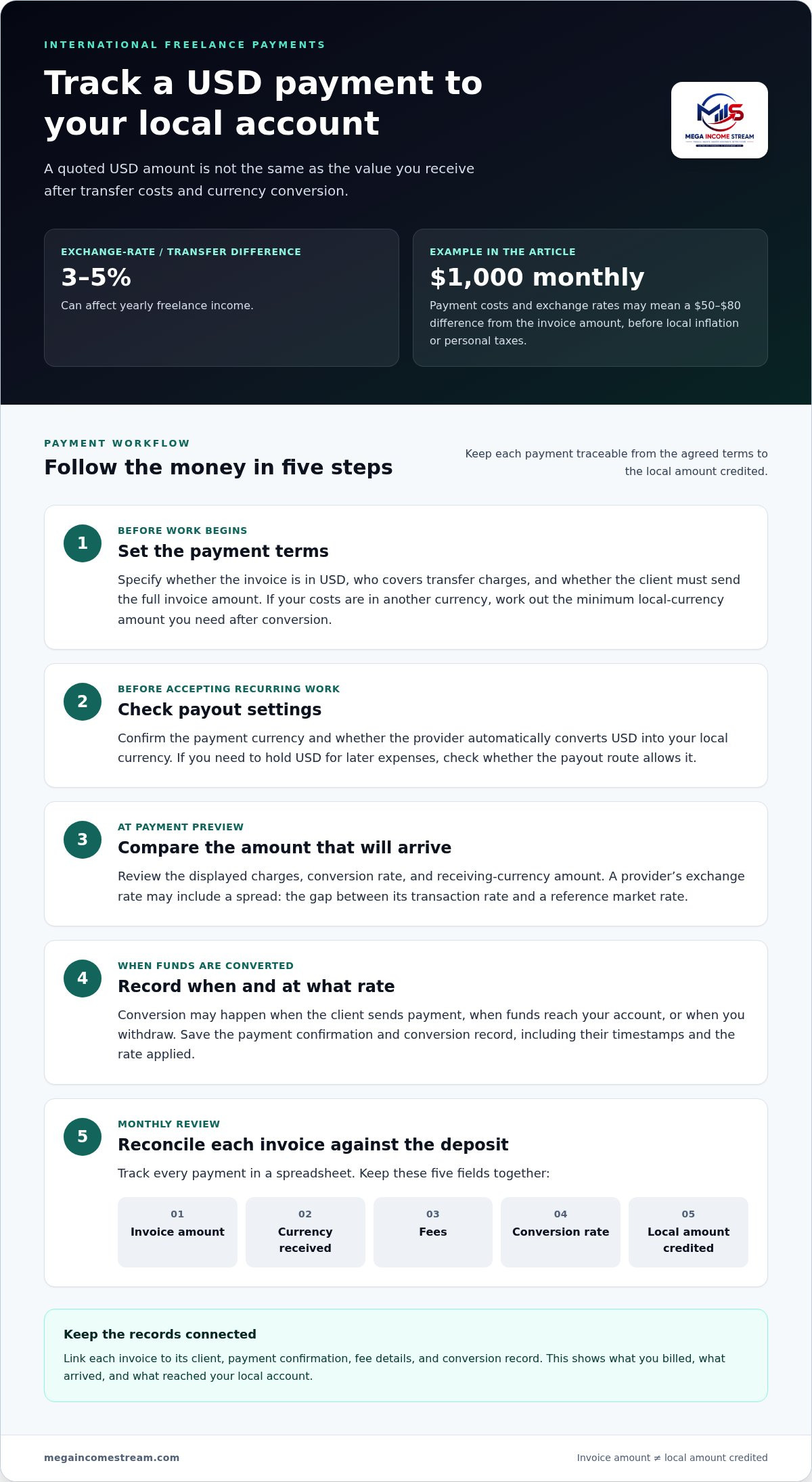
A quoted USD payment is not the same as its value after fees and conversion. A provider may convert funds automatically, while its exchange rate includes a spread. The spread is the gap between the rate used for your transaction and a reference market rate. A 3–5% difference in exchange rates or transfer fees can affect a freelancer’s yearly income.
Consider a freelancer receiving $1,000 monthly from a US client. After payment costs, the amount credited in local currency may be lower than the invoice amount, depending on the method and exchange rate. That range represents a $50–$80 difference from the invoice amount, before accounting for local inflation or personal taxes. Record the invoiced amount and the amount credited, rather than treating them as identical.
Review each platform’s payout settings before accepting recurring work. Some providers automatically convert USD into local currencies such as BDT, PKR, EGP, or NGN. If you need to hold USD for later expenses, automatic conversion may remove that option. Compare the payment currency, conversion rate, displayed charges, and receiving-currency amount in the transaction preview.
The timing of conversion matters too. A provider may convert funds when the client sends payment, when funds reach your account, or when you initiate a withdrawal. The exchange rate can change between those steps. If a payment remains in USD until withdrawal, for example, you may choose when to withdraw, but the rate at that time determines its local-currency value.
Processing time affects the rate applied. A transfer that settles after a delay may be converted at a different rate from one processed promptly. The exact process depends on the platform, transfer method, and receiving account. Compare the timestamp on the payment confirmation with the timestamp and rate on the conversion record. Save both with the invoice.
Set contract terms before work begins. Specify whether the invoice is in USD, who covers transfer charges, and whether the client must send the full invoice amount. If your operating costs are in another currency, calculate the minimum local-currency amount you need after conversion. Use that figure to assess the offered USD rate, without assuming the exchange rate will stay constant.
For a practical audit, track each payment in a spreadsheet with five fields: invoice amount, currency received, fees, conversion rate, and local amount credited. Review the entries monthly. If a $1,000 invoice repeatedly produces a lower local payout than expected, compare the platform’s conversion record with its payment confirmation and adjust your contract or payout settings before the next billing cycle.
3. Comparing payment solution features and fees
Compare each payment route by availability, processing requirements, and likely deductions. A method that works for a recurring US client may not suit a one-off project or your receiving account. Use this comparison to decide which route to include in your contract and invoice.
| Payment method | Useful for | Trade-off to consider |
|---|---|---|
| ACH transfer | Direct, regular payments from US-based clients | It can be faster and cheaper than an international wire, but speed and availability may be drawbacks. |
| International wire | Cross-border bank transfers | The client may need your SEPA or SWIFT code to schedule the transfer. |
| Paper check | Clients who pay by mailed check | International checks can take a long time to process. |
| Payment-platform payout | Receiving platform earnings through account details | Check which payout methods the platform supports and how the transfer reaches your account. |
Some freelancers add nsave USD or GBP account details to payment platforms, then select direct bank transfer, ACH transfer, or wire transfer as the payout method. This can give the client a clear way to pay, but available options depend on the platform and the account details entered. Match your chosen method to the payment instructions shown in your account.
Traditional bank wires or PayPal may reduce an Indian freelancer’s international payment by around 5% to 8% through fees and currency markups. Compare the cost against the service’s other practical features, such as its supported route and transfer process. Don’t select a method based on one fee alone; consider the amount that reaches your account and how the route fits your invoicing workflow.
For each option, record the invoice currency, transfer method, displayed charges, and amount credited. Keep the transfer confirmation with the related invoice. This creates a consistent basis for comparing methods across clients and projects, rather than relying on memory or a quoted fee.
Set up your payment workflow before the next invoice: choose the route, add the correct receiving details, and state the agreed method in your payment instructions. If a client pays through a platform, make sure the payout selection matches your account. For recurring work, review completed transactions periodically and adjust your preferred route when your records show a better fit.
4. Do freelancers make good money in India?
Freelance income in India ranges widely, so compare monthly earnings with expenses, unpaid hours, and payment costs. A reported average range is ₹10,000 to ₹30,000 per month, but that benchmark combines different roles and experience levels. International client work can raise gross revenue, yet the amount deposited into your bank account is not the same as spendable income.
Experience is one useful comparison point. Indian beginners working with international clients are estimated to earn ₹30,000–₹75,000 monthly. Mid-level freelancers are estimated at ₹1,00,000–₹2,50,000, while experts may earn ₹2,50,000–₹8,00,000 or more. These ranges describe estimated gross income, not guaranteed take-home pay. Client demand, workload, specialization, and repeat business all affect results.
Consider the difference between a daily target and monthly cash flow. At ₹3,000 per paid day for 20 paid working days, gross monthly income reaches ₹60,000 before taxes, business expenses, and unpaid time. An independent freelancer must also account for proposal writing, revisions, bookkeeping, and gaps between projects. Track those hours separately; otherwise, your effective hourly return can look higher than it is.
Billing in USD can make an international contract attractive, but conversion costs and exchange-rate movements affect the local amount received. A payment provider, for example, may convert funds before they reach your Indian bank account. For each payment, record the USD invoice, conversion rate, fees, and INR credited. Compare net results across platforms such as Upwork and direct client arrangements, rather than judging by the quoted USD amount alone.
Diversify your sources of work to protect cash flow. You might combine a recurring monthly client, fixed-scope projects, and smaller assignments through a platform. This reduces dependence on a single contract ending, although managing several active projects can increase your workload and coordination demands. Assess each source by net income, payment timing, and time spent delivering the work.
For freelance income in India, maintain clear records of invoices, receipts, platform statements, business expenses, and bank deposits. Tax treatment depends on your circumstances and applicable rules, so do not treat gross receipts as post-tax income. Organize records by financial year and keep USD and INR amounts distinct. A qualified tax professional can explain how reporting applies to your situation.
Review your rates monthly to see whether they support sustainable income. Compare total billed work with money received, expenses, unpaid hours, and the local cost of running your business. If inflation raises operating costs, update your pricing assumptions rather than relying on last year’s INR conversion. This makes international earnings a measurable cash-flow system, not just a larger invoice total.
5. Freelancing benefits and financial risks
Freelancing can broaden your global client pipeline, but income stability depends on how you manage risk. Independent work gives you control over clients, projects, and schedule. It also makes you responsible for finding work, tracking expenses, and maintaining cash reserves. Treat your skills as business assets and build a system to protect the income they generate.
A diverse client mix can reduce reliance on a single contract. Combine recurring work with defined projects and referrals, for example, and track each source separately. This can help you expand without assuming every client will renew. Review revenue concentration, payment timing, and workload regularly. If one client dominates your pipeline, use available capacity to develop another source of demand.
Build a financial buffer into your pricing. Freelancers commonly add a 15–25% profit margin to support business growth, savings, and emergencies. That margin is separate from personal spending. Track software, equipment, subcontracting, and unpaid administration so your project rate reflects operating costs. Revisit the calculation when local inflation raises expenses or your skills support more complex work.
Cross-border income brings exchange-rate exposure. A USD invoice may convert into less local currency before reaching your account, and platform charges and transfer costs can reduce the payout further. Record the invoice currency, transfer amount, conversion rate, and local amount received. Compare these figures across payment cycles, then plan essential expenses around local-currency cash flow rather than the headline USD total.
Payment risks include late transfers, disputed work, and suspicious requests. Be alert to clients who ask you to pay an upfront release charge, return money after an overpayment, or begin substantial work without agreed terms. Use a signed scope, staged deliverables, and documented payment instructions. Confirm unexpected changes through a separate, known communication channel before sending money or files.
Tax responsibilities depend on where you live and your tax status. In the United States, freelancers pay a combined self-employment tax rate of 15.3%, according to the Internal Revenue Service. That U.S. figure does not establish the tax treatment for freelancers elsewhere. Keep income and expense records organized by tax period, and separate business receipts from personal transactions.
Use a monthly risk review: reconcile invoices, identify overdue payments, compare net receipts with expenses, and update your cash-flow plan. Check whether one platform, client, or currency creates too much dependence. If you want a structured way to strengthen this workflow, map a more resilient freelance income strategy around your clients, payment routes, and operating costs.
Mega Income Stream: Business Strategies
Mega Income Stream helps freelancers turn income goals into practical business strategies. If you have mapped your rates, payment costs, and client mix but need a clearer growth plan, its Making Money Insights can help you assess revenue opportunities and develop more sustainable income streams. The Consulting Business offering supports entrepreneurs reviewing their business direction and looking for ways to optimize revenue. Use these resources when your next step goes beyond choosing a transfer method, such as shaping a service offer or reducing reliance on one source of clients. The aim is a clearer plan based on your workflow and business priorities. Visit megaincomestream.com to explore how Mega Income Stream can support your planning.
Turn Your Freelance Income Into a Stronger System
A reliable freelance business grows from repeatable decisions, not one favorable payment. Treat earning in USD as an international freelancer as an operating system: review which services attract suitable clients, where your workflow loses time, and how each project contributes to sustainable income. Then choose one improvement to test, such as tightening your project scope or creating a clearer offer for repeat work.
Start with a simple monthly review. Identify your strongest client source, the work that brings the best return on your time, and the business risk that needs attention next. Use those findings to set a practical goal for the coming month, then track whether your actions move the numbers in the right direction.
If you want help turning that review into a growth plan, contact Mega Income Stream to discuss your next business step. Build deliberately, learn from each cycle, and keep strengthening the income workflow you control.
Frequently Asked Questions
How Much Do Freelancers Make in 2026?
There’s no single income figure that represents every freelancer in 2026. For earning in USD as an international freelancer, estimate revenue from the work you can realistically sell and deliver, not just your advertised rate. Separate one-time projects from recurring contracts, and account for time spent finding clients. A full schedule of short projects can produce a different result from fewer, longer engagements.
Do freelancers need special documentation to receive payments from foreign clients?
Payment requirements depend on your country and the route used. Keep a clear audit trail connecting each payment to its purpose: include the invoice reference in your payment records, and save statements showing the sender, date, currency, and credited amount. If your payment service provides a transaction ID, store it with the matching client record. Local reporting requirements vary, so keep records organized for review.
How Do Payment Fees Quietly Cut Your Freelance Income?
Some costs appear as charges, while others are reflected in the exchange rate applied to a transfer. To check the difference, compare the provider’s quoted conversion rate with a reference rate for the same time, then record any separately itemized deductions. This helps distinguish an explicit fee from a rate spread. Use the comparison to decide whether to absorb payment costs or address them in your contract terms.
Can I really earn ₹5 lakh per month from freelancing?
₹5 lakh per month is a revenue target, not a standard salary benchmark. Reaching it requires enough paid work at suitable rates, plus the capacity to deliver that work without sacrificing quality or repeat business. A freelancer might combine larger projects with ongoing contracts, but the mix must fit their skills and available time. Assess the target against actual client demand and delivery capacity.
Do freelancers make good money in India?
Freelancing can provide good income in India when paid work consistently covers business and personal costs. Track how much revenue comes from repeat clients, how long payments take, and how much time sales and administration require. Consider whether local costs are rising faster than your rates. A stable pipeline and clear financial records provide a more useful picture than one strong month.
Does the payment method affect how much a freelancer actually earns?
Yes. The payment method can affect the amount credited and the steps needed to resolve a delayed or incomplete payment. When earning in USD as an international freelancer, specify the agreed currency and payment route in your contract and invoice. Record the expected amount and the transfer received. This makes it easier to identify whether a discrepancy came from the payment route or the original invoice.
How Do Freelance Earnings Vary by Skill and Experience?
Skills with clear business outcomes can strengthen proposals because clients can assess what the work is intended to deliver. Experience also helps freelancers scope projects, spot hidden requirements, and present relevant work samples. For example, a designer with examples for a specific industry can make their value easier to evaluate than one offering a broad, undifferentiated service. Demand and client budgets still shape the final rate.
Is freelancing worth it?
Freelancing may suit people who want control over the clients and services they pursue and are prepared to handle business development as well as delivery. Test the fit by setting a defined review period and tracking new inquiries, accepted proposals, repeat work, and time spent on administration. Use the results to adjust your offer or workflow. This turns a career choice into a decision informed by real operating evidence.











Comments