
 By
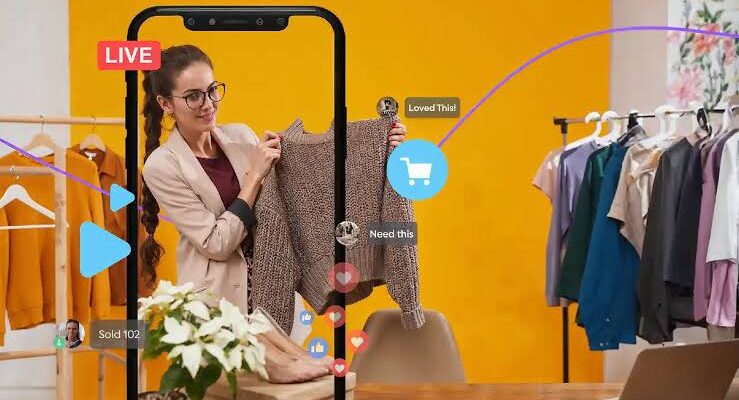
The digital retail scene is rapidly changing, with Live Shopping developing as a significant force alongside traditional e-commerce.
The live shopping phenomenon, predicted to be worth $129.6 billion by 2024¹, is transforming online shopping for customers worldwide. But how does live shopping compare to typical e-commerce?
Consider this: rather than waiting for them to find your goods on a website, you show them live. They watch it in action, ask questions, participate, and make purchases—all in real time. That’s the magic of live shopping.
What was once a buzzword is now a thriving $129.6 billion worldwide market, reshaping how firms like yours interact with customers. Live Shopping combines the finest of video, social interaction, and direct response marketing, right where your target audience currently spends their time.
This is not a replacement for traditional e-commerce; rather, it is an enhancement with something more human, immersive, and powerful.
Let’s look at the differences and synergies between these two techniques.
Traditional E-Commerce
Traditional e-commerce is based on a multi-step procedure that might result in drop-offs at each stage. Customers are bombarded with promotional messages when they navigate to the webshop, search for products, add them to their carts, and finally finish the checkout procedure.
Live shopping provides a more efficient and entertaining experience. Viewers are directly exposed to products in an engaging style, creating a sense of connection and urgency. Questions can be answered in real time, reducing ambiguity and increasing trust. This results in a smoother flow, allowing viewers to smoothly shift from discovery to purchase inside the live stream itself.
Livestream Shopping
Live Shopping changes the standard customer journey into a dynamic and interactive one. Businesses may use their existing social media audience by inviting followers to live events broadcast directly on Facebook and Instagram. These live feeds show products in real time, allowing viewers to get a close look and ask questions directly.
The magic happens at the actual event itself. Viewers can easily add things to their carts by entering buy codes in the comments box.
Customers who indicate interest are then sent a bespoke link via Facebook or Instagram that takes them directly to the brand’s webshop for a seamless checkout experience. This eliminates the need to traverse a separate online store and streamlines the buying process, resulting in improved conversion rates for businesses and a more engaging shopping experience for customers.
A closer look at the differences between the two methods reveals a few major distinctions:
Key Metrics Comparison
The Conversion-Rate Difference Can Be Huge
This is where livestream commerce gets interesting. McKinsey reports that companies have achieved conversion rates approaching 30%, potentially up to ten times conventional ecommerce rates. Its earlier analysis of leading Taobao livestreams found an average conversion rate of about 28% in the cited period.
Later McKinsey research found conversion among frequent live-commerce users—defined there as the percentage of shows attended that resulted in a purchase during or after the show—of approximately:
| Market | Reported Conversion |
|---|---|
| United States | 33% |
| Europe | 30% |
| China | 32% |
| Latin America | 36% |
These figures came from McKinsey’s survey of frequent live-commerce users and therefore should not be treated as universal e-commerce conversion benchmarks. That’s an important distinction.
A highly engaged person deliberately watching a shopping livestream isn’t equivalent to a random visitor arriving on a product page from Google.
Still, the figures demonstrate the persuasive potential of live commerce.
Why Does Livestream Shopping Convert So Well?
Imagine you’re buying a blender. On a traditional product page you see:
- Blender X
- 1,500 watts
- Six blades
- $149
- Add to Cart
Useful?
Absolutely.
Exciting?
Probably not.
Now imagine watching someone put frozen fruit, ice and nuts into that blender. Thirty seconds later, they’re pouring out a smoothie.
You have just watched the product prove itself. That creates several conversion advantages.
1. Customers See the Product in Action
Livestreaming answers the question:
“Does this thing actually work?”
This is particularly valuable for:
- Beauty products.
- Fashion.
- Electronics.
- Kitchen equipment.
- Fitness products.
- Home products.
- Collectibles.
The demonstration reduces the imagination required from the buyer.
2. Questions Get Answered Immediately
Traditional e-commerce often looks like this:
Question → Search FAQ → Read reviews → Search Google → Think about it → Leave
Livestreaming can turn that into:
Question → Host answers → Purchase
Every unnecessary step between desire and checkout creates another opportunity to lose the customer.
3. Livestreaming Creates Social Proof
A customer sees hundreds or thousands of other people watching. Comments appear:
- “I bought mine last month. Love it.”
- “Does this come in blue?”
- “Just ordered!”
The shopping experience suddenly feels social rather than solitary.
Coresight Research has found that consumers value real-time engagement in livestream shopping, while its research also identifies trust and product quality as important influences on purchasing decisions.
Read Also: Shopify vs WooCommerce: Best E-commerce Engine for Startups With Zero Coding Experience
4. Urgency Changes Behavior
Livestreams frequently use:
- Limited-time discounts
- Exclusive bundles
- Limited inventory
- Live-only bonuses
McKinsey specifically identifies time-limited tactics such as one-off coupons as one factor that can accelerate conversion. The psychological difference is straightforward.
A static product page says:
“Come back whenever you’re ready.”
A livestream might say:
“This bundle is available during today’s event.”
Provided the scarcity is genuine, that urgency can shorten decision time.
Static Ecommerce Has a Different Problem: Friction
The traditional e-commerce funnel often becomes:
Product Page → Cart → Checkout → Payment
Every stage can lose customers. Baymard Institute’s compilation of 50 studies puts average documented online cart abandonment at approximately 70.22%.
In other words, getting someone to click Add to Cart is far from the finish line.
Baymard’s research identifies problems such as complicated checkout processes, unexpected costs and poor checkout usability as potential reasons customers leave. It estimates that large e-commerce sites could potentially improve conversion by around 35% through better checkout design alone.
That’s a useful warning for brands excited about livestreaming. You can create the world’s most persuasive livestream, but if customers hit a terrible checkout afterward, you can still lose the sale.
When Does Livestream Shopping Work Best?
Livestream commerce is particularly attractive when a product benefits from explanation. Consider:
Beauty
Customers want to see: Texture + Colour + Application + Results
Fashion
Customers want: Fit + Movement + Styling + Size guidance
Electronics
Customers want: Demonstration + Features + Comparison + Questions answered
Collectibles
Live formats add: Community + Scarcity + Discovery + Entertainment
Home and Kitchen
Demonstrations can prove that a product actually solves the problem advertised. These categories naturally benefit from visual storytelling.
When Are Static Product Pages Better?
You don’t need to livestream toilet paper. For straightforward, familiar or frequently repurchased products, livestreaming may simply add unnecessary friction.
Static pages can be better when customers already know:
What they want + Why they want it + What it costs
They are also important for search-driven shoppers. Someone Googling:
“Best noise-cancelling headphones for travel”
may want to compare specifications quietly for 30 minutes rather than watch an hour-long broadcast.
Different purchase intentions require different experiences.
The Better Strategy: Combine Both
This is where things become much more interesting. Imagine this ecommerce funnel:
Instagram/TikTok/Website
↓
Livestream Demonstration
↓
Questions Answered
↓
Product Page
↓
Reviews + Specifications
↓
Checkout
↓
Purchase
The livestream handles:
Discovery + Demonstration + Trust
The product page handles:
Details + Comparison + Validation
The checkout handles:
Transaction
Each part does what it is best at.
Coresight Research estimated that the U.S. livestreaming e-commerce market could reach $68 billion in 2026, up from an estimated $20 billion in 2022, representing a projected compound annual growth rate of roughly 36%.
That doesn’t mean static e-commerce disappears. It means another layer is being added to the shopping journey.
Final Verdict
If you have to choose only one, the answer depends on your business. For a store needing a permanent, searchable sales channel:
Build excellent product pages first.
For a brand with demonstrable products, engaged social audiences and hosts who can genuinely educate customers:
Add livestream shopping.
But the strongest model is usually:
Livestream + Product Page + Optimized Checkout
McKinsey summarizes the attraction of live commerce clearly: it can offer “up to ten times higher conversion rates than in conventional e-commerce.”
That’s impressive. But don’t interpret it as proof that every livestream will convert at 30%. The real lesson is more human.
People often buy when they understand a product, trust the person explaining it and can get their questions answered without friction.
Livestream shopping happens to bring those things together exceptionally well.
Traditional product pages provide something equally important:
Convenience.
So the future of e-commerce probably isn’t choosing between a salesperson on screen and a beautifully designed product page. It’s letting the livestream create the excitement—and making sure the product page and checkout are good enough to finish the job.
FAQ
Does livestream shopping have a higher conversion rate than regular ecommerce?
It can. McKinsey reports companies seeing livestream conversion rates approaching 30%, potentially up to ten times conventional ecommerce in some cases. Results vary substantially by market, audience, platform, product, and how conversion is measured.
Should e-commerce brands replace product pages with livestreams?
No. Product pages remain important for search, detailed information, comparison, and 24/7 purchasing. Livestreams work better as an additional discovery and persuasion channel.
What products work best for livestream shopping?
Products that benefit from demonstrations, explanations, styling, comparisons or real-time questions—including beauty, fashion, electronics, home products and collectibles—are natural candidates.
Why do traditional e-commerce sites lose so many customers?
Checkout friction is one major contributor. Baymard’s latest compilation places average documented cart abandonment at about 70.22%.
Source: sprii.io/articles








Comments