
 By
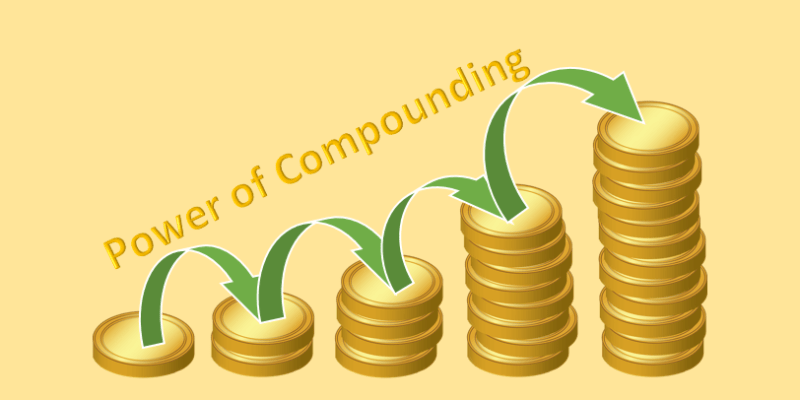
Can investing just $10 a day really build wealth? Yes—over a sufficiently long period, consistently investing $10 a day and reinvesting the returns can potentially grow into hundreds of thousands of dollars. At a hypothetical 7% average annual return, investing the equivalent of $10 every day could grow to approximately $371,000 after 30 years and nearly $800,000 after 40 years.
The key isn’t the $10 alone.
It is:
Small contributions + Consistency + Investment returns + Reinvestment + Time = Compound wealth
The U.S. Securities and Exchange Commission’s Investor.gov describes the principle simply:
“regular investments + time → wealth.”
Compound growth occurs because you potentially earn returns not only on the money you originally invest, but also on previous returns that remain invested. Investor.gov compares the effect to a snowball accumulating more snow as it rolls.
This doesn’t guarantee that $10 a day will make anyone wealthy. Investment returns fluctuate, fees and taxes matter, and losses are possible. But the mathematics demonstrates why starting small can still be powerful.
What Could $10 a Day Become?
Ten dollars per day equals approximately:
- $70 per week
- $304 per month
- $3,650 per year
Here’s what investing approximately $3,650 annually could theoretically produce under different return assumptions:
| Time | 5% Return | 7% Return | 10% Return |
|---|---|---|---|
| 10 years | $47,232 | $52,647 | $62,307 |
| 20 years | $125,023 | $158,449 | $230,975 |
| 30 years | $253,145 | $371,075 | $687,565 |
| 40 years | $464,164 | $798,381 | $1,923,574 |
These figures assume the equivalent of $10 per day is invested monthly, with returns compounded monthly. They are mathematical illustrations—not predictions—and exclude taxes, fees and inflation.
Investor.gov notes that some experts use 7%–10% as a historical long-term estimate for diversified U.S. stock investments, but actual investing has no fixed rate of return.
What Exactly Is Compound Growth?
Suppose you invest $1,000 and earn 10%. After one year:
$1,000 + $100 = $1,100
If you leave everything invested and earn another 10%, your next return isn’t $100.
It’s:
10% of $1,100 = $110
You now have:
$1,210
The extra $10 represents a return generated by your previous return. Continue that process for decades and the difference can become enormous.
Investor.gov provides a simple example: saving $1 every day gives you $365 after one year. If that $365 earned 5% annually, it could theoretically become $465.84 after five years and $1,577.50 after 30 years, even without additional contributions.
Now imagine continuously adding new money throughout those 30 years. That’s where compounding becomes much more powerful.
Why $10 a Day Can Matter
People sometimes postpone investing because they think they need $10,000 or $100,000 before starting. Compounding rewards a different resource:
Time.
Consider two hypothetical investors.
Investor A
Invests $10 daily from age 25 to 65.
At a hypothetical 7% return, the portfolio could approach $800,000.
Investor B
Waits until age 45.
Investing the same amount for only 20 years produces approximately $158,000 under the same assumptions. The difference isn’t primarily because Investor A found a brilliant investment.
Investor A gave the money an additional 20 years to compound. That is why starting earlier can sometimes be more important than starting bigger.
Step 1: Find Your $10
You don’t necessarily need to literally put a $10 note into an investment account every morning. The objective is to create the equivalent contribution. Look for money being spent on:
- Unused subscriptions.
- Frequent takeaways.
- Impulse purchases.
- Unnecessary banking fees.
- Premium services you rarely use.
- Convenience purchases.
- Expensive upgrades.
This doesn’t mean eliminating everything enjoyable.
Instead ask:
“Could I redirect $10 of today’s consumption toward tomorrow’s financial independence?”
If $10 isn’t affordable, start with $2.
If $10 becomes easy, increase it to $15 or $20.
Consistency matters more than an impressive starting amount.
Step 2: Automate the Investment
One of the simplest ways to remain consistent is to remove the daily decision. Instead of asking every evening:
“Should I invest $10 today?”
automate roughly:
$70 weekly
or:
$304 monthly
Investor.gov specifically recommends automatically depositing money into savings and investing regularly over time. It suggests investing a fixed amount or percentage that you can afford and increasing contributions as income rises or expenses fall.
Read Also: 9 Low-Risk Ways to Generate Compound Wealth
FINRA similarly says automatic contributions can reduce the pressure of deciding when to buy and support dollar-cost averaging.
Automation converts:
good intentions
into:
financial infrastructure.
Step 3: Invest Rather Than Merely Save Long-Term Money
Saving and investing serve different purposes. Cash can be appropriate for emergency reserves and short-term needs. Long-term wealth may require assets capable of growing faster over extended periods, although that introduces greater risk.
FINRA reports that historically, stocks have generated average annual returns of just over 10% over the long term, compared with roughly 6% for corporate bonds, 5.5% for Treasury bonds and 3.5% for cash equivalents such as short-term Treasury bills. Higher historical returns came with greater risk.
Therefore, don’t interpret the earlier 10% illustration as a promise. Markets don’t deliver identical returns every year. A diversified portfolio could rise 20% one year and decline significantly the next.
Your investment strategy should reflect your time horizon, goals and ability to tolerate losses.
Step 4: Diversify Your Investments
Compounding doesn’t protect you from choosing a terrible investment. Putting $10 every day into one speculative company isn’t the same as pursuing a diversified long-term strategy.
FINRA summarizes diversification with the familiar phrase:
“Don’t put all your eggs in one basket.”
Diversification means spreading investments across multiple securities and potentially multiple asset classes. Depending on circumstances, that might include combinations of:
Stocks + Bonds + Cash equivalents + International investments
Broad mutual funds and exchange-traded funds can make diversification easier because one fund may contain many underlying investments. Diversification doesn’t eliminate losses, but it can reduce concentration risk.
Step 5: Keep Investment Fees Low
Compounding has an enemy:
fees that compound against you.
A 1% annual fee can look insignificant. Over decades, it can become substantial.
The SEC provides an illuminating example involving a hypothetical $100,000 investment growing 4% annually for 20 years.
With a 0.25% annual fee, the portfolio would end at approximately $208,000.
With a 1% annual fee, it would finish around $179,000.
That’s approximately a $29,000 difference.
Why?
Fees remove money that could otherwise remain invested and potentially generate future returns. Always examine expense ratios, trading costs, advisory fees and account charges.
Step 6: Increase the $10 as Your Income Grows
Ten dollars should be the starting point, not necessarily the finish line.
Imagine this progression:
| Stage | Daily Equivalent | Annual Contribution |
|---|---|---|
| Beginner | $5 | $1,825 |
| Starting investor | $10 | $3,650 |
| Income increases | $20 | $7,300 |
| Established career | $30 | $10,950 |
| Higher savings capacity | $50 | $18,250 |
When you receive a salary increase, promotion or business-income boost, increase your investment before lifestyle spending absorbs everything.
Investor.gov specifically suggests increasing investment contributions when your income increases or your expenses decline.
This creates a powerful combination:
Compounding investment returns + Compounding contributions
The Three Enemies of Compound Wealth
Compounding works best when you avoid repeatedly interrupting it. Watch particularly for:
1. High-Interest Debt
Paying extremely high interest while trying to generate uncertain investment returns can work against your financial progress.
2. Constant Withdrawals
Money removed today loses decades of potential future compounding.
3. Chasing “Guaranteed” High Returns
Investor.gov identifies promises of high investment returns with little or no risk as a warning sign of potential investment fraud. Building wealth slowly may sound less exciting than doubling your money overnight.
It is also much more grounded in financial reality.
Bottomline
The power of compounding isn’t that $10 is a huge amount of money. It’s that the same $10 can become part of a growing financial engine when invested consistently for decades.
At a hypothetical 7% annual return:
- 10 years → approximately $52,647
- 20 years → approximately $158,449
- 30 years → approximately $371,075
- 40 years → approximately $798,381
Yet your direct contributions over 40 years would total only about $146,000. The remainder of the hypothetical balance comes from investment growth and compounding.
Actual returns will differ, potentially substantially. But the principle remains.
Investor.gov’s formula captures it well:
“regular investments + time → wealth.”
So don’t wait until you feel wealthy enough to start building wealth.
Start small. Automate it. Diversify. Minimize unnecessary fees. Reinvest your returns. Increase contributions as your income grows. And give compounding the one ingredient nobody can manufacture later: time.
FAQ
Can $10 a day make you a millionaire?
Potentially, given enough time and sufficiently high returns—but it isn’t guaranteed. Under the assumptions used here, $10 a day compounded at 10% theoretically exceeds $1 million before 40 years. At 7%, the 40-year figure is approximately $798,000.
Is 10% annual growth guaranteed?
Absolutely not. Investor.gov says investing has no set rate of return. Historical averages can be useful for illustrations but cannot predict future performance.
Should I invest $10 every day?
You could, but daily transactions aren’t necessary. Investing approximately $70 weekly or $304 monthly can represent roughly the same savings target.
What if I can only afford $5?
Start there. Building the habit matters. When your income increases, consider increasing your contribution.
Source: hswa.money









Comments