
 By
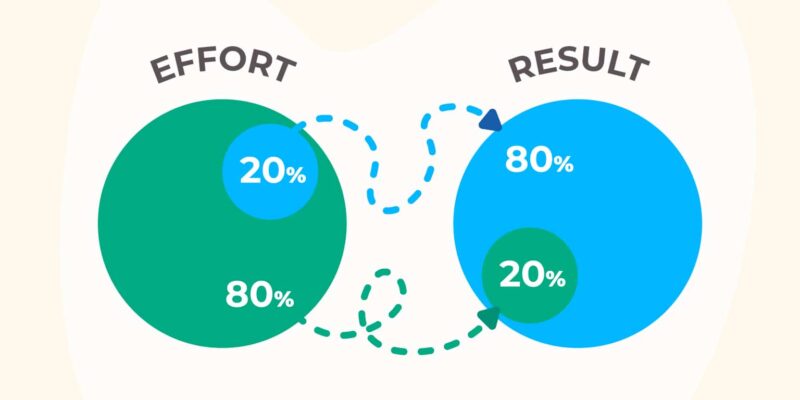
What is the 80/20 rule of income, and how can you use it to earn more? The 80/20 rule suggests that a relatively small proportion of your activities may generate a disproportionately large share of your results. To apply it to income, identify the clients, products, skills and tasks producing the greatest financial returns, spend more time on them, and reduce, automate or delegate lower-value work.
The principle does not mean exactly 20% of your work will always generate precisely 80% of your income. The Pareto Principle is a rule of thumb about unequal relationships between inputs and outputs.
The American Psychological Association defines the broader Pareto principle as:
“80% of any given output is produced by 20% of input.”
It traces the concept to Italian economist and sociologist Vilfredo Pareto. For entrepreneurs, freelancers and employees, the lesson is powerful:
Being busy and creating economic value are not the same thing.
The 80/20 Rule of Income at a Glance
| Low-Yield Activities | Potential High-Yield Activities |
|---|---|
| Constantly checking email | Closing sales |
| Unnecessary meetings | Serving profitable clients |
| Repetitive administration | Creating valuable products |
| Excessive social-media browsing | Lead generation |
| Perfecting minor details | Improving conversion rates |
| Manual data entry | Business development |
| Low-value clients | High-value client relationships |
| Tasks software can automate | Strategy and creative work |
The objective isn’t to eliminate every small task. It is to prevent low-value activities from consuming the time needed for high-value work.
What Is the 80/20 Rule?
The 80/20 rule, also called the Pareto Principle, describes situations where a relatively small number of inputs account for a large proportion of results. It is associated with Vilfredo Pareto, who studied distributions of wealth and income. The idea was later generalized into the observation that outputs are often distributed unevenly.
In business, you might discover:
- A minority of customers generate most profits.
- A few products generate most sales.
- Several articles generate most website traffic.
- A handful of clients generate most freelance income.
- A small group of activities generates most new customers.
The percentages don’t need to equal exactly 80 and 20. You might discover:
70% of profit comes from 30% of customers
or:
90% of leads come from 10% of marketing activities.
The important insight is concentration.
Why the 80/20 Rule Matters for Income
Most people have limited working hours. The financial question therefore becomes:
What is the highest-value use of the next hour?
Modern workplace research suggests a surprisingly large portion of time can disappear into activities surrounding work rather than the skilled work itself.
Asana’s 2023 Anatomy of Work Global Index surveyed 9,615 knowledge workers across six countries and reported that 58% of the workday was spent on “work about work”—coordination rather than skilled or strategic work. Respondents estimated better processes could save approximately 4.9 hours per week.
Microsoft similarly found that the average employee in its 2023 Work Trend Index spent 57% of Microsoft 365 time communicating through meetings, email and chat, compared with 43% creating. Meanwhile, 68% said they lacked enough uninterrupted focus time.
This doesn’t mean communication is useless. It demonstrates why protecting high-value time matters.
Step 1: Identify Your Highest-Yield Activities
Start by measuring where your money actually comes from. Suppose a freelancer has five services:
| Service | Monthly Revenue | Hours Required | Revenue per Hour |
|---|---|---|---|
| Blog writing | $1,000 | 40 | $25 |
| SEO audits | $2,000 | 20 | $100 |
| Consulting | $1,500 | 10 | $150 |
| Social media | $600 | 30 | $20 |
| Admin support | $400 | 20 | $20 |
Total monthly revenue:
$5,500
At first glance, blog writing looks important because it generates $1,000.
But consulting produces:
$150 per hour
while social-media work produces:
$20 per hour.
The freelancer now has useful information.
Instead of simply asking:
“How can I work more?”
the better question becomes:
“How can I create more $150 hours and fewer $20 hours?”
That is 80/20 thinking.
Step 2: Find Your Most Profitable Customers
Revenue alone can be misleading. A customer paying $5,000 who requires endless revisions, meetings and support might be less profitable than a $3,000 customer requiring little administration.
Analyze customers according to:
Revenue – Direct Costs – Time Required = Economic Value
Look for clients who:
- Pay reliably.
- Purchase repeatedly.
- Require reasonable support.
- Refer other customers.
- Buy high-margin services.
- Are enjoyable and efficient to serve.
Then ask:
Where can I find more customers like these?
Instead of chasing every possible customer, build your marketing around your best customer profile.
Step 3: Protect Revenue-Producing Hours
Your most productive hours shouldn’t disappear into email. If you’re a consultant, your highest-yield activities might be:
Client acquisition + Consulting + Creating intellectual property
Schedule these first.
For example:
- 9:00–11:00 → Deep work
- 11:00–12:00 → Sales/outreach
- 12:00–1:00 → Meetings
- 2:00–3:00 → Administration
- 3:00–4:00 → Email
The exact schedule isn’t important. The principle is:
High-value work gets protected time rather than whatever time remains. Microsoft’s research reinforces why this matters: 68% of respondents said they lacked sufficient uninterrupted focus time.
Step 4: Apply 80/20 to Your Products
Suppose an online business sells ten digital products. After reviewing the numbers, the owner discovers two products generate 70% of profit. Instead of immediately creating product number eleven, the owner could improve those two winners.
Read Also: Automating Your Income: Tools That Run Businesses For You
Possible actions include:
- Improve the landing pages.
- Create premium versions.
- Increase relevant traffic.
- Test pricing.
- Add upsells.
- Build bundles.
- Improve email marketing.
- Create complementary products.
This is a critical entrepreneurial lesson:
You don’t always need more products. Sometimes you need more leverage from the products already working.
Step 5: Automate Low-Yield Work
Some tasks are necessary but don’t require your personal attention. Examples include:
- Appointment reminders.
- Invoice generation.
- Data entry.
- Routine reports.
- File organization.
- Standard customer emails.
- Lead routing.
- Social scheduling.
Automation can protect time for activities requiring human judgment.
Microsoft reported in 2024 that users were spending 60% of their Microsoft 365 time in emails, chats and meetings and 40% in creation applications. It also reported that 68% of surveyed workers struggled with the pace and volume of work.
As Wharton neuroscientist Michael Platt explained in Microsoft’s report:
“When we’re constantly switching, we don’t work as well.”
The objective isn’t automation for its own sake. It is to buy back valuable attention.
Step 6: Delegate the Necessary but Low-Value Tasks
Not everything can be automated. Some tasks should be delegated. Suppose your expertise earns $100 per productive hour. You spend five hours weekly on administrative work that someone qualified could perform for $20 per hour.
The theoretical opportunity cost of doing it yourself is significant.
Five hours of administrative work:
5 × $20 = $100 outsourcing cost
Five hours of your potential revenue-producing work:
5 × $100 = $500
If those five recovered hours reliably generate $500, paying $100 for assistance could make economic sense. Of course, additional factors such as quality, training, confidentiality and workload matter.
Delegation is valuable only when the recovered time is used productively.
Step 7: Use a Weekly 80/20 Audit
At the end of every week, ask:
- Which activities created revenue?
- Which activities created qualified leads?
- Which customers generated the best margins?
- Which activities consumed time without meaningful results?
Then classify tasks:
| Category | Action |
|---|---|
| High value + High return | Do more |
| High value + Time intensive | Improve |
| Low value + Necessary | Automate/delegate |
| Low value + Unnecessary | Eliminate |
This simple exercise can prevent months of unproductive busyness.
The 80/20 Rule for Different Income Models
Freelancers
Identify the clients and services producing the highest effective hourly rate.
Content Creators
Find the content generating the most traffic, subscribers and revenue, then create related content.
Affiliate Marketers
Identify the pages, keywords and products generating most commissions.
E-commerce Businesses
Identify the products and customer segments producing the strongest margins and repeat purchases.
Employees
Identify activities most strongly connected to important objectives, measurable results and valuable expertise.
Consultants
Spend more time solving high-value client problems and less time performing repetitive administration.
The implementation differs. The question remains:
What creates disproportionate value?
Don’t Misuse the 80/20 Rule
The Pareto Principle is not a mathematical law guaranteeing that 20% of every activity produces exactly 80% of every result. The APA describes it as a general rule of thumb about disproportionate inputs and outputs.
Don’t eliminate activities simply because they don’t directly produce income. Accounting may not generate sales, but you still need accurate accounts.
Customer support may not immediately produce revenue, but poor service can destroy retention.
Cybersecurity may appear unproductive—until a security incident occurs. The better distinction is:
Necessary work vs unnecessary work
and:
High-leverage work vs work that can be performed more efficiently.
Final Thoughts
The 80/20 rule of income isn’t about working only 20% of the time. It is about understanding that your working hours don’t necessarily have equal economic value.
Modern workplace data shows why that distinction matters. Asana reported that knowledge workers spent 58% of their day on “work about work,” while Microsoft’s research found 68% of workers lacked sufficient uninterrupted focus time.
The solution is not simply:
Work harder.
It is:
Measure → Identify → Prioritize → Automate → Delegate → Eliminate → Repeat
- Find the customers producing your best profits.
- Find the services producing your highest return on time.
- Find the marketing channels producing qualified customers.
- Find the products people repeatedly buy.
- Then protect the time required to grow those activities.
The most valuable question you can ask at the beginning of a working day may therefore be:
“If I could complete only one task today, which one would create the greatest meaningful result?”
Do that work first.
Because the real power of the 80/20 rule isn’t doing less for the sake of doing less.
It is spending more of your limited time on the work that actually moves your income, business and career forward.
FAQ
What is the 80/20 rule for making money?
It means identifying the relatively small number of activities, customers, products or investments responsible for a disproportionately large share of your financial results and concentrating resources accordingly.
Does the 80/20 rule actually work?
It can be a useful analytical framework, but 80/20 isn’t a guaranteed ratio. Your real distribution might be 70/30, 90/10 or something entirely different.
What are high-yield tasks?
High-yield tasks are activities with disproportionate impact on important outcomes. Depending on your work, these could include sales, negotiations, serving profitable clients, developing valuable products, improving conversions or building strategic partnerships.
How often should I conduct an 80/20 analysis?
A simple weekly review works well for tasks, while deeper monthly or quarterly reviews can examine customers, products, marketing channels and profitability.
Source: salesforce.com










Comments