
 By
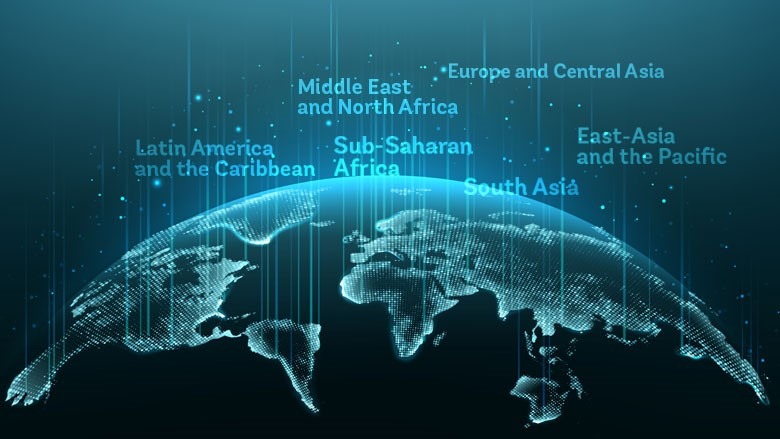
AI growth differs across regions: Africa shows tremendous growth potential driven by cloud usage and a developing startup culture in countries like South Africa, Nigeria, and Kenya, despite a low current market share. With significant gains anticipated for ASEAN countries and robust growth in some economies, such as China and South Korea, as well as ongoing Middle Eastern investment, Asia is a prominent factor. Europe has a more complex situation with strong capabilities in areas like AI equipment manufacturing and services but major reliance on US-dominated cloud infrastructure and semiconductor design, however its overall AI industry is huge and reforms could improve productivity benefits.
Africa
- High growth potential: The region is positioned for rapid growth, with cloud adoption rising fastest globally and the AI market potentially quadrupling by 2030.
- Key markets: South Africa, Nigeria, and Kenya are leading the charge, with significant numbers of AI startups and growing VC investment.
- Challenges: Africa currently holds a tiny fraction of the global AI market and investment, and faces challenges related to underdeveloped data center capacity and internet penetration.
- Government and initiatives: Continental strategies and local initiatives are focused on increasing investment, developing talent, and addressing data scarcity for African languages.
Asia
- Major market: The Asia-Pacific region is a significant global market for AI and is expected to contribute substantially to global AI market growth.
- Economic potential: Some projections forecast that ASEAN economies could gain nearly $1 trillion in additional GDP over the next decade due to AI.
- Middle East focus: Countries like Saudi Arabia and the UAE are pushing ambitious national AI strategies, investing heavily in research, infrastructure, and smart city projects.
- Challenges: Despite strong growth, the region also faces challenges related to inequality in AI adoption and the potential for job displacement.
Europe
- Mixed landscape: Europe shows strength in specific AI value chain segments, such as AI semiconductor equipment, and has a growing AI services and applications market.
- Areas of weakness: The region has low market shares in AI semiconductor design and manufacturing, and its cloud infrastructure market is heavily dominated by US companies.
- Potential for growth: While base-case productivity gains may seem modest, the IMF notes that pro-growth reforms could lead to much larger gains for Europe in the long run.
- Strategic efforts: European countries are focused on developing their own foundation models and are seeking to increase their overall position through targeted support and regulatory frameworks.
Africa’s AI environment in 2024 and 2025 is increasingly defined by a few of front-runner nations that are driving the pace in innovation, policy, and investment. Egypt leads the continent with its comprehensive AI Strategy 2025 2030, which stresses governance, infrastructure, skills development, and sectoral adoption, aiming to make AI a core contributor to national GDP. Following closely behind, South Africa is home to over 726 AI-focused businesses that are bolstered by robust infrastructure, international collaborations, and ongoing talent development initiatives.
Meanwhile, Kenya has emerged as East Africa’s digital powerhouse, receiving $1.05 billion in AI-related investments in 2024, backed by a robust startup ecosystem and growing adoption of AI solutions across fintech, agriculture, and public services. With over 456 AI companies, Nigeria has a sizable domestic market and a vibrant entrepreneurial culture supported by organizations like the National Center for Artificial Intelligence and Robotics (NCAIR). High readiness scores are displayed by smaller but more nimble countries like Rwanda and Mauritius, who leverage digital infrastructure, data-driven government, and targeted policy frameworks to draw talent and investment.
Beyond these heavyweights, several emerging competitors are making major progress in the AI race. Tunisia, Morocco, and Senegal are improving rapidly because to progressive AI policies, increasing investment in local talent, and strengthened regulatory frameworks. Tunisia, for example, has invested extensively in AI training and incubators, presenting itself as a regional powerhouse for innovation in North Africa.
Morocco’s AI activities focus on integrating digital technologies into public administration and commercial sector applications, while Senegal is supporting startup growth and digital adoption through public-private collaborations. Collectively, these rising stars illustrate that Africa’s AI advancement is not limited to a few countries but is expanding across regions, creating a more diversified and competitive ecosystem.
Read Also: AI Investment Trends: Where VCs Are Betting Big
The mix of national strategies, investment influx, and adoption momentum defines the current hierarchy of African AI leadership. Countries like Egypt, South Africa, Kenya, and Nigeria dominate in scale and readiness, while Mauritius and Rwanda excel in governance and strategic execution. In the meantime, developing countries are using focused policies to advance quickly.
This dynamic picture highlights that Africa’s AI boom is both concentrated and expansive: concentrated in the top-performing countries driving innovation and investment, yet expansive in its potential for emerging economies to join the race. The region is positioned to play a major role in the global AI arena as infrastructure advances, skill development quickens, and investment flows increase.
What’s Fueling or Holding Back the AI Growth in Africa
The rapid rise of AI across Africa is driven by a mix of enabling factors that provide fertile ground for innovation and acceptance. The most important of them is the growth of digital infrastructure, which makes it easier to implement AI applications across industries. This includes data centers, high-speed fiber networks, and coming 5G coverage in urban areas. Another important factor is skill development, with nations like Egypt, South Africa, and Kenya setting up AI training programs in academic institutions, tech centers, and through collaborations with multinational tech companies.
Regulatory frameworks are also expanding, as countries increasingly understand the need for clear AI governance, ethical norms, and data protection rules to enhance investor and public confidence. Despite these advances, Africa currently holds only ~3 % of global AI talent, highlighting both the opportunity and the challenge in scaling expertise across the continent.
Despite these positive motivations, considerable impediments remain to hinder AI advancement in Africa. Internet penetration remains restricted, with only ~37 % of Africans online in 2023, constraining access to AI tools and digital platforms. Funding gaps compound the challenge, as venture capital and state investment are largely concentrated in a few leading nations, leaving emerging economies with insufficient resources to build AI firms or grow current programs.
Many nations lack comprehensive AI legislation, data governance frameworks, or ethical norms, which might impede both domestic innovation and international cooperation. Regulatory differences can provide difficulties. These obstacles collectively slow the dissemination of AI technology, particularly in rural or underserved regions, and underscore the necessity for coordinated continental policies.
Several African governments and regional agencies are actively addressing these impediments through strategic initiatives and policy frameworks. The African Union’s Continental AI Strategy, established in 2024, aspires to streamline AI governance, develop regulatory frameworks, and facilitate cross-border knowledge transfer to boost AI use continent-wide. Countries like Rwanda and Mauritius are leading by example, combining investments in digital infrastructure with targeted AI skills programs and regulatory experimentation to attract entrepreneurs and foreign investors. Similarly, Kenya and South Africa are employing public-private partnerships to extend internet access, develop AI labs, and boost talent pipelines.
These programs show a growing understanding that overcoming funding, infrastructure, and regulatory obstacles is crucial for preserving competitiveness as well as for guaranteeing that Africa’s AI revolution is inclusive, sustainable, and able to produce revolutionary social and economic benefits.
Future Outlook
Africa’s AI business is primed for spectacular expansion over the next decade, with forecasts predicting that capturing only 10 % of the global AI market could add up to $1.5 trillion to the continent’s GDP by 2030. Growing digital infrastructure, increased internet usage, and growing AI adoption in important industries including public services, healthcare, agriculture, and finance all support this development potential. Countries with established ecosystems, Egypt, South Africa, Kenya, and Nigeria, are particularly well-positioned to lead, utilizing their existing startup base, talented personnel pools, and supporting regulatory frameworks to capture a major share of this economic value.
Looking ahead, the AI ecosystem in Africa is likely to experience dynamic transformations, with fresh entrants and smaller governments gaining traction through niche specialization, language and data localization, and innovative regulatory approaches. For instance, countries like Tunisia, Morocco, and Rwanda are investing in localized AI solutions that meet language variety and sector-specific needs, from finance to public health.
Ethical AI deployment and solid regulatory frameworks will progressively differentiate successful AI centers, assuring responsible innovation while limiting risks such as bias, data misuse, and cybersecurity concerns. These strategic measures could rebalance the competitive landscape, allowing rising businesses to fight alongside established frontrunners.











Comments