
 By

By 2030, the artificial intelligence (AI) business is expected to grow to a size of between $1.81 trillion and $1.89 trillion worldwide, with some projections indicating a total economic impact of up to $15.7 trillion.
Forecasts for the Market through 2030
The AI market is projected to be significantly different but continuously high by many research firms:
- Grand View Research projects the market will reach approximately $1.81 trillion (or $1,811.75 billion) by 2030, growing at a Compound Annual Growth Rate (CAGR) of 36.6% from 2024 to 2030.
- Facts & Factors estimates the market size will hit $1.812 trillion by the end of 2030, with a CAGR of nearly 38% between 2023 and 2030.
- Resourcera projects the market will reach around $1.89 trillion by 2030.
- Statista forecasts a market volume of approximately $826.7 billion by 2030, with a CAGR of 27.67% from 2025 to 2030.
Key Growth Drivers and Trends
The significant growth of the AI market is driven by several factors:
- Increased adoption: AI is being rapidly adopted across a wide range of industries, including healthcare, banking, finance and insurance (BFSI), automotive, retail, and manufacturing.
- Technological advancements: Continuous innovation in deep learning, machine learning algorithms, and natural language processing is accelerating growth.
- Investment and initiatives: Both private sector investments and government initiatives (such as in the US, China, and Europe) are fueling R&D and implementation of AI technologies.
- Efficiency and automation: Businesses are leveraging AI to automate tasks, improve operational efficiency, and enhance the customer experience.
Major Segments and Regional Growth
- Segments: Software solutions are expected to maintain a dominant share of the market, while the services segment is anticipated to exhibit the highest CAGR. The healthcare and the media/advertising segments are expected to be major areas of growth and dominance.
- Regions: North America holds the largest market share, but the Asia-Pacific region is projected to register the fastest growth rate in the forecast period.
Artificial intelligence (AI) is quickly emerging as the key technological advancement of our day. According to a recent UN Trade and Development (UNCTAD) report, the worldwide AI market is expected to grow by 25 times in just ten years, from $189 billion in 2023 to $4.8 trillion by 2033.
By then, AI might increase from 7% to 29% of the worldwide frontier technology market, quadrupling its share and becoming the industry leader.
However, the quick development of AI could worsen global gaps. Large and developed economies benefit from a deeper talent pool of individuals with the necessary abilities, and development is highly concentrated.
Just 100 businesses, mostly in the US and China, were responsible for 40% of all AI research and development (R&D) worldwide in 2022. Together, the two nations generate one-third of the world’s AI papers and possess 60% of all AI patents.
AI in the workplace: worldwide effects on employment
AI is already changing a number of industries, including automated coding, customer support, product design, and content production.
Up to one-third of occupations in developed nations may be at risk of automation, which may impact 40% of jobs globally. However, those same economies stand to gain more: AI has the potential to improve 27% of their tasks, increasing productivity and enhancing human abilities.
Developing nations must reconsider industrial policy and refocus on technology, innovation, and knowledge-intensive services in order to compete in an AI-driven future.
When it comes to establishing national AI strategy, they must catch up. In contrast to just 30% of developing nations (not including the least developed), two thirds of industrialized economies have one by 2023. Just 12% of the least developed nations had a plan in place.
According to the report, national strategies should focus on AI’s three key leverage points: infrastructure, data and skills. Priorities include:
- Upgrading infrastructure to ensure equitable access to electricity, the internet and computing power.
- Promoting open data and sharing to improve storage, access and collaboration.
- Building AI literacy across the population by integrating STEM and AI into education from early schooling to lifelong learning.
Deciding AI’s future: Global cooperation is essential
AI is borderless, but its governance is fragmented and dominated by a few wealthy nations. Only the G7 countries are involved in all major AI governance initiatives, while 118 countries – mostly developing – are not involved in any.
This lack of representation is alarming. While national regulation is important, inclusive global collaboration is essential to ensure AI serves the public good.
Read Also: The Silent Partner: How Artificial Intelligence Drives Instagram Growth
Today’s AI landscape is shaped by multinational tech giants. Apple, Nvidia and Microsoft each have a market value of around $3 trillion – rivaling the GDP of the entire African continent.
Core AI Market Growth Driver
- Enterprise AI Adoption
The short answer to the question of where the majority of the fuel for the size of the AI market comes from is straightforward: businesses. While leaders may disagree on whether to intervene, very few people are still debating whether or not AI is necessary. Waiting suddenly appears to be the greater risk when a store is increasing sales with customization engines or a peer bank reports huge drops in fraud losses.
Industry Vertical Analysis
Enterprise adoption doesn’t look the same everywhere. But the throughline is impact that ties back to the bottom line:
- Healthcare: The global AI in medical imaging market was about $1.36 billion in 2024 and could reach $19.78 billion by 2033, growing at a 34.67% CAGR. Hospitals are already piloting AI-powered image processing tools combining computer vision with other technological innovations to improve accuracy. Early detection not only saves lives but also reduces costly late interventions.
- Finance: Machine learning has proven most effective in fraud detection. HSBC cut false positives by 60% after deploying AI algorithms, while other banks report 30–50% improvements in fraud identification and loss reduction. In an industry where customer experience is everything, fewer false alarms mean both savings and trust.
- Retail: McKinsey estimates that moving personalization performance to the top quartile could unlock $1 trillion in additional value across US industries. Retailers using AI-driven recommendation engines are already seeing double-digit lifts in return on ad spend and retention, which translates directly into millions in annual revenue.
- Manufacturing: Predictive maintenance has shifted from experiment to clear use cases for process automation on the factory floor. MarketsandMarkets also projects the global predictive maintenance market to hit $47.8 billion by 2029 at a 35.1% CAGR. For a mid-sized manufacturer, even a modest 5–10% downtime reduction could mean six-figure annual savings per plant.
Not every rollout is smooth. Healthcare AI projects often stall on data quality, and personalization in retail can backfire if tuned poorly. But the companies that win aren’t the ones who avoid setbacks. They’re the ones who refine, retest, and double down where the ROI is strongest.
Implementation Priorities
Once leaders agree AI isn’t optional, the next question is: where do we start? In practice, the smartest entry points are projects that deliver visible returns with manageable risk:
- Workflow Automation: Expense approvals, invoice matching, and compliance reporting are repetitive, low-value tasks that are perfect for AI-driven automation. Enterprises report cutting approval cycle times by 30–50%, freeing up thousands of staff hours annually. That’s the capacity you can redirect to higher-value work.
- Natural Language Processing (NLP): Chatbots have evolved beyond FAQs. Trained on full workflows, they can reset passwords, file claims, and even process cancellations. One telecom company reported its AI assistant resolved more than half of inquiries without human escalation, cutting live-agent load by 70%. For support teams, that means fewer midnight calls and less burnout.
- Predictive Analytics: Retailers are using predictive models to anticipate demand swings and adjust inventory ahead of time. Churn prediction works the same way: AI can flag which customers are at risk so retention offers hit at the right moment. Studies show proactive retention can boost customer loyalty by 10–20% while cutting excess inventory costs. In plain terms, you sell more of what you stock and lose fewer customers along the way.
- AI Agents: In procurement, they can vet suppliers, negotiate terms, and draft contracts far faster than human teams alone. In sales, they act as virtual assistants that qualify leads, schedule demos, and send follow-ups automatically. For many companies, this has shortened sales cycles from months to weeks, accelerating both cash flow and revenue recognition.
Some executives worry these early pilots won’t scale fast enough. But pilots aren’t about transforming the whole company overnight. They’re about building momentum. Trim approval times in half or cut customer support queues in minutes, and suddenly you’ve got the proof (and political capital) to pitch bigger initiatives.
ROI & Success Metrics
At the end of the day, AI adoption only sticks when it delivers numbers you and your leadership team care about. It’s not enough to say a project “worked.” You need to connect it to hard KPIs, like savings, revenue lift, or customer retention.
- Personalization ROI: McKinsey estimates personalization leaders could unlock $1 trillion in incremental value. For retailers, that plays out as 10–20% lifts in repeat purchases and millions in lifetime customer value.
- Fraud Detection ROI: Banks using AI-powered fraud detection report 30–50% loss reductions. HSBC saw a 60% drop in false positives alone. The payoff is fewer customers locked out of accounts and millions saved in avoided chargebacks.
- Predictive Maintenance ROI: MarketsandMarkets projects predictive maintenance to reach $47.8 billion by 2029, because the economics are proven. Just a 10% downtime cut can save mid-sized manufacturers hundreds of thousands annually per plant. Scale that across multiple sites, and the savings stack fast.
This is the kind of ROI case that turns AI from a “technology experiment” into a budget priority.
- AI Infrastructure Expansion
Infrastructure is the engine if adoption is the fuel. On presentations and strategy speeches, chatbots, copilots, and fraud detection all seem fantastic. However, you need horsepower to make them function throughout an organization: pipelines to deploy them consistently, databases to ground them, and GPUs to train models. Even the most intelligent pilots stall without it.
The infrastructure is (slowly) catching up, which is why the trillion-dollar AI market is occurring. Businesses can shift pilots into production without going over budget or betraying confidence when compute and storage are in place. When AI is integrated into everyday operations and ceases to be a test case, the industry will grow.
So, where are companies actually writing checks? Four areas stand out:
- High-Performance GPUs: NVIDIA’s data center revenue hit $47.5B in 2024, up more than 400% in a year. The demand came from hospitals training imaging models, banks fine-tuning fraud detection, and tech giants scaling generative AI, especially across North America and the Asia Pacific. So, if you’re planning AI development at scale, don’t wait until you need GPUs. Secure access early through cloud credits, partnerships, or advance contracts. Delays of even a few months can set your rollout back.
- Vector Databases: Think of these as the memory banks for AI. They make retrieval-augmented generation (RAG) possible, grounding outputs in your own data instead of letting models “make things up.” That’s why vector database companies like Pinecone, Milvus, and Weaviate are securing significant funding. Practical move? Start small. Index contracts, support docs, or a product catalog. Prove that the model can answer your questions before trying to boil the ocean.
- Cloud-Native AI Platforms: AWS Bedrock, Azure OpenAI, and Google Vertex AI let mid-sized firms rent access to powerful models through APIs. No massive machine learning team required. Logistics companies are already spinning up routing tools in weeks instead of years. If you’re a mid-sized enterprise, this is the easiest on-ramp: prototype, pay for what you use, and only scale if it sticks.
- Edge AI: Latency and privacy make this non-negotiable in some sectors. Retailers are running in-store recommendation engines locally to keep shoppers engaged in real time. Manufacturers are embedding AI cameras on production lines to catch defects before they hit shipping. Hospitals process scans inside their own networks, so sensitive data never leaves the building. If compliance or speed are deal-breakers in your industry, test edge deployments early. You’ll find out quickly whether it saves you from regulatory headaches or downtime losses.
Each of these bets chips away at friction in a different way: faster training, safer outputs, quicker deployment, or tighter compliance. Together, they turn AI from a big promise in meetings into a tool you can actually run day to day.
- Regulatory Evolution
If adoption is the fuel and infrastructure the engine, regulation is the guardrail. It’s not flashy, but it decides how fast (and how safely) you can scale AI. For most leaders, the real debate isn’t “Can we build it?” It’s “Can we roll it out without tripping over compliance or reputational landmines?”
Why Regulation Shapes Growth
Here’s the thing: markets stall without trust. Customers hesitate if they think their data isn’t safe. Investors slow down if compliance risk feels unpredictable. Clear rules give both groups confidence to stay in the game.
But predictability has a price. Compliance reviews, model audits, and data-localization rules eat up budget. Guidance varies, but analysts suggest AI governance can consume 7–20% of total project spend depending on risk level. For a $10M rollout, that’s anywhere from hundreds of thousands to a couple million set aside for oversight before launch.
Regional Approaches
So how heavy does that load feel? Depends where you’re building:
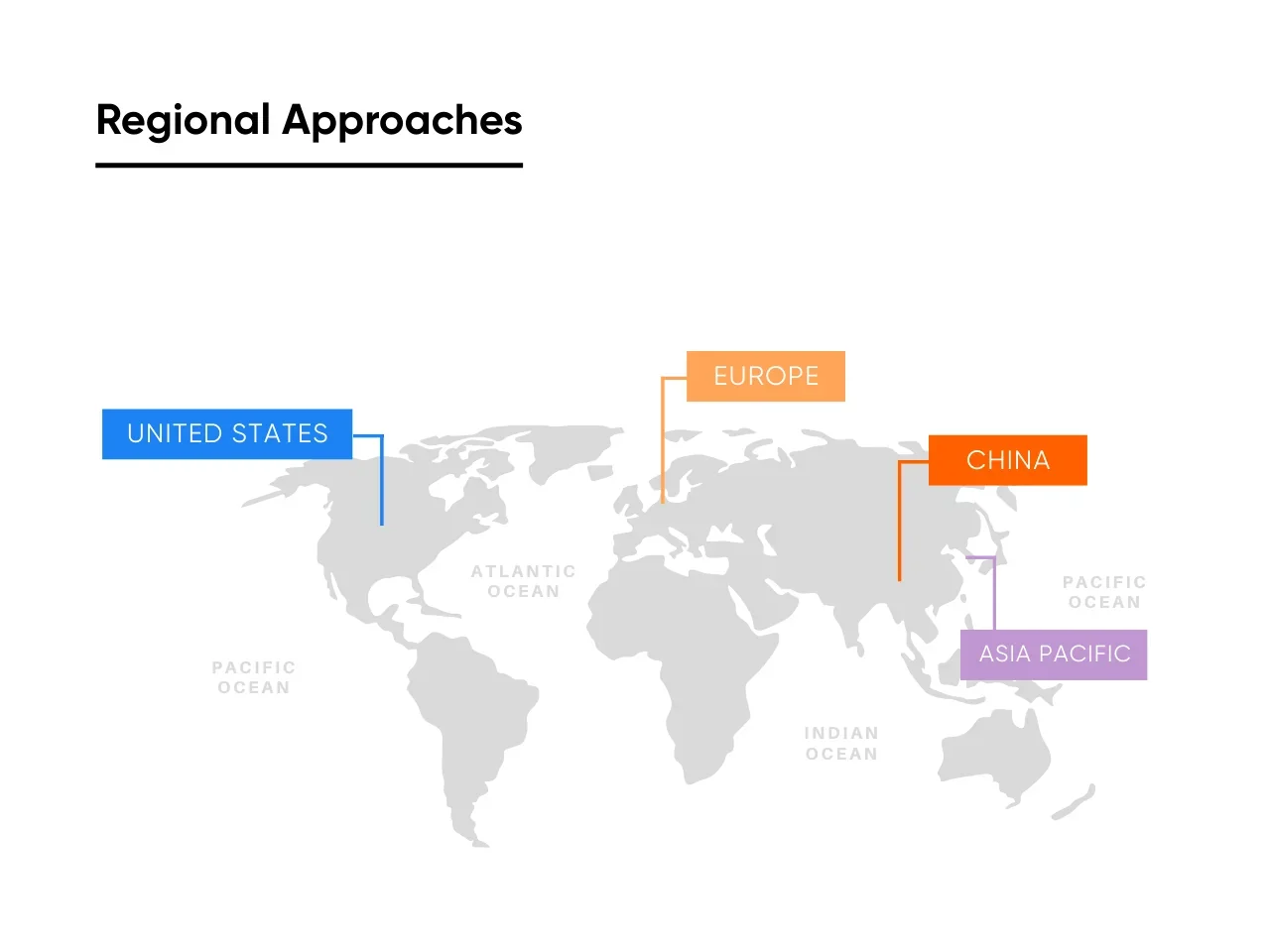
- European Union: The EU AI Act, finalized in 2024, is the most comprehensive framework yet. High-risk systems (biometric ID, credit scoring, medical devices) need formal conformity assessments. If you’re selling into Europe, audits will soon feel as routine as financial ones.
- United States: Lighter touch so far. The 2023 Executive Order set fairness and safety guidelines but left enforcement to agencies. That means faster launches today, but more uncertainty tomorrow. Firms already adding explainability features are basically buying insurance against tighter rules later.
- China: Regulators are strict, especially on generative AI. Providers must pass security checks and align outputs with state guidelines. For multinationals, that often means running parallel tracks: one system for China, another for the rest of the world.
- Asia-Pacific Hubs: South Korea announced nearly $7B in AI investment by 2027 focused on semiconductor competitiveness, especially AI chips, while Singapore and the UAE lean on lighter oversight paired with financial incentives. These regions often provide clearer regulatory signals and, in some cases, subsidies that can offset adoption costs.
Global spend on AI governance and compliance software is projected anywhere from $1.2–1.4B by 2030 on the low end to $15.8B by 2030 on the high end, depending on how broadly you define the category. Either way, it’s a market growing quickly, led by Europe but spreading across the Asia-Pacific. Even if you’re not directly in those regions, expect requirements to creep into vendor contracts.
Conclusion
By 2030, the size of the global AI market is expected to surpass $1 trillion. Infrastructure is catching up, businesses are implementing at scale, and regulations are lowering barriers. The businesses that are truly succeeding are demonstrating ROI in fraud detection, diagnostics, personalization, and predictive maintenance; they will only scale if the backbone and compliance are prepared.
The framing is altered if you want to profit from this significant technological advancement. AI is now discussed as an investment rather than a side project. Every dollar must be linked to increased income, lower expenses, or decreased risk. Your pilot dies in committee if you miss that link. If you succeed, you will have a funded roadmap.











Comments