
 By
Entity Optimization (or Entity-based SEO) aims to increase topical authority and context by mapping relationships between concepts, whereas traditional SEO focuses on specific keywords and page-level rankings. Entity SEO strives to establish your business as a recognized, trustworthy entity, enhancing visibility in AI-driven searches, whereas traditional SEO promotes traffic through keyword matching.
Key Differences:
- Focus: Traditional SEO targets specific phrases, while Entity Optimization covers topics comprehensively to show depth.
- Targeting: SEO seeks to rank a page; Entity Optimization seeks to establish a, entity (person, place, brand) that Google understands.
- Approach: Traditional SEO relies on keyword density; Entity Optimization uses semantic, contextual relationships and structured data (Schema).
- Goal: Entity SEO builds long-term authority and Trust, making it critical for modern AI-driven searches.
Key Aspects of Entity Optimization:
- Structured Data (Schema): Using JSON-LD to explicitly define entities.
- Topic Clusters: Creating content that covers related subtopics, not just one keyword.
- Internal Linking: Establishing connections between related concepts within your site.
- Semantic Search: Ensuring your content answers the “who, what, and why” rather than just repeating a word.
Entity-Based SEO
Entity SEO is a more specific approach to SEO that focuses on entities’ unique, identifiable things like places, brands, products, and concepts rather than solely on keywords. It’s all about helping search engines understand what your content is about exactly, not just the words connected with it.
Since search engines are getting smarter. This approach is more helpful so that the search engine can understand the meaning and context of your content and provide the most relevant results.
Let’s understand this with an example,
In the traditional SEO method, if you are trying to rank your content for the best ice cream. So you will stuff your content with keywords like best ice cream, good ice cream, and top ice cream, and the search engine will only see the collection of words you are trying to rank.
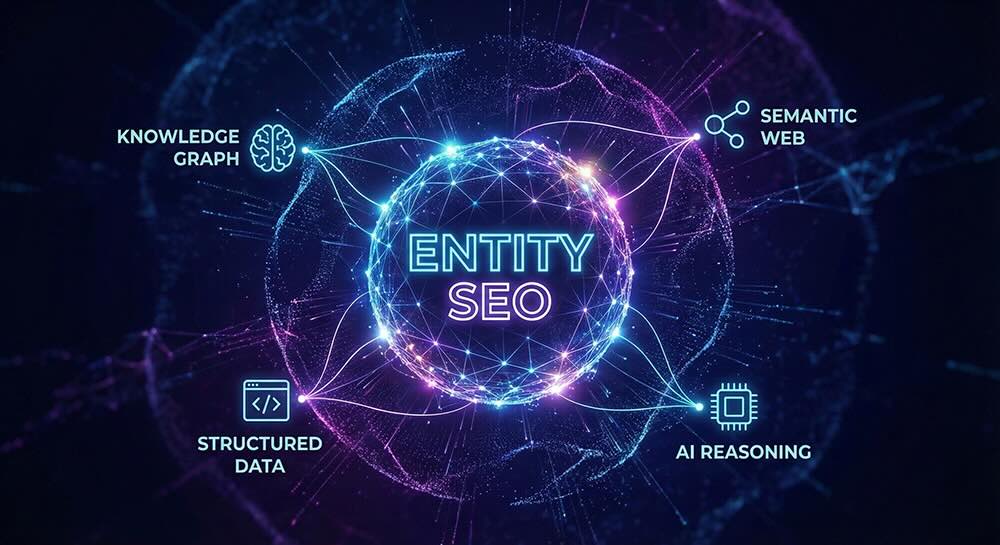
However, with entity-based SEO, search engines don’t just see the phrase “best ice cream” as a string of words. They understand it as a concept or entity. Search engines like Google use knowledge graphs and natural language processing to understand your content and how it connects to a larger web of related ideas. For example, “best ice cream” as an entity can relate to other entities like ice cream brands (e.g., Ben & Jerry’s, Häagen-Dazs), places like New York City ice creams, flavors like vanilla, chocolate chip cookie dough, and related concepts like desserts, frozen treats, and dairy products.
This deeper understanding allows search engines to deliver more relevant and context-rich results, even if the exact keywords aren’t used. Even if your content doesn’t use the best ice cream multiple times. Search engines can determine that your content is relevant if it includes these contextually connected entities.

In the above image, you can see different examples of entities associated with ice cream. The image shows Google’s autocomplete suggestions for the best ice cream. It highlights how Google understands and connects user intent with entities like products, places, and attributes. These aren’t just keyword phrases. They represent real-world entities that help Google deliver more relevant, semantic results.
Key Strengths
- Uses context, not just keywords
- Provide comprehensive and structured information
- Greater visibility in features like Knowledge Panels, Featured Snippets, or People Also Ask
- More sustainable against algorithm updates
The Connection Between EEAT and Entity SEO
Google’s ranking systems rely on both EEAT (Experience, Expertise, Authoritativeness, Trustworthiness) and Entity SEO (how search engines understand real-world people, organizations, and concepts) to assess content quality. These two frameworks work together in the following ways:
1. Experience & Entity Recognition
Google values first-hand experience, particularly for YMYL (Your Money or Your Life) topics. Entity SEO supports this by helping Google identify:
- Who has the experience (e.g., a doctor, a travel blogger, a product tester).
- What real-world entities validate that experience (e.g., medical licenses, published works, brand affiliations).
- Where the experience took place (e.g., a local business, an event, a service area).
The more clearly an entity (like an author or business) is connected to verifiable experience, the stronger the EEAT signals become.
2. Expertise & Entity Associations
Expertise is reinforced when content is tied to knowledgeable entities that Google already recognizes. This relationship works because:
- Google’s Knowledge Graph stores information about experts, institutions, and authoritative sources.
- When an entity (e.g., a university, a certified professional, a well-known brand) is associated with content, it inherits some of that entity’s credibility.
- Without clear entity connections, Google struggles to validate expertise.
For example, an article about law written by a recognized legal scholar (entity) carries more weight than one by an unnamed writer.
3. Authoritativeness & Entity Relationships
Authority in search results depends on how entities relate to each other across the web. This works because:
- Google measures authority by analyzing which entities reference or endorse others (e.g., news sites quoting experts, brands partnering with influencers).
- High-authority entities (like established publishers or institutions) strengthen the credibility of entities they associate with.
- Entity-based SEO helps Google map these connections through citations, backlinks, and co-occurrence in content.
For instance, if Harvard University (entity) links to a research paper, Google views that paper as more authoritative.
4. Trustworthiness & Entity Consistency
Trust is established when entity data is accurate and consistent across the web. This connection exists because:
- Google cross-references entities (like businesses, authors, or organizations) to check for mismatches in names, credentials, or reputations.
- Inconsistent entity signals (e.g., conflicting business listings, unverified author profiles) erode trust.
- Reliable entities (those with uniform, verifiable information) are deemed more trustworthy by search algorithms.
A business with consistent contact details, licenses, and citations (entities) across the web will be seen as more trustworthy than one with conflicting records.
Read Also: Why Entity Optimization Matters for Businesses
Google uses entities (people, brands, concepts) to verify EEAT signals (Experience, Expertise, Authority, Trust), while strong EEAT helps entities rank better. Entities provide content’s foundation (“who/what/why”), while EEAT evaluates their credibility. Together, they help Google assess quality content, meaning optimizing both improves search visibility and trustworthiness.
Traditional SEO
It’s a classic method of search engine optimization using the specific words and phrases that users type when they look for something. Traditional organic SEO relies more on metrics like search volume, keyword difficulty, exact match terms, and keyword density.
For example, if you are optimizing your mobile store to be easily discoverable for relevant searches, you might use keywords like best budget smartphone, top smartphones, and mobile phones repeatedly in the title, meta description, headers, and body content. This approach is more effective for capturing traffic from users searching for exact phrases. However, it can have limitations as users search differently. It misses the broader context or intent behind a search.

In the above image, you can see a traditional keyword SEO example. The phrase “best budget smartphones under $300” is used in the title, meta description, headers, and content. The focus is on keyword repetition to match search queries, without covering related topics or deeper context.
Key Strengths
- Use of high-volume and relevant keywords
- Optimization of titles, headers, meta tags, and throughout the content
- Still relevant for paid search and content targeting
Conclusion
Entity SEO is a significant advancement in search engine optimization. Traditional SEO focuses on keywords and links, but Entity SEO seeks to help search engines grasp the linkages between subjects, entities, and concepts. By optimizing for Entity SEO, you can raise the visibility of your content, build trust, and utilize capabilities such as the Knowledge Graph and voice search optimization.




Comments