
 By
Data warehousing is the process of storing and analyzing historical data in a structured repository, whereas Data as a Service (DaaS) is a service model for distributing data to consumers, including data from a data warehouse. One significant distinction is that data warehousing is a specific architecture for organizing and analyzing data, whereas DaaS is a flexible, cloud-based delivery model that enables users to access and use data without managing the underlying infrastructure.
Data as a Service (DaaS)
Data as a Service (DaaS) is a data management method that uses data as a corporate asset to improve business agility. It is one of the “as a service” solutions that have grown in popularity since the internet’s rise in the 1990s, when Software as a Service (SaaS) was first introduced. DaaS, like other “as a service” models, enables enterprises to manage the huge volumes of data they generate every day and provide that useful information across the business for data-driven decision making.
The DaaS approach focuses on supplying data from many sources on demand via APIs. Designed to simplify data access, it provides curated datasets or data streams that may be consumed in a variety of formats, which are frequently unified through data virtualization. In fact, a DaaS design may incorporate a variety of data management technologies such as data virtualization, data services, self-service analytics, and data cataloging.
Essentially, DaaS allows businesses to tap into their increasingly extensive and complicated data sources to deliver the most important insights to users. This data democratization is crucial for every firm looking to convert data into meaningful value. It represents a huge opportunity to monetize an organization’s data and gain a competitive advantage with a more data-centric approach to business operations and processes.
- Purpose: A cloud-based delivery model where data is provided to users as a service, freeing it from the constraints of a traditional data center.
- Function: Focuses on the delivery, integration, and accessibility of data for users to consume for various purposes, such as analytics, machine learning, and market research.
- Structure: Can handle various data formats, including raw, unstructured, and semi-structured data, not just the highly structured data of a warehouse.
- Usage: Supports a wide range of use cases, from customer insights and supply chain optimization to training AI models.
Data Warehousing
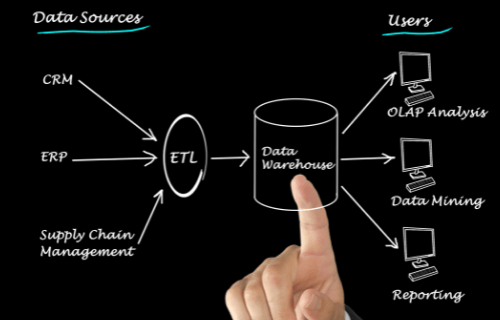
A data warehouse is a data management system that is intended to facilitate and support business intelligence activities, particularly analytics. Data warehouses are designed mainly for querying and analysis, and they frequently hold vast amounts of historical data. The data in a data warehouse is typically derived from a variety of sources, including application log files and transaction programs.
Read Also: Data as a Service Market Trends and Predictions
A data warehouse collects and consolidates vast amounts of information from various sources. Its analytical skills enable firms to gain significant business insights from their data, hence improving decision-making. It gradually accumulates a history record that can be extremely useful to data scientists and business analysts. Because of these qualities, a data warehouse can be regarded as an organization’s “single source of truth.”
A typical data warehouse often includes the following elements:
- A relational database to store and manage data
- An extraction, loading, and transformation (ELT) solution for preparing the data for analysis
- Statistical analysis, reporting, and data mining capabilities
- Client analysis tools for visualizing and presenting data to business users
- Other, more sophisticated analytical applications that generate actionable information by applying data science and artificial intelligence (AI) algorithms, or graph and spatial features that enable more kinds of analysis of data at scale
Organizations can also select a solution combining transaction processing, real-time analytics across data warehouses and data lakes, and machine learning in one MySQL Database service—without the complexity, latency, cost, and risk of extract, transform, and load (ETL) duplication.
- Purpose: A centralized, structured repository for collecting, storing, and managing large volumes of historical and current data from various sources within an organization.
- Function: Designed for efficient querying, analysis, and reporting, acting as the backbone for business intelligence (BI) systems.
- Structure: Data is highly structured and optimized for SQL queries, with a schema defined by business requirements.
- Usage: Best for data mining, business analysis, and sourcing specific, pre-identified business use cases.
Data as a Service vs Data Warehousing
| Feature | Data Warehousing | Data as a Service (DaaS) |
|---|---|---|
| What it is | An architectural component: a structured, centralized data repository | A cloud-based service model: a way to deliver and access data |
| Focus | Storing and analyzing data for BI and reporting | Providing access to data from various sources as a service |
| Infrastructure | Requires significant management and maintenance of hardware and software | Provider manages the infrastructure, freeing the customer from these responsibilities |
| Data Type | Typically stores structured, historical data | Can provide access to structured, semi-structured, and raw data |
What is Data Warehouse as a Service (DWaaS)?
DWaaS is a cloud-based, fully managed data warehousing service that eliminates the need for initial hardware investment and continuous maintenance, which are typical of traditional on-premises methods. Snowflake, Google BigQuery, and Amazon Redshift are among the main DWaaS service providers. DWaaS enables current data stacks and composable architectures by offering a centralized, scalable, and performant environment for storing and processing huge amounts of structured and semi-structured data gathered from multiple sources. This enables data teams to build flexible data pipelines, resulting in faster insights and analytical applications.
Cloud data warehouses are versatile platforms that support a wide range of analytical use cases across various industries. Let’s explore a few below:
Healthcare: Improving patient outcomes and operational efficiency
In the healthcare industry, DWaaS is commonly used to centralize patient data from electronic health records (EHRs), medical devices, lab reports, and other sources. This enables analysis to identify trends in patient populations, predict disease outbreaks, optimize treatment plans, and improve operational efficiency by analyzing resource utilization and patient flow.
Retail: Personalizing offers and forecasting inventory
Retailers leverage DWaaS to analyze customer purchase history, browsing behavior, and demographic data to gain a comprehensive understanding of customer behavior and personalize product recommendations and offers. They also use it for inventory forecasting, analyzing sales trends, seasonality, and external factors to optimize stock levels and reduce waste.
Finance: Streamlining risk and compliance reporting
Financial institutions use DWaaS to consolidate data from various trading platforms, risk management systems, and regulatory reporting and analytics tools. This enables them to perform complex risk calculations, generate regulatory reports efficiently, detect fraudulent activities, and gain insights into market trends.
SaaS: Enabling product analytics and customer health scoring
Software-as-a-Service (SaaS) companies use DWaaS to analyze user behavior in their applications, measure customer engagement, and develop customer health scores. This data-driven approach also enables them to understand how users interact with their products, which features are most popular, and where users might be encountering difficulties, to identify areas for improvement.
Media and entertainment: Analyzing audience engagement
Media and entertainment companies use DWaaS to analyze audience viewing habits, content preferences, and engagement metrics across various platforms. This data informs content creation strategies, advertising targeting, and personalized content recommendations.










Comments