
 By

To improve an existing business strategy, measure current performance, set focused SMART goals, and align each team’s priorities with them. A value-based strategy focuses on the benefits customers need and the value your business can consistently deliver. The U.S. Small Business Administration’s market research and competitive analysis guidance can support that customer and market review.
When results weaken, it’s tempting to respond with more activity: another campaign, a new offer, or longer hours. But adding tactics before diagnosing the gap can stretch resources without fixing the cause. Review performance to establish a baseline, then use customer feedback and team input to find where execution or assumptions need to change. Clear ownership helps turn strategic priorities into work people can act on.
This guide explains how to assess performance with SWOT analysis, translate priorities into SMART goals, and connect those goals to accountable work across your organization. You’ll also learn how to recognize when a focused adjustment is enough and when a larger pivot may be needed. The Baldrige framework’s performance improvement resources offer another reference point as you build a strategy your team can execute, measure, and revise.
Key Takeaways
- Use customer feedback, reviews, and funnel data to identify which parts of your offer create value and where potential customers drop off.
- Build a SWOT analysis around current performance, then use it to spot strengths to leverage and risks that could weaken execution.
- Turn strategic priorities into SMART goals with clear measures, deadlines, and accountable owners.
- Align team work with a focused set of objectives, visible milestones, and regular progress reviews.
- Watch for persistent performance gaps or threats to long-term financial viability as signals to adjust the plan or consider a pivot.
What Is Value-Based Strategy?
A value-based strategy guides business decisions by the benefits customers care about and the strengths your organization can deliver. Identify those benefits, then align your offer, marketing, operations, and performance measures with them. Each action should make the customer’s choice clearer or improve their experience.
- Investigate what customers value. Review customer feedback, support conversations, and online reviews for recurring needs. Compare those findings with competitor websites, social channels, product descriptions, and customer reviews. For example, if buyers praise a competitor’s faster setup, test whether clearer onboarding would strengthen your offer. Distinguish customer evidence from internal assumptions, then choose a value gap to address.
- Turn customer needs into a distinct offer. Explain the specific problem your product or service solves, who benefits, and why your approach is competitive. Test those claims through customer interviews or feedback forms. If freelance clients value predictable delivery, for example, make project milestones and scope visible before purchase. Implement changes only when they fit customer evidence and your team’s strengths.
- Make sustainability part of delivered value. Identify practical ways to reduce waste or improve resource use, then describe the customer benefit accurately. A café might divert food scraps from landfill and explain the practice alongside its menu. A digital business could review unnecessary file storage or packaging for physical products. Track operational effects and customer responses so sustainability supports the offer rather than becoming an unsupported marketing claim.
- Expand reach through focused channels. Use content marketing, social media, or pay-per-click campaigns to attract prospects who fit your offer. Partner with complementary businesses that already serve those customers. Before entering an international market, assess demand, relevant expertise, localization needs, and delivery requirements. For example, a software provider could test localized landing-page content before investing in a broader rollout.
- Build a funnel that moves prospects forward. Map how potential customers discover your offer, evaluate it, and become buyers. Match each stage with a useful action: publish educational content for discovery, provide product comparisons during evaluation, and use follow-up emails to address objections. Track where prospects leave the funnel. If many visit a pricing page but don’t inquire, clarify the offer and next step.
- Measure whether value creates business results. Track revenue, market share, customer retention, and churn alongside funnel activity. Churn measures customers who stop using your goods or services over a period. Compare results across customer groups and offerings to see where value holds or weakens. If revenue rises but retention falls, investigate post-purchase feedback before expanding the same acquisition campaign.
Assessing current business performance with SWOT analysis
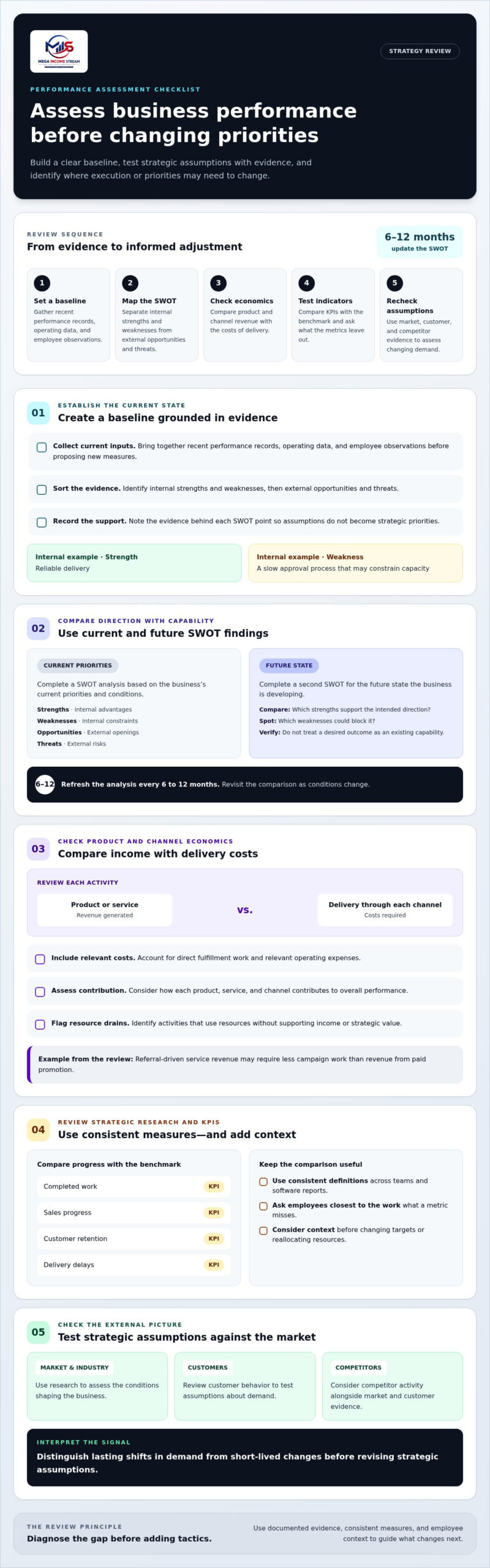
Establish a clear performance baseline before changing priorities. Use SWOT findings, cost-to-income analysis, and market evidence to distinguish internal execution problems from external shifts.
- Set a current-state benchmark. Gather recent performance records, employee observations, and operating data before proposing new measures. Sort findings into internal strengths and weaknesses, then external opportunities and threats. For example, reliable delivery may be a strength, while a slow approval process may constrain capacity. Record the evidence behind each point so assumptions don’t become strategic priorities.
-
Compare Current and Future SWOT Findings
Complete one SWOT analysis for current priorities and another for the future state the business is developing. Compare each category to identify which strengths support the intended direction and which weaknesses could block it. Avoid treating a desired future outcome as an existing capability. Update the SWOT analysis every 6 to 12 months so the comparison reflects changing conditions.
- Analyze product and channel cost-to-income. Compare the revenue from each product or service with the costs of delivering it through each channel. Include direct fulfillment work and relevant operating expenses, then assess each activity’s contribution to overall performance. A service that earns revenue through referrals may require less campaign work than one acquired through paid promotion. Identify activities that absorb resources without supporting income or strategic value.
-
Review Strategic Research and KPIs
Connect market and industry research with key performance indicators that measure productivity and inform decisions. Compare completed work, sales progress, customer retention, and delivery delays with the current benchmark. Use consistent definitions across teams and software reports to avoid misleading comparisons. Ask employees closest to the work what a metric misses, then consider that context before changing targets or reallocating resources.
-
Examine Market Research and Trends
Combine market and industry research with customer behavior and competitor activity to test strategic assumptions. Distinguish lasting shifts in demand from short-lived signals before committing resources. Before entering a new market, assess whether the business has relevant expertise or can develop it, and whether the market is viable. Compare the evidence with current strengths, delivery capacity, and expected customer needs.
Using SMART goals for strategic planning
Set specific, measurable, achievable, relevant, and time-bound goals, then assign owners and progress measures. Small businesses with limited budgets can prioritize a few high-impact improvements and test them with existing resources before expanding investment.
-
Set and Prioritize Business Goals
List the outcomes the business needs, then rank them by customer or operational impact, feasibility, and strategic fit. Focus on three to five goals; more than five major goals can dilute resources and attention. For example, improving onboarding may address a clear weakness more directly than adding another marketing channel. Don’t treat every useful idea as an immediate priority.
-
Shape Goals Using SMART Criteria
Rewrite each priority as a specific, measurable, achievable, relevant, and time-bound objective. “Improve customer retention” needs a defined customer group, a measure, a target, and a deadline. Use the current retention baseline to set a realistic target, then name the person responsible for reporting progress. Without a measure or timeframe, a goal is difficult to act on or evaluate.
- Translate priorities into work. Break each goal into tasks employees can complete alongside existing responsibilities. If the objective is to improve onboarding, actions might include reviewing the welcome sequence, identifying customer drop-off points, and revising one message. Assign each action an owner and clarify which decisions they can make. This connects strategic goals to daily execution.
- Check resource and culture fit. Compare each proposed goal with available staff time, skills, tools, and operating capacity. A small team might test a process change using existing software before committing to a larger rollout. Consider whether the goal fits the working environment and team culture. If it depends on skills the team lacks, include training or a smaller learning step in the plan.
- Make progress visible. Choose an indicator for each goal and review it alongside task completion. For a new customer onboarding process, track whether the new steps are being used and whether the selected customer measure changes. Separate completed actions from business outcomes; finishing a task doesn’t prove the goal has been achieved. Use gaps to identify the next adjustment.
- Revise priorities when evidence changes. Review progress against the agreed measures and deadline, then decide whether to continue, change the approach, or pause the goal. If a low-cost test doesn’t address the intended weakness, revise the action instead of adding unrelated work. Record why each change was made so employees understand how new decisions connect to the strategy.
Strategic planning and organizational alignment
To improve strategy execution, connect the organization’s vision to goals, owners, milestones, and team capacity. Begin with planning sessions, then map the transition into clear tasks and review points.
-
Run Planning Sessions
Bring employees and decision-makers together to translate strategic priorities into operational choices. Start with the organization’s vision and mission, then review relevant KPI analysis, customer research, market conditions, and employee interviews. Ask each team to identify dependencies, skills, and resource limits. Record decisions, owners, and unresolved questions so the session produces actions, not just broad ambitions.
-
Create Strategic Roadmaps
Turn each priority into a roadmap with milestones, accountable owners, and dependencies. Focus on three to five goals, and connect each milestone to a measurable objective. For example, a business improving customer onboarding can map the process review, workflow update, staff training, and performance review. Show on the roadmap how separate teams contribute to the same outcome.
- Connect objectives to purpose. Write or revisit vision and mission statements before finalizing objectives. A vision describes the intended future direction, while a mission clarifies the organization’s purpose and the value it provides. Check that every objective supports both. If a proposed project serves neither statement, explain its strategic role or remove it from the active plan.
- Map how the business creates value. Consider using a business model canvas to explore how the business creates and delivers value. Invite employees responsible for sales, delivery, and customer support to identify practical constraints. Their input can reveal duplicated work or a handoff that weakens the customer experience. Use the canvas to test initiatives before committing teams to implementation.
- Plan the transition before launch. For a major change, map the implications for processes, profits, costs, brand, team structure, and culture. Then specify tasks, stakeholders, deadlines, customer communications, and short- and long-term goals. For example, changing a core service may require revised sales materials and updated delivery workflows. Explain the rationale early to build team support and surface execution risks.
- Manage execution as a cycle. Use PDCA, Plan, Do, Check, Act, to test operational changes and refine them based on results. Standardize new processes, map workflows, train employees, and check implementation. Prepare contingency plans for disruptions such as operational failures, economic downturns, or natural disasters. Review milestones with owners and adapt the roadmap when evidence shows that tasks, resources, or sequencing need to change.
Signs that a business strategy may need to change
Adapt the strategy when customer needs, competitor moves, or financial results show its assumptions no longer fit. Change the offer, channel, or operating model only after identifying which signal threatens progress and profit.
-
Recognize Changing Customer Needs
Compare recent customer feedback, repeat purchases, support requests, and sales conversations with the needs your offer addresses. Look for recurring requests, new objections, or customers choosing a different solution. If buyers increasingly need faster delivery, for example, review fulfillment steps before changing the product itself. Distinguish repeated patterns from isolated comments, then test a targeted adjustment and track the response.
-
Monitor Competitor Changes
Review competitor websites, social channels, product updates, and customer reviews for changes in positioning or service. Compare those changes with your customer feedback and sales results. A competitor’s new feature matters only if it shifts customer expectations or affects your ability to win and retain buyers. Don’t copy a rival without evidence. Identify the underlying customer need and choose a response that draws on your strengths.
- Investigate persistent performance gaps. Compare actual revenue, retention, and other strategic KPIs with your plan’s objectives. If the team completes planned actions but results remain weak, check whether those actions address the real constraint. For example, more marketing may not solve a delivery bottleneck that drives cancellations. Look for recurring gaps across customer groups or channels before changing priorities.
- Assess threats to financial viability. Consider a pivot when a challenge threatens the business’s long-term financial viability. Examine whether the issue comes from falling demand, rising delivery effort, weak margins, or dependence on one revenue source. Map how each option affects costs, profit, customer value, team structure, and brand. A change that boosts sales but undermines sustainable delivery may deepen the problem.
- Choose the smallest useful response. Match the scale of change to the evidence. Adjust a message or customer journey when the core offer still fits; reconsider the offer or business model when customer needs and economics have shifted. Define the test, owner, customer communication, and success measure before implementation. Review the results and decide whether to continue, revise, or stop.
- Act on opportunity without chasing every trend. Compare emerging market opportunities with customer evidence, available capabilities, and the strategy’s intended direction. A new channel may expand reach, but it can also distract from profitable work. Record why the opportunity matters, what resources it requires, and which existing activity will receive less focus. Use this evidence to decide whether to adapt now or keep monitoring.
Mega Income Stream: Business Strategies
Mega Income Stream offers Business Strategies for entrepreneurs who need to turn performance findings into practical growth decisions. If your review reveals unclear priorities, untested revenue opportunities, or a strategy that’s difficult to execute, its Making Money Insights and Consulting Business offerings connect analysis with actionable planning.
Bring a defined challenge, such as declining customer retention or a channel that consumes resources without creating enough value. Clear goals and relevant performance measures can focus the strategic discussion. The next step is to turn the findings into decisions your team can implement and assess.
To discuss your business strategy, visit Mega Income Stream.
Make Your Next Strategic Move Deliberate
A strategy is useful when it shapes the business’s next decision. Treat the plan as an operating tool, not a document to revisit only after results disappoint. Keep a brief record of decisions, assumptions, and lessons from execution. This helps distinguish a meaningful shift from a temporary response to noise.
A practical way to improve an existing business strategy is to use new evidence to guide the next decision. As you improve an existing business strategy, preserve activities that create value while revising assumptions that no longer fit. If your team needs help linking growth opportunities with execution, bring unresolved choices into a focused strategic discussion.
Connect with Mega Income Stream about your business strategy and take the next step with a clearer plan. Keep testing, learning, and moving forward with purpose as you improve an existing business strategy.
Frequently Asked Questions
What next steps should I take?
Choose a strategic issue that currently limits results, then assign someone to gather the supporting evidence. Bring relevant figures, customer comments, and operational examples to a brief decision meeting. Agree on the first action, its owner, and how the team will report the outcome. Keep a decision log so later reviews can distinguish the original assumption from what the business learned through execution.
How do you assess an existing business strategy?
Assess the strategy by testing whether its assumptions match actual business performance and customer behavior. Review revenue by offer, sales sources, customer retention, delivery workload, and feedback from employees handling daily operations. Then trace each gap to its cause. For example, weak repeat sales may reflect product fit, onboarding, or support. Finding the cause helps leaders change the right part instead of replacing the whole plan.
Which KPIs should businesses use to measure strategy performance?
Choose KPIs that connect strategic goals to business outcomes, rather than tracking activity alone. A subscription business might monitor recurring revenue, customer churn, retention, and support resolution. A service firm could track qualified inquiries, proposal acceptance, project profitability, and repeat work. Pair each outcome measure with an operational indicator that helps explain movement. For example, falling repeat work alongside slower delivery can point to an execution issue.
How can market research identify opportunities to refine business strategy?
Use market research to compare customer problems, competitor positioning, and changes in buying behavior. Combine customer interviews with reviews, sales objections, search behavior, and industry information. Look for needs supported by multiple evidence sources, then test whether the business can serve them effectively. For instance, repeated requests for a self-service option could justify a small digital onboarding experiment before a larger product redesign.
What strategy frameworks help identify gaps in an existing business plan?
Choose a framework based on the gap you need to diagnose. SWOT organizes internal capabilities and external conditions. A business model canvas maps how an offer reaches customers and generates income. PDCA helps examine an operational change through planning, testing, reviewing, and adjusting. These tools answer different questions, so use one to uncover the issue and another only when it clarifies a separate decision.
How can companies align employees and operations with a revised strategy?
Translate the revised direction into role-specific decisions, process changes, and team communication. Explain what will stop, what will continue, and how employees should handle recurring customer or operational situations. Update relevant work instructions and sales materials together so teams don’t rely on conflicting versions. Managers can gather questions during regular check-ins, then resolve unclear ownership or resource conflicts before they disrupt delivery.
What are common risks when changing business strategy, and how can they be managed?
Common risks include confusing customers, disrupting delivery, underestimating team capacity, and diverting resources from profitable work. Reduce exposure by testing changes on a defined offer, customer group, or workflow before expanding them. Set a review point and specify what evidence would prompt continuation, revision, or a stop. Keep customer communications and internal responsibilities consistent throughout the test, and maintain a fallback process for essential operations.










Comments