
 By
The popular advice on Accrual Method vs Cash Method is lazy. People tell you cash is simple and accrual is accurate, then leave you to pick a vibe. That framing will get you into trouble, because the key question isn't preference. It's eligibility, inventory, and whether you can pay tax on money you haven't collected yet.
Pick wrong and you'll misprice work, misread a profitable month, or file taxes on a method the IRS never let you use. Pick right and the books answer two different questions cleanly. One view tells you whether the work made money. The other tells you whether you can pay rent on Friday.
Table of Contents
- What Each Method Actually Recognizes
- Side by Side on an Everyday Transaction
- Tax Eligibility and the Gross-Receipts Test
- Matching the Method to Your Business Model
- Why Accrual Profit Can Still Leave You Broke
- Changing Method Without Triggering an Audit Headache
- Picking the Right Method for Your Situation
What Each Method Actually Recognizes
The difference is recognition timing, not honesty or sophistication. The cash method records income when you receive it and expenses when you pay them. The accrual method records income when the economic activity happens and expenses when you receive the benefit or become obligated to pay, even if cash moves later.
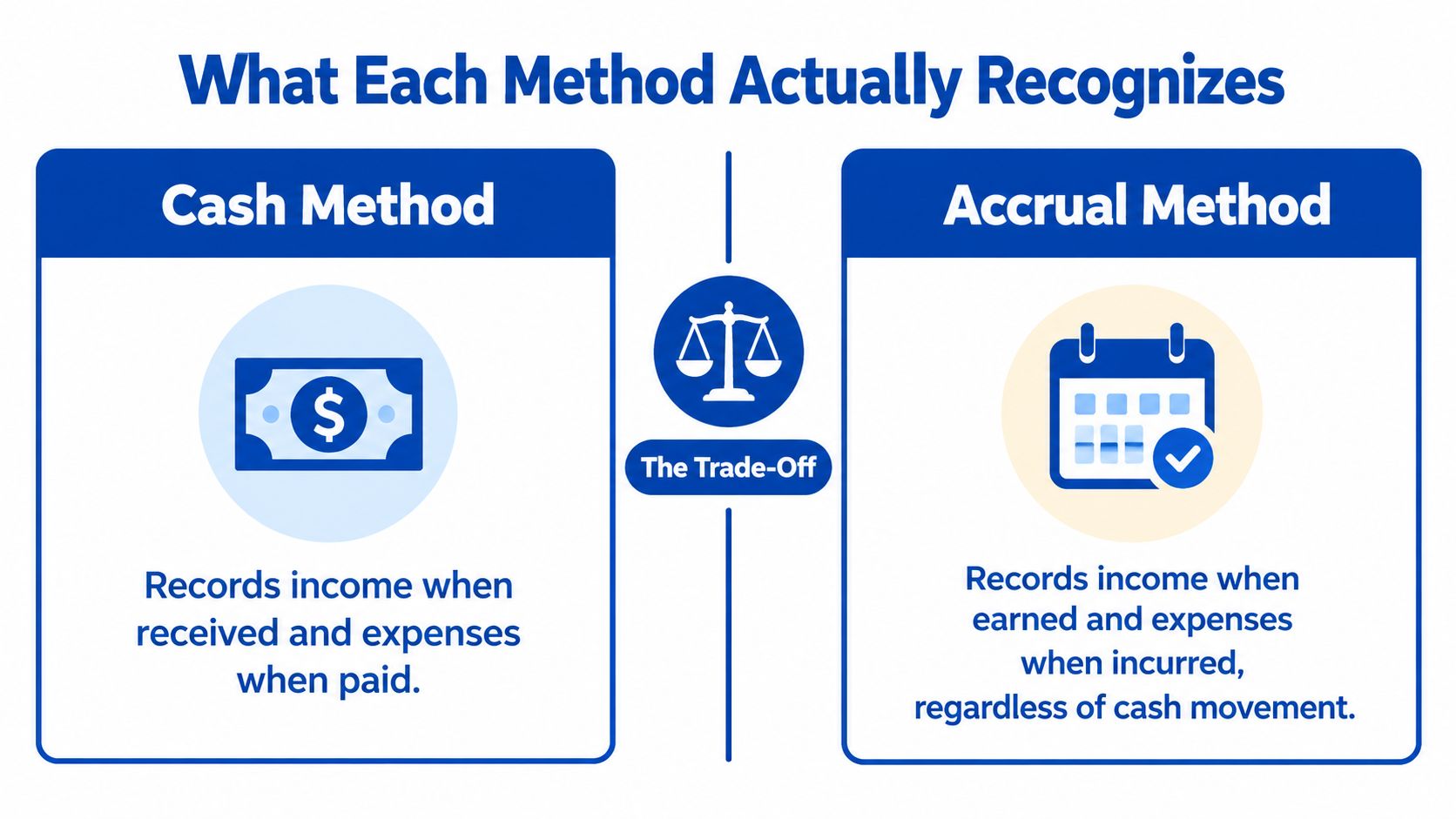
Deliver goods in December and get paid in January, and accrual puts the revenue in December. Cash puts it in January. Neither changes what the customer bought. Each changes which period gets credit for the sale, and that changes every margin, trend, and tax conversation that follows.
The Question Each Method Answers
Cash answers a bank balance question. What arrived, what left, what's left. Accrual answers a performance question. What did you earn, what do you owe, and what obligations have you already created.
That's why FASB's conceptual framework on accrual recognition notes that accrual information about assets, liabilities, and their changes "cannot be obtained from cash receipts and payments alone." A list of receipts can't show an unpaid invoice, a contractor you owe, or a subscription you've collected but haven't delivered.
- Cash visibility: Your books track money that has already moved, so liquidity is obvious and obligations stay invisible.
- Accrual visibility: Your books track accounts receivable, accounts payable, prepaid expenses, and deferred revenue, so obligations show up before cash moves.
- Reporting consequence: Financial statements prepared under generally accepted accounting principles use accrual concepts to match activity to the period it happened in.
Practical rule: If timing differences in your business are small, the methods converge. If customers pay late, suppliers extend credit, or prepayments cross periods, they diverge fast.
Don't ask which method is morally better. Ask which timing gaps exist in your business today. That answer decides almost everything else.
Side by Side on an Everyday Transaction
Take a $10,000 invoice earned in March and collected in May. Under accrual, March revenue rises by that amount and March cash doesn't change. Under cash, March shows nothing and May looks like a strong month that you didn't produce in May.
The Same Month, Two Income Statements
| Event | Cash Method | Accrual Method |
|---|---|---|
| Work delivered in March | No revenue recorded | Revenue recorded in March |
| Payment arrives in May | Revenue recorded in May | Cash replaces the receivable |
| March report | Understates activity | Shows work performed |
| May report | Overstates new activity | Shows collection only |
The tax rule behind that split is precise. Under cash, income counts when it is received or constructively received and expenses count when paid, while IRS Publication 538 on accounting periods and methods describes accrual income as recognized when your right to receive it is fixed and the amount can be determined with reasonable accuracy. Expenses follow the same logic in reverse. You recognize them when the liability is established, the amount is reasonably measurable, and economic performance requirements are met.
Now add a contractor. She does the work in April and you pay her in May. Accrual puts her cost in April, matched against the April revenue she helped produce. Cash puts the cost in May, so April margins look flattering and May margins look worse for no operational reason.
Where the Distortion Compounds
Annual subscriptions create the mirror problem. Collect a year of fees upfront and cash shows a windfall in month one. Accrual holds the undelivered portion as deferred revenue and releases it as you deliver. Your cash report says you're rich. Your accrual report says you owe months of work.
- Invoice timing: Late collections push cash revenue into periods where no work happened.
- Deposits and prepayments: Upfront cash inflates the collection month and starves later months.
- Inventory purchases: A large stock buy paid today can crush a cash month that sold very little.
- One-time payments: Annual software or insurance bills distort the month you pay them under cash.
Run this test on one real transaction from last quarter. Write down when the work happened, when the obligation became fixed, and when cash moved. If those three dates differ, cash is already distorting your monthly performance, whether you've noticed or not.
Tax Eligibility and the Gross-Receipts Test
Bookkeeping method and tax method aren't automatically the same decision, and confusing them is expensive. Internal Revenue Code Section 446 generally permits the cash receipts and disbursements method, an accrual method, another authorized method, or a permitted combination. Then Section 448 takes the cash option away from certain taxpayers.
Section 448 restricts the cash method for certain C corporations, partnerships with a C corporation partner, and tax shelters unless an exception applies. Some farming and personal service businesses receive separate exceptions. Entity structure comes first in this analysis, before revenue, before software, before what your bookkeeper prefers.
The $32 Million Line for 2026
For tax years beginning in 2026, the inflation adjusted gross receipts test for the cash method exception is $32 million, measured as average annual gross receipts over the preceding three taxable year period. The threshold was $31 million for tax years beginning in 2025, which tells you the number moves with inflation rather than staying fixed. Check the current figure every year. Don't build a system around last year's limit.
The three year average matters more than people expect. One unusually strong year doesn't disqualify you by itself, and one weak year doesn't rescue a business that's grown past the line. That's deliberate. The IRS is testing sustained scale, not a single good quarter.
Who Can Use the Cash Method for Tax in 2026
| Entity Type | Default for 2026 | Cash Method Eligible? | Inventory Trigger |
|---|---|---|---|
| Sole proprietor, no inventory | Choice of method | Generally yes | None if no inventory |
| C corporation under the test | Choice if exception met | Yes, if three year average qualifies | Inventory generally needs accrual |
| C corporation over the test | Accrual required | No | Accrual applies |
| Partnership with C corp partner | Restricted like a C corp | Only if exception met | Inventory generally needs accrual |
| Tax shelter | Accrual required | No | Accrual applies |
| Business holding inventory | Accrual for purchases and sales | Cash only if a small business exception applies | This is the trigger itself |
Inventory Overrules Your Preference
Businesses generally must use accrual accounting for inventory purchases and sales, although qualifying small business taxpayers may receive an exception. That single rule ends the debate for most ecommerce and product businesses. You can't wish your way into pure cash accounting while stock sits on shelves.
Method selection also moves taxable income between years, because it controls when revenue and deductible expenses enter the calculation. If you're also working through filing mechanics, the guide on how to do a tax return for a company covers that side separately. Keep the two questions distinct. What your books show for management and what your return reports for tax follow related but separate rules.
If you're approaching the threshold, model both methods before you change systems. Switching after you cross the line, under deadline pressure, is how transition errors happen.
Matching the Method to Your Business Model
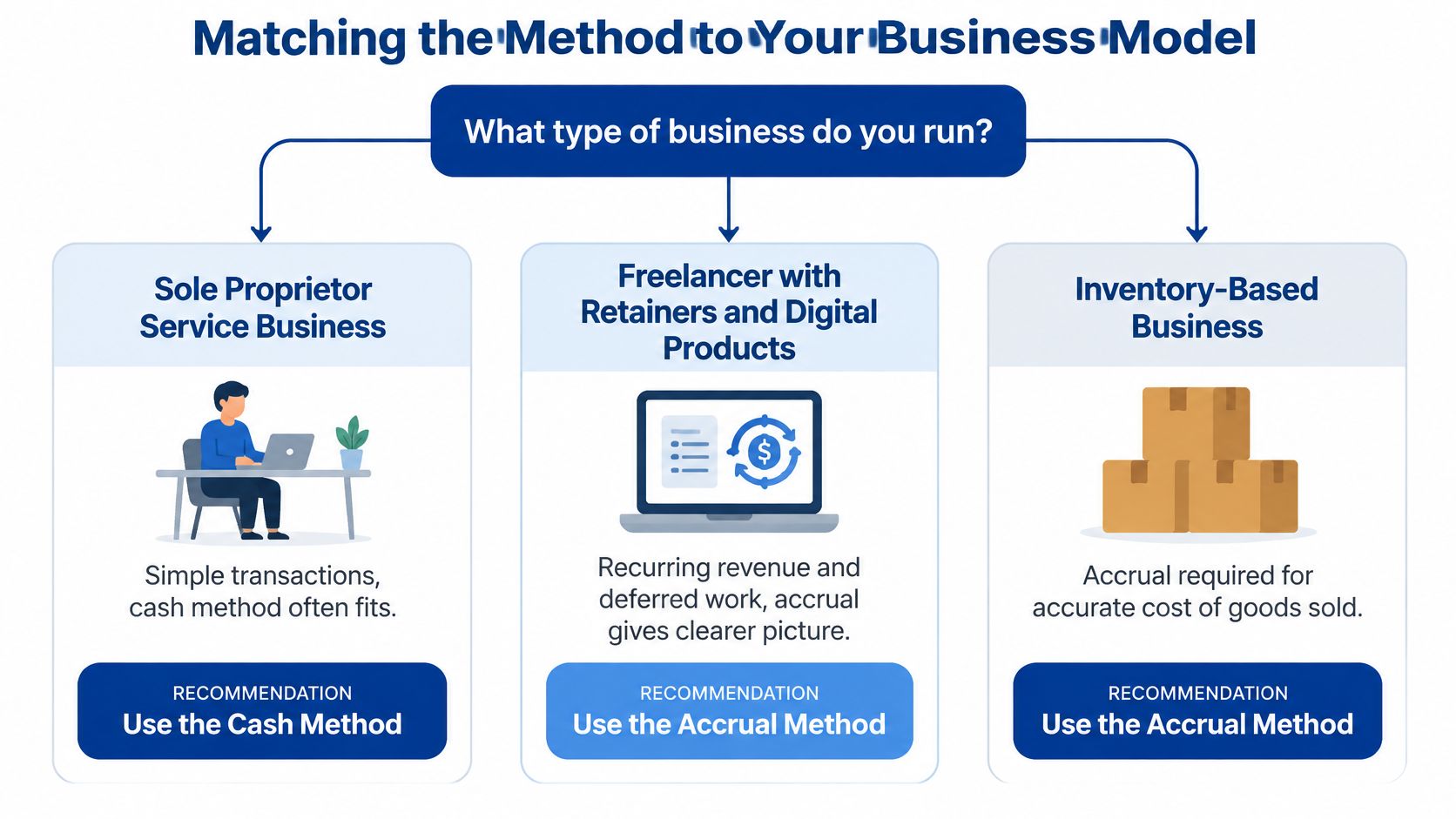
Stop asking which method wins in the abstract. Match it to the business you run. Five profiles cover most readers, and each one has a clear default.
Service Work Paid on Delivery
A sole proprietor selling services, getting paid promptly, holding no inventory, and owing little to anyone can stay on cash. Timing differences are immaterial, so the simpler system wins. Don't buy complexity you don't need.
That answer expires the moment you add retainers, digital products, or net payment terms. A freelancer moving into monthly retainers now has recurring obligations, unpaid invoices, and work owed after payment. Accrual tracking shows which clients are profitable. Cash just shows who happened to pay this month.
Stock, Subscriptions, and Scale
- Ecommerce operator with inventory: Use accrual for purchases and sales so cost lands in the same period as the revenue it produced.
- Software seller with annual plans: Use accrual so upfront collections become deferred revenue instead of a fake revenue spike.
- Agency using contractors: Use accrual so contractor costs match the client work they delivered, not the month you settled their invoices.
- C corporation near the threshold: Plan as if accrual is coming, because crossing the three year average removes the choice.
Accrual earns its keep where working capital is material. Credit sales, long term contracts, and significant future obligations all create assets and liabilities that cash reporting cannot capture. That's where metrics like gross margin, operating margin, receivable days, and payable days start meaning something.
But don't let the better income statement fool you. A FASB Concepts Statement on the objective of financial reporting.pdf) supports reconciling accrual net income to operating cash flow, because accrual profit is not a liquidity metric. Track collections, payment timing, and working capital movements separately, or you'll celebrate revenue while the account empties.
Upgrade trigger: Move from cash to accrual when receivables, payables, inventory, depreciation, prepaid costs, or multi period obligations become significant. Not when an article tells you accrual is more professional.
Mega Income Stream publishes editorial guides on business operations and income models, including coverage of rental property tax reporting under both methods, which is a useful parallel if property income is part of your mix. Treat published guidance as a starting point. Your entity type and inventory position still make the final call.
Why Accrual Profit Can Still Leave You Broke
Accrual is better at measuring profitability. It is actively dangerous as a spending guide, and owner operators learn that the hard way. Reported earnings can rise while cash falls because receivables grow, inventory absorbs cash, or you pay suppliers faster than customers pay you.
The image below captures a familiar moment, a profitable report on screen and a bank balance that disagrees.

That's not an accrual failure. It's a category error. Profitability and liquidity are different objectives, and one report can't do both jobs. Even the IFRS for SMEs standard and its cash flow statement requirement requires a statement of cash flows classified into operating, investing, and financing activities, on top of accrual financial statements. The standard setters don't trust accrual alone to show liquidity. Neither should you.
Build a Dual View System
Run accrual for decisions about pricing, margins, and customer profitability. Run a weekly cash dashboard for decisions about spending. The dashboard needs bank balance, expected collections, tax reserves, and upcoming commitments. Nothing fancier than that, reviewed every week without exception.
- Bank balance today: The only number that pays bills this week.
- Collections expected: Receivables by due date, with late payers flagged rather than assumed.
- Commitments due: Contractor invoices, rent, software renewals, and tax payments already obligated.
- Reserves held back: Cash you technically have but already owe for undelivered work or taxes.
Platform businesses feel this gap hardest. Marketplaces and payment processors hold funds during settlement periods, so revenue you earned isn't spendable yet. Refunds pull money back after you've recorded the sale. Advertising bills arrive on their own schedule regardless of when customers paid you.
The short video below walks through the accrual and cash distinction with worked examples, which helps if you learn better by watching entries move.
If collections are the weak point in your own dashboard, work through the practical steps in this overview of ways to improve your cash flow and fix the timing at the source. Faster invoicing, deposits, and shorter terms close the gap more reliably than any reporting method. Accuracy for profitability won't save a business that can't see its cash.
Changing Method Without Triggering an Audit Headache
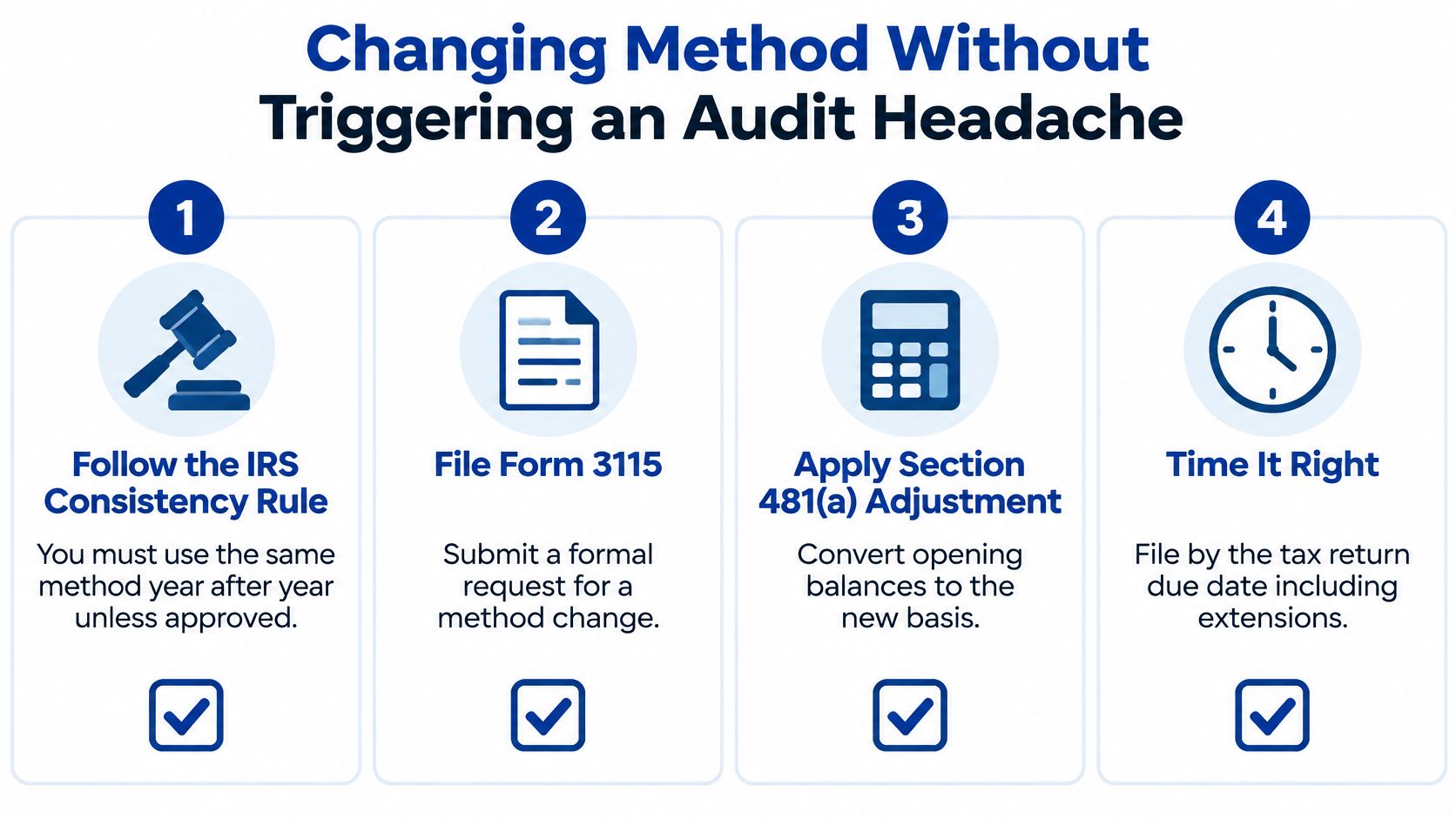
You don't get to flip methods whenever a year looks inconvenient. The IRS requires you to apply your chosen method consistently from year to year. Changing it is a formal act, and treating it casually is what creates audit exposure.
The Formal Path
- Confirm you need a tax change at all: Updating internal management reports is your business. Changing the method on your return is the IRS's business.
- File Form 3115: This is the formal request to change accounting method, and some changes qualify for automatic approval while others need advance consent.
- Calculate the adjustment: A Section 481(a) adjustment converts opening balances to the new basis so nothing gets counted twice or skipped.
- Apply the new method from the start of the year: Half year switches create exactly the inconsistencies the consistency rule exists to prevent.
The adjustment step is where transitions break. Switch from cash to accrual carelessly and an invoice collected after the switch can be recognized as new revenue even though it was already earned. Switch the other way and income can vanish from both years. Neither error looks like an honest mistake on examination. Both look like manipulation.
Two Transitions Done Right
A freelancer graduating into retainers should list every open invoice, every prepaid retainer, and every unpaid contractor bill as of the change date. Those balances become the opening accrual position. Anything not on that list will surface later as a mystery difference nobody can explain.
A small ecommerce business crossing the inventory line has a different job. Stock on hand, goods in transit, and supplier balances all need values before the first accrual period opens. Skip the count and your cost of goods will be wrong in every period that follows.
Change methods at a year boundary, with a documented opening balance sheet, and with the adjustment calculated before you file. Improvising mid year is the expensive version.
Get a tax adviser involved before filing if your entity type, inventory position, or gross receipts sit anywhere near a boundary. The fee for advice is smaller than the fee for fixing a botched change. Consistency after the switch matters as much as the switch itself, because a second unexplained change invites questions about the first.
Picking the Right Method for Your Situation
Here's the verdict, without the balanced summary most comparisons hide behind. Cash for simple, immediate payment service work. Accrual for everything with inventory, credit, subscriptions, or scale. A combination where the law allows it and your facts support it.
The Recommendation Matrix
| Your Situation | Default Method | Reason |
|---|---|---|
| Solo service provider, paid promptly, no inventory | Cash | Timing differences are immaterial |
| Freelancer with retainers or digital products | Accrual tracking, cash dashboard | Recurring obligations need period matching |
| Ecommerce or any business holding stock | Accrual for inventory | Purchases and sales must land together |
| Subscription business collecting annually | Accrual | Upfront cash is deferred revenue, not profit |
| C corporation approaching the gross receipts line | Accrual, planned early | The exception expires as you grow |
The combination option deserves more attention than it gets. IRS Publication 334 on small business accounting methods supports the position that the IRS allows combination methods when they clearly reflect income and expenses and are applied consistently. So the practical question is often whether cash can cover some activities while accrual handles inventory or long term contracts. That's a better question than which method wins.
A business generally must use the same method for its books and taxable income, which is why this decision belongs in a tax conversation, not just a software setup screen. Pair the choice with the broader thinking in this explanation of what the tax planning strategy involves before your year end, not after it. Timing decisions made in December are worth far more than corrections made in April.
Decision prompt: Write down your entity type, whether you hold inventory, and your average gross receipts over the last three tax years. Those three facts eliminate most of your options and leave you with the right one.
Revisit the choice when any of those three facts change. A new entity structure, a first inventory purchase, a move into retainers, or sustained growth toward the threshold all reopen the question. Businesses don't outgrow cash accounting because they get complex. They outgrow it because timing gaps get large enough to mislead them, and by then the misleading reports have already shaped pricing and hiring decisions.
Act this quarter. Confirm your eligibility, choose the method your facts require, and set up the weekly cash view alongside it if you land on accrual. The method debate ends when your books match your obligations.
Mega Income Stream publishes practical guides on business operations, taxes, and income building for freelancers, ecommerce operators, and growing small businesses, including detailed coverage of accounting choices like this one. If you're setting up your books, changing methods, or planning around a growth threshold, visit Mega Income Stream for step by step guidance you can apply this quarter.
Crafted with Outrank










Comments