
 By
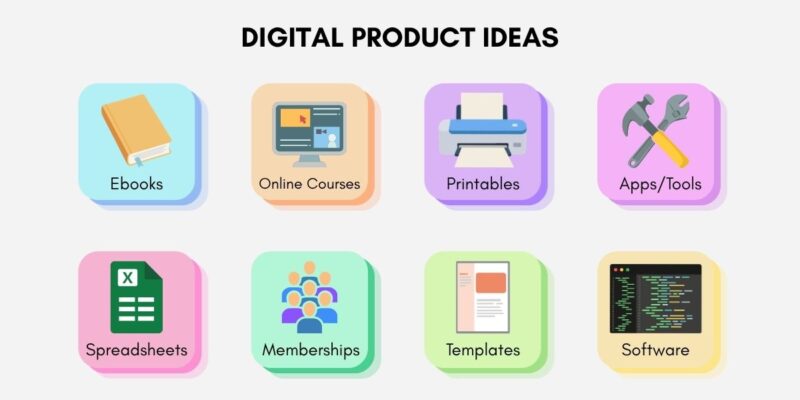
Some of the best options are ebooks, online courses, templates, printables, stock media, software or digital tools, and licensed creative assets. Unlike physical products, these assets can often be duplicated and delivered automatically without manufacturing another unit every time a customer purchases.
The seven digital assets worth considering are:
- Ebooks and digital guides
- Online courses
- Templates and spreadsheets
- Printables and planners
- Stock photos, video and audio
- Software, apps and digital tools
- Licensed graphics, fonts and creative assets
However, “sell forever” should not be taken literally. Digital products still require marketing, customer support and occasional updates. Products involving technology, regulations or fast-changing information may need frequent revisions.
The attraction is scalability.
Shopify reported in its 2026 digital-products guide that digital products generated more than $157 billion in 2026. It also notes that digital goods avoid physical inventory and shipping and can potentially produce margins around 90% after fees, although actual profitability varies considerably by product and platform.
7 Digital Assets Compared
| Digital Asset | Creation Difficulty | Repeat-Sale Potential | Typical Format |
|---|---|---|---|
| Ebooks | Low–Medium | High | PDF, EPUB |
| Online courses | Medium–High | Very High | Video, audio, text |
| Templates | Low–Medium | Very High | Excel, Canva, Notion |
| Printables | Low | High | PDF, PNG |
| Stock media | Medium | High | JPG, MP4, WAV |
| Software/tools | High | Very High | App, plugin, SaaS |
| Creative assets | Medium | Very High | Fonts, graphics, presets |
The strongest product isn’t necessarily the easiest one to create. It is the one that solves a problem people are willing to pay to solve.
1. Ebooks and Digital Guides
Ebooks are among the easiest digital assets to understand. You possess useful knowledge, organize it into a structured resource and sell the resulting file repeatedly.
Potential topics include:
- Personal finance.
- Career development.
- Business.
- Technology.
- Cooking.
- Fitness.
- Professional skills.
- Travel.
- Parenting.
- Hobbies.
Specificity is usually stronger than generality.
Instead of:
“The Complete Guide to Excel”
consider:
“Excel Financial Reporting for Small Business Owners.”
Amazon Kindle Direct Publishing provides one distribution route. KDP currently offers 35% and 70% ebook royalty options, subject to pricing, territory and other eligibility requirements. From July 7, 2026, the Amazon.com list-price range qualifying for the 70% option is $2.99–$12.99.
You can also sell PDFs directly through your own website or digital-product platforms.
2. Online Courses
If an ebook teaches through text, an online course can combine:
Video + Audio + Worksheets + Quizzes + Demonstrations
Potential courses include:
- Excel for Accountants
- AI Automation for Small Businesses
- Photography for Beginners
- SEO for Local Businesses
- Google Workspace Administration
The scalability is attractive. Suppose you spend 80 hours developing a course. Selling it to the first customer doesn’t require you to record the entire course again for customer number two.
The same lessons could theoretically serve hundreds or thousands of students.
Shopify identifies online courses and educational content among prominent digital-product categories and notes that a completed course can serve large numbers of students, although material needs updating as it becomes outdated.
That final point matters.
Create once doesn’t mean ignore forever.
3. Templates and Spreadsheets
Templates are potentially excellent digital assets because they save customers time. People don’t necessarily want another 200-page explanation. Sometimes they want:
“Give me something that already works.”
Examples include:
- Business-plan templates.
- Financial dashboards.
- Budget spreadsheets.
- Invoice templates.
- Project trackers.
- Social-media calendars.
- CV templates.
- Presentation decks.
- Notion dashboards.
- Canva templates.
Imagine developing a sophisticated budgeting spreadsheet once. If you price it at $29:
| Sales | Gross Revenue |
|---|---|
| 10 | $290 |
| 100 | $2,900 |
| 500 | $14,500 |
| 1,000 | $29,000 |
These figures are hypothetical gross revenue before transaction fees, taxes, advertising, refunds and other expenses. The file doesn’t change substantially between customer one and customer 1,000.
That’s digital leverage.
4. Printables and Planners
Printables are digital files customers download and print themselves. Examples include:
- Calendars.
- Meal planners.
- Wedding planners.
- Children’s activity sheets.
- Habit trackers.
- Savings challenges.
- Checklists.
- Study planners.
- Business worksheets.
- Educational materials.
They can have relatively low production costs because there is no physical inventory to manufacture or ship. Etsy, for example, permits sellers to offer their original designs as digital downloads. Its rules specify that digital products listed on the marketplace must be made or designed by the seller.
Read Also: Creating and Selling Digital Products With AI: A Comprehensive Guide
That restriction is important.
Don’t download someone else’s printable, change the colours and assume you now own a product. Create original work or ensure you possess appropriate commercial rights.
5. Stock Photos, Videos and Audio
Creative professionals can turn media libraries into digital assets. A photographer might create:
Business photography + Travel photography + Food photography + Property photography
A videographer could produce:
Drone footage + City footage + Nature clips + Background videos
Musicians and audio professionals could create:
Sound effects + Beats + Background music + Audio loops
The asset can potentially be licensed multiple times rather than sold exclusively to one customer. This introduces an important distinction:
Selling ownership vs licensing usage rights.
You may retain copyright while granting customers specified permission to use the asset. A strong licensing business therefore needs clear terms covering issues such as:
- Commercial use.
- Personal use.
- Modification.
- Redistribution.
- Number of users.
- Attribution.
- Exclusivity.
Shopify specifically identifies photography, music, art and licensed digital content among digital products creators can sell online.
6. Software, Apps and Digital Tools
Software can be harder to create but potentially far more scalable. Examples include:
- WordPress plugins.
- Browser extensions.
- Mobile applications.
- Calculators.
- AI tools.
- Automation scripts.
- Website themes.
- Spreadsheet add-ons.
- SaaS applications.
Instead of selling information explaining how to solve a problem, software may solve part of the problem automatically. For example:
Information product: “How to Calculate Freelance Project Profitability.”
Digital tool: “Freelance Project Profit Calculator.”
You can also combine both. Sell a course explaining the methodology and include the calculator as a premium resource.
Software requires more ongoing maintenance than a static PDF. Bugs, cybersecurity, operating-system changes, integrations and customer support mean it is rarely genuinely “create once and forget.”
But it can create recurring revenue through:
Subscriptions + Licences + Premium upgrades + Enterprise plans
7. Licensed Graphics, Fonts and Creative Assets
Designers can create reusable intellectual property. Examples include:
- Fonts.
- Icons.
- Illustrations.
- Lightroom presets.
- Photoshop brushes.
- Presentation themes.
- Website graphics.
- Social-media packs.
- Logo elements.
- Video transitions.
Instead of continually accepting custom design jobs, you create an asset once and license it repeatedly. For example:
Custom design model:
One customer → One project → One payment.
Digital asset model:
One design → Many customers → Multiple payments.
Shopify’s digital-selling tools support formats including PDFs, templates, graphics, fonts, videos and other downloadable files. It describes the model succinctly:
“Upload once. Sell on repeat.”
That captures the fundamental economics of digital assets.
Where Can You Sell Digital Assets?
Several business models are available. You can sell through:
- Your own website, giving you greater control over branding and customer relationships.
- Marketplaces, which can provide existing traffic but may charge higher fees.
- Specialized platforms, designed for creators and digital downloads.
For example, Gumroad’s current published fee for direct sales is 10% plus $0.50 per transaction, excluding separate payment-processing costs under its current help documentation. Sales originating through Gumroad Discover carry a 30% platform fee.
This illustrates an important principle:
Gross sales are not profit.
Always calculate:
Revenue – Platform Fees – Payment Fees – Advertising – Software – Taxes – Refunds = Actual Profit
How to Create a Digital Asset That Actually Sells
Don’t start with:
“What can I make?”
Start with:
“What problem can I solve repeatedly?”
A useful framework is:
Problem → Audience → Solution → Digital Asset → Distribution → Feedback → Improvement
For example:
Small-business owners struggle with cash-flow forecasting.
- You understand Excel.
- You create a cash-flow forecasting template.
- You produce a tutorial showing how to use it.
- You publish articles and videos around cash-flow management.
- The content attracts the target customer.
- The template solves the customer’s immediate problem.
Now your expertise has become an asset.
Final Words
The seven digital assets you can create once and potentially sell repeatedly are ebooks, courses, templates, printables, stock media, software and licensed creative assets.
Their advantage comes from a fundamental difference between physical and digital economics.
If you sell 1,000 physical chairs, someone must manufacture approximately 1,000 chairs.
If you sell 1,000 copies of a spreadsheet template, you don’t need to manually recreate the spreadsheet 1,000 times.
Digital delivery platforms can automate distribution after checkout. Shopify, for example, supports automatic delivery of digital files and links, while Amazon KDP offers eligible ebook publishers royalty options of up to 70%.
But don’t confuse scalability with effortless money.
The successful formula is:
Create once → Market repeatedly → Sell repeatedly → Improve occasionally
- Start with knowledge or skills you already possess.
- Find a recurring problem.
- Turn the solution into a downloadable or accessible asset.
- Build an audience around the problem.
- Automate purchasing and delivery.
- Then use customer feedback to make the asset increasingly valuable.
The ultimate digital asset isn’t simply something you can sell forever. It’s something useful enough that new customers continue wanting to buy it long after the original work of creating it is complete.
FAQ
Can digital products generate passive income?
They can generate relatively passive sales, but they aren’t completely passive. Marketing, customer service, updates, platform management and product improvements still require work.
What is the easiest digital product to create?
Ebooks, simple templates, checklists and printables generally have relatively low technical barriers. However, easy creation also means competition can be high.
Do digital products require inventory?
Usually not in the traditional sense. Files can be delivered electronically. Shopify, for example, supports automatic digital delivery through downloadable files or links.
Can I sell the same digital product forever?
Potentially for many years, but demand, technology and information change. Evergreen products may require fewer updates, while software and technical courses can require frequent maintenance.
Source: createsell.com








Comments