
 By

If you write about home improvement, tools, or DIY projects, you’ve probably wondered whether you can earn money sending readers to a retailer they already trust. The home depot affiliate programs setup does exactly that, letting you monetize content around one of the biggest home improvement brands in the country without holding any inventory yourself.
Here’s the short answer: Home Depot runs its affiliate program through Impact Radius, offering commission rates that typically range from 1% to 8% depending on product category, with a cookie window that’s shorter than most niche affiliate programs. Approval isn’t automatic either, Home Depot reviews your site’s traffic, content quality, and niche fit before letting you in.
This guide walks you through exactly what to expect: current commission rates by category, the eligibility requirements you need to meet before applying, a step-by-step signup process through Impact, and practical tips for getting approved faster and actually earning meaningful income once you’re in. Whether you run a home improvement blog, a YouTube channel reviewing tools, or a broader personal finance site looking to add another income stream, you’ll leave knowing whether this program fits your strategy.
Why the Home Depot affiliate program matters for creators
Home Depot pulls in over $150 billion in annual revenue and sits as the largest home improvement retailer in the United States. That kind of scale matters to you as an affiliate because brand recognition does half the selling work before a reader even clicks your link. Nobody hesitates before buying a drill or a bag of mulch from Home Depot the way they might with an unfamiliar dropshipping site. When you recommend a product and link to Home Depot, you’re not asking your audience to trust a stranger, you’re pointing them toward a store they’ve probably shopped at in person dozens of times.
Built-in trust translates to conversions
That existing trust shows up directly in your numbers. Affiliate conversion rates depend heavily on how much friction exists between a click and a purchase, and brand familiarity removes a huge chunk of that friction. A reader comparing lawnmowers doesn’t need convincing that Home Depot is a legitimate retailer with fair return policies and reliable shipping. They just need your content to help them pick the right model. This is different from promoting a niche supplement brand or an unknown software tool where you carry the full weight of building trust yourself.
A trusted retailer sells the product for you before your reader even clicks.
Who actually benefits from this program
Not every creator gets equal value from Home Depot’s affiliate setup, and being honest about that upfront saves you wasted effort. The program works best for a specific set of niches and content formats:
- Home improvement bloggers writing tool reviews, renovation guides, or seasonal project tutorials
- YouTube creators filming build videos, tool comparisons, or DIY tutorials where product links sit naturally in descriptions
- Real estate and property investors producing content about flipping houses, staging homes, or landlord maintenance
- Personal finance sites covering budget renovations, home value additions, or money-saving DIY alternatives to hiring contractors
- Gardening and landscaping creators promoting seasonal outdoor equipment, plants, and lawn care tools
If your audience already asks questions like “what drill should I buy” or “how do I fix a leaky faucet,” you’ve got a natural fit. If your content lives entirely outside physical products, this program won’t move the needle much for you.
A low-barrier entry into affiliate marketing
One underrated reason this program matters: it gives creators a straightforward entry point into e-commerce affiliate marketing without the complexity of managing multiple vendor relationships. Instead of chasing individual manufacturer programs for every brand of tool or appliance you mention, you get access to Home Depot’s entire catalog, from power tools and paint to appliances and outdoor furniture, through one application. That consolidation saves you administrative time and lets you focus on content instead of managing a dozen separate affiliate dashboards.
The program also runs through Impact Radius, a platform widely used by major retailers, which means the reporting, tracking, and payout infrastructure is professional-grade rather than some clunky in-house system. You get real-time click and conversion data, which helps you figure out which content actually drives sales rather than guessing.
Where it fits in a diversified income strategy
For readers of a site like this one, the real value isn’t just the commission check, it’s what the program represents strategically. Relying on a single income stream, whether that’s ad revenue, one affiliate partnership, or a single freelance client, leaves you exposed when algorithms change or a program shuts down. Adding a retail affiliate program like Home Depot’s to your existing mix, alongside things like Amazon Associates or niche-specific programs, spreads your risk and gives you multiple paths to revenue from the same content.
This matters even more if you already write about passive income or side hustle strategies, since recommending physical products tied to home projects is a natural complement to content about saving money, building equity, or increasing a home’s resale value. A single article about “budget kitchen upgrades before selling your house” can house half a dozen product links, each one a small but repeatable income source.
The seasonal nature of home improvement also works in your favor if you plan content around it. Spring brings gardening and outdoor project searches, summer drives AC and cooling equipment demand, fall triggers home maintenance and winterization content, and the holidays push tool gift guides and appliance upgrades. That predictable cycle means you can plan a content calendar around demand spikes rather than guessing when your audience will be ready to buy.
None of this guarantees success automatically. Commission rates on some categories run thin, and you’ll need consistent traffic to make the program worthwhile, which the next sections cover in detail. But for the right creator, in the right niche, with the right traffic, Home Depot’s brand power and catalog breadth make it one of the more reliable retail affiliate programs to add to your toolkit.
How to sign up for the Home Depot affiliate program
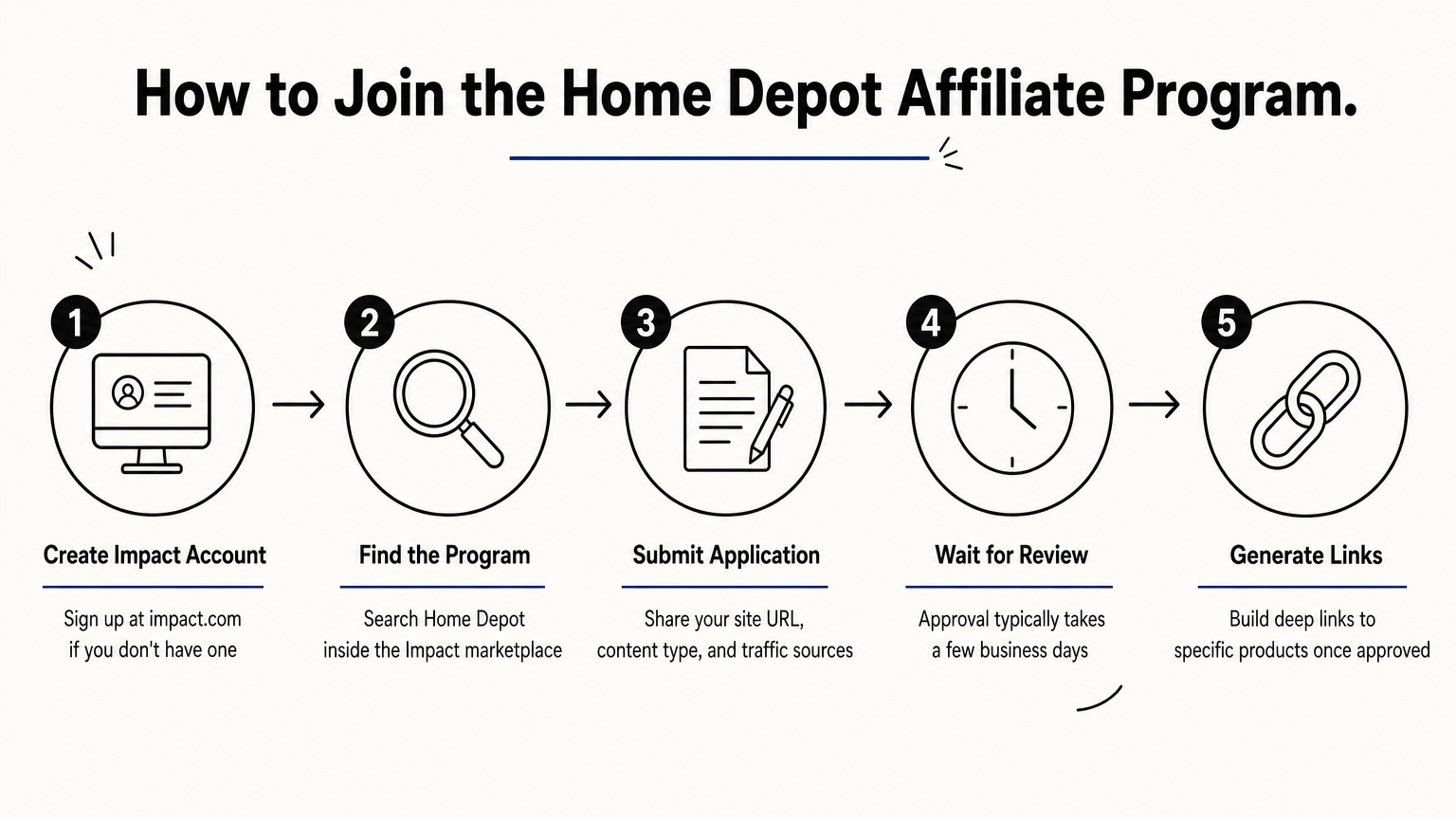
Getting into the Home Depot affiliate program starts with understanding that you’re not applying to Home Depot directly. You’re applying through Impact Radius, the affiliate network platform Home Depot uses to manage its partnerships, track clicks, and process payments. This matters because your entire relationship, from application to payout, runs through Impact’s dashboard rather than a Home Depot-branded portal, so you’ll want to get comfortable navigating that system before you dive in.
What you need before applying
Home Depot doesn’t accept every website that submits an application. Before you spend time filling out forms, make sure you meet the baseline requirements reviewers actually check:
- An active website or channel with original content, not a placeholder page or a site still under construction
- Consistent traffic, ideally with analytics you can point to if asked, even if you’re not required to submit exact numbers upfront
- Relevant content niche, meaning home improvement, DIY, real estate, gardening, personal finance, or similar categories where product recommendations make sense
- A clear privacy policy and disclosure page, since affiliate programs increasingly check for FTC-compliant disclosure language
- No policy violations, such as sites built primarily around coupon stacking, incentivized clicks, or content that scrapes other retailers
Approval depends less on your traffic size and more on whether your content genuinely fits the home improvement niche.
Step-by-step signup process
Once you’ve confirmed your site meets those baseline standards, the application itself is fairly quick. Here’s the process from start to finish:
- Create an Impact Radius account at impact.com if you don’t already have one. Many affiliates already run accounts here for other retail partnerships, so check before creating a duplicate.
- Search for the Home Depot program inside the Impact marketplace, sometimes listed as “The Home Depot” or “Home Depot Affiliate Program.”
- Submit your application, which typically asks for your website URL, a description of your content, your promotional methods, and expected traffic sources.
- Wait for review, which usually takes a few business days but can stretch longer during high-volume periods like the run-up to Black Friday.
- Check your email and Impact dashboard for approval status, since Home Depot sometimes requests additional information before finalizing a decision.
- Generate your tracking links once approved, using Impact’s link-generation tools to create affiliate URLs for specific products or category pages.
Rejections happen more often than new affiliates expect, usually because the site looks thin on content, lacks disclosure language, or doesn’t clearly connect to home improvement topics. If you get turned down, treat it as feedback rather than a dead end. Build out more content, add a proper disclosure page, and reapply after a few months once your site has more substance to show.
Setting up tracking and links correctly
After approval, your next job is making sure every link you place actually tracks correctly. Impact’s dashboard lets you build deep links to specific products rather than just the Home Depot homepage, which matters because a reader landing on a random product page converts far less often than one landing exactly where your content pointed them. Take the extra few minutes to link directly to the item you’re reviewing or recommending. If you’re already running other affiliate programs and comparing which platforms fit your content best, our breakdown of Amazon Associates vs Clickbank walks through similar tracking and payout considerations worth weighing alongside Home Depot’s setup.
Commission rates, cookie duration, and payouts explained
Once you’re approved, the numbers matter more than anything else, and Home Depot’s commission rates are modest compared to some niche programs. You’re typically looking at a range between 1% and 8% depending on the product category, with big-ticket items like appliances often sitting at the lower end and smaller accessories or seasonal goods paying out closer to the higher end. That spread means your earnings depend heavily on which products you push, not just how much traffic you send.
Commission rates by category
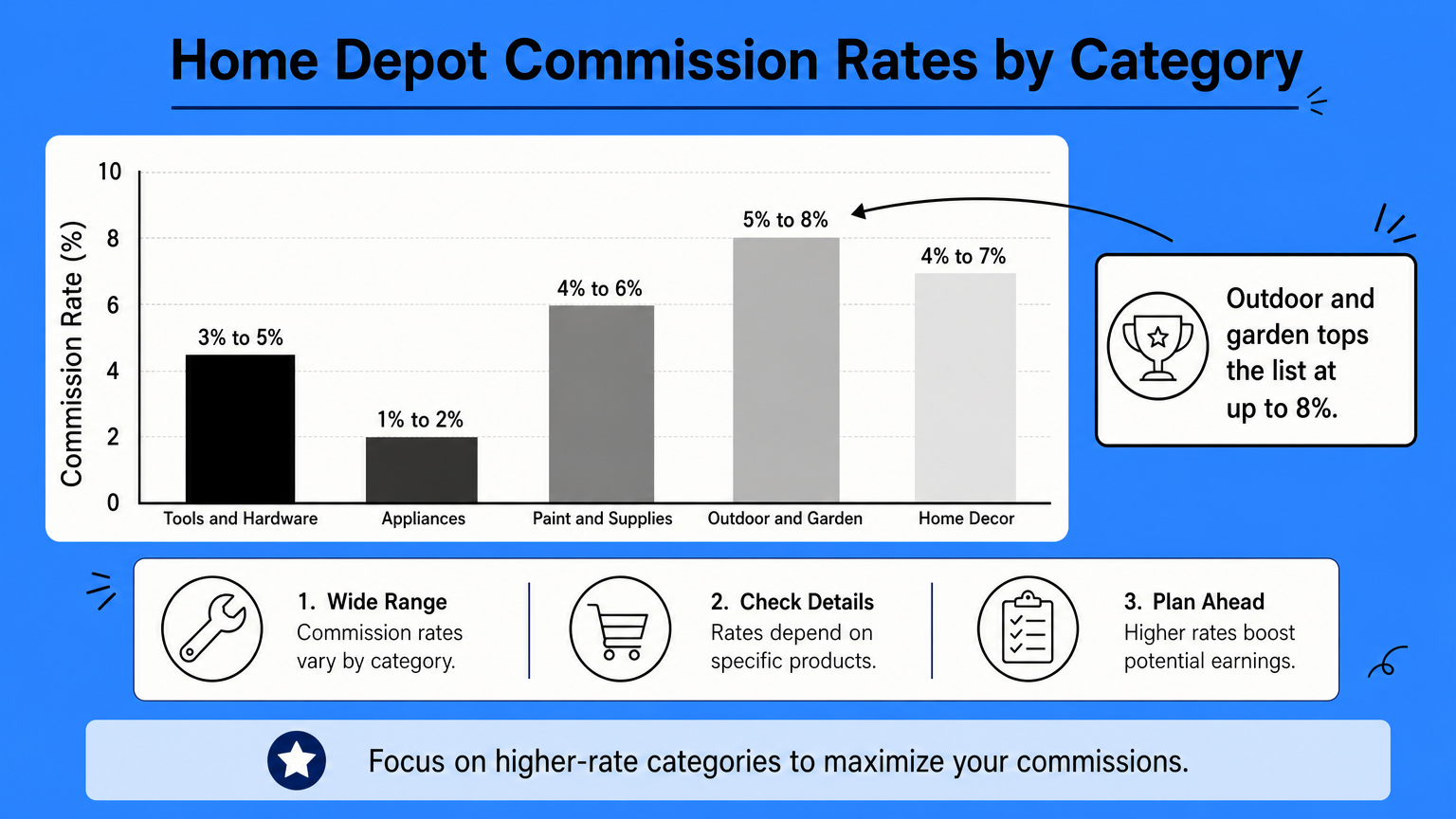
Rates shift periodically, so always confirm current numbers inside your Impact dashboard before building a content strategy around them. As a general guide, here’s how the categories typically break down:
| Category | Typical Commission Rate | Notes |
|---|---|---|
| Tools and hardware | 3% to 5% | Steady demand, moderate price points |
| Appliances | 1% to 2% | High price but low percentage due to thin margins |
| Paint and supplies | 4% to 6% | Frequent repeat purchases |
| Outdoor and garden | 5% to 8% | Seasonal spikes drive strong payouts |
| Home decor | 4% to 7% | Lower price but decent percentage |
A 1% commission on a $2,000 refrigerator can still beat an 8% commission on a $15 garden tool, so do the math before choosing what to promote.
Why the cookie window is shorter than you’d expect
Home Depot’s cookie duration typically runs around 1 day for click-based attribution, which is noticeably shorter than programs like Amazon Associates or many niche retailers offering 30 to 90 day windows. This shorter window changes how you write content. You can’t rely on a reader bookmarking your article and buying two weeks later, since the cookie will have expired long before then. Instead, your content needs to drive a decision close to the moment of the click, meaning strong calls to action, clear product comparisons, and urgency around seasonal buying windows all matter more here than they would with a longer-tracking program.
This is one of the biggest adjustments new affiliates underestimate when they move from Amazon-style programs to Home Depot’s setup. Plan your content to answer buying questions directly rather than just building general awareness, since general awareness content loses its tracking advantage almost immediately.
Payout thresholds and payment methods
Payouts run through Impact Radius rather than a Home Depot-branded system, and you’ll need to hit a minimum earnings threshold before funds actually move to your account, commonly set around $50. Quick reference for what to expect:
- Payment schedule: Monthly, typically net-30 after the close of the earning period
- Minimum threshold: Usually $50, though this can vary by account setup
- Payment methods: Direct deposit or PayPal, depending on what you’ve configured in your Impact profile
- Reporting: Real-time dashboard access showing clicks, conversions, and pending versus confirmed commissions
Returns and cancellations also affect your bottom line more than new affiliates expect. If a customer returns a purchased item, Home Depot reverses the commission, and appliance or furniture returns happen often enough that you shouldn’t count pending earnings as guaranteed until they clear. Check your dashboard regularly rather than assuming every tracked sale turns into a paid commission, since the gap between clicks, confirmed sales, and actual payouts is where a lot of affiliate math goes wrong for people who don’t watch the numbers closely.
Best product categories to promote as an affiliate
Knowing the commission structure only gets you halfway there. The real question is which products actually convert well enough, and pay well enough, to justify the content you build around them. Some categories look tempting on paper because of high commission percentages, but they sit on products nobody buys on impulse. Others carry lower rates but move so consistently that they still win over time. Picking the right mix is what separates a home depot affiliate programs strategy that pays rent from one that just sits there generating pennies.

Outdoor and garden equipment wins on volume and season
Gardening and outdoor tools consistently rank among the strongest performers for affiliates, and it’s not just because the commission rate runs higher at 5% to 8%. Demand spikes hard every spring and summer, and readers researching lawnmowers, trimmers, or patio furniture tend to already be in buying mode rather than just browsing. Content built around “best cordless leaf blower” or “how to set up a raised garden bed” tends to convert faster than generic awareness posts because the searcher already knows what they want, they just need help picking a specific model.
Tools and hardware offer steady, repeatable income
Unlike seasonal categories, tools and hardware sell year round, which makes them a dependable backbone for your content calendar. A reader replacing a broken drill doesn’t wait for a sale season, they buy the week it breaks. This category also lends itself naturally to comparison content, buying guides, and review videos, which tend to rank well in search and hold up over time without constant updates.
Steady categories like tools keep the lights on while seasonal spikes bring the bigger paydays.
Paint and home decor drive frequent, repeat purchases
Paint supplies and home decor items pay a solid 4% to 7% and benefit from something other categories don’t: repeat buying behavior. Someone who paints one room often paints another within a few months, and decor purchases tend to cluster around moving, redecorating, or seasonal refreshes. If you write renovation or staging content, this category gives you multiple entry points across a single project, from primer and brushes to finishing touches like curtains or shelving.
Appliances pay less per sale but sell at higher price points
Appliances sit at the bottom of the commission scale, usually 1% to 2%, but the math still works because of ticket size. A 1.5% commission on a $1,800 washer and dryer set beats a lot of smaller-ticket sales combined. This category works best paired with content about home renovations before selling a house or upgrading a rental property, where the reader is already committed to a bigger purchase and just needs guidance on which model fits their budget.
Here’s a quick way to think about where to focus your content effort:
- High-frequency, lower-ticket: tools, paint, hardware. Good for steady, recurring content.
- Seasonal, higher-percentage: outdoor and garden gear. Good for spring and summer content pushes.
- Low-percentage, high-ticket: appliances and furniture. Good for renovation or moving-focused content.
- Mid-range, decor-driven: home decor and lighting. Good for staging, remodeling, or lifestyle content.
Most successful affiliates don’t pick just one category. They build a content mix that leans on steady sellers for consistent traffic and layers seasonal or high-ticket recommendations on top when the timing fits. That blend keeps your income from swinging wildly between months while still capturing the bigger commission checks when the opportunity shows up.
How Home Depot compares to other retail affiliate programs
Comparing retail affiliate programs side by side tells you a lot about where Home Depot actually sits in the pecking order, and the honest answer is: it’s neither the best-paying nor the worst option available. Home Depot’s 1% to 8% range sits below Amazon Associates in some categories and above it in others, while its one-day cookie window is dramatically shorter than most competitors. Knowing these differences before you commit your content strategy to one program saves you from building an entire site around assumptions that don’t match reality.
Commission rates and cookie windows side by side
Grouping the major retail affiliate programs into a single table makes the tradeoffs obvious fast:
| Program | Commission Range | Cookie Duration | Payout Threshold |
|—|—|—|
| Home Depot | 1% to 8% | 1 day | $50 |
| Amazon Associates | 1% to 10% | 24 hours | $10 (direct deposit) |
| Lowe’s | 2% to 4% | 1 to 3 days | Varies by network |
| Wayfair | 1% to 7% | 7 days | Varies by network |
| Best Buy | 1% to 4% | 1 day | Varies by network |
Notice that most big-box retail programs cluster around short cookie windows and modest commission percentages. This isn’t a Home Depot weakness specifically, it’s just how large retailers with thin margins structure affiliate payouts across the entire industry.
Retail affiliate programs rarely compete on commission rate alone, they compete on catalog size, trust, and how fast a reader converts.
Where Home Depot pulls ahead
Outdoor and seasonal categories are where Home Depot’s catalog genuinely beats general marketplaces. A dedicated home improvement retailer stocks deeper inventory in lawn equipment, power tools, and building materials than a generalist site ever will, and that depth means your product recommendations feel more authoritative when they come with a Home Depot link attached. Readers researching a specific drill model or a particular paint brand also benefit from Home Depot’s detailed product pages, warranty information, and in-store pickup options, none of which a smaller or less specialized retailer can match as consistently.
Where competitors pull ahead
Questions about cookie duration usually decide which program wins for a given content type. Amazon’s shorter attribution window gets offset by its sheer purchase volume and cross-category buying, meaning a reader clicking your drill link might buy a completely unrelated item and still earn you a commission. Wayfair’s seven-day cookie gives you noticeably more room for readers who browse before committing, which matters for furniture and decor content where purchase decisions take longer. If your audience compares prices across multiple sessions before buying, a program with a longer cookie will outperform Home Depot even at a similar commission rate.
Choosing based on your content, not just the numbers
Deciding which program deserves your primary focus comes down to matching your content format to each program’s strengths rather than chasing the highest listed percentage. Home Depot fits creators writing project-based, decision-ready content where readers already know what they need. Amazon fits creators covering a wider mix of products where cross-selling matters more than category depth. Wayfair and similar home goods programs fit slower-decision purchases like furniture. Running two or three programs side by side, and tracking which one actually converts for your specific traffic, beats guessing based on commission rate alone.
Tips to boost your Home Depot affiliate earnings
Making real money from this program isn’t about landing on the perfect product once, it’s about stacking small advantages that increase your profits until they add up. Given the short cookie window and modest commission rates covered earlier, you need every edge you can get. The tips below come from what actually moves the needle for home depot affiliate programs partners rather than generic advice you’d find on any affiliate blog.
Write buying-stage content, not awareness content
General “why home improvement matters” articles waste your traffic on Home Depot’s one-day cookie. Readers need to click and buy fast, so your content should meet them at the exact moment they’re ready to purchase. Titles like “best pressure washer under $200” or “which cordless drill should you buy in 2026” pull in searchers who already decided to spend money, they just need the final push. Save the broader educational content for topics without a purchase-ready reader attached, and reserve your Home Depot links for pages where the buying decision is already halfway made.
Content built for the moment of decision beats content built for general awareness every time the cookie window is short.
Use comparison tables and specific product callouts
Readers skim before they buy, and a comparison table does more selling than three paragraphs of prose ever will. Break down specs, price ranges, and best-use cases side by side, then link each row directly to the specific product page rather than a category page. This small habit alone increases conversion because it removes an extra click and matches your reader’s intent to the exact item they were reading about.
Time your content around seasonal demand
Spring and early summer bring outdoor and garden traffic. Fall drives insulation, weatherproofing, and heating equipment searches. Winter holidays push tool gift guides and small appliance upgrades. Building a content calendar around these cycles, and publishing a few weeks ahead of peak search volume, gets your pages indexed and ranking before the buying window opens rather than after it closes.
Diversify traffic sources instead of relying on one channel
Search traffic alone leaves you exposed to algorithm shifts, so pair it with other channels:
- YouTube tutorials with affiliate links in the description, since video content often ranks separately from your written site
- Email newsletters sent right before seasonal buying windows open, when your cookie’s short duration matters less because you’re driving intent-to-buy traffic directly
- Pinterest boards for DIY and renovation projects, which tend to drive steady long-tail traffic to older posts
- Social media posts timed around sales events, since Home Depot’s periodic promotions give you a natural reason to post
Track performance and cut what isn’t working
Check your Impact dashboard regularly rather than assuming your top-traffic pages are also your top-earning ones. Sometimes a low-traffic page focused on a high-ticket item outperforms a popular post promoting cheap accessories. Once you spot which content actually converts, double down there instead of spreading effort evenly across everything you’ve published.
Bundle Home Depot links with other income streams
Rather than treating this program as your only monetization method, layer it into a broader strategy. A single renovation guide can carry Home Depot product links alongside display ads, an email opt-in, or a link to a related passive income resource. This approach mirrors advice we’ve covered when comparing platforms like Fiverr and agency work, where stacking multiple income sources on the same content beats relying on one alone.
Common mistakes that cost Home Depot affiliates money
Most affiliates lose money through small, repeated errors rather than one big blunder. These mistakes eat into commissions quietly, so you often don’t notice until you compare what you should have earned against what actually landed in your account. Knowing the common traps ahead of time saves you from learning them the expensive way.
Linking to the wrong page
Sending traffic to a category page or the Home Depot homepage instead of the exact product you reviewed kills conversions fast. A reader who just read 800 words about a specific pressure washer doesn’t want to hunt through a category page to find it again, and most won’t bother. Always generate a deep link through Impact’s tools that points straight to the product page you’re recommending, and double check the link after Home Depot redesigns its site, since URLs sometimes shift and break old links without warning.
Ignoring the one-day cookie window
Treating Home Depot links like Amazon links is a costly habit. Writing broad, evergreen content and hoping readers eventually click through days later ignores the reality of a one-day cookie, and that mismatch between content style and tracking window is one of the biggest reasons new affiliates underperform. Content needs to drive an immediate decision, not plant a seed for later.
If your content doesn’t push a reader to click and buy within hours, the commission is already gone before they decide.
Chasing commission percentage over actual sales
Newer affiliates often build entire articles around the highest-percentage category without checking whether anyone actually buys those products online. Outdoor gear pays 5% to 8%, but if your traffic doesn’t include anyone shopping for a leaf blower, that high rate means nothing. Overweighting content toward commission percentage instead of realistic buyer intent leaves you with pages that rank fine but never convert.
Skipping proper disclosure
Quietly dropping affiliate links without disclosure isn’t just against FTC guidelines, it also risks your Impact account getting flagged during a program review. The FTC’s endorsement guidelines require clear, easy-to-find disclosure near any affiliate link, and Home Depot’s compliance team does check for this during approval and periodic audits. Skipping this step can cost you your entire account, not just a few commissions.
Letting dead links and out-of-stock products sit unattended
Products get discontinued, prices change, and links go stale, but a lot of affiliates never revisit old posts to fix them. A reader clicking through to a dead product page bounces immediately, and that’s a lost sale you’ll never see in your dashboard. Set a recurring reminder, maybe quarterly, to audit your top-performing pages and swap out any broken or discontinued product links before they quietly drag your conversion rate down.
Treating pending commissions as guaranteed income
Counting every tracked click as confirmed money is a mistake that catches people off guard around tax season or when planning a budget. Returns on appliances and larger purchases happen often enough that Home Depot reverses those commissions after the fact, so treat your dashboard’s pending numbers as an estimate rather than a paycheck until they actually clear.
Is this affiliate program right for you?
So, does the home depot affiliate programs setup deserve a spot in your income mix? If you already write about home improvement, DIY projects, real estate, or budget renovations, the answer is yes. You get a trusted brand, a massive catalog, and predictable seasonal demand to plan content around, even with a short cookie window and modest commission rates. If your content lives entirely outside physical products, your time is better spent elsewhere.
Either way, no single program should carry your entire income. Pair Home Depot with other affiliate partnerships, ad revenue, or freelance work so a shorter cookie window or a rate change doesn’t sink your month. That’s the whole point of building multiple income streams instead of betting on one.
If you’re ready to diversify your earnings beyond this one program, start with our guide to proven ways to make money online and keep growing what you already have.
Article Summary
This guide explains how content creators can monetize home improvement, DIY, real estate, and personal finance content through the Home Depot affiliate program, run via Impact Radius, offering commissions of 1% to 8% depending on category and a notably short one-day cookie window. It covers eligibility requirements (active site, consistent traffic, relevant niche, disclosure policy), the step-by-step signup process, and how to generate tracking links. Commission breakdowns show outdoor/garden and paint categories paying highest (4-8%), while appliances pay lowest (1-2%) but offer high ticket value. Payouts run monthly through Impact with a typical $50 threshold via direct deposit or PayPal, and returns can reverse commissions. The article compares Home Depot to competitors like Amazon, Lowe’s, Wayfair, and Best Buy, noting Home Depot excels in catalog depth for outdoor and tools but loses on cookie duration. Practical tips include writing buying-stage content, using comparison tables, timing posts around seasonal demand, diversifying traffic sources, and tracking performance. Common mistakes include linking to wrong pages, ignoring the short cookie window, chasing high commission percentages without buyer intent, skipping disclosures, and treating pending commissions as guaranteed. Ultimately, it recommends pairing Home Depot with other income streams for diversification rather than relying on it alone.











Comments