
 By
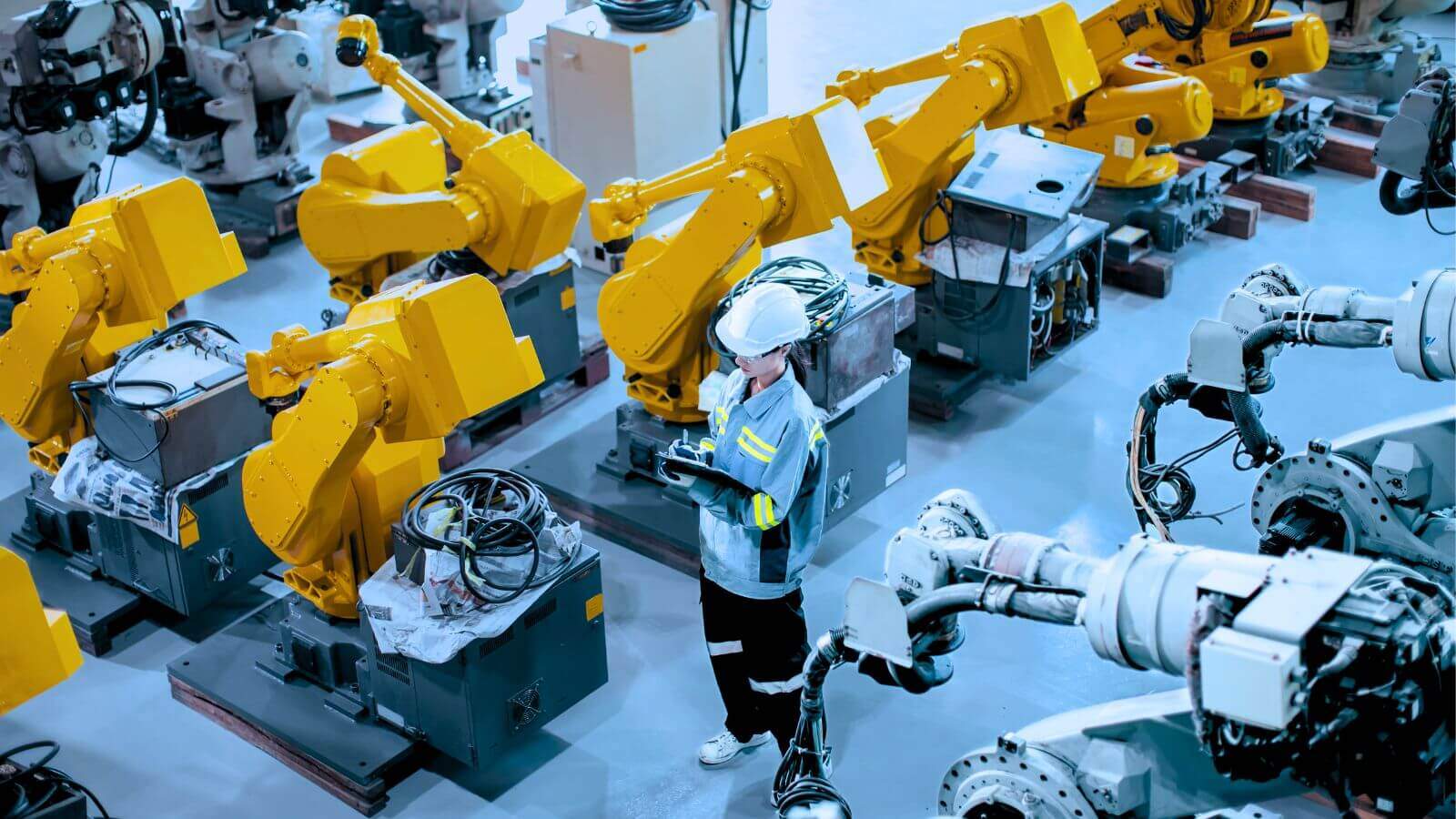
AI is shifting production from reactive to predictive systems, supporting Industry 4.0 and Industry 5.0. Smart factories can now predict equipment breakdowns, optimise production cycles, and decrease waste in real time by combining IoT sensors with machine learning.
Core Pillars of AI in Smart Factories
- Predictive Maintenance (PdM): Uses AI to analyze vibration, temperature, and pressure data to forecast machine failures before they occur.
- Impact: Can reduce unplanned downtime by 30–50% and lower maintenance costs by 10–40%.
- Techniques: Employs supervised learning for failure prediction and unsupervised learning for anomaly detection.
- Automated Quality Control: Computer vision systems inspect products on the line, identifying microscopic defects with higher precision than human inspectors.
- Collaborative Robotics (Cobots): AI-enhanced robots work alongside humans, adapting to their environment and taking over repetitive or hazardous tasks.
- Digital Twins: Virtual replicas of physical assets allow manufacturers to simulate “what-if” scenarios and optimize workflows without risking actual equipment.
Strategic & Economic Benefits
- Cost Reduction: Extends equipment lifespan and optimizes spare parts inventory by replacing components only when necessary.
- Operational Efficiency: AI-driven scheduling adjusts for real-time demand and resource availability, improving Overall Equipment Effectiveness (OEE).
- Sustainability: AI minimizes energy waste by identifying inefficiencies in power-intensive machinery and reducing scrap rates.
- Enhanced Safety: Real-time monitoring flags hazardous conditions and equipment malfunctions, preventing workplace accidents.
Implementation Challenges
- Data Quality: AI models require high-quality, clean, and structured data, which can be difficult to obtain from legacy systems.
- High Initial Investment: Significant upfront costs for sensors, IoT infrastructure, and AI platform deployment.
- Skill Gap: Shortage of specialized talent in data science and AI required to manage and interpret complex industrial models.
- Cybersecurity: Increased connectivity creates new vulnerabilities, requiring robust encryption and regular security audits.
Future Directions
- Edge AI: Processing data directly on machines to reduce latency and enable instantaneous decision-making.
- Explainable AI (XAI): Developing models that provide transparent reasoning for their predictions to build trust with human operators.
- Generative AI: Used for rapid prototyping, drafting maintenance instructions, and analyzing unstructured logs.
Automation in manufacturing is the use of control systems (such as computers, robotics, and information technologies) to manage various processes and machinery in an industrial setting. In many workplaces today, automated technology have replaced human participation in repetitive activities, lowering errors, increasing safety, and shortening production cycles.
However, while automation has many advantages, it still relies primarily on pre-programmed instructions and lacks adaptability in unexpected situations.
AI-powered manufacturing incorporates machine learning, data analytics, and cognitive computing into industrial processes. Unlike traditional automation, which is based on rules, AI allows computers to learn from experience, adapt to new conditions, and make autonomous, data-driven judgments. Instead of replacing automation, AI enhances it by transforming static workflows into dynamic, self-optimizing processes that enable predictive maintenance, intelligent quality inspection, and process optimization.
Where Automation Reaches Its Limits in Manufacturing
Traditional automation excels at executing repetitive, structured tasks with speed and precision. However, it struggles when variability increases. It cannot interpret unstructured data, detect subtle quality deviations in real time, or reconfigure itself dynamically to respond to changing customer demands.
For manufacturers pursuing mass customization, zero-defect quality, and predictive operations, these limitations become critical barriers. AI addresses these gaps by introducing adaptability, continuous learning, and decision-making capabilities directly into the production environment.
These constraints explain why forward-looking manufacturers are increasingly turning to AI-powered systems. The following technologies form the foundation of this transformation.
Key Technologies Driving AI in Manufacturing
The shift from traditional automation to AI-driven manufacturing is powered by technologies that make factories more intelligent, responsive, and resilient.
- Machine Learning (ML) and Deep Learning: Machine learning algorithms allow systems to learn from data and improve over time. In manufacturing, ML is used to analyze sensor data, detect patterns, and predict outcomes such as maintenance needs or production bottlenecks.
- Computer Vision: Computer vision enables machines to visually interpret their environment. AI-powered vision systems inspect products in real time, detect defects, and support consistent quality control across production lines.
- Internet of Things (IoT): IoT devices collect large volumes of real-time data from machines and processes. An IoT monitoring system extends this capability by continuously tracking machine health, process variables, and performance metrics. AI leverages this data to optimize production, predict failures, and improve supply chain coordination.
- Robotics and Collaborative Automation: AI-enhanced robots go beyond predefined routines. They can adapt to changing conditions, learn from their environment, and collaborate more effectively with human operators.
- Robotic Process Automation (RPA): RPA automates repetitive, rule-based business processes, allowing human workers to focus on higher-value activities. When combined with AI, RPA supports optimized workflows such as maintenance scheduling and audit processes.
- Natural Language Processing (NLP): NLP enables machines to understand and process human language. In manufacturing environments, NLP improves interaction between operators and systems and supports analysis of unstructured data such as maintenance logs or customer feedback.
What are the Benefits of Using AI in Manufacturing Today?
Integrating AI into manufacturing unlocks capabilities far beyond those of traditional automation systems.
1. Enhanced Operational Efficiency
AI can dynamically optimize manufacturing processes in real-time, improving operational efficiency. By continuously analyzing data, AI systems can adjust machine settings or reallocate resources to prevent bottlenecks and ensure smooth operations. This level of optimization extends to energy consumption, reducing waste and lowering operational costs.
Read Also: AI in Retail: Personalization & Inventory Optimization
AI-driven automation is also more adaptable than traditional automation. As demand changes or unexpected issues arise, AI can make on-the-fly adjustments, ensuring that production lines remain responsive to fluctuating conditions.
2. Predictive Maintenance and Reduced Downtime
AI-powered predictive maintenance is one of the most significant applications of AI in manufacturing. By using AI to analyze real-time data from equipment, manufacturers can predict failures before they occur. This approach reduces the need for time-based maintenance and ensures that machines are serviced when necessary, rather than when they break down. F.e., AI can predict the wear and tear on a machine’s critical components, such as motors or bearings, and recommend proactive maintenance actions. This significantly reduces unplanned downtime, prolongs the lifespan of equipment, and minimizes costly repairs.
3. Automated Quality Control
AI’s ability to monitor and inspect quality in real time is revolutionizing the quality assurance process. Traditional quality control relies on human inspectors, who may miss defects or inconsistencies. With AI-powered computer vision, defects can be detected with greater precision, even down to microscopic levels. This leads to more consistent product quality and higher customer satisfaction. AI can also identify emerging quality trends, enabling manufacturers to take corrective action before defective products reach the market.
4. Enhanced Decision-Making
By integrating data from multiple sources, such as production performance, supply chain status, and market demand, AI enables faster, more accurate decision-making. Machine learning models can identify patterns and correlations that may be invisible to human analysis, helping managers choose the most effective actions in complex scenarios. This leads to better production planning, optimized inventory levels, and improved overall strategic outcomes.
5. Agility and Flexibility in Production
AI’s ability to process vast amounts of real-time data enables manufacturers to be more agile and responsive. If demand changes, AI systems can adapt production schedules, resource allocation, and machine parameters to meet new requirements. This level of flexibility is particularly valuable in industries where customization is increasingly in demand. For instance, in automotive manufacturing, AI can manage assembly lines for multiple car models, automatically adjusting settings to accommodate different designs or production volumes.
6. Environmental Sustainability
AI supports environmental sustainability in manufacturing by optimizing energy use, reducing material waste, and enabling more efficient resource management. F.e., AI can fine-tune process parameters to minimize scrap rates or adjust energy-intensive operations to run during periods of lower grid demand.
Barriers to AI Adoption in Manufacturing
Despite its vast potential, implementing AI in manufacturing comes with distinct challenges that must be addressed.
1. High Initial Investment
Integrating AI into manufacturing often requires substantial upfront spending on technology and infrastructure. Legacy equipment may need upgrades, new sensors and IoT devices must be installed, and advanced platforms deployed. Training staff and managing changeover periods further increase total cost of ownership.
2. Integration and Interoperability
AI solutions must seamlessly connect with MES, ERP, SCADA, and shop-floor equipment. Weak interfaces and isolated data systems not only slow implementation but also create ongoing maintenance challenges.
3. Data Management and Security
AI depends on large volumes of high-quality data, which must be stored, processed, and made accessible in real time. This requires robust infrastructure and strict cybersecurity measures to protect sensitive production data from potential breaches.
4. Data Readiness and Harmonization
AI models need clean, consistent, and unbiased data to perform effectively. This means standardizing and harmonizing sources across sites, then staging them so data is feature-ready and usable by all relevant functions.
5. Operational Fit and Ownership
AI initiatives work best when tied to clearly defined, measurable use cases that align with real production needs. Assigning a single accountable owner across IT and OT keeps scope focused and adoption on track.
6. Skill Gap and Workforce Transition
Manufacturers need structured upskilling programs and long-term workforce strategies, which may require additional investment.
How Is AI Used in Manufacturing?
AI is applied across the manufacturing floor in targeted ways that deliver measurable results:
- Predictive Maintenance: AI analyzes vibration, temperature, and operational data to anticipate failures before they occur, enabling maintenance teams to act proactively.
- Automated Quality Inspection: Computer vision detects surface defects, misalignments, or color inconsistencies in real time, improving quality assurance at scale.
- Adaptive Process Control: Machine learning models adjust parameters such as speed, pressure, or temperature on the fly to maintain optimal production conditions.
- Demand Forecasting & Inventory Optimization: AI-driven analytics predict customer demand patterns, ensuring materials and finished goods are available without excess stock.
- Energy Efficiency Management: AI identifies energy-saving opportunities, such as shifting high-consumption processes to off-peak hours.
- Generative Design & Prototyping: AI accelerates product design cycles by proposing geometry and process improvements based on performance requirements.
- Supply Chain Audit: AI-powered supply chain audits enhance the auditing process by automating data collection, ensuring compliance, and identifying inefficiencies in real time.
These applications are rarely implemented all at once. Most manufacturers begin with a single high-impact area, often predictive maintenance or quality inspection, and expand further once ROI has been validated.
What is a Smart Factory?
A smart factory uses AI and thousands of connected sensors to continuously optimize its operations. Think of real-time decision-making, not just automation. Every machine, process, and component is equipped with sensors that feed data to AI systems, measuring everything from temperature and vibration to power consumption and output quality.
Key technologies powering smart factories include:
- Internet of Things (IoT): Connecting devices to the internet for data collection and remote control.
- Artificial Intelligence (AI): Enabling machines to learn and adapt to changing conditions.
- Machine Learning: Using algorithms to analyze data and make predictions.
- Robotics: Automating tasks for increased productivity and precision.
- Big Data Analytics: Processing large datasets to uncover valuable insights.
With these technologies, smart factories are revolutionizing manufacturing processes and driving Industry 4.0.
How AI Drives Operational Excellence in Manufacturing
AI revolutionises manufacturing by enabling predictive maintenance, quality control, and optimized production processes. Let’s look at an example – a smart factory producing cars. Machine IoT sensors monitor their performance in real-time, gathering data on factors like temperature, vibration, and energy consumption.
This data is then fed into AI algorithms that can predict potential equipment failures before they occur.
By anticipating breakdowns, maintenance teams can schedule repairs proactively, minimizing downtime and maximizing production efficiency. On the more advanced side, AI-powered vision systems can inspect products for defects, ensuring quality standards are met.
As the system learns from each inspection, it becomes increasingly accurate in identifying flaws, reducing the need for manual quality control.
Furthermore, AI can optimize production schedules based on real-time demand and supply chain data. They can analyze historical data and current trends with AI algorithms to forecast future demand, allowing manufacturers to adjust production plans accordingly.
This helps avoid overproduction or stockouts, improving inventory management and cost savings.
Can Everything Be Automated in Manufacturing?
Yes and no. While the vision of a fully autonomous smart factory is enticing, practical limitations and technological hurdles still exist.
Repetitive tasks, like transporting materials or assembling products, are ideal for automation. Manufacturing operations focus most of their efforts on these tasks performed by robots. However, other business process types can become more complicated.
Unpredictable Processes: Processes that involve variability or require adaptability pose challenges for automation. For example, quality control tasks that identify subtle defects or make subjective judgments often require human expertise. AI vision systems are an option but can be prohibitively expensive for small and medium-sized manufacturers.
Non-Automatable Processes: Certain tasks, particularly those involving fine motor skills, dexterity, or complex decision-making, remain beyond the capabilities of current automation technology. For instance, tasks like kitting, which involves picking and placing small parts, require precision and adaptability that is difficult to achieve with robotic systems.
To overcome these limitations, manufacturers can adopt a “redesign for automation” approach. This involves rethinking processes, products, and factory layouts to make them more fit for automation.
For example, instead of relying on complex robotic systems to handle a variety of part sizes, manufacturers can redesign their processes to group similar parts together, reducing the number of required robots and simplifying the automation process.
Summary
AI in manufacturing allows smart factories to transition from reactive to proactive operations by evaluating real-time data from IoT sensors to forecast equipment failures, improve maintenance schedules, and reduce downtime. Manufacturers use machine learning and AI to increase productivity, save costs, lengthen asset lifespans, and improve quality control.










Comments