
 By
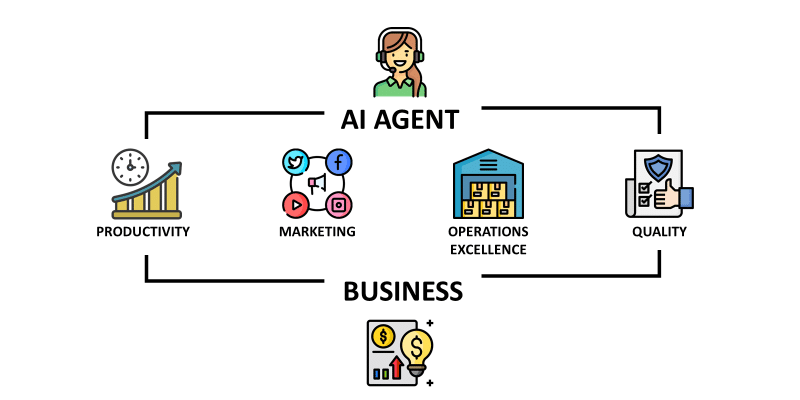
How do you make money as an AI automation agent? Find a repetitive business problem, build a reliable workflow that solves it, and charge for implementation and ongoing support. Local businesses pay for faster responses, fewer mistakes, and less administrative work—not impressive AI terminology.
Can this become a substantial income stream? Yes, if clients receive measurable value and stay with you. But a mega income stream is an ambition, not a guaranteed result. Revenue depends on your sales ability, delivery costs, support workload, and client retention.
What Is an AI Automation Agent?
Here, an AI automation agent means a service provider who builds and maintains business workflows. AAA can also mean “AI automation agency”; it is not a formal professional qualification.
Your service connects tools a business already uses, such as forms, email, calendars, and customer records. AI can interpret a customer message, extract details, or prepare a reply. Ordinary automation moves those details between systems.
The distinction matters. A booking confirmation often needs clear rules, while an untidy customer enquiry may benefit from AI. Use each where it adds value.
Is There Real Demand in the United States?
Yes, recent U.S. research shows widespread interest and adoption, although surveys report different rates. The latest available figures include:
| Finding | Source and date | Meaning for your service |
|---|---|---|
| 66% of surveyed small businesses use AI | U.S. Chamber, October 2, 2026 | Many prospects already understand AI |
| 41% use six or more technology platforms | U.S. Chamber, 2026 | Connecting existing systems may be valuable |
| 84% plan to increase technology use over two to three years | U.S. Chamber, 2026 | There is interest in further adoption |
| AI use hovered between 17% and 20% | Census BTOS, December 2025–May 2026 | Adoption remains uneven across employer businesses |
The Chamber and Census use different populations, questions, and periods. Their figures are not directly comparable, and neither measures demand specifically for outside automation consultants.
As Holly Wade, executive director of the NFIB Research Center, said in its June 2025 release:
“Small business owners are our nation’s top source of innovation, yet many small businesses struggle to keep up with technological advancements.”
Your opportunity is to make adoption practical.
Step 1: Which Local Business Niche Should You Choose?
Choose one niche with repeated tasks, reachable owners, and measurable problems.
| U.S. business example | Workflow to explore | Outcome to measure |
|---|---|---|
| Phoenix HVAC contractor | Classify quote requests and route enquiries | Response time and booked estimates |
| Dallas auto repair shop | Organise service requests and draft updates | Administrative time per booking |
| Chicago cleaning company | Capture enquiries and schedule follow-up tasks | Enquiries reaching a sales conversation |
| San Diego salon | Send approved appointment reminders | Attendance and scheduling workload |
These are illustrative opportunities, not reported customer results. Choose businesses you can interview before committing to a solution.
Step 2: How Do You Find a Problem Worth Paying For?
Ask the owner to show you a recurring task, then measure its current cost. Useful discovery questions include:
- Which enquiries go unanswered or arrive too late?
- Where does the team copy information between applications?
- How often does someone correct the same mistake?
- What happens when the usual employee is unavailable?
- Which software and customer data can the workflow access?
Suppose a receptionist spends ten hours monthly copying enquiries. At an assumed $25 hourly labour cost, that represents $250 of staff capacity. Saving it does not necessarily reduce payroll; the value may be more time for customers.
Read Also: How to Build 5 Simultaneous Passive Income Streams
Separate proven time savings from hoped-for sales. A business owner will trust a modest, defensible calculation more than an invented revenue forecast.
Step 3: What Should Your First Workflow Do?
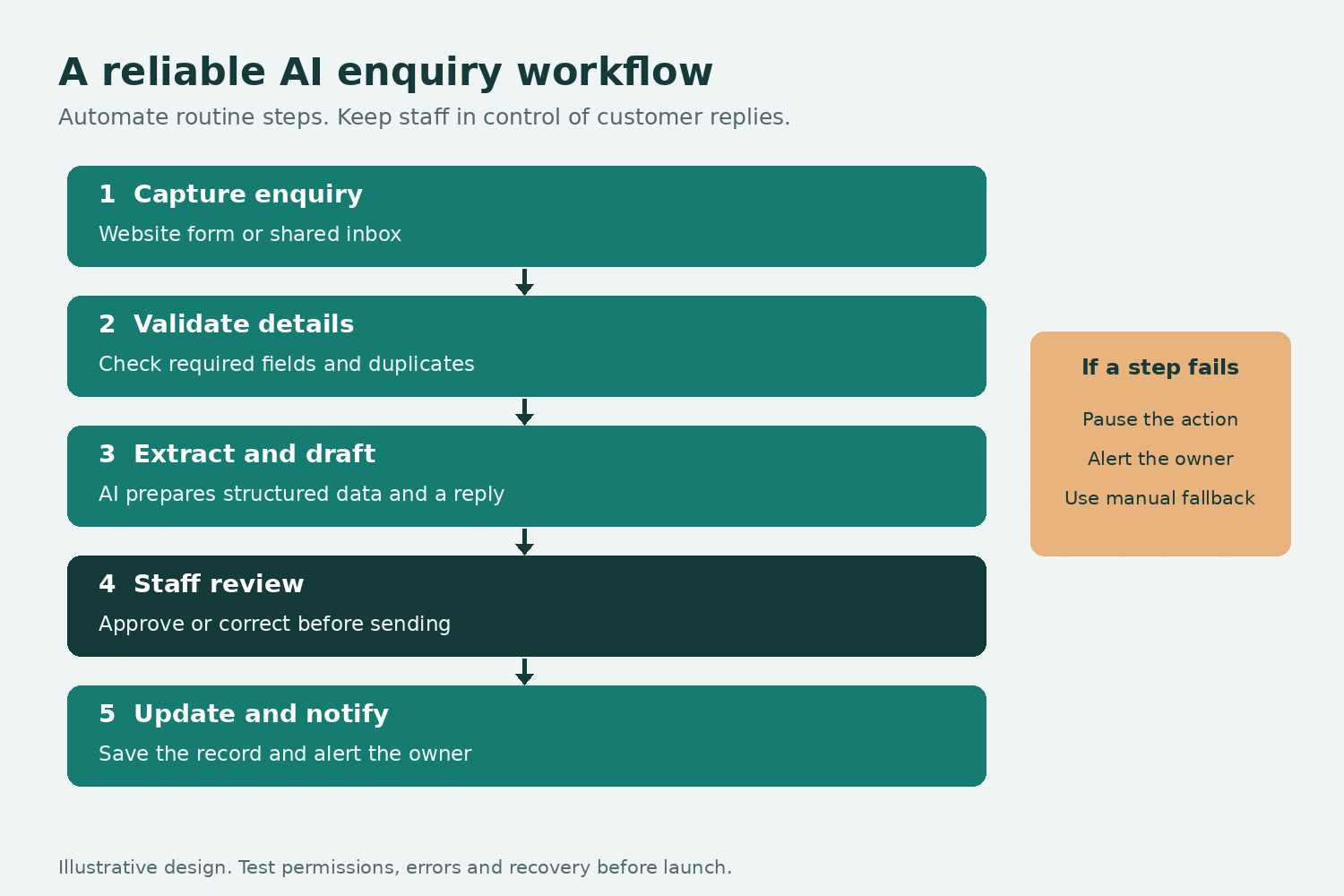
Solve one problem from beginning to end. A useful first offer is enquiry handling: receive a form submission, extract details, create a customer record, draft an acknowledgement, and notify the owner.
Begin with approved replies and human review. Let staff handle unusual questions, pricing exceptions, and complaints.
There are real U.S. examples of practical value. The Chamber describes San Francisco’s Henry’s House of Coffee using AI for marketing and content tasks. U.S. Chamber of Commerce Owner Hrag Kalebjian said:
“It truly helps us be more efficient and focus on what we do best: roasting great coffee.”
Zapier reports that Smart Charge America removed five minutes of work per quote, allowing each estimator to process 15 additional quotes daily. That is a vendor-reported automation case, not proof of typical AI agency earnings.
Step 4: Which Tools and Skills Do You Need?
Learn one automation platform well, then add the integrations your clients need. Make connects applications and supports workflow logic; n8n supports AI workflows with human review steps. Check available integrations before choosing your stack.
Focus on five skills:
- Mapping triggers, actions, decisions, and exceptions.
- Connecting applications through supported integrations or APIs.
- Extracting and validating structured information from messages.
- Testing failures, duplicate submissions, and missing details.
- Explaining results in language a business owner understands.
Use synthetic data for demonstrations. Add error alerts, spending limits, and a manual fallback. Never assume an AI answer is correct simply because it sounds confident.
Step 5: How Should You Price Your Service?
Charge separately for the build and the work required to keep it useful. The following prices are illustrative starting offers, not market averages:
| Package | Illustrative price | Defined scope |
|---|---|---|
| Paid pilot | $300–$600 once | One workflow, limited users, agreed test period |
| Implementation | $1,000–$2,500 once | Setup, integrations, testing, documentation, training |
| Managed support | $200–$750 monthly | Monitoring, maintenance, reporting, limited changes |
Quote software, model usage, messaging, and hosting separately or set explicit allowances. State who owns accounts, how extra work is priced, and what happens when the client leaves.
Match price to verified value and complexity. If a workflow creates only $250 of monthly benefit, a $750 retainer needs another clear justification.
Step 6: How Do You Find and Close Clients?
Start with a short, personalised demonstration of a problem the owner recognises. Build a focused prospect list using public business directories, local associations, and referrals.
Your opening should explain the result: “I help repair shops turn incoming service enquiries into organised booking tasks.” Avoid leading with model names or technical architecture.
Then follow this sequence:
- Confirm the problem through a brief conversation.
- Demonstrate the workflow using sample information.
- Agree on one success measure and a baseline.
- Offer a bounded paid pilot.
- Present implementation and support terms after discussing results.
Use respectful outreach and avoid mass scraping or deceptive claims.
Step 7: How Do You Deliver Without Losing Trust?
Make ownership, approvals, and recovery clear before launch. Test normal enquiries, missing fields, duplicate records, unavailable services, and failed integrations.
Give the client documentation, a walkthrough, and an obvious way to pause automation. Limit data access to what the workflow needs. Keep credentials protected and agree on retention and deletion.
Before customer messages go live, confirm approved wording and applicable consent requirements. Escalate sensitive decisions to staff instead of letting AI improvise.
A monthly report should show successful runs, failures, time saved, costs, and relevant business outcomes. Maintenance is part of the product, not an afterthought.
Step 8: How Do You Grow Recurring Revenue?
Standardise delivery, retain satisfied clients, and expand only after proving capacity. Reuse workflow templates, onboarding checklists, and monitoring routines within your chosen niche.
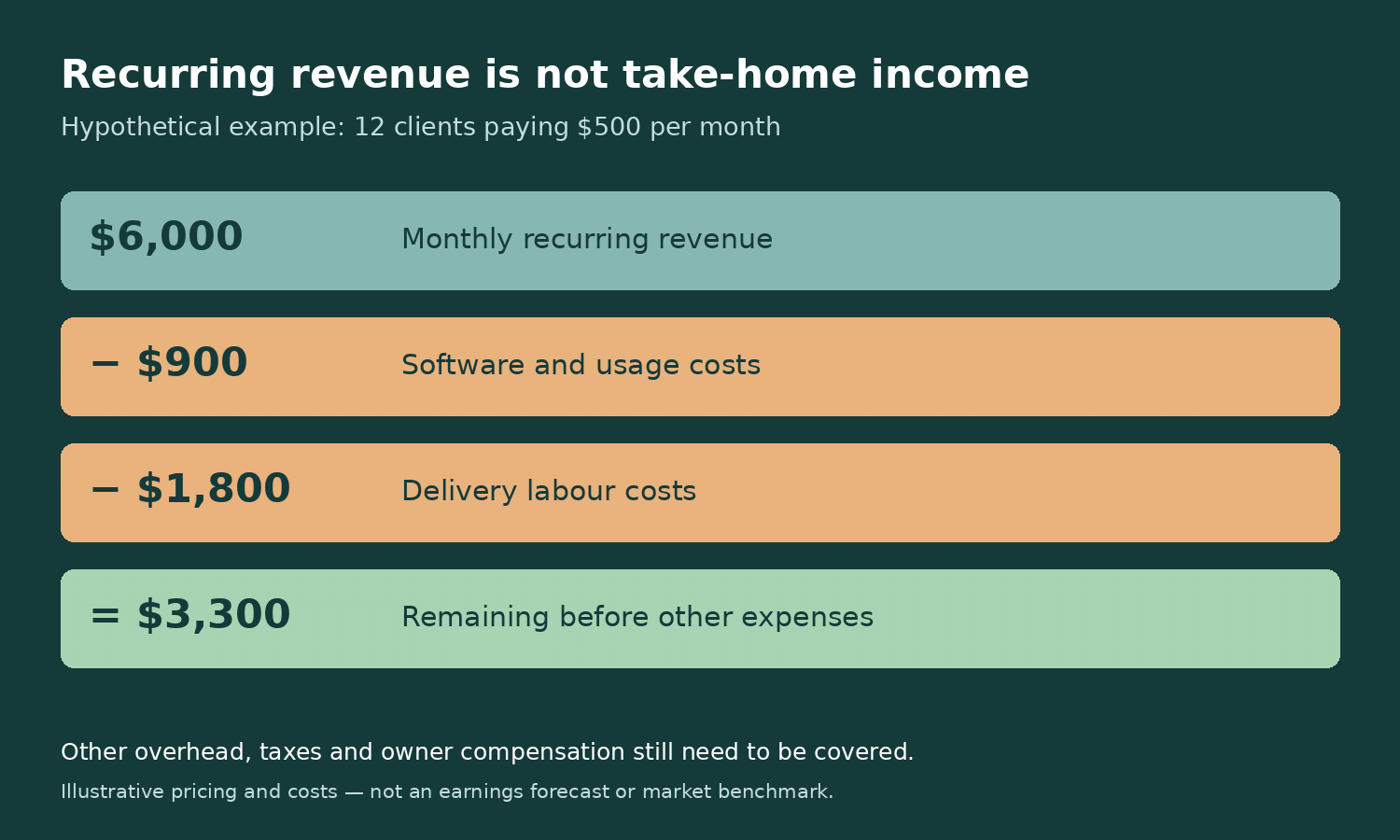
Consider a hypothetical business with 12 clients paying $500 monthly. That produces $6,000 monthly recurring revenue. If software costs $900 and delivery labour costs $1,800, $3,300 remains before other overhead, taxes, and owner compensation.
Setup fees add separate revenue, but they are not recurring. Track support hours, acquisition costs, cancellations, and unpaid invoices. Growing client numbers without controlling workload can make the business less profitable.
Ask satisfied customers for referrals and permission to publish verified case studies. Increase pricing when documented value and service demands justify it.
Final Thoughts
Building a mega income stream as an AI automation agent starts with ordinary business problems: slow replies, repeated data entry, and confusing handoffs. Pick a niche, deliver one reliable improvement, and prove the value.
The strongest recurring revenue comes from workflows customers continue using and a service they trust. Consistent delivery matters more than ambitious income claims.
FAQs
1. Do I need coding skills to start?
Not necessarily. Visual platforms handle many workflows, but integrations, debugging, and security require technical understanding. Learn progressively and keep initial projects simple.
2. Which workflow should I sell first?
Choose a frequent, measurable task. Enquiry organisation or internal follow-up is often easier to validate than a fully autonomous customer service agent.
3. Can this become passive income?
Usually not completely. Workflows need monitoring, updates, and client support. Standardisation can reduce effort, but recurring revenue still carries recurring responsibilities.
4. How quickly can I reach $10,000 monthly?
There is no reliable timeline. At $500 per client, you would need 20 paying clients for $10,000 revenue, before expenses and cancellations.











Comments