
 By
If you’re managing a hospital, clinic, or healthcare network, you know full well that electronic health records form the real core of today’s treatment. The two big players have been Epic and Cerner. Albeit not an easy choice, as both systems could put any worthy system to shame, but with controller nuances, among slight differences in their choosing: one perhaps for the patient, mechanic, and computer. Let us try to understand their functionalities better, to allow you to decide which fits best into your organization.
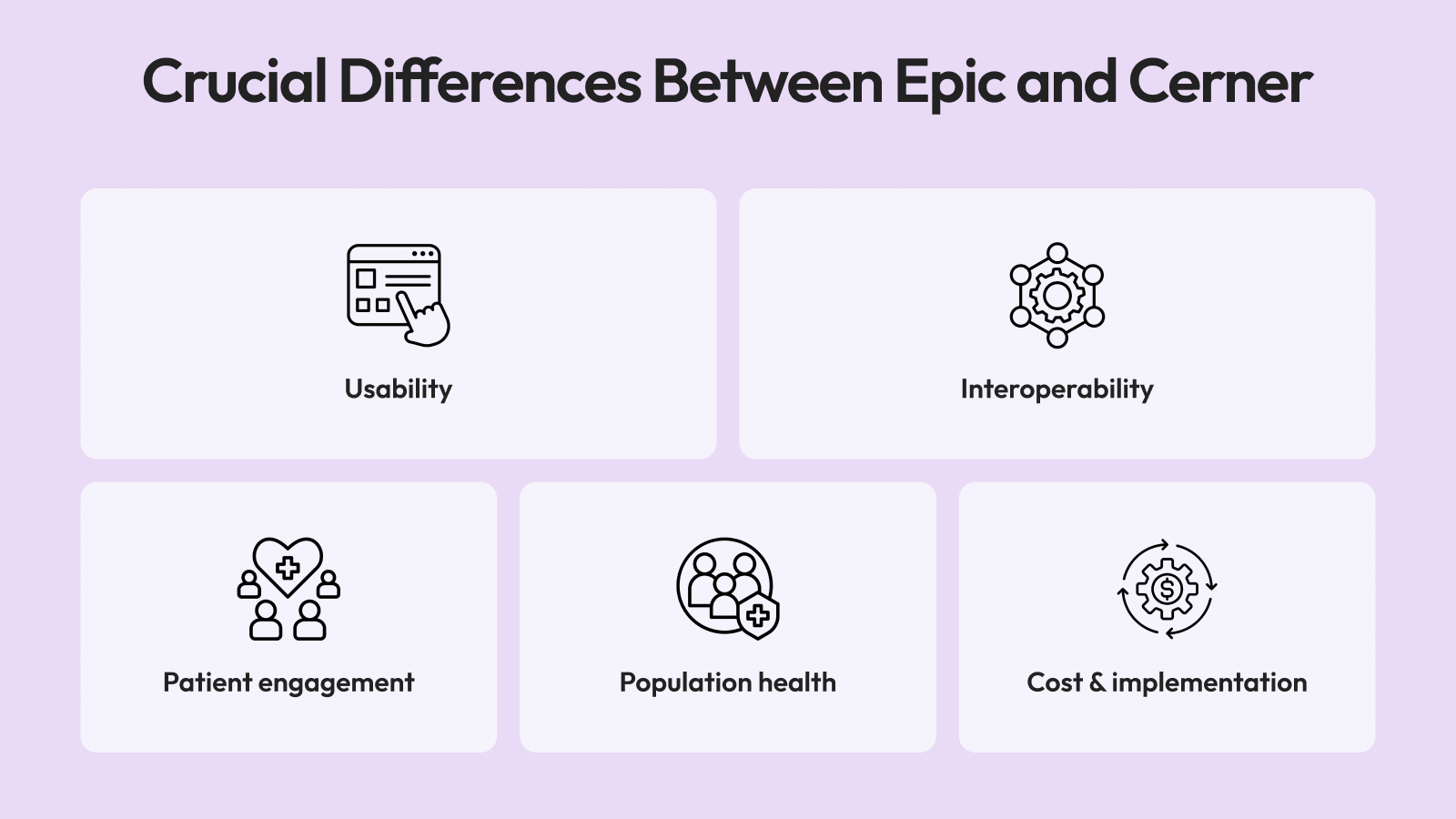
Epic vs. Cerner: Crucial Differences Between Two Key Players in EHR
When building an EHR system, you should consider what Epic and Cerner systems are. Since 1979, Epic Systems has been seen by many as the ultimate choice for large hospital networks and academic medical centers. Deep integration, a plethora of features, and heavy emphasis on patient engagement- especially through its MyChart portal- have all gone into Epic’s reputation for providing a seamless care experience.
The same year, Cerner was formed and is now a part of Oracle. It is known for its flexibility, scalability, and presence in a broad spectrum of facilities, unlike the small community hospitals and somewhat larger regional health systems that Cerner has traditionally served. Cerner has served those organizations that want adaptable healthcare IT and interconnected solutions across the board; the key differences lie in how easy the systems are to use, processes offered for customization, criteria and mechanism of interoperability pricing models, and the overall approach toward healthcare technology.

Usability and Interface
Epic is often dubbed as sleek but very rigid in the design of the interface. The interface is designed to be uniform across modules. Though the consistency lends great support to training super-large organizations, it can be restrictive to those who want lots of customizations at the user level.
Cerner systems are highly customizable. Workflows are tailored to meet local requirements. Nurses from one specialty or location could be looking at an entirely different screen interface from their colleagues. That flexibility is needed by smaller hospitals with unique workflows, but also increases complexity in training and maintenance.
An academic medical center would probably choose Epic given that residents, specialists, and rotating staff all require a standardized and predictable experience, while a regional hospital system with its wide array of workflows could be better suited by Cerner.
Integration and Interoperability
Epic is an extremely famous array among many hospitals and is considered a completely closed environment. Other than the internal integration across its multitude of modules, hardly any software runs from inpatient to outpatient to revenue cycle-if you buy Epic everywhere within your hospital systems, you get seamless interoperability.
Cerner seems to lean more toward open standards and interoperability. Its HealtheIntent platform allows organizations working in population health or needing to integrate data from non-Cerner systems to aggregate data or join data from numerous sources.
A health network that owns multiple hospital facilities with different EHRs may probably prefer Cerner as a way for the unification of data for care coordination across the system. At the same time, one big hospital may prefer Epic for the unified experience, not having to worry about linking to other vendors.
Patient Engagement
Epic dominates patient-facing technology. The great reputation and wide adoption of their MyChart portal have made it the symbol of patient engagement. Using MyChart, patients schedule appointments, view test results, message providers, and pay bills, all from one place. Some health systems claim that they picked Epic solely because of MyChart.
Cerner had its own patient portals, yet they were often considered neither polished nor cohesive. This may change, given Oracle’s recent acquisition of Cerner, but historically, Epic was the yardstick by which patient engagement was measured. So, if your strategic intent is to increase patient self-service and digital loyalty, then Epic is the tested and proven set of industry-leading solutions.
Data Analytics and Population Health
Cerner stands strong with population health management. The service of HealtheIntent is intended to pool data from different sources and analyze trends to identify at-risk populations, thus, a crucial factor for a health system in a value-based care arrangement. Epic has some analytics tools, such as Cogito, but predominantly excels at managing data within the Epic environment. So if all your data lives in Epic, its analytics are quite good. If you need to incorporate claims data, social determinants, or records from other EHRs, then Cerner may have the potential edge. For an organization focused on value-based care and cross-system data analysis, Cerner has a more open and scalable solution.
Implementation and Support
Installing Epic-huge implementations made famous for their costs and slowness. Large health systems often put hundreds of millions of dollars into the Epic for years. If installed well, it is very stable and well-supported.
Usually cheaper and more flexible to implement, with prices that can scale somewhat, it is limited to a small organization. Community hospitals that cannot justify the price of an Epic will often go with Cerner. But with so much customization permitted by Cerner, quality may vary across differences in sites unless carefully managed.
For an academic health center with lots of money and IT resources, the go-to is often Epic. For a regional health system or community hospital, the allure of Cerner is chiefly its flexibility and price point.
Cost Considerations
Cost is most often the deciding factor. Epic is considered to be in the price range of the higher-end systems. Implementation fees, licensing fees, and support contracts go up quickly. Health systems that invest in acquiring and implementing Epic view it as a long-term investment worthy of standardization and quality considerations.
Cerner has a wider variety of pricing structures and is generally viewed as being more affordable when initially contemplating the implementation of a system. Because of the modular design, hospitals will install the features as their budgets permit. Therefore, the majestic and thorough urban hospital will embrace Epic with the full thrust of its finances and prestige, whereas the truly desperate rural hospital needs to accept that Cerner is a functional system without emptying its treasury.
Real-World Choices
Epic is used by major systems like Mayo Clinic, Johns Hopkins, and Cleveland. These organizations value standardization, tight integration in the system, and a smooth patient experience. Everyone from doctors to nurses to administrative staff experiences the same interface. This makes training easier and can reduce errors.
Epic is also very well suited to supporting research and clinical trials. For data-heavy hospitals, the particular structure of Epic is preferred. Another major benefit is MyChart, the patient portal of Epic. Through MyChart, patients can easily schedule appointments, check test results, and join telehealth sessions. For bigger systems looking to grow or merge, Epic is the glue that holds it all together.
Whereas networks like AdventHealth and many regional hospitals use Cerner. These systems usually need to cover a diverse set of sites, all with their own needs. The flexibility of Cerner makes it easier to tailor the workflow for each site.
Cerner is a great option in population health as well. The HealtheIntent platform allows drawing data from a multitude of sources. This is helpful for hospitals focusing on value-based care or partnering with others under a different EHR.
Many smaller hospitals go with Cerner because of budget concerns. It is less costly at startup, maintaining a window for growth. Big academic centers often go for the Epic vendor, while the Cerner vendor fits better with regional and community-based systems in search of flexibility and lower upfront costs.
Which One Should You Choose?
There is no universal Epic versus Cerner, so buy according to your agendas. If you are after the gold standard of integration, patient engagement, and long-term stability and have deep pockets, then obviously Epic nails it. On the flip side, if you need flexibility, population health, and some interoperability with external systems, and are working with a tighter budget, Cerner almost sells itself.
Both systems, in general, keep progressing with improvements: Epic is increasing the interoperability between tools like Care Everywhere, whereas Oracle’s buying of Cerner indicates new investments and innovations. Consider your organization’s size, budget, strategic objectives, and IT capabilities before making your decision. Selection of an EHR vendor is one of the most crucial decisions you will ever make; it defines how clinicians practice, patient experiences, and certainly your ability to innovate and remain competitive long-term. The sooner you begin to engage your stakeholders, the sooner you will be able to align the selected system with your mission and vision.










Comments