
 By
Cyber threats are increasingly sophisticated, tenacious, and destructive in the modern business world where digital is the first priority. The advanced attacks cannot be detected and countered by traditional antivirus software. That is where Endpoint Detection & Response (EDR) comes into play as an essential part of the contemporary cybersecurity solutions.
EDR is concerned with the constant monitoring of endpoints, including laptops, desktops, mobile devices, and servers, to identify suspicious activity so that security teams can identify, investigate, and respond to threats before they can do serious harm.
Endpoint Detection & Response is a technology that gives real-time insights into endpoint activities and threats. In contrast to the traditional antivirus tools, which are primarily prevention-oriented, EDR solutions also prioritize the detection and response.
An EDR system is a system that monitors and analyzes data on endpoints in real-time to detect abnormal activity that may be malicious. It aids organizations to react to incidents in a timely manner reducing the amount of downtime and data loss.
How EDR Works?
The general functionality of an EDR solution is based on four functions:
Continuous Monitoring EDR tools continuously monitor endpoint activity, logging processes, file changes, and network connections.
Threat Detection: EDR detects the possible threats like malware, ransomware, or unauthorized access by using behavioral analysis, machine learning, and threat intelligence.
Incident Investigation –Security teams are able to analyze the detailed logs and timelines to know how a threat got in and propagated through the system.
Automated & Manual Response – EDR is able to quarantine infected devices, block malicious processes and clean up malicious files to stop further damage.
Why EDR is Essential for Modern Businesses?
With more employees working remotely and cloud adoption growing, businesses have more endpoints than ever. Each endpoint is a potential entry point for cybercriminals. EDR helps secure these points by:
- Detecting threats that bypass traditional security solutions.
- Providing detailed insights into attack vectors.
- Enabling fast containment to reduce impact.
- Supporting compliance with data protection regulations.
The Data Centers and Backup in EDR Strategy
Although EDR is effective, it is more effective when used in conjunction with a comprehensive cybersecurity strategy. Having critical systems hosted in a secure Data Center UAE is an added defence. Data centers provide enterprise-level security, including restricted physical access, 24/7 surveillance, and redundant power sources-which means that even during attacks, critical EDR infrastructure will still be operational.
Moreover, when combined with a good Data Backup Solution, EDR can guarantee that even in case of ransomware or malicious malware, the business can restore its systems to a clean state within a short period. Backups of data stored in secure offsite locations prevent the loss of important files permanently and ensure continuity of operations.
EDR vs. Traditional Antivirus
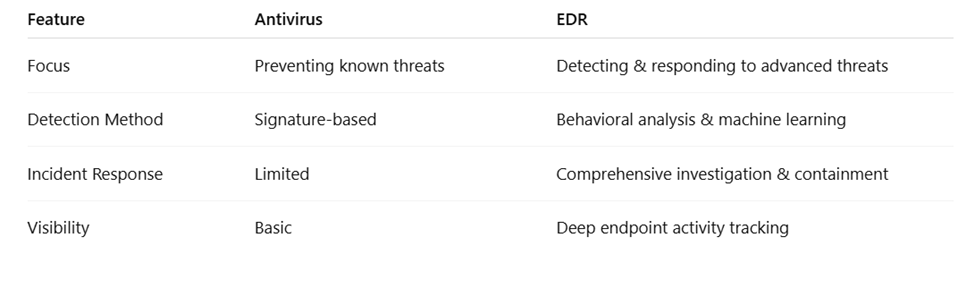
While both EDR and antivirus aim to protect systems, their approaches are different:
Best Practices for Implementing EDR
To get the most from EDR, organizations should:
- Deploy it on all endpoints, including remote devices.
- Integrate EDR with SIEM (Security Information and Event Management) systems for centralized analysis.
- Regularly train employees to recognize and report suspicious activity.
- Combine EDR with a Data Backup Solution for maximum resilience.
- Host mission-critical systems in a secure Data Center UAE for enhanced uptime and safety.
Conclusion
Endpoint Detection & Response is more than just another cybersecurity tool—it’s a proactive approach to detecting, analyzing, and neutralizing threats before they can cause harm. By combining EDR with the security of a Data Center UAE and a robust Data Backup Solution, businesses can create a multi-layer defense strategy that safeguards their data, systems, and reputation in an increasingly hostile cyber landscape.









Comments